Spicy Green Book is a nonprofit organization dedicated to enhancing the digital presence of Black-owned food and beverage businesses. Their deck outlines a model that connects professional volunteers—designers, photographers, and videographers—with business owners to create high-quality marketing content at no cost. The organization addresses the disproportionate impact of COVID-19 on minority-owned businesses, citing that 41% of Black-owned businesses shuttered compared to 17% of white-owned ones. With a three-year plan to expand into 35 major urban areas and a funding requirement of $650,00…
Key takeaways
- The organization operates as a nonprofit, differentiating itself from for-profit competitors like Yelp and Eat Okra (Slide 3).
- COVID-19 had a disproportionate impact, with 41% of Black-owned businesses closing compared to 17% of white-owned ones (Slide 3).
- Only 51% of the 11 million minority-owned businesses have an online presence due to low margins and high marketing costs (Slide 3).
- The process involves hand-curating premium content and creating quality listings on the Spicy Green Book platform (Slide 5).
- Proof of concept is shown through increased Instagram followings for partners, such as Belly's Sliders & Wings growing from 10.7K to 11.7K (Slide 7).
- The market opportunity includes 2.58 million Black-owned businesses in the U.S. generating $150 billion in annual revenue (Slide 8).
- Traction includes 150+ volunteer applications and 60+ businesses listed across multiple states (Slide 10).
- The three-year expansion plan targets 35 major urban areas with over 50 listings in each (Slide 11).
Spicy Green Book Pitch Deck Analysis
Spicy Green Book presents a mission-driven pitch deck that focuses on digital equity for Black-owned food and beverage businesses. The deck is structured to highlight a specific social problem—the lack of digital presence and the disproportionate economic impact of the pandemic on Black entrepreneurs—and offers a volunteer-driven nonprofit solution. The visual style relies heavily on high-quality food photography, which aligns with the industry they serve, though the slide design itself varies in consistency.
Slide 1: Title and Mission
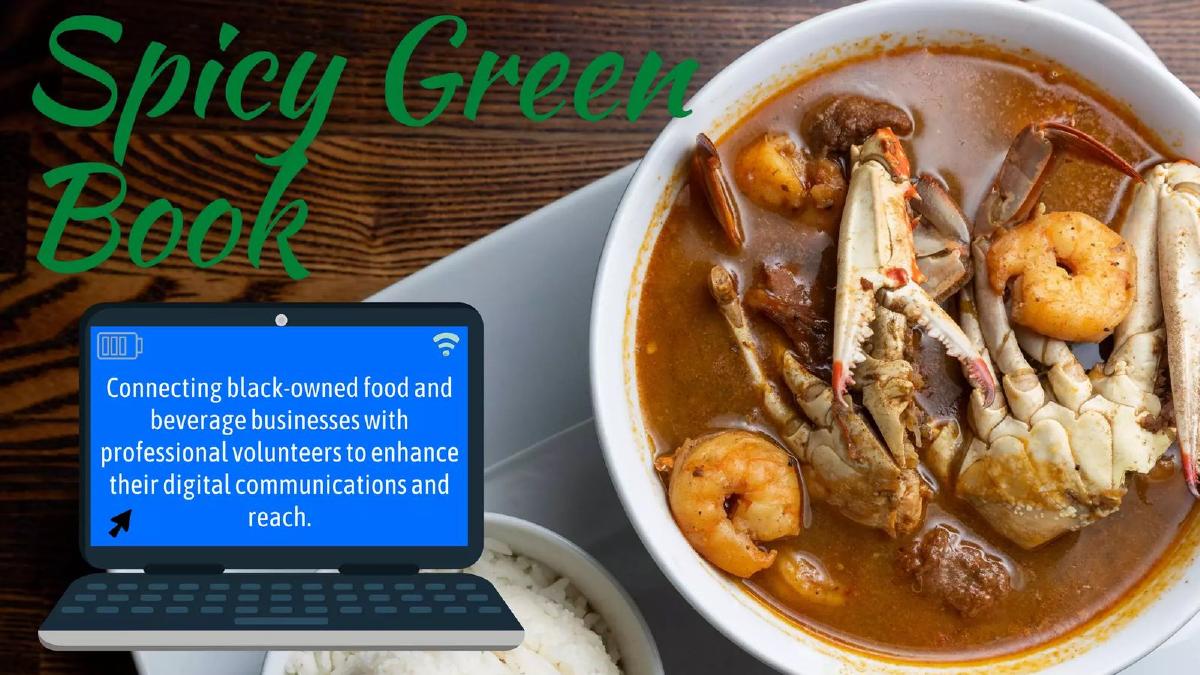
The opening slide introduces Spicy Green Book with a clear mission statement: "Connecting black-owned food and beverage businesses with professional volunteers to enhance their digital communications and reach." The use of a laptop graphic over a bowl of seafood soup immediately establishes the intersection of technology and the culinary arts. It sets a professional yet community-focused tone for the rest of the presentation.
Slide 2: Vision and Impact
This slide contextualizes the organization's work within the broader framework of structural racism in the U.S. It emphasizes that facilitating economic growth in the Black community is a direct response to these systemic issues. A key statistic from the Pew Research Center is cited: "Blacks are 2x more likely to be unemployed than Whites." The slide also notes that business owners on the platform are "tellers of their own stories," moving beyond just being a street address or URL.
Slide 3: The Problem
The problem slide is data-heavy, citing the National Bureau of Economic Research and the Urban Institute. It highlights two critical issues: the 41% closure rate of Black-owned businesses during COVID-19 and the fact that 90% of the 11 million minority-owned businesses are sole proprietorships. Crucially, it notes that only 51% have an online presence due to high marketing costs. This slide also introduces "Comparables" like Yelp and Eat Okra, positioning Spicy Green Book as the only nonprofit alternative providing free professional services.
Slide 4: The Solution
The solution is presented as a three-pillar approach: Connecting Businesses With Creatives, Creating Content, and Generating Exposure. The organization facilitates relationships between professional designers/photographers and restaurateurs. The goal is to provide quality visual and textual content that helps owners tell their stories and grow their customer bases through social media and press coverage.
Slide 5: The Process
This slide outlines a four-step operational workflow: 1. Research and sign up a business. 2. Match the business with professional creatives. 3. Submit content to the owner with guidance on how to use it. 4. Create a quality listing on the Spicy Green Book platform. The inclusion of a mobile phone graphic showing food photography reinforces the digital nature of the output.
Slide 6: Visual Proof of Work
A collage of eight photos shows the organization in action. It features photographers at work in cafes, interviews being conducted, and business owners posing with their products. This slide serves as a "behind the scenes" look that validates the claims made in the process slide, showing real people and real businesses being supported.
Slide 7: Proof of Impact
Slide 7 provides quantitative proof of impact by showing Instagram follower growth for three specific partners. Belly's Sliders & Wings grew from 10.7K to 11.7K, Seafood Xperience grew from 6.7K to 7.3K, and Pineapple Express grew from 3.5K to 4.3K. While these are modest gains in absolute numbers, they demonstrate a consistent upward trend across different business sizes.
Slide 8: The Market and Media Reach
This slide defines the market size: 2.58 million Black-owned businesses in the U.S. generating $150 billion in revenue. It also lists media outlets that have covered the organization, including ABC7, The Boston Globe, and the OC Register. The strategy for reaching volunteers and businesses involves partnering with schools and Fortune 500 companies, which suggests a scalable outreach model.
Slide 9: The Team
The team slide introduces three key figures: Danilo Batson (Director & Founder), Dan Williams (Director of Technology), and Kimberly Jackson (Business Strategist). While the slide includes photos and titles, it lacks professional biographies or past accomplishments, which is a significant omission for investors or donors looking to evaluate execution capability.
Slide 10: Current Traction
Under the heading "Where We Are," the deck lists current milestones: 150+ volunteer applications, 60+ businesses listed in multiple states, a live website, and an active nonprofit bank account. It also mentions that Form 1023 (the application for 501(c)(3) status) has been filed. The "Why Now?" section notes that 2020 represents a peak in social consciousness regarding race-based economic inequality.
Slide 11: Future Roadmap
The three-year plan is ambitious: expanding from Southern California to 35 major urban areas with over 50 listings in each. Other goals include tripling the average social media following for partners, releasing a mobile app, and adding business planning consultations. This slide provides a clear vision of what the organization intends to become.
Slide 12: The Ask
The funding needs are broken down by year: $100,000 for Year 1, $200,000 for Year 2, and $350,000 for Year 3. A pie chart shows that 70% of the budget is allocated to full-time salaries for the Director and Director of Technology. The remaining 30% is split between supplies/travel (20%), software/server costs (5%), and advertising (5%). The slide also lists several part-time hiring needs, including a Grant Writer and Counsel.
Slide 13: Contact Information
The final slide provides a phone number, email address, and website URL, accompanied by the tagline "Put your money where your heart is." The background image of a dessert waffle maintains the culinary theme of the deck.
What Works in This Deck
Strong Problem Definition: The deck uses reputable sources (NBER, Urban Institute) to quantify the economic challenges faced by Black-owned businesses, making the mission feel urgent and necessary. · Clear Differentiation: By explicitly comparing themselves to for-profit entities like Yelp, they justify their nonprofit status and the need for philanthropic support. · Visual Consistency: The use of high-quality food photography throughout the deck keeps the focus on the product and the industry they are serving. · Transparent Financials: The breakdown of the $650,000 three-year ask is specific and shows a clear understanding of what it will take to scale the operations.
What Is Missing or Could Be Improved
Team Biographies: The team slide (Slide 9) is very thin. Donors and investors need to know the professional background of the founders to trust they can manage a $650k budget and a national expansion. · Unit Economics of Impact: While Slide 7 shows follower growth, the deck lacks data on whether this digital exposure translates into increased revenue for the businesses. A case study on sales growth would be more compelling than social media metrics alone. · Sustainability Plan: As a nonprofit, the deck doesn't explain how they will sustain operations after the initial three-year funding period. Will they rely on recurring grants, corporate sponsorships, or a tiered service model? · Volunteer Management Details: With 150+ volunteer applications mentioned on Slide 10, the deck doesn't explain how they vet, train, or retain these professionals to ensure the quality of the content remains high.
Founder Takeaways
Leverage Macro Trends: Spicy Green Book successfully ties its mission to the specific socio-economic climate of 2020. Founders should always explain "Why Now?" in the context of broader market or social shifts. · Show, Don't Just Tell: The inclusion of Slide 6 (photos of the team working) and Slide 7 (metrics of impact) provides tangible evidence that the organization is active and effective. · Be Specific with the Ask: Don't just ask for a lump sum. Breaking down funding needs by year and by category (as seen on Slide 12) shows a level of planning that gives funders confidence. · Identify the Gap: If you are entering a crowded market (like business directories), clearly identify the one thing your competitors aren't doing—in this case, providing free professional creative services.
Frequently asked questions
- What is the primary mission of Spicy Green Book?
- Spicy Green Book is a nonprofit that connects Black-owned food and beverage businesses with professional volunteers to enhance their digital communications and reach. As stated on Slide 1, the goal is to provide these businesses with the tools and exposure needed to thrive in a digital-first economy, specifically responding to structural racism and economic disparities in the United States.
- How does Spicy Green Book differ from competitors like Yelp?
- According to Slide 3, while platforms like Yelp, Eat Black Owned, and Eat Okra share the space, they are for-profit entities. Spicy Green Book distinguishes itself by being a nonprofit that pairs clients with qualified professionals to increase their online reach at no cost to the business owner, focusing on content creation rather than just directory listing.
- What specific services does the organization provide to businesses?
- The organization facilitates relationships with professional designers, videographers, and photographers to create quality textual and visual content for websites and social media (Slide 4). They also provide guidance on how to use this content and create a 'premium' listing for the business on the Spicy Green Book platform (Slide 5).
- What are the organization's growth targets for the next three years?
- Slide 11 outlines a three-year plan to expand from Southern California into 35 major urban areas, aiming for at least 50 listings in each city. They also intend to triple the average social media following for their partners, release a mobile app, and add business planning consultation to their suite of free services.
- How will the requested funding be utilized?
- The funding needs are $100,000 for Year 1, $200,000 for Year 2, and $350,000 for Year 3. Slide 12 provides a breakdown of expenses: 70% for full-time salaries (Director and Director of Technology), 20% for supplies and travel, 5% for software/server costs, and 5% for advertising.