Spectral Compute’s pitch deck is a masterclass in identifying a high-value friction point—Nvidia’s CUDA lock-in—and presenting a technical solution that promises 100% compatibility without performance penalties. The deck highlights a staggering 5-year cost of $35,040,000 for 80 Nvidia H200 GPUs compared to significantly cheaper AMD alternatives, positioning their SCALE framework as the bridge to massive savings. While the deck is light on specific team bios and current revenue, it leans heavily on developer traction, citing a top spot on Hacker News and 15.64k unique monthly visitors. By focu…
Key takeaways
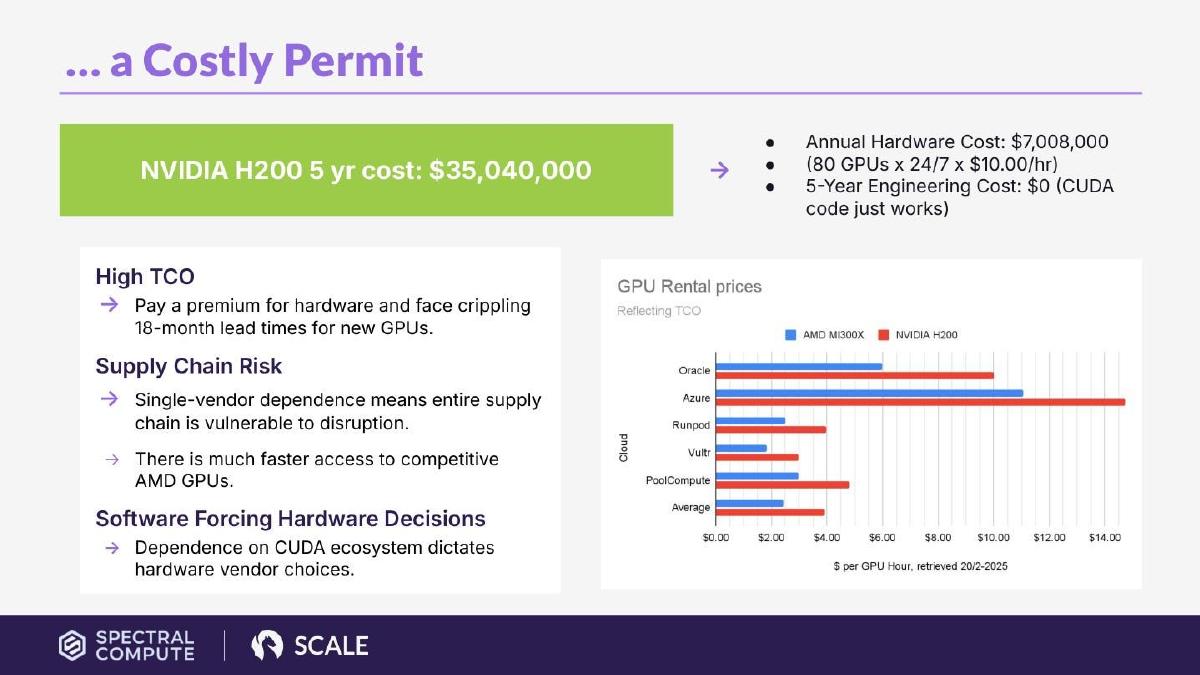
- The deck identifies a massive cost barrier, noting a $35,040,000 5-year cost for 80 Nvidia H200 GPUs on Slide 2.
- Spectral Compute positions its SCALE framework as the first to offer 100% CUDA compatibility on non-Nvidia platforms on Slide 3.
- The company claims a '7-year technical lead' and proprietary technology as its primary barrier to entry on Slide 7.
- Early market validation is demonstrated through 15.64k unique monthly visitors and 47+ published articles since July 2024 on Slide 4.
- The deck provides specific financial projections for development, estimating a 2025 spend of £1.077m excluding marketing on Slide 6.
- The total addressable market is defined as a $274.21B GPGPU market on Slide 7.
- Revenue potential is pegged at $100M+ ARR based on a 20% market capture of currently available MI300X GPUs on Slide 7.
- The product roadmap is explicit, targeting a first widely-available commercial release in January 2026 on Slide 6.
Spectral Compute: The Software Bridge to Hardware Freedom
Spectral Compute entered the market at a time of peak Nvidia dominance. As reported by Business Insider, the company raised a $6M Seed round in 2024 to develop SCALE, a framework that allows CUDA code—the industry standard for AI—to run on non-Nvidia hardware. The deck is a clinical, technical, and financially-driven argument for why the current GPU status quo is unsustainable and why a software-based compiler is the only viable solution.
Slide 1: The Hook
The cover slide is minimalist, featuring the company logo and the product name, SCALE. The subtitle, "Avoid GPU vendor lock-in and use CUDA on any chip," is a direct value proposition. It doesn't waste time with vague mission statements; it identifies a specific technical pain point and offers a specific solution. The footer notes the document is 'Private and confidential' and dated 2025, suggesting this version of the deck was used for post-raise updates or late-stage Seed discussions.
Slide 2: The Cost of the Status Quo
Slide 2, titled "... a Costly Permit," is the most effective slide in the deck. It quantifies the problem using hard numbers. It cites a "NVIDIA H200 5 yr cost: $35,040,000" for a cluster of 80 GPUs running 24/7 at $10.00/hr. It contrasts this with the "5-Year Engineering Cost: $0" if CUDA code just works, implying that the only reason companies pay the Nvidia premium is to avoid the massive cost of rewriting code for other chips. A bar chart compares GPU rental prices across providers like Oracle, Azure, and Runpod, consistently showing AMD MI300X as the lower-cost alternative to the H200. This slide establishes the 'Why Now': the price delta between vendors has become too large to ignore.
Slide 3: The Solution (SCALE)
This slide introduces SCALE as the first framework to offer "100% CUDA compatibility on non-NVIDIA platforms." The company makes five bold claims: zero switching costs, zero ongoing maintenance, no performance penalty, proprietary performance gains, and easier code writing through extensions. By emphasizing that SCALE is a "native compiler," they distance themselves from slower emulation or translation layers that have failed in the past. The slide concludes that SCALE is a "massive unlock for the industry," shifting the power from hardware vendors back to software developers.
Slide 4: Developer Traction
Titled "The Industry is Buzzing," Slide 4 provides top-of-funnel validation. Since launching on July 12, 2024, the company claims its first public release reached the "top of HackerNews for days." They list 47+ published articles , 15.64k unique monthly visitors , and 401 Discord users . While these aren't revenue numbers, for a deep-tech infrastructure play, developer mindshare is a leading indicator of eventual adoption. The inclusion of a Cloudflare traffic graph adds a layer of raw data to support the claims.
Slide 5: The Partnership Ecosystem
Slide 5 addresses "Current Traction : Industry Partnerships." It breaks potential partners into three buckets: OEM/VAR, Cloud Service Providers, and Developers. Crucially, a footnote states that these are "Anonymized per legal requirements." While this protects the company's relationships, it leaves the reader wanting specific names. The slide suggests the business model will involve "embedded licensing and value-added service," indicating a B2B software licensing play rather than a direct-to-consumer or pure open-source model.
Slide 6: The Technical Roadmap
The "Key Milestones" slide provides a clear timeline for the $6M investment. It targets January 2026 for the first commercial release and September 2026 for General Availability. The slide is dense with technical jargon (MFMA hardware support, cuBLASLt, vLLM, Llama.cpp), which serves to signal the team's deep expertise to technical investors. It also includes a budget forecast: an "Expected spend 2025: £1.077m" and a further "£1.15m" through September 2026, both excluding marketing. This level of transparency in spending is rare in Seed decks and likely built significant trust during the raise.
Slide 7: The Investment Opportunity
The final slide summarizes the bull case. It claims a "7-year technical lead" and a "$274.21B GPGPU market." The most aggressive claim is the "Potential for $100M+ annual recurring revenue" based on capturing 20% of the currently available MI300X GPU market. This slide ties the technical feasibility (Slide 3) and the market pain (Slide 2) into a financial outcome. It mentions an "Experienced team with proven track record," though, as noted, the deck lacks a dedicated team slide with names and logos of previous employers.
What Spectral Compute Omitted
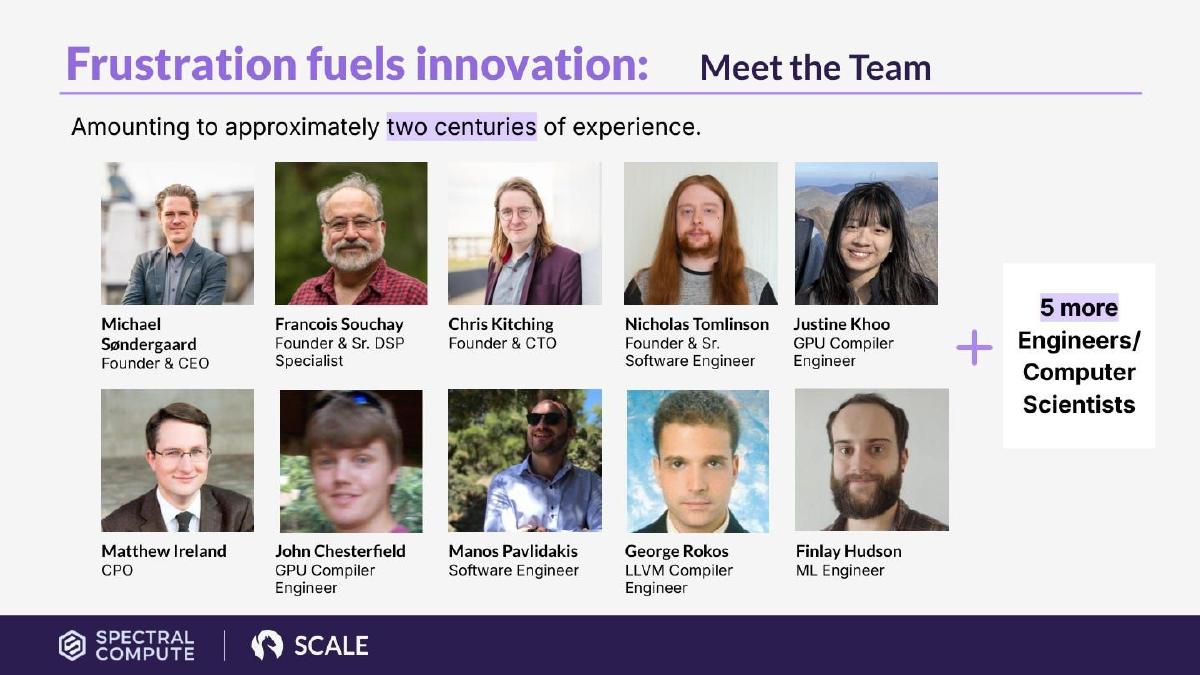
The most glaring omission is a Team Slide . While Slide 7 mentions an "experienced team," there are no bios, no LinkedIn links, and no mention of the founders' backgrounds in high-performance computing. In a Seed round, investors are primarily betting on the team's ability to execute on a difficult technical challenge. Omitting this suggests either the deck was intended for an audience already familiar with the founders or that the company is relying entirely on the strength of the technology and early traction.
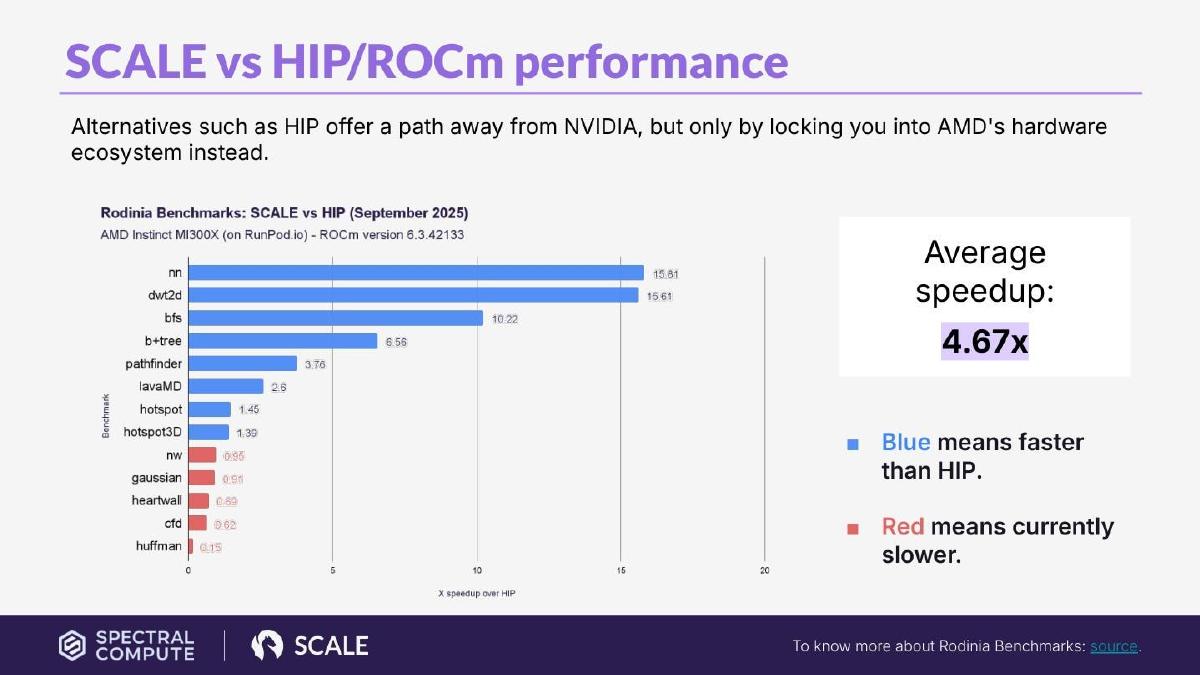
Additionally, there is no Competitor Slide . Spectral Compute is not the first to try to break CUDA lock-in (projects like ROCm, ZLUDA, and SYCL exist). By not addressing these, the founders miss an opportunity to explain why their "native compiler" approach is superior to existing open-source or vendor-backed alternatives.
What Founders Should Copy
Founders should emulate the Problem Quantification found on Slide 2. Instead of saying "Nvidia is expensive," Spectral Compute calculated the exact 5-year TCO (Total Cost of Ownership) for a specific cluster size. This turns a vague complaint into a mathematical certainty that an investor can model. The Roadmap Detail on Slide 6 is also exemplary; it lists specific libraries and projects (like PyTorch and Llama.cpp) that will be supported, giving investors a checklist to measure future progress against.
Conclusion
Spectral Compute’s deck is a highly focused, technical document that speaks the language of the current AI infrastructure boom. By framing their software as a multi-million dollar cost-saving tool for enterprises, they moved the conversation away from "cool tech" and toward "essential infrastructure." Despite the lack of team bios, the clarity of the problem and the specificity of the roadmap provided enough confidence to secure a $6M Seed round in a competitive European market.
Frequently asked questions
- What is the core problem Spectral Compute is solving?
- Spectral Compute addresses 'GPU vendor lock-in.' Currently, most AI and high-performance computing applications are written in CUDA, which only runs on Nvidia hardware. This creates a supply chain risk and forces companies to pay a premium for Nvidia chips. Spectral Compute’s SCALE framework allows this existing CUDA code to run on competing hardware, such as AMD GPUs, without needing a rewrite.
- How does the company justify its market opportunity?
- The deck points to a $274.21B GPGPU market. It specifically highlights the price disparity in GPU rentals; for example, on Slide 2, it shows that while an Nvidia H200 might cost $10.00/hr, an AMD MI300X is significantly cheaper across various cloud providers. They estimate that capturing just 20% of the MI300X market could lead to over $100M in annual recurring revenue.
- What are the technical claims regarding performance?
- On Slide 3, the company asserts there is 'no inherent performance penalty due to emulation or translation.' They claim SCALE is a native compiler and library set, not an emulation layer. Furthermore, they suggest their proprietary compiler can actually offer performance gains and that their extensions make writing performant code easier and cheaper.
- What does the roadmap look like for this Seed-stage company?
- The company is currently in a pre-commercial phase. Slide 6 outlines a January 2026 date for the first widely-available commercial release, featuring support for math libraries like cuBLASLt and cuFFT. General Availability is slated for September 2026, by which time they expect to support major projects like PyTorch, TensorRT-LLM, and Llama.cpp.
- Is there any mention of current revenue or customers?
- No. The deck focuses on 'Industry Partnerships' on Slide 5, but these are anonymized due to legal requirements. The traction slide (Slide 4) focuses entirely on developer interest and top-of-funnel metrics like Discord users (401) and website visitors (15.64k) rather than signed contracts or dollar-based revenue.