Spark's 9-slide Seed deck is a masterclass in leveraging founder-market fit to bypass the need for early revenue data. The company, which raised $2.5M in 2024 as reported by Business Insider, centers its narrative on the partnership between Moriah Elizabeth, a creator with over 10 million subscribers, and Laura Mae Brown, a veteran of Riot Games and EA. The deck focuses heavily on the 'why' and 'how' of the product, positioning digital art as a gamified daily habit for Gen Z. While it lacks traditional slides for competition, business models, and financial projections, the sheer scale of the…
Key takeaways
- The deck highlights a massive built-in distribution advantage with co-founder Moriah Elizabeth's 10M+ YouTube subscribers on slide 3.
- Operational credibility is established through co-founder Laura Mae Brown’s background at Riot Games, EA, and Amazon on slide 3.
- The total addressable market is defined as a $44B Arts & Crafts market targeting 67M Gen Z crafters in the US on slide 4.
- Product features focus on lowering the barrier to entry for creativity through guided prompts and a 'unique toolkit' on slides 5 and 6.
- The platform incorporates social gaming mechanics, such as passing 'sparks' to friends for 'team masterpieces' as shown on slide 6.
- The deck omits a business model slide, leaving the monetization strategy for the $2.5M Seed round unstated.
- There is no competitive landscape analysis, suggesting the founders rely on their unique creator-led positioning to stand apart.
- The deck lacks a formal 'Ask' slide or use of funds breakdown, despite successfully raising $2.5M according to publisher reports.
The Power of Built-in Distribution
Spark’s 9-slide deck is a concise example of how to pitch a consumer app when you have an overwhelming advantage in distribution. According to Business Insider, the company raised a $2.5M Seed round in 2024. The deck doesn't spend time on complex unit economics or competitive matrices; instead, it focuses on the synergy between a massive creator audience and veteran gaming execution.
Slide 1: Title and Brand Identity
The opening slide introduces the Spark logo—a stylized orange cat with stars. The aesthetic is friendly, approachable, and clearly targeted at a younger demographic. There is no tagline on this slide, letting the visual brand identity take center stage.
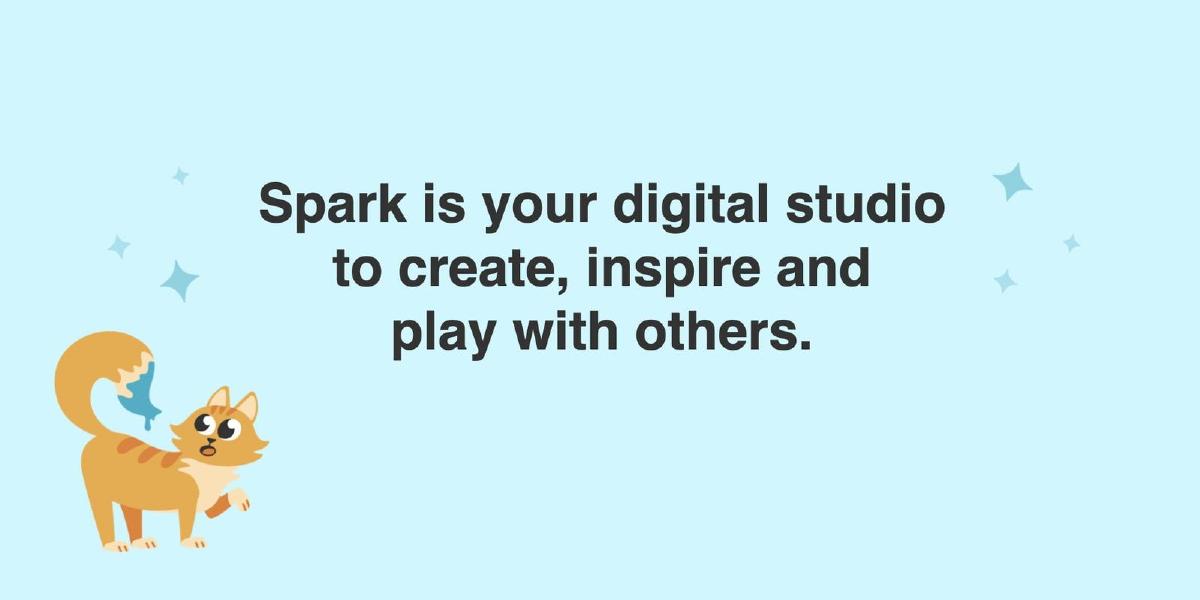
Slide 2: The Vision Statement
"Spark is your digital studio to create, inspire and play with others." This slide establishes the three pillars of the product: creation (tools), inspiration (content), and social play (community). It positions the app not just as a tool, but as a social destination.
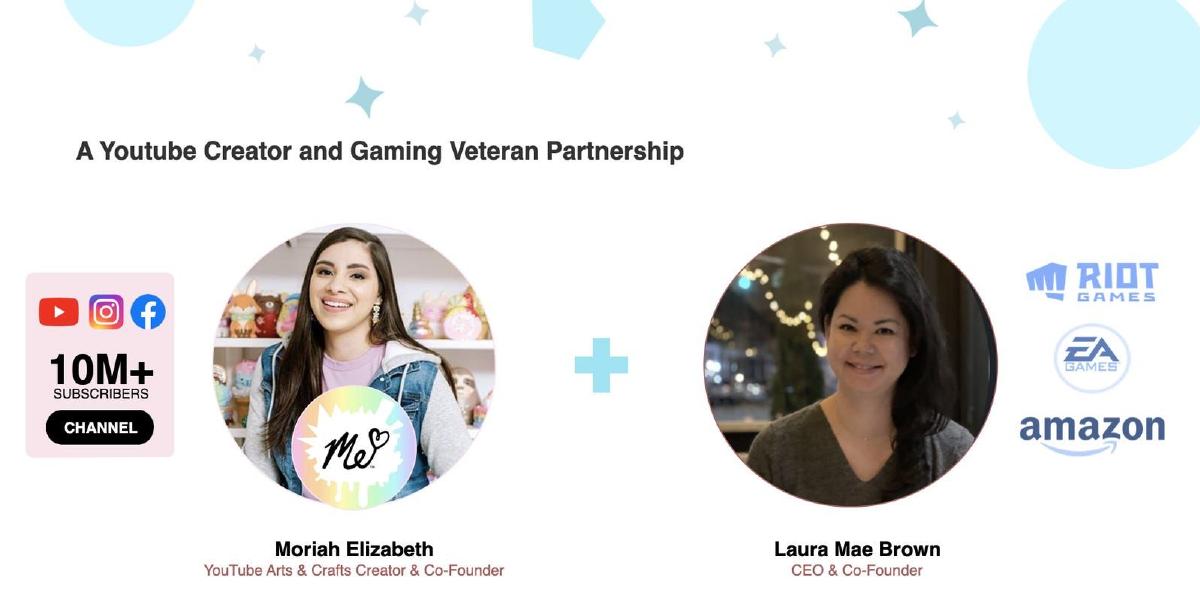
Slide 3: The Team (The 'Why Now')
This is arguably the most important slide in the deck. It presents a "YouTube Creator and Gaming Veteran Partnership." On the left, Moriah Elizabeth is listed as a Co-Founder with "10M+ Subscribers" and a prominent YouTube/Instagram/Facebook graphic. On the right, Laura Mae Brown (CEO & Co-Founder) is backed by logos for Riot Games, EA Games, and Amazon . This combination addresses the two biggest risks in consumer tech: 'Can you get users?' (Moriah) and 'Can you build a high-quality product?' (Laura).
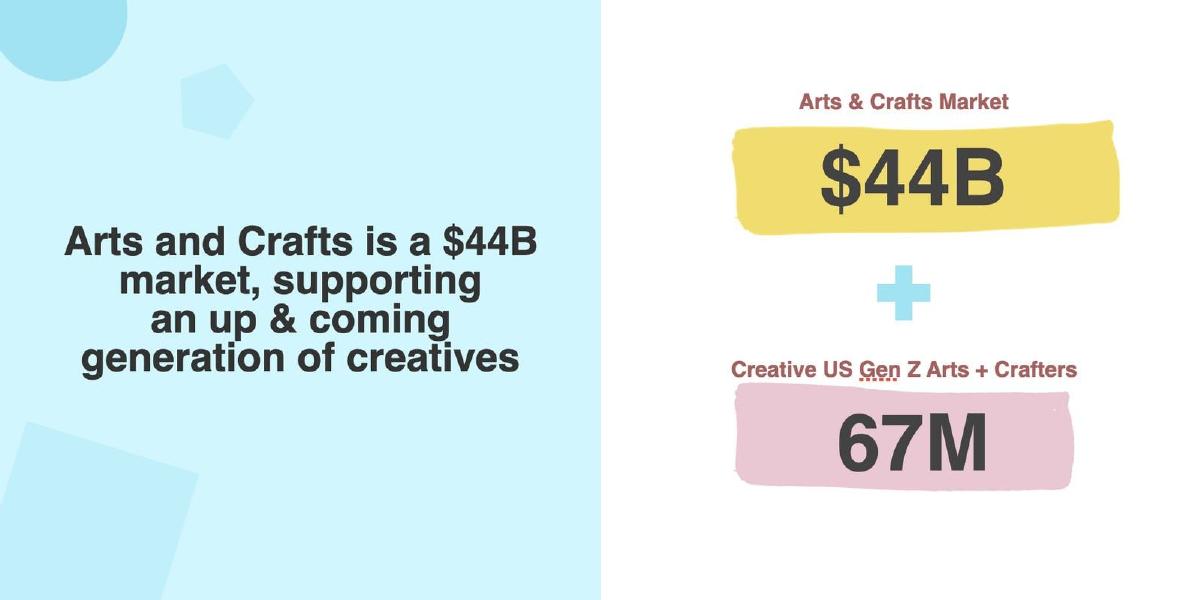
Slide 4: Market Opportunity
Spark defines its market through two large figures: a "$44B" Arts & Crafts market and "67M" Creative US Gen Z Arts + Crafters. By combining a massive spending category with a specific, digitally native demographic, the founders argue that there is a significant whitespace for a mobile-first, social art platform.
Slide 5: Product Value Proposition
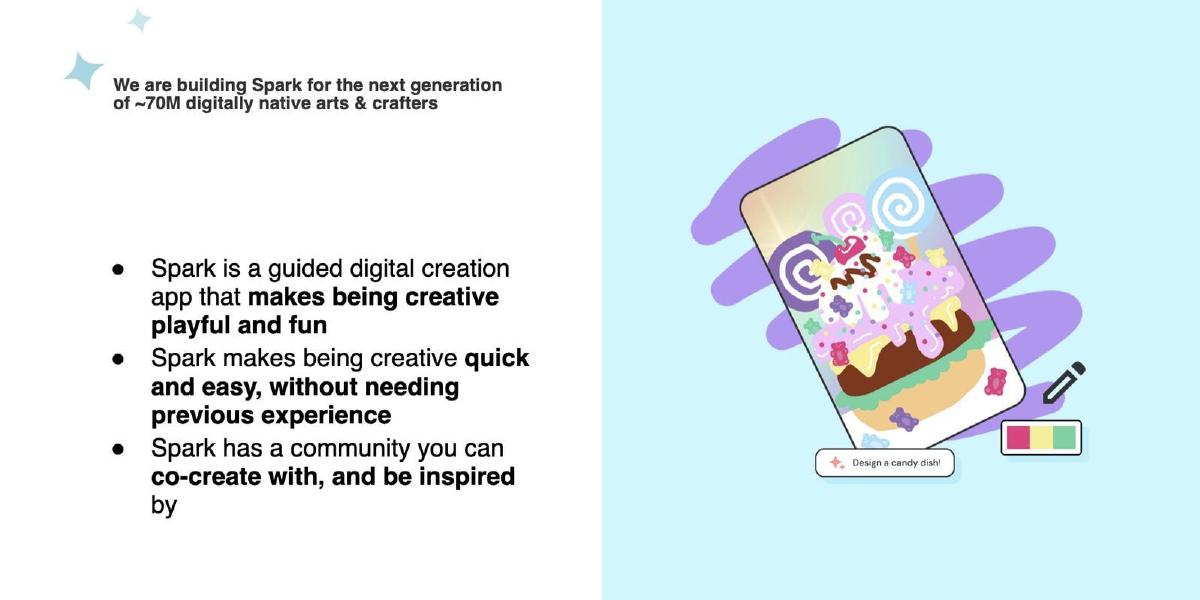
The deck moves into the product mechanics, stating that Spark is a "guided digital creation app" designed to be "playful and fun." Key bullet points emphasize that it is "quick and easy" and requires "no previous experience." This is a crucial distinction from professional tools like Procreate or Adobe, positioning Spark as an entry-level, high-engagement platform.
Slide 6: The Engagement Loop
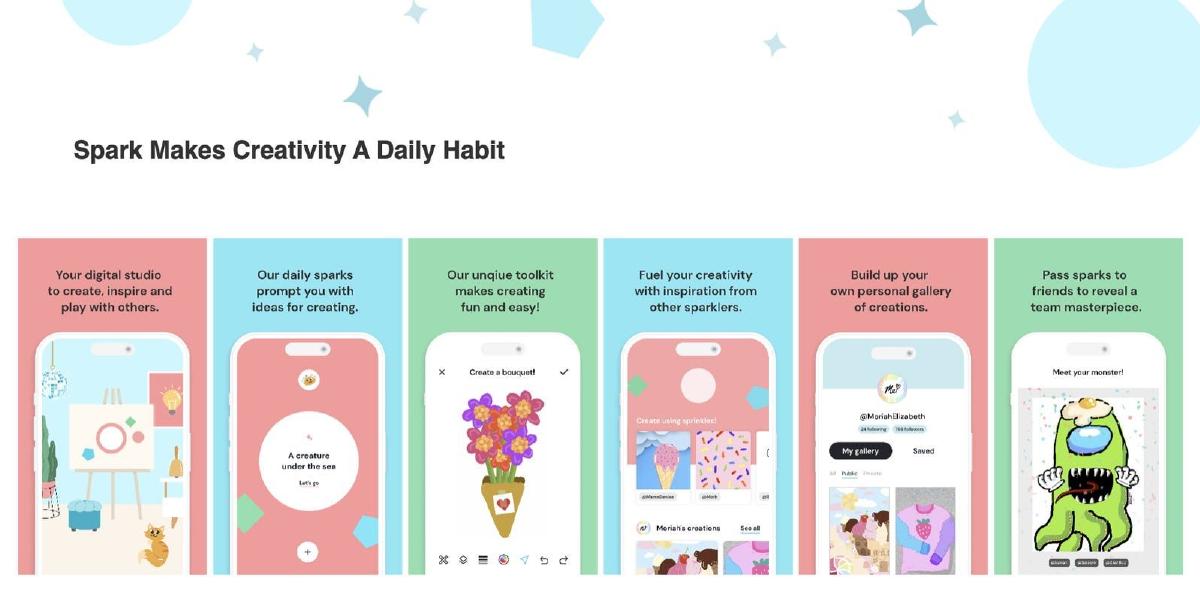
Titled "Spark Makes Creativity A Daily Habit," this slide uses a six-panel storyboard to show the user journey:
Daily prompts ('sparks') for ideas. · A unique toolkit for easy creation. · Social inspiration from other 'sparklers.' · A personal gallery of creations. · Collaborative 'team masterpieces' created by passing sparks to friends.
This slide demonstrates how the app intends to drive retention through both content (prompts) and social pressure (collaborative art).
Slide 7: The Emotional Hook
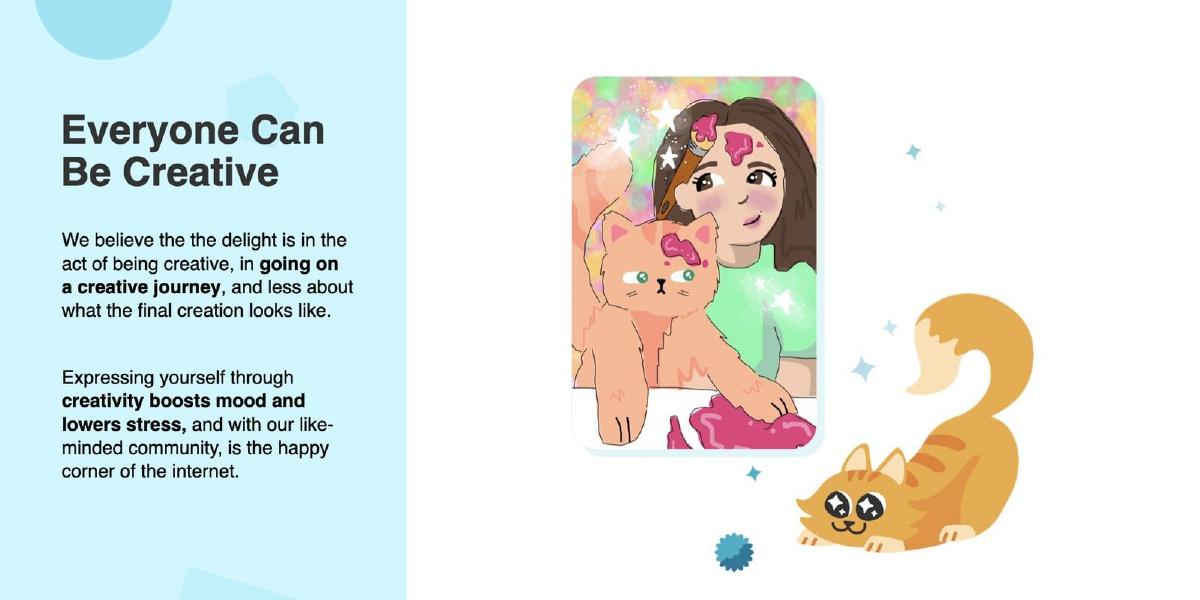
"Everyone Can Be Creative." This slide leans into the mental health and wellness aspect of the product, stating that the "delight is in the act of being creative... and less about what the final creation looks like." It claims the app "boosts mood and lowers stress," positioning Spark as the "happy corner of the internet."
Slide 8: The Personal Studio
This slide shows a highly stylized, gamified 'personal studio' interface. It includes a call to action: "Tap the easel first to start on today's sparks! Tap on me at any time for a tour." This suggests a meta-layer to the app where users can customize their digital environment, a common monetization and engagement tactic in gaming.
Slide 9: Closing
The deck ends with a play on a common idiom: "A spark a day keeps the imagination at play!" It reinforces the daily habit theme established in Slide 6.
What Spark Got Right
Founder-Market Fit: The pairing of a creator who already owns the attention of the target market with an executive who has shipped products at the highest level of gaming is a compelling narrative. It removes the 'cold start' problem that kills most consumer apps.
Clarity of Purpose: The deck never confuses the investor. It is a social, guided art app for Gen Z. The visual language of the slides matches the product perfectly, creating a cohesive brand experience before the investor even downloads the app.
Focus on Retention: By dedicating an entire slide (Slide 6) to the daily habit loop, the founders show they are thinking about long-term engagement, not just initial downloads from Moriah’s fan base.
What is Missing from the Spark Deck
Business Model: There is no mention of how Spark will make money. While Seed rounds often prioritize growth over revenue, investors usually want to see a hypothesis—whether it's subscriptions, microtransactions, or advertising.
Competitive Landscape: The deck ignores existing players. There is no mention of TikTok’s creative effects, Roblox’s creation tools, or dedicated art apps like Tayasui Sketches. Acknowledging the competition helps define the product's unique positioning.
The Ask and Use of Funds: The deck does not state how much they are raising or what they will do with the capital. While we know from publisher reports that they raised $2.5M, a standard pitch deck usually includes a slide detailing the hiring plan and product roadmap for the next 18-24 months.
Unit Economics and Metrics: If the app was already live, there are no mentions of DAU/MAU (Daily/Monthly Active Users), retention rates, or organic growth stats. If it was pre-launch, a slide on 'Early Signals' or 'Beta Feedback' would have strengthened the case.
Founder's Playbook: What to Copy
Lead with your 'Unfair Advantage': If you have a distribution channel that others don't, make it the centerpiece of your deck. Spark put the 10M+ subscriber count on Slide 3, essentially telling investors, "We have already solved the hardest part of consumer tech."
Use Storyboarding: Slide 6 is a perfect example of how to explain a product's UX without a demo video. The step-by-step panels make the 'Daily Habit' concept tangible and easy to understand.
Design for your Audience: The Spark deck looks like the Spark app. The colors, fonts, and characters are consistent. This shows a level of product-led thinking that suggests the founders understand their brand deeply.
Frequently asked questions
- How does Spark plan to monetize its user base?
- The pitch deck does not explicitly state a business model or revenue strategy. Given the industry (Consumer app) and the co-founder's background in gaming (Riot, EA), potential avenues could include in-app purchases for digital tools, subscription tiers, or physical craft kits, but these are not detailed in the 9 slides provided.
- What is the primary competitive advantage cited in the deck?
- The primary advantage is distribution. Slide 3 highlights Moriah Elizabeth's 10M+ YouTube subscribers. In the crowded consumer app market, having a zero-cost acquisition channel of this magnitude is a significant moat that likely drove the $2.5M Seed round interest.
- Who is the target audience for the Spark app?
- Slide 4 specifically identifies 'Creative US Gen Z Arts + Crafters,' estimating this population at 67 million people. The app's design, featuring guided prompts and social 'team masterpieces,' is tailored to 'digitally native' users who may lack professional art experience.
- Does the deck include a roadmap or milestones?
- No. The deck focuses on the current product vision and the founders' backgrounds. It does not list specific technical milestones, launch dates, or user growth targets, which is unusual for a Seed deck but common in 'founder-led' rounds where the team is the primary selling point.
- What is the 'Daily Habit' mentioned in the deck?
- Slide 6 outlines a loop designed to drive retention: daily prompts ('sparks'), easy-to-use tools, social inspiration, a personal gallery, and collaborative 'team masterpieces.' The goal is to move digital art from a sporadic activity to a daily social interaction.