Spade’s 13-slide Series A deck is a masterclass in technical positioning within the fintech infrastructure space. By highlighting a specific, archaic pain point—transaction data that hasn't changed since the 1960s—Spade establishes an immediate need for its real-time merchant intelligence platform. The deck relies heavily on performance benchmarks, such as a sub-50ms latency, and social proof from high-growth fintech customers like Ramp and Mercury. While the deck lacks a traditional 'Ask' slide or detailed financial projections, it successfully communicates a clear value proposition: turning…
Key takeaways
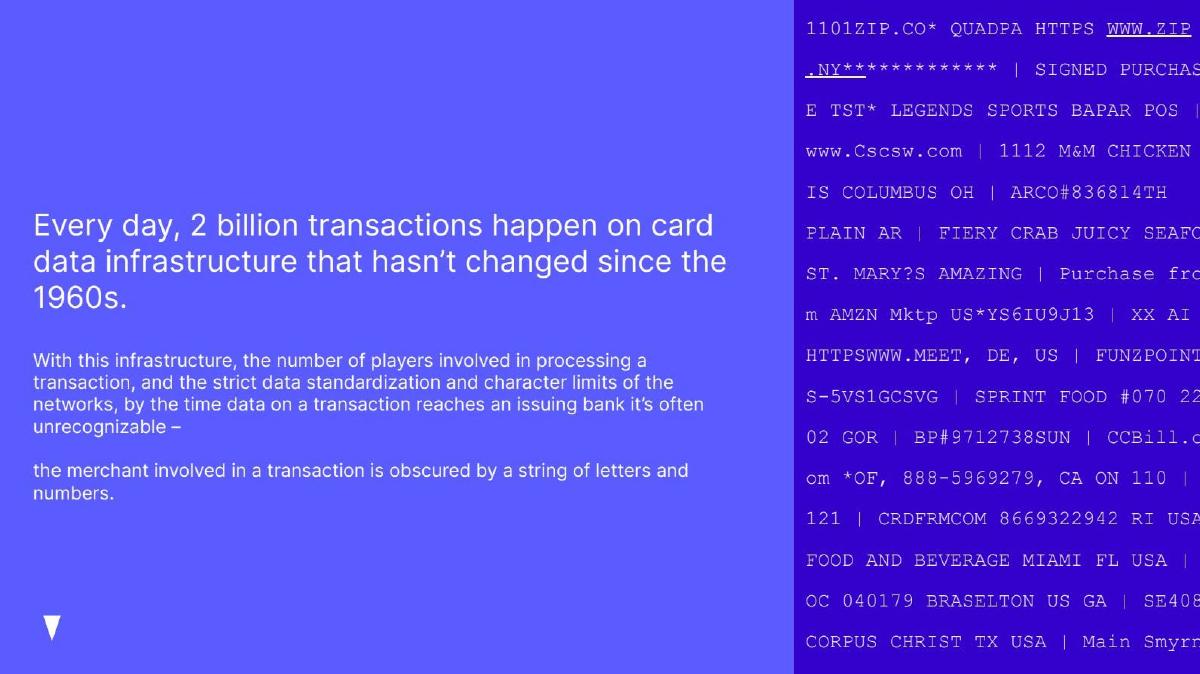
- Spade identifies a massive scale problem, noting that 2 billion transactions occur daily on infrastructure dating back to the 1960s (Slide 3).
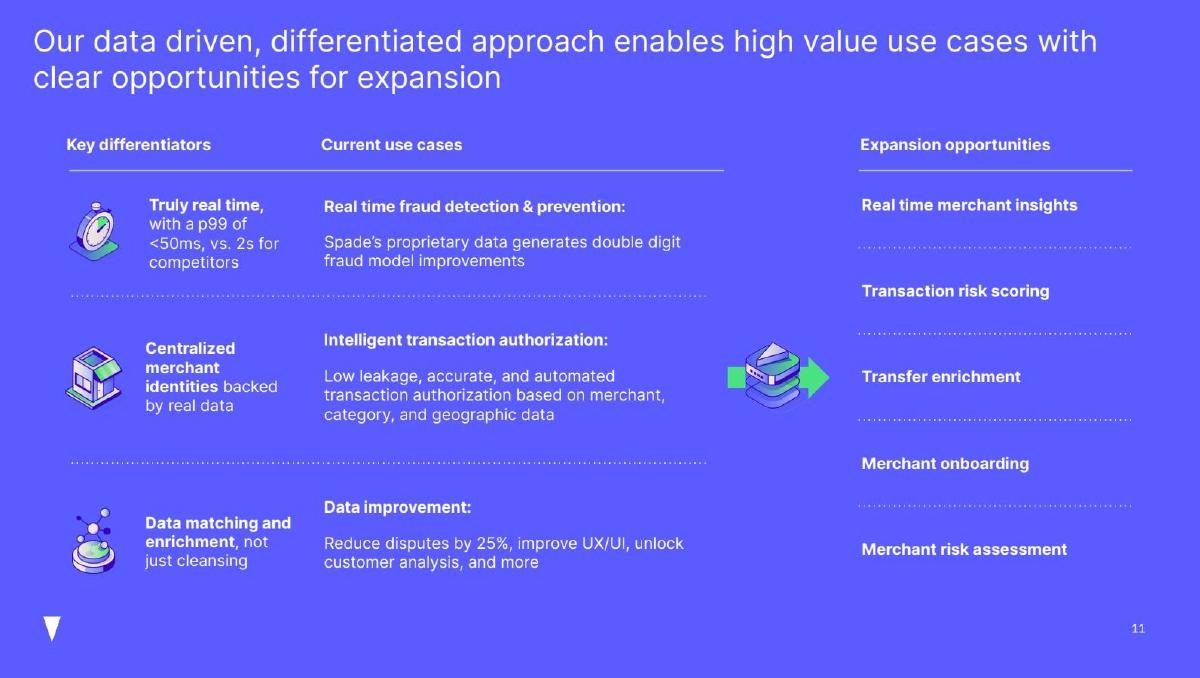
- The platform offers a technical performance edge with a p99 latency of <50ms, compared to a 2-second industry standard (Slide 11).
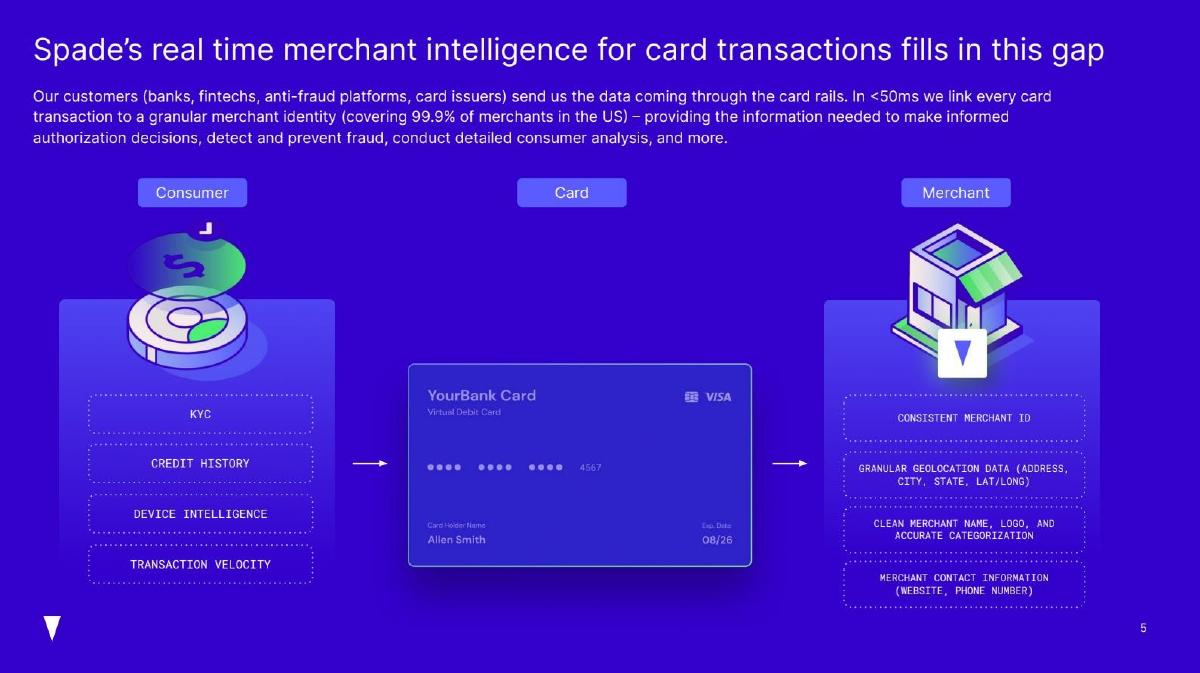
- Spade claims to cover 99.9% of merchants in the US, providing granular data like geolocation and merchant contact info (Slide 5).
- The deck uses a 'Sample Transaction' slide to visually demonstrate the transformation of raw, unreadable strings into structured data (Slide 7).
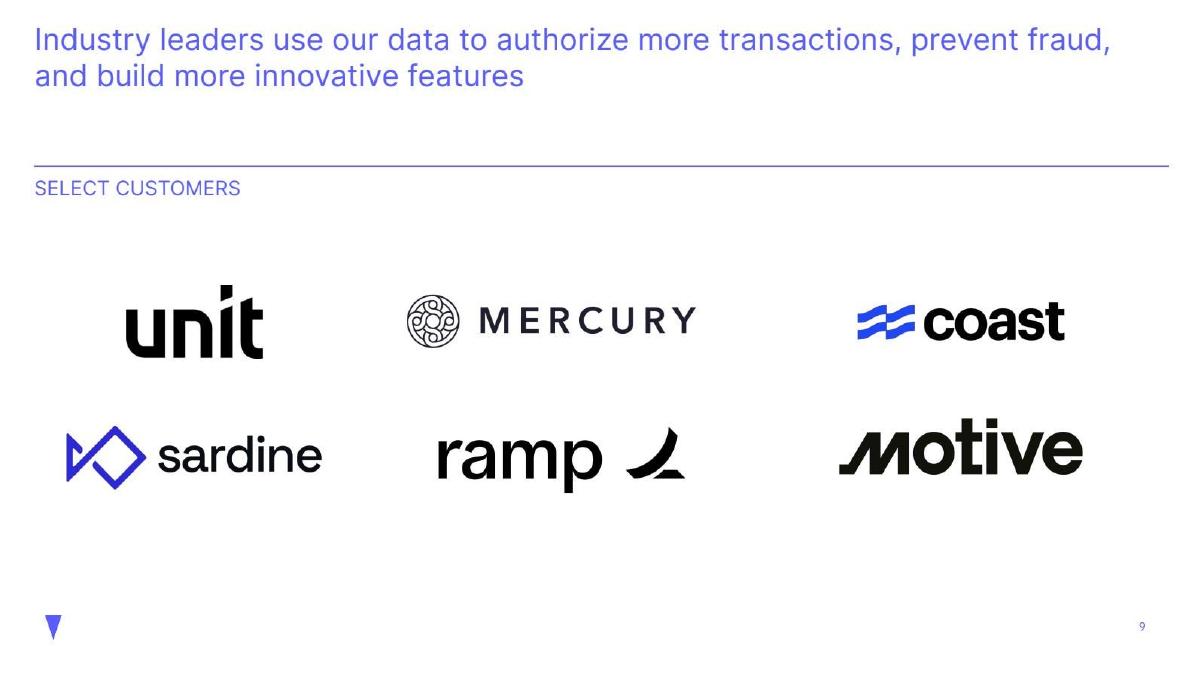
- Customer validation is strong, featuring logos from prominent fintechs including Unit, Mercury, Sardine, Ramp, Coast, and Motive (Slide 9).
- The product claims to reduce transaction disputes by 25% and generate double-digit fraud model improvements (Slide 11).
- The team slide emphasizes pedigree, showing experience from Square, Uber, Venmo, and Blend (Slide 13).
- The deck omits a specific funding ask, financial roadmap, or detailed competitive landscape analysis.
Introduction: The Infrastructure Play
Spade’s Series A deck, used to raise $10M in 2023, is a focused narrative on fixing the 'broken' plumbing of the financial world. As reported by Business Insider, this round was intended to scale their merchant intelligence platform. The deck itself is 13 slides long, though only a selection of key slides are analyzed here. It follows a classic infrastructure-as-a-service (IaaS) logic: identify a legacy bottleneck, present a high-performance technical solution, and prove it with early adopter logos.
Slide 1: Title and Positioning
The cover slide establishes Spade as 'The fastest and most accurate provider of real-time merchant intelligence for the card ecosystem.' This is a high-signal opening. It doesn't just say what they do; it claims two specific competitive advantages: speed and accuracy. The branding is minimalist, using a blue-to-purple gradient that is common in modern fintech, signaling that they are a contemporary technology company rather than a legacy financial services provider.
Slide 3: The Problem of Legacy Infrastructure
Slide 3 sets the stakes. It states that 'Every day, 2 billion transactions happen on card data infrastructure that hasn’t changed since the 1960s.' This is a classic 'why now' and 'why this matters' slide. By anchoring the problem in the 1960s, Spade frames the current system as archaic and unfit for modern needs. The slide explains that due to strict data standardization and character limits, merchant identities are obscured by 'a string of letters and numbers' by the time they reach an issuing bank. The right side of the slide visually reinforces this with a wall of unreadable transaction strings, creating a visceral sense of the chaos banks have to deal with.
Slide 5: The Solution and Data Depth
Slide 5 introduces Spade’s real-time merchant intelligence as the bridge for this gap. The slide is highly technical, which is appropriate for a Series A infrastructure pitch. It claims that in less than 50ms, Spade can link a transaction to a 'granular merchant identity' covering 99.9% of US merchants. The slide breaks down exactly what data is returned: Consistent Merchant ID, granular geolocation (lat/long), clean merchant name/logo, and contact information. This slide is critical because it defines the product not just as a cleaner, but as an enrichment engine that enables 'informed authorization decisions' and 'fraud prevention.'
Slide 7: The 'Before and After' Visual
Slide 7 is perhaps the most effective slide in the deck. It provides a 'Sample transaction' comparison. On the left, it shows the raw data: 'CRDFRMCOM' with a generic MCC code and a phone number. On the right, it shows the Spade-enriched output: 'Credcall, LLC,' a digital channel, a specific industry category (Banking and Finance - Credit Reporting), a match score of 93.8, and a full address with coordinates. This visual proof-of-concept makes the abstract value proposition of the previous slides concrete. It shows an investor exactly what the customer is buying.
Slide 9: Customer Validation and Social Proof
For a Series A, traction is paramount. Slide 9 displays logos of 'Industry leaders' using Spade’s data. The list includes Unit, Mercury, Coast, Sardine, Ramp, and Motive. These are not just random companies; they are high-growth fintechs and 'banking-as-a-service' platforms that handle massive transaction volumes. Including Ramp and Mercury specifically signals that Spade is already integrated into the workflows of the most sophisticated new players in the card ecosystem. This slide serves as a proxy for technical due diligence—if Ramp is using it, the tech likely works at scale.
Slide 11: Differentiators and Use Cases
Slide 11 moves into the 'moat' and 'expansion' territory. It lists three key differentiators: 1) Speed ( The final slide presented is the team slide. It features the three founders: Oban MacTavish (CEO), Cooper Hart (CTO), and Tess Bloch (Operations). Below them, it mentions '+ 10 team members' and displays logos from Square, Uber, Venmo, Blend, Lyft, Acorns, and Pinwheel. This is a 'pedigree' slide. It tells investors that while the team is small, they come from the exact companies (Square, Venmo, Uber) that have had to solve these transaction data problems internally in the past. It suggests a high level of domain expertise and 'founder-market fit.'
What Works in the Spade Deck
Specific Technical Benchmarks: Spade doesn't just say they are fast; they cite a p99 latency of The 'Before and After' Contrast: Slide 7 is a masterclass in showing, not telling. By placing the unreadable raw string next to the enriched data, they eliminate the need for complex explanations of how the API works. The value is self-evident.
Strategic Customer Selection: The logos on Slide 9 are perfectly aligned with their target market. By winning the 'modern' fintech stack first (Ramp, Mercury), they create a narrative of inevitability when they eventually move toward legacy banks.
What is Missing from the Spade Deck
The Financials: There is a total absence of revenue figures, growth rates (MoM or YoY), or unit economics. While this information is often kept in a separate data room, a Series A deck usually includes at least a trend line or a 'North Star' metric growth chart to show momentum.
The Ask: The deck ends without a slide stating how much they are raising or what the milestones for the next 18-24 months are. While the publisher reports a $10M raise, the deck itself doesn't guide the investor toward a specific transaction.
Competitive Landscape: While they mention 'competitors' in passing on Slide 11 regarding latency, they don't name them or provide a feature-by-feature comparison. In a crowded fintech data space, investors would likely want to know how they stack up against incumbents like Plaid or specialized players like Snowdrop Solutions.
Founder's Playbook: What to Copy
Use the 'Legacy' Frame: If you are building infrastructure, frame the status quo as 'archaic.' Spade’s mention of the 1960s is a powerful way to make their solution feel like a mandatory upgrade rather than a luxury.
Quantify the Pain: Don't just say your product saves money. Say it 'reduces disputes by 25%.' These specific figures give investors a hook to build their own ROI models during due diligence.
Focus on Pedigree: If your team comes from industry giants, use those logos prominently. In early-stage fintech, where trust and security are everything, having 'Venmo' or 'Square' on your team slide acts as a significant de-risking mechanism.
Keep it Visual: Spade avoids long paragraphs. They use icons, flowcharts (Slide 5), and data samples (Slide 7) to tell the story. This makes the deck highly skimmable, which is how most VCs will consume it on a first pass.
Frequently asked questions
- What is the primary problem Spade is solving?
- Spade addresses the issue of obscured transaction data. Current card infrastructure often reduces merchant information to unrecognizable strings of letters and numbers. Spade cleans and enriches this data in real-time to provide banks and fintechs with a clear merchant identity, which is essential for fraud prevention and authorization decisions.
- How does Spade differentiate its technology from competitors?
- The deck highlights speed and depth as key differentiators. Spade reports a p99 latency of less than 50 milliseconds, whereas they claim competitors take up to 2 seconds. Additionally, they emphasize 'data matching and enrichment' rather than just simple 'cleansing,' providing deeper insights like geolocation and merchant logos.
- Who are Spade's target customers?
- According to Slide 5, Spade targets banks, fintechs, anti-fraud platforms, and card issuers. Their current customer list includes notable names in the corporate card and banking-as-a-service space, such as Ramp, Mercury, and Unit.
- What metrics does Spade use to prove its value?
- Spade cites several key performance indicators: 99.9% merchant coverage in the US, a 25% reduction in disputes for customers, and 'double-digit' improvements in fraud detection models. These figures aim to show both the breadth of their data and the tangible ROI for financial institutions.
- What is missing from the Spade pitch deck?
- The deck is missing several standard Series A components, including a slide detailing the specific amount being raised (the 'Ask'), a breakdown of how funds will be used, a financial forecast or revenue growth chart, and a formal competitive matrix.