Claroty’s Series D deck is a masterclass in establishing a 'perfect storm' narrative to justify late-stage capital. By framing the acceleration of digital transformation against a backdrop of increasing cyber attacks on critical infrastructure, Claroty positions itself as the essential bridge between IT and OT security. The deck effectively uses a timeline of high-profile breaches—from Stuxnet to the Israel Water Utility attack—to create urgency. While it lacks specific revenue figures or unit economics, it compensates with a massive list of strategic partners like Siemens and Rockwell Automa…
Key takeaways
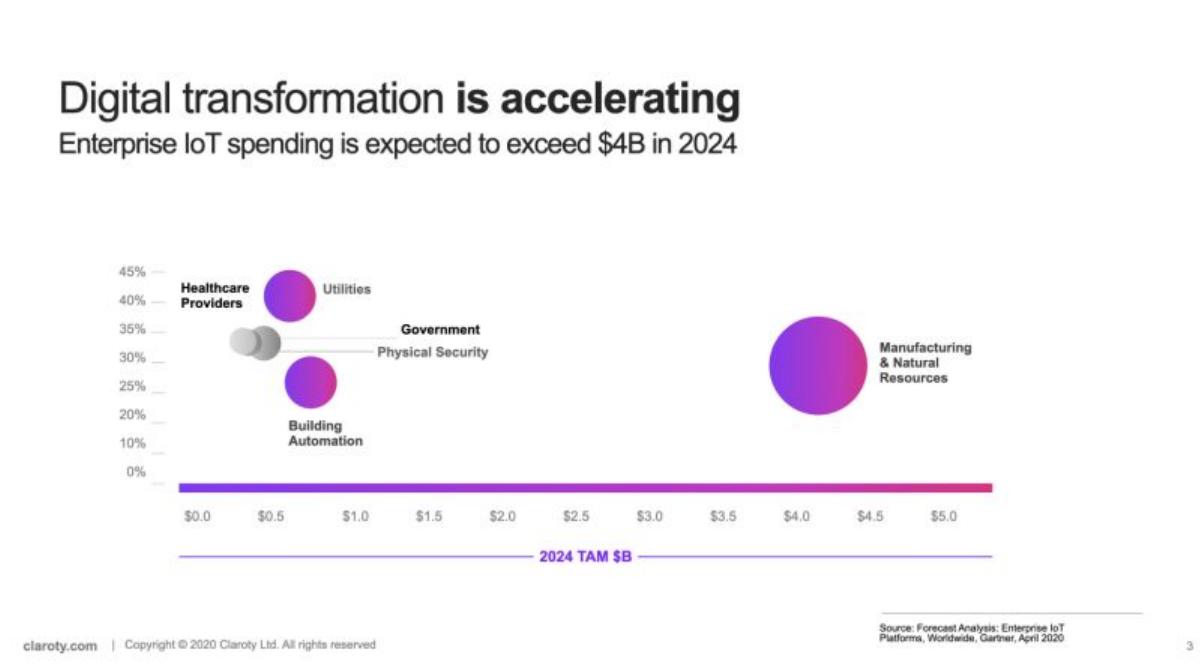
- Enterprise IoT spending is projected to exceed $4B by 2024, with Manufacturing & Natural Resources representing the largest segment (Slide 3).
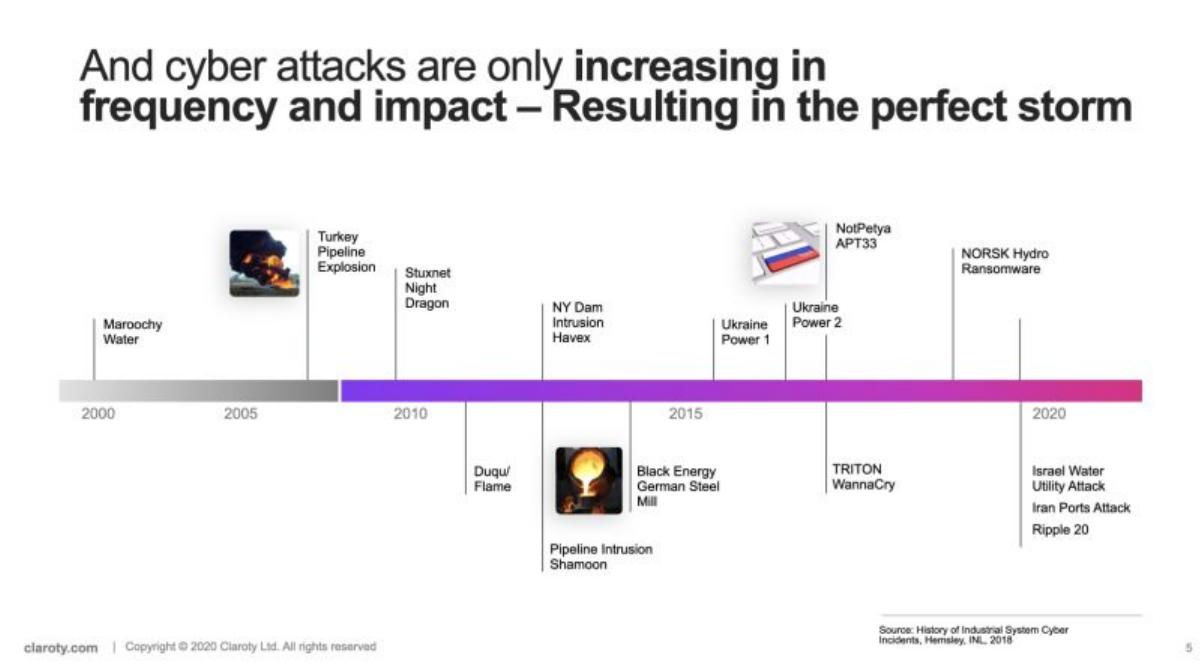
- The 'Perfect Storm' narrative is supported by a timeline of industrial cyber incidents starting from 2000, including Stuxnet and the 2020 Israel Water Utility attack (Slide 5).
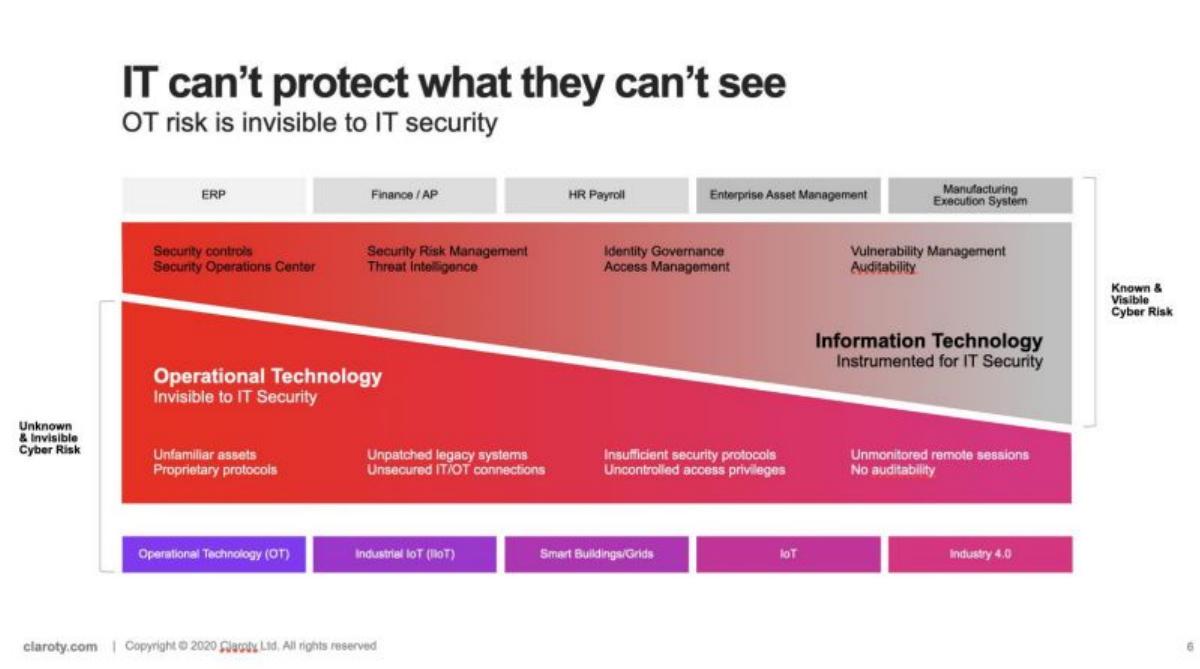
- A significant gap exists where Operational Technology (OT) remains invisible to standard IT security protocols, creating unknown and invisible cyber risks (Slide 6).
- Claroty had already raised $100M total through its Series C and employed over 270 people at the time of this deck (Slide 8).
- The platform claims to be the only solution protecting 'everything within four walls,' covering IoT, OT, and IIoT (Slide 9).
- Market data suggests 93% of companies will augment or replace OT monitoring systems within three years due to IoT adoption (Slide 13).
- The company’s growth strategy involves moving from direct sales in critical infrastructure to strategic partnerships for healthcare and BMS (Slide 14).
- The leadership team includes former executives from Siemens, IBM, and RSA, plus a Board Advisor who previously led FireEye and McAfee (Slide 15).
The Industrial Security Imperative
Claroty’s Series D deck arrives at a time when the convergence of IT and OT (Operational Technology) has moved from a technical trend to a national security priority. The deck, used to raise $140M in 2021, focuses heavily on the macro-environmental factors that make industrial cybersecurity a 'must-have' rather than a 'nice-to-have.' By analyzing the 16 slides provided, we can see a clear progression from market fear to product-led confidence.
Slides 1-2: The Vision and The Storm
The deck opens with a simple, bold title: "Securing the Industrial Economy." This immediately elevates the company's mission above simple software sales. Slide 2 introduces the thematic core of the pitch: "Digital transformation & the perfect storm." This is a classic late-stage fundraising tactic—positioning the company as the solution to a massive, inevitable global shift.
Slides 3-5: Quantifying the Crisis
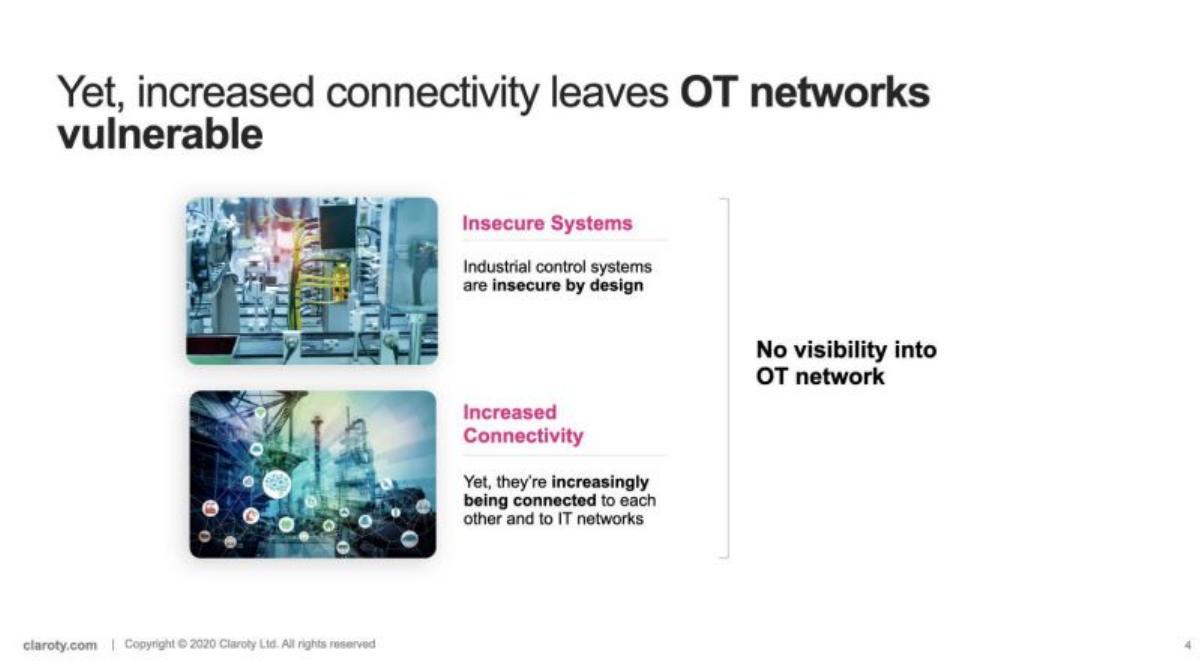
Slide 3 uses Gartner data to show that "Enterprise IoT spending is expected to exceed $4B in 2024." The visualization places Manufacturing & Natural Resources as the largest bubble, justifying Claroty's initial focus. Slide 4 defines the technical problem: "Increased connectivity leaves OT networks vulnerable." It highlights that industrial control systems are "insecure by design."
Slide 5 is perhaps the most compelling in the deck. It provides a timeline of cyber attacks from 2000 to 2020. By listing specific incidents like Stuxnet , WannaCry , and the Israel Water Utility Attack , Claroty removes any doubt about the reality of the threat. This slide serves to build urgency, suggesting that the frequency and impact of these attacks are only increasing.
Slide 6: The Visibility Gap
This slide illustrates the 'Unknown & Invisible Cyber Risk.' It creates a visual contrast between the well-protected IT layer (ERP, Finance, HR) and the vulnerable OT layer (Industrial IoT, Smart Buildings). The text notes that OT risk is "invisible to IT security" due to "unfamiliar assets" and "proprietary protocols." This defines the specific niche Claroty occupies: the bridge that makes the invisible visible.
Slides 7-8: The Solution and The Pedigree
Slide 7 is a transition slide stating Claroty's role as the "leading Industrial Cybersecurity Platform." Slide 8 provides the 'hard facts' that Series D investors look for: HQ in New York City , Founded in 2015 , $100M total funding (Series C) , and 270+ employees . The slide is crowded with high-tier logos, including investors like Temasek and Bessemer Venture Partners , and strategic partners like Siemens and CrowdStrike . This level of social proof is critical for a $140M round.
Slides 9-10: Product Architecture and Competitive Advantage
Slide 9 breaks down the platform into five pillars: Vulnerability Management , Threat Detection , Threat Intelligence , Risk Management , and Secure Remote Access . All of these sit on a foundation of "Asset Visibility." Slide 10 defines their competitive moat: a "Deep Protocol Library" and "Best-in-Class Security Research." They claim to lead the ICS market in 2020 in terms of new vulnerabilities disclosed, positioning them as thought leaders in the space.
Slides 11-12: The Customer Journey
These slides shift to the sales motion. Slide 11 describes the "Industrial Cybersecurity Journey," helping customers identify their 'onramp' based on maturity. Slide 12 introduces specific product names: Claroty Edge , Claroty Continuous Threat Detection , and Claroty Secure Remote Access . The mention of Claroty Edge as the "industry's first zero-infrastructure OT security solution" is a key product differentiator aimed at reducing friction in deployment.
Slides 13-14: Market Growth and Expansion
Slide 13 provides the market size metrics. It notes that the Global Number of IoT-Connected Devices was expected to reach 14.6 billion by 2021 . It also claims that "93% of companies will augment/replace OT monitoring systems" within three years. Slide 14 outlines the roadmap for expansion. Today, they focus on Critical Infrastructure and Industrial Manufacturing . In the near-term, they target Healthcare , BMS , and Transport . Long-term, they aim for a "Pervasive Presence Across All Verticals."
Slide 15: The Team
The team slide is a 'who's who' of cybersecurity and industrial leadership. It features Yaniv Vardi (CEO) , Galina Antova (Co-Founder) , and Benny Porat (Co-Founder) . The inclusion of Admiral (ret.) Michael Rogers (former NSA) and Dave DeWalt (ex-FireEye/McAfee) provides immense regulatory and industry credibility, which is vital for a company dealing with critical national infrastructure.
What Works in the Claroty Deck
1. The 'Perfect Storm' Narrative: The deck does an excellent job of connecting macro trends (IoT spending) with specific, scary events (cyber attack timeline). This creates a sense of inevitability that appeals to late-stage investors.
2. Ecosystem Dominance: By showing Siemens, Rockwell, and Schneider Electric as both partners and investors, Claroty demonstrates that they have 'captured' the incumbents rather than just competing with them. In the industrial world, these relationships are the ultimate barrier to entry.
3. Clear Product Segmentation: Instead of presenting a monolithic 'platform,' the deck breaks the offering into specific tools (Edge, CTD, SRA) that correspond to different levels of customer maturity. This shows a sophisticated understanding of the sales cycle.
What is Missing from the Claroty Deck
1. Revenue and Growth Metrics: As a Series D deck, the absence of ARR (Annual Recurring Revenue), NRR (Net Revenue Retention), or specific growth percentages is notable. While these were likely in a separate data room, their absence here makes the deck feel more like a marketing presentation than a financial one.
2. Unit Economics: There is no mention of Customer Acquisition Cost (CAC) or Lifetime Value (LTV). For a company with 270+ employees, investors would want to see how efficiently the company is scaling.
3. Case Studies: While the deck lists many partners, it does not include a single specific case study showing how a customer reduced risk or saved money using the platform. The 'Perfect Storm' is theoretical; a case study would make the solution concrete.
Founder Takeaways
Build a 'Fear, Uncertainty, and Doubt' (FUD) Timeline: If you are in a security or compliance space, a timeline of failures (Slide 5) is the most effective way to prove the problem is real and urgent. Don't just say the market is growing; show the cost of doing nothing.
Leverage Strategic Investors: Claroty’s partner list (Slide 8) is their strongest asset. If you can get your industry’s giants to invest, use their logos prominently to signal that you are the 'standard' for that sector.
Map the Customer Journey: Don't just sell a product; sell a path to maturity (Slide 11). This helps investors understand how you land and expand within a large enterprise account.
Frequently asked questions
- What is the primary problem Claroty solves according to the deck?
- Claroty addresses the visibility gap between Information Technology (IT) and Operational Technology (OT). Slide 6 explains that while IT is instrumented for security, OT remains 'invisible,' characterized by unfamiliar assets and proprietary protocols. This lack of visibility prevents organizations from protecting critical industrial infrastructure as it becomes increasingly connected to IT networks.
- How does Claroty demonstrate market validation?
- Validation is shown through a 'Powerful Partnerships Ecosystem' on Slide 8. The company lists major industrial players like Siemens, Rockwell Automation, and Schneider Electric as both investors and partners. They also highlight integrations with top-tier cybersecurity firms like CrowdStrike and Check Point, alongside service partnerships with Deloitte, KPMG, and PwC.
- What are the specific product offerings mentioned?
- Slide 12 details three core offerings: Claroty Edge (a zero-infrastructure OT security solution for fast deployment), Continuous Threat Detection (for sophisticated detection and threat intelligence), and Secure Remote Access (a zero-trust network architecture specifically designed for OT environments).
- What is the projected market growth for OT and IIoT security?
- Slide 13 forecasts a ~23.2% CAGR for the OT & IIoT security market. It estimates the total market value will grow from $1.669 billion in 2018 to $3.847 billion by 2022, driven by the increasing number of IoT-connected devices, which reached 12.8 billion in 2020.
- Who are the key people behind Claroty?
- The team (Slide 15) is led by CEO Yaniv Vardi and co-founders Galina Antova (ex-Siemens) and Benny Porat (ex-IDF 8200 Unit). The board includes Admiral (ret.) Michael Rogers, former head of the NSA and U.S. Cyber Command, and Dave DeWalt, former CEO of FireEye and McAfee.