Clarity’s deck presents a focused solution for the Japanese labor market, specifically addressing the economic loss caused by women leaving the workforce. The narrative moves from a macro-economic problem—170 million yen lost per person who leaves for childbirth (Slide 4)—to a product-based solution using an 8-index survey (Slide 9). The business model is clearly defined with two distinct revenue streams: a per-person survey fee and a monthly SaaS subscription (Slide 11). While the deck shows strong early traction with 10,000 monthly visitors (Slide 10), it lacks a specific financial 'Ask' or…
Key takeaways
- The deck identifies a massive economic loss of 1.7 billion yen per woman leaving the workforce due to childbirth (Slide 4).
- Clarity positions itself as a matching platform that resolves the 'mismatch' between corporate culture and women's career needs (Slide 7).
- The product utilizes an 8-index survey covering factors like career growth, equality, and flexibility (Slide 9).
- Traction is demonstrated by a growth chart reaching 10,000 monthly visitors by November 2018 (Slide 10).
- The business model includes a survey fee of 8,000 yen per person and a SaaS fee starting at 35,000 yen per month (Slide 11).
- The total addressable market for recruitment advertising is cited as 800 billion yen (Slide 12).
- The team consists of six members, including a CEO, Lead Engineer, UI/UX Designer, and Tech Advisor (Slide 13).
- The deck omits a specific funding 'Ask' or a breakdown of use of funds (Slide 14).
Executive Summary
Clarity presents a 14-slide pitch deck focused on the Japanese recruitment market, specifically targeting the professional female demographic. The deck is structured as a classic problem-solution narrative, beginning with the high cost of employee turnover and ending with a scalable SaaS and survey-based business model. While the visual design is clean and the traction is promising, the deck functions more as a product overview than a complete investment memorandum, as it lacks specific financial requests and competitive positioning.
Slide 1: Title Slide
The cover slide features the Clarity logo—a stylized 'C' in blue and teal gradients. It identifies the company as Clarity K.K. and introduces the CEO, Satomi Furuya. The design is minimalist, establishing a professional and modern brand identity from the outset.
Slide 2: The Hook
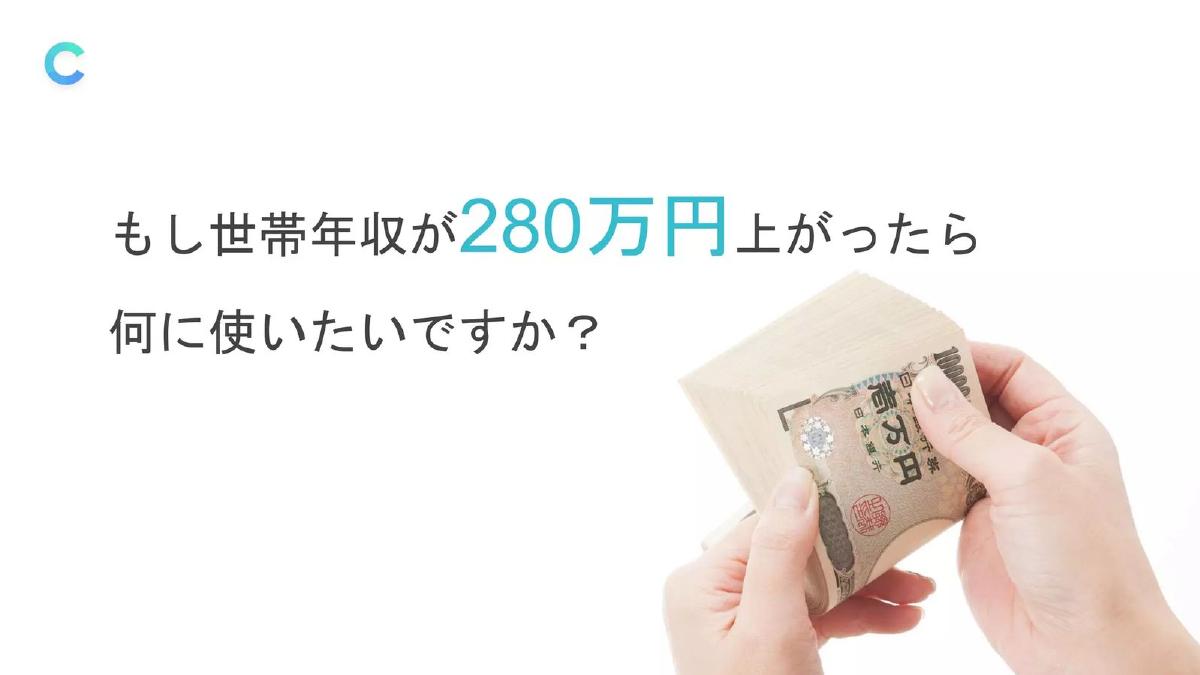
Slide 2 poses a provocative question to the reader: "If your household income increased by 2.8 million yen, what would you want to use it for?" This is accompanied by an image of a hand holding a large stack of 10,000 yen notes. This slide serves to frame the economic potential of the platform's mission in personal terms before moving to corporate data.
Slide 3 & 4: The Economic Problem
Slide 3 is a transition image of a woman working in a bright office. Slide 4 provides the data-backed 'Why': 1.7 billion yen . This figure represents the estimated economic loss to a company caused by a single employee leaving due to childbirth. By quantifying the problem in such stark terms, Clarity establishes a high-stakes environment where their solution becomes a financial necessity for employers rather than just a social good.
Slide 5 & 6: The Mismatch
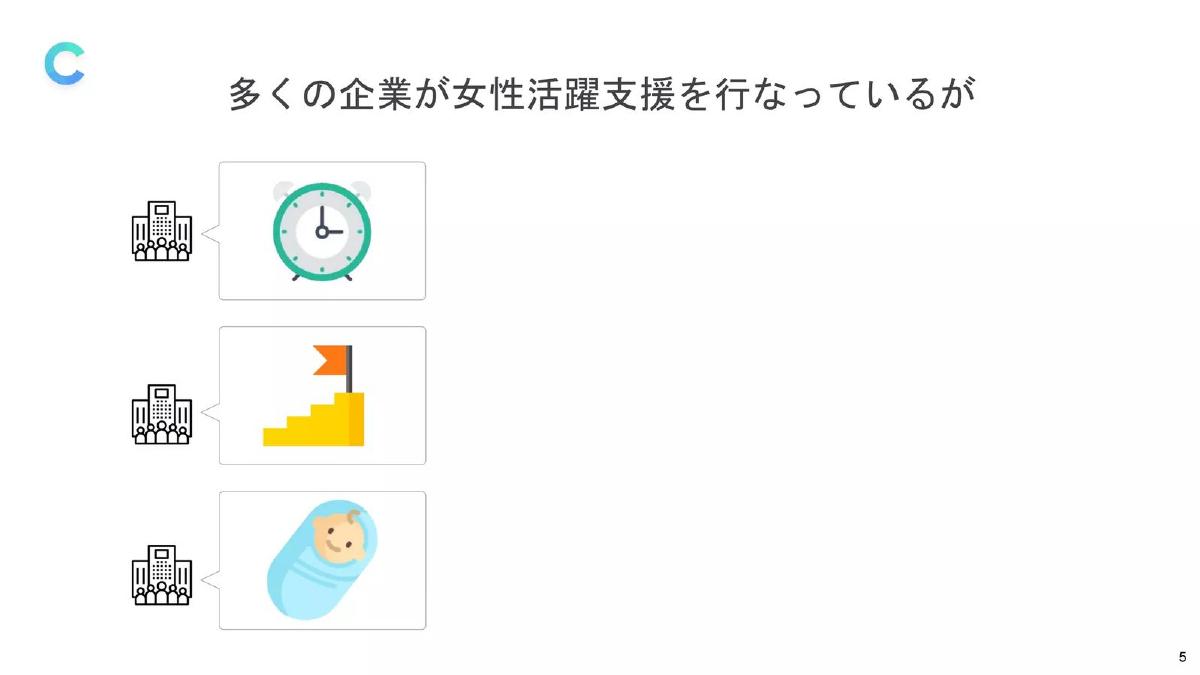
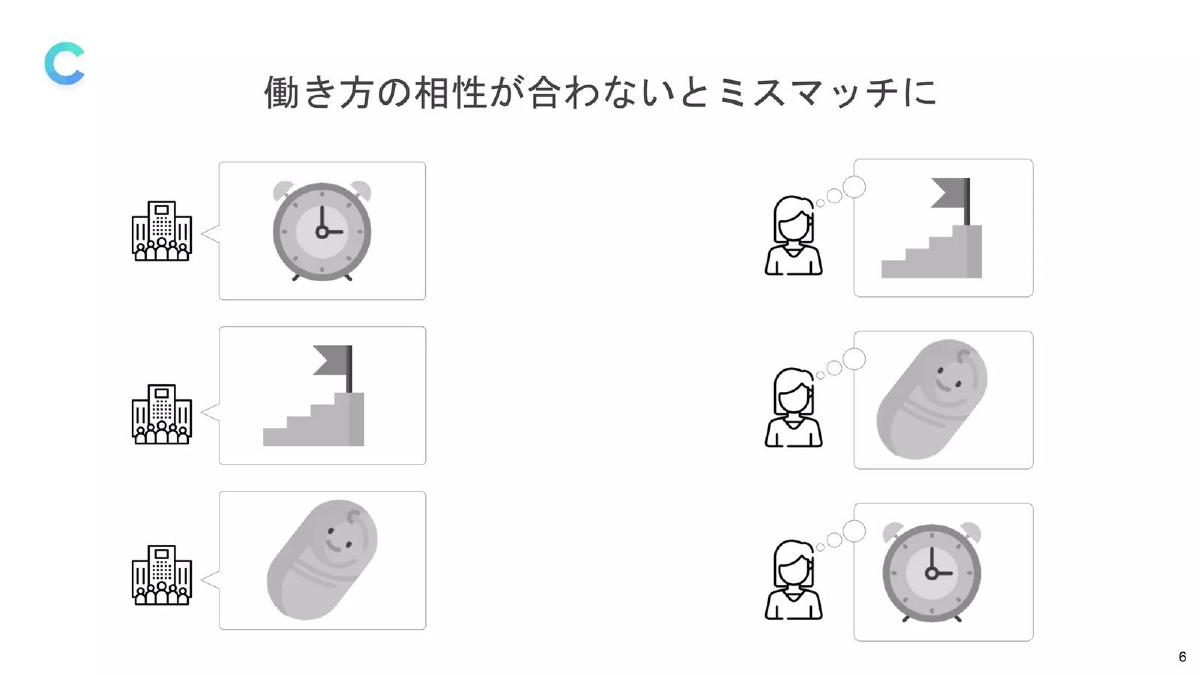
Slide 5 notes that while many companies are trying to support women's careers, there is still a gap. Slide 6 uses icons (clocks, flags, babies) to illustrate the "mismatch" between what companies offer and what women need. The icons represent time flexibility, career advancement, and childcare support. The slide argues that when these don't align, the result is a failed hire or a resignation.
Slide 7 & 8: The Solution
Slide 7 introduces a heart icon between the company and the employee, stating, "We will resolve this mismatch!" Slide 8 shows the product in action on a MacBook Air. The tagline translates to "Matching women and companies through work-style compatibility diagnosis." The interface shown is a job portal that displays a "compatibility score" based on the user's preferences, making the solution tangible.
Slide 9: The 8-Index Survey
This slide breaks down the product's methodology. Clarity uses 8 indices to evaluate companies: Career Growth, Equality of Pay and Opportunity, Ease of Childrearing, Freedom of Place and Time, Culture and Atmosphere, Corporate Ethics, Tools and Efficiency, and Extra-curricular Benefits. This slide is crucial because it explains the proprietary data layer that powers their marketplace.
Slide 10: Traction
Clarity demonstrates growth with a line graph showing monthly visitors from August 2018 to November 2018. The headline states that 10,000 people per month are already visiting the site. The graph shows a steady upward trend, which provides the necessary proof of concept to investors that there is market demand for this specific type of recruitment platform.
Slide 11: Business Model
The business model is presented clearly with two overlapping circles. The first is a Survey model for internal corporate research, priced at 8,000 yen per person . The second is a SaaS model for monthly job postings, starting at 35,000 yen per month . This dual-revenue approach suggests that Clarity can monetize both a company's existing workforce (retention) and their future workforce (recruitment).
Slide 12: Market Size
The deck identifies the Total Addressable Market (TAM) as the recruitment advertising market, valued at 800 billion yen . This large number justifies the venture-scale potential of the business, suggesting that even a small percentage of market capture would result in significant revenue.
Slide 13: Team
The team slide features six members: Satomi Furuya (CEO), a Lead Engineer, a Senior Marketer, a UI/UX Designer, a Tech Advisor, and an Intern. The presence of a dedicated lead engineer and a UI/UX designer suggests that the company is product-led and has the internal capacity to build and iterate on its platform.
Slide 14: Contact Information
The final slide repeats the core value proposition: "Matching women and companies through work-style compatibility diagnosis." It provides the CEO's email and Facebook contact info. Notably, there is no mention of the amount of money being raised or the terms of the round.
What Works in This Deck
Strong Problem Quantification: Using the 1.7 billion yen figure (Slide 4) immediately shifts the conversation from a "soft" HR issue to a "hard" financial loss, which is more compelling for investors. · Clear Revenue Streams: The business model (Slide 11) is unambiguous. Investors can easily see how the company makes money and how those two streams (Survey and SaaS) complement each other. · Proprietary Methodology: The 8-index survey (Slide 9) gives the platform a "moat" or a unique selling point that differentiates it from generic job boards like LinkedIn or Indeed. · Visual Traction: The growth chart (Slide 10) is simple and shows the right directionality, proving that the team can execute on user acquisition.
What is Missing
The Ask: This is the most significant omission. There is no slide detailing how much capital is being raised, the valuation, or the milestones the company intends to hit with the new funding. · Competitive Landscape: The deck does not mention other recruitment platforms or how Clarity plans to defend its position against established incumbents in the 800 billion yen market. · Unit Economics: While the pricing is listed, there is no data on Customer Acquisition Cost (CAC) or Lifetime Value (LTV), which are critical for evaluating a SaaS/Marketplace hybrid. · Roadmap: The deck shows where the company is, but not where it is going. A product or expansion roadmap would help investors understand the long-term vision.
Founder's Guide: What to Copy
The "Mismatch" Visual: Using simple icons to represent complex human needs (Slide 6) is an excellent way to communicate a problem without using walls of text. · The Macro-to-Micro Flow: Starting with a massive market problem (Slide 4) and narrowing it down to a specific product feature (Slide 9) is a classic, effective storytelling technique. · Transparent Pricing: Listing your actual prices (Slide 11) shows confidence in the business model and helps pre-qualify the types of investors who understand that price point.
Frequently asked questions
- What is Clarity's primary value proposition?
- Clarity aims to eliminate the mismatch between women and companies by using a diagnostic tool based on eight specific indices. By matching work styles and corporate environments, they seek to reduce the high turnover rate associated with life events like childbirth, which the deck claims costs companies 1.7 billion yen per person in lost economic value.
- How does Clarity generate revenue?
- The company employs a dual-revenue model. First, it charges 8,000 yen per person for internal corporate surveys. Second, it operates a SaaS model for job listings and recruitment, starting at 35,000 yen per month. This allows them to monetize both the diagnostic data and the actual recruitment process.
- What stage of growth is shown in the deck?
- The deck shows early-stage traction. Slide 10 displays a traffic growth chart from August 2018 to November 2018, indicating they reached 10,000 monthly visitors. This suggests the platform was live and gaining momentum at the time of the pitch, though it does not list total revenue or number of corporate clients.
- Who is the target audience for this platform?
- The platform is a B2B2C marketplace. On the 'C' side, it targets professional women seeking compatible work environments. On the 'B' side, it targets Japanese corporations looking to improve their diversity and inclusion metrics and reduce turnover costs in a recruitment market valued at 800 billion yen.
- What critical information is missing from the deck?
- The deck lacks a 'The Ask' slide, meaning there is no mention of how much capital they are raising or the valuation. It also omits a competitive landscape analysis, detailed unit economics (LTV/CAC), and a multi-year financial projection or product roadmap.