Clair addresses the financial instability of the hourly workforce by offering fee-free, instant access to earned wages. Their deck highlights a significant market opportunity, noting that 80% of workers live paycheck to paycheck and 40% cannot cover a $400 emergency. The core of their strategy is an 'embedded' model, partnering with Time & Attendance (T&A) providers to reach employees at the source of their work data. While the deck is concise at only 11 slides, it effectively communicates a clear B2B2C distribution model and demonstrates early traction with a T&A partner representing over 45…
Key takeaways
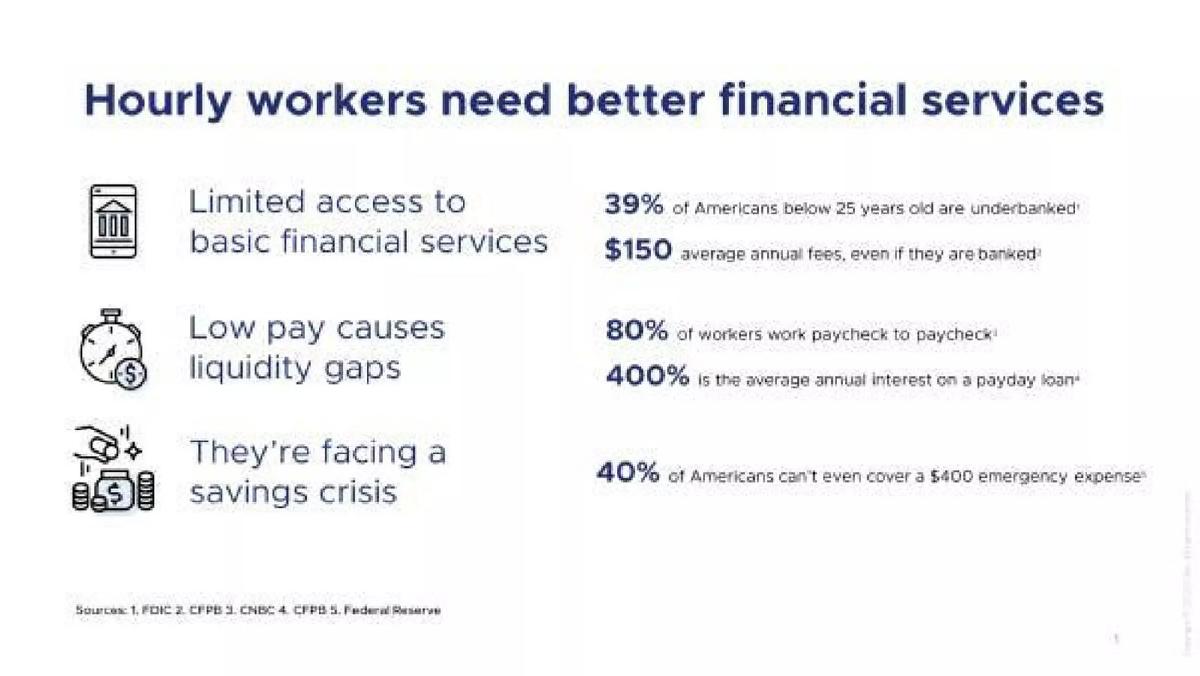
- Clair identifies a massive problem: 80% of workers live paycheck to paycheck and face 400% average annual interest on payday loans (Slide 1).
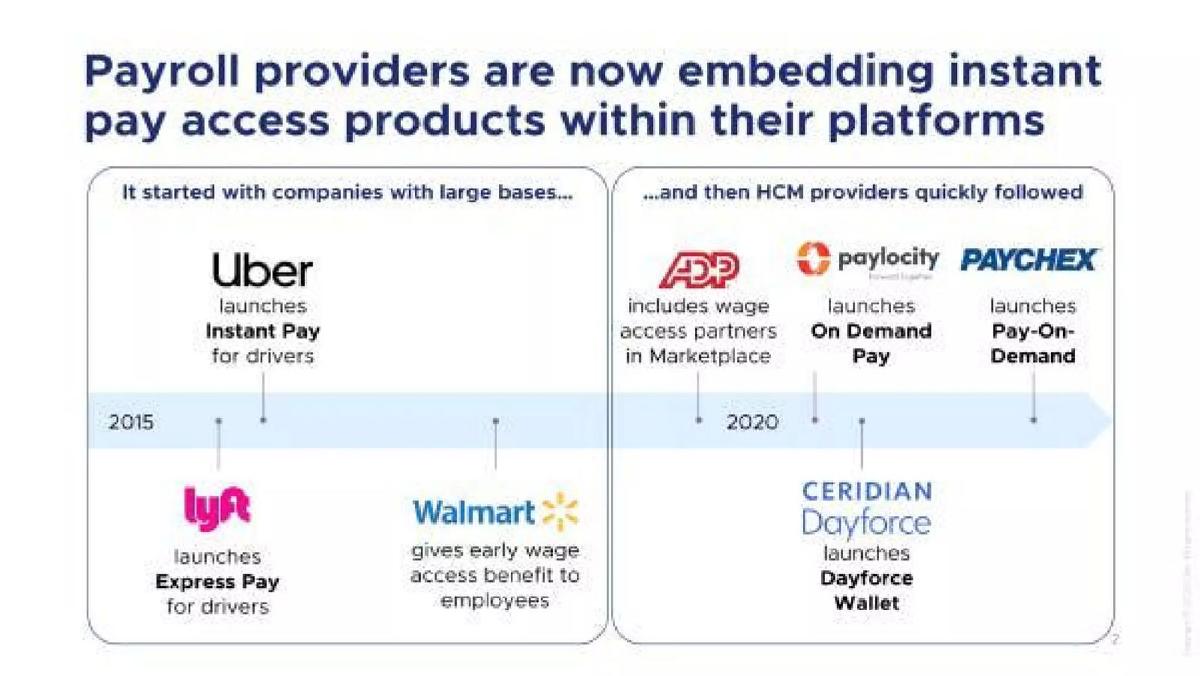
- The company positions itself as part of a broader trend of instant pay access, following giants like Uber, Lyft, and Walmart (Slide 2).
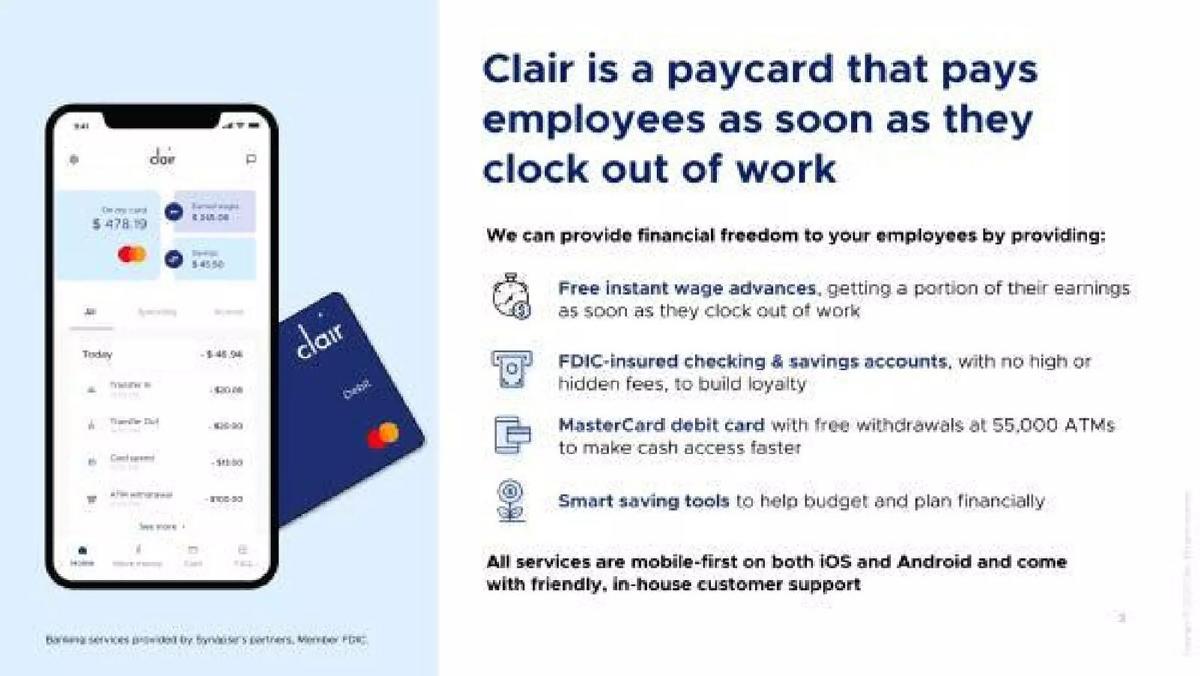
- The product is a comprehensive digital banking suite including a Mastercard debit card with access to 55,000 fee-free ATMs (Slide 3).
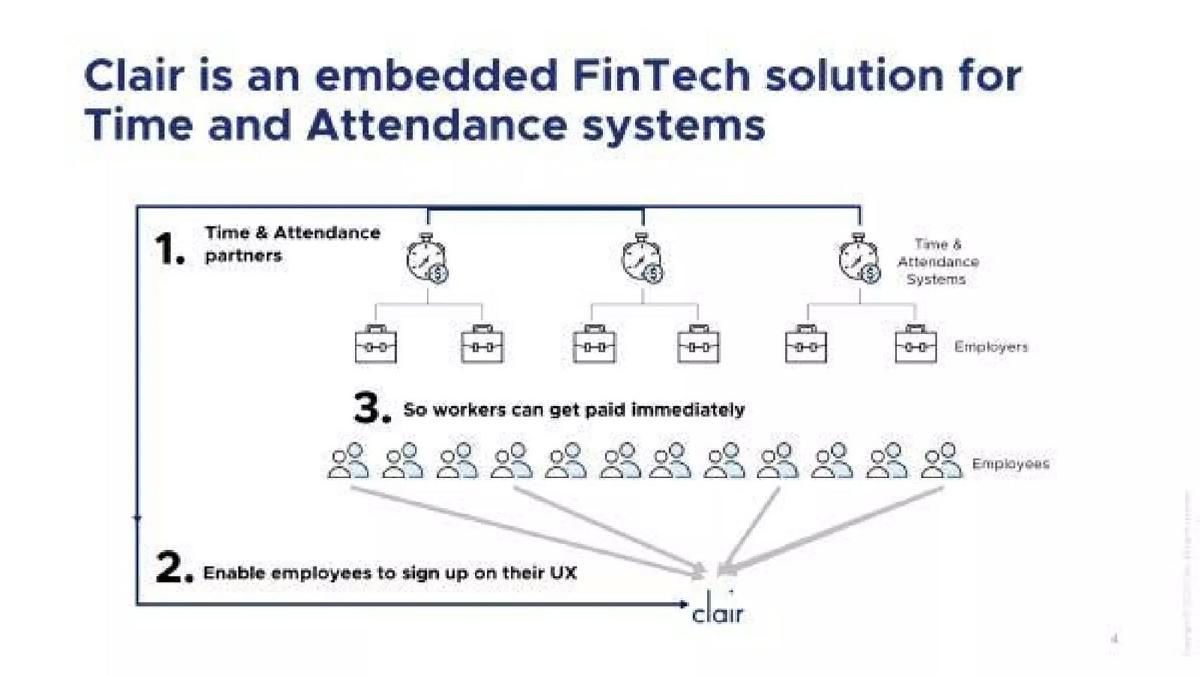
- Clair's distribution strategy relies on embedding their UX directly into Time & Attendance partner systems (Slide 4).
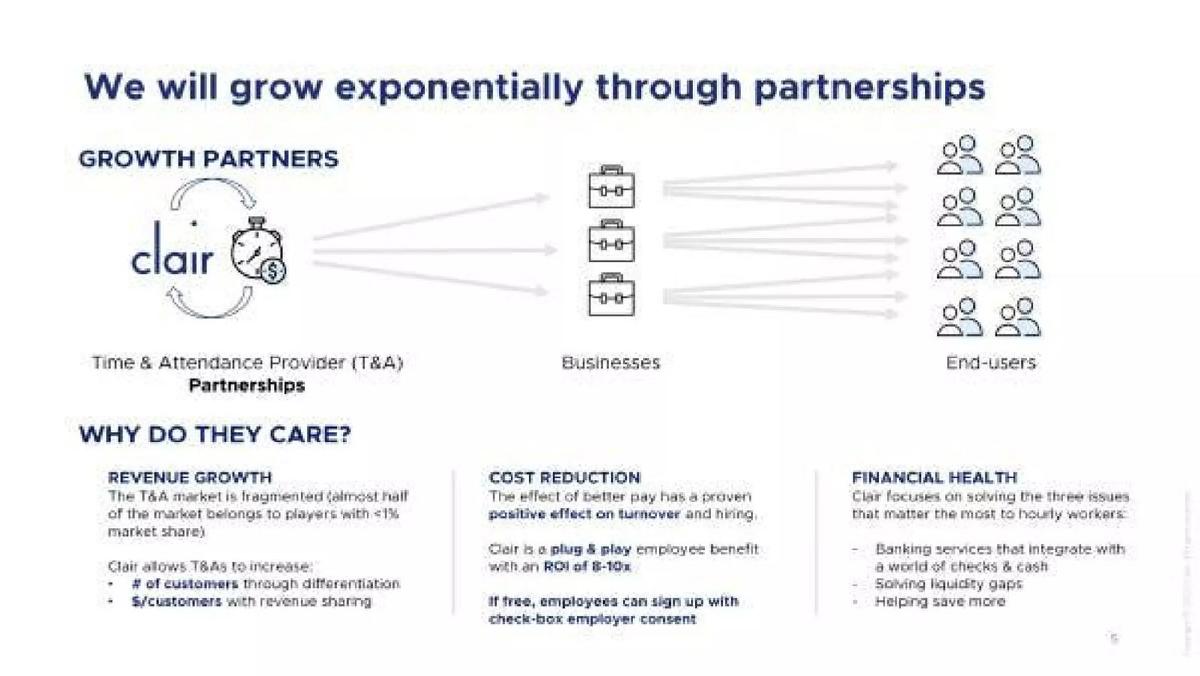
- The business model offers a clear ROI for partners, claiming an 8-10x ROI for employers through reduced turnover (Slide 5).
- Early traction is evidenced by a signed T&A partnership covering 450,000+ users (Slide 6).
- The deck includes a specific $3.0M equity round ask, despite the catalogue listing showing a total of $19.6M raised over time (Slide 9).
- The hiring plan is highly technical, with 33% of new hires dedicated to technology and 12% to product and data (Slide 9).
Executive Summary: The Embedded Paycheck Revolution
Clair enters the fintech space with a mission-driven approach to solving the 'savings crisis' for hourly workers. Their 11-slide deck is a masterclass in identifying a systemic pain point and presenting a scalable, partner-led solution. By focusing on the 80% of workers living paycheck to paycheck, Clair positions itself not just as a bank, but as a financial wellness tool. The deck successfully argues that the infrastructure for instant pay is the next logical step in the evolution of HR technology, following the lead of gig-economy giants like Uber and Lyft.
Slides 1-2: The Problem and Market Context
The deck opens with a clear, punchy mission statement: "Helping employees get paid the minute they clock out of work." This immediately frames the product around a specific action (clocking out) and a specific benefit (getting paid). Slide 1 backs this up with sobering statistics: 39% of Americans under 25 are underbanked, and the average annual interest on a payday loan is a staggering 400%. By citing sources like the FDIC and the Federal Reserve, Clair establishes the gravity of the problem they are solving.
Slide 2 provides the 'Why Now?' by showing a timeline of the industry. It notes that the trend started in 2015 with Uber's 'Instant Pay' and Lyft's 'Express Pay,' followed by Walmart in 2017. By 2020, major HCM (Human Capital Management) providers like ADP, Paylocity, and Paychex had launched similar products. This slide serves two purposes: it validates the demand for the service and suggests that any provider without this capability is falling behind the market curve.
Slides 3-4: The Product and Integration Model
Slide 3 introduces the Clair product suite. It is described as a "paycard that pays employees as soon as they clock out of work." The features are standard for a neobank—FDIC-insured accounts, no hidden fees, and a Mastercard with 55,000 fee-free ATMs—but the 'Free instant wage advances' is the hook. The slide emphasizes that the service is mobile-first and includes in-house customer support, which is critical for building trust with a vulnerable user base.
Slide 4 is perhaps the most important slide for an investor interested in scalability. It illustrates the 'Embedded FinTech' model. Instead of trying to acquire employees one by one, Clair integrates with Time & Attendance (T&A) partners. These partners sit above the employers, who in turn sit above the employees. By 'enabling employees to sign up on their UX,' Clair creates a frictionless acquisition funnel that leverages existing workplace behavior.
Slides 5-7: Growth Strategy and Early Traction
Slide 5 explains why these partners would want to work with Clair. For T&A providers, it offers revenue growth through differentiation and revenue sharing. For employers, it offers an 8-10x ROI by reducing turnover. For workers, it solves liquidity gaps. This 'triple-win' scenario is a compelling argument for a B2B2C business model.
Traction is evidenced in Slides 6 and 7. Slide 6 claims a signed T&A partnership with over 450,000 users, supported by quotes from 'Client A' through 'Client D.' While the names are anonymized, the quotes suggest a strong market pull, with one client stating they 'pulled the plug' on a competitor due to regulatory concerns, implying Clair has a superior compliance posture. Slide 7 shows a pilot with an employer of 800 users and a pipeline of thousands more, demonstrating that the model works at both the partner and individual employer levels.
Slides 8-9: Execution and The Ask
Slide 8 details the company's accomplishments to date. They launched their app 4 weeks ahead of schedule and achieved compliance approval in 2.5 months—significantly faster than the 6-month industry standard. This speaks to the team's operational efficiency. They also mention having 10+ clients in the pipeline with a potential reach of over 2 million users.
Slide 9 contains the financial 'Ask.' They are seeking a $3.0M equity round, having previously raised $550,000 in pre-seed funding. The use of funds is heavily weighted toward hiring (46%), with a specific hiring plan that prioritizes Technology (33%) and Sales (17%). This is a standard allocation for a seed/Series A stage company looking to harden its product and scale its sales efforts. The inclusion of 'Back-end bank' costs (17%) highlights the capital-intensive nature of fintech infrastructure.
Slides 10-11: The Team
The deck concludes with the leadership team on Slide 10. The founders possess a strong mix of traditional finance and social impact experience. CEO Nico Simko’s background at JP Morgan in Wholesale Payments M&A is a perfect fit for a company building payment rails. CPO Erich Nussbaumer’s experience in micro-lending in Africa adds a layer of expertise in serving underbanked populations. The presence of a dedicated Head of Tech with transactional banking experience (Julie Gelé) rounds out a team that looks capable of handling the regulatory and technical hurdles of the banking industry.
What Works in the Clair Pitch Deck
1. Clear Distribution Advantage: The deck spends significant time explaining the 'Embedded' model. In a crowded fintech market, showing how you will acquire users for cents rather than dollars is the most effective way to win over investors. The diagram on Slide 4 makes this complex B2B2C relationship easy to understand.
2. Strong Market Validation: By aligning themselves with the moves made by Uber and Walmart, Clair makes their product feel like an inevitability rather than a luxury. They aren't creating a new behavior; they are bringing a proven behavior to a wider market.
3. Speed of Execution: The mention of beating the compliance approval timeline by 3.5 months (Slide 8) is a powerful signal. In fintech, the ability to navigate bureaucracy quickly is a competitive moat.
What is Missing from the Clair Pitch Deck
1. Unit Economics: While the deck mentions revenue sharing, it does not provide a breakdown of how Clair actually makes money. There is no mention of interchange rates, interest margins, or expected Lifetime Value (LTV) vs. Customer Acquisition Cost (CAC). For a $3M ask, investors would typically expect a clearer path to profitability.
2. Competitive Landscape: Slide 2 mentions that ADP and Paychex have launched similar products. The deck fails to explain how Clair competes with these incumbents. If a worker's payroll provider already offers on-demand pay, why would the employer switch to or add Clair? A slide addressing the competitive moat against these giants is a notable omission.
3. Regulatory Detail: Given that 'Client B' on Slide 6 mentioned pulling a competitor's product due to regulatory issues, more detail on Clair's specific regulatory framework or bank partnership (MetaBank is mentioned in the catalogue listing but not prominently in the slides) would have strengthened the pitch.
What a Founder Should Copy from this Deck
1. The 'Why Now' Timeline: Slide 2 is a perfect example of how to use industry history to justify your company's existence. It shows a trend line that points directly to your solution.
2. The Use of Funds Breakdown: Slide 9 doesn't just say 'we are hiring'; it provides a percentage-based breakdown of where those hires will go. This shows a level of strategic planning that gives investors confidence.
3. The 'Triple-Win' Value Prop: Slide 5 is a great template for any B2B2C company. You must explain why the platform, the business, and the end-user all benefit. If any link in that chain is weak, the model fails.
Final Thoughts
Clair's deck is a lean, professional presentation that focuses on the mechanics of growth. It avoids the fluff often found in mission-driven decks and instead focuses on the 'plumbing'—the integrations and partnerships that will drive scale. While it lacks deep financial modeling, it successfully sells the vision of a new standard for the American paycheck. The $19.6M eventually raised suggests that the 'Embedded FinTech' narrative was highly effective in the 2019-2020 investment climate.
Frequently asked questions
- What is Clair's primary value proposition for workers?
- Clair provides hourly workers with fee-free, instant access to their earnings the moment they clock out. According to Slide 3, this includes FDIC-insured checking and savings accounts, a Mastercard debit card, and smart saving tools to help users budget and avoid the 'liquidity gaps' that often lead to high-interest payday loans.
- How does Clair acquire users without high marketing spend?
- Clair uses an embedded distribution model. As shown on Slide 4 and Slide 5, they partner with Time & Attendance (T&A) providers. By integrating into the software workers already use to punch in and out, Clair gains access to large pools of employees (such as the 450,000+ users mentioned on Slide 6) with minimal direct-to-consumer acquisition costs.
- What is the revenue model for Clair?
- While the deck does not explicitly detail every revenue stream, Slide 5 mentions 'revenue sharing' with T&A partners. Typically, digital banking platforms like Clair earn revenue through interchange fees when users spend with their debit cards and potentially through interest on deposits, though the deck emphasizes that the service is free for the end-user.
- What stage of development was the product in during this pitch?
- According to Slide 8, the application was live on Apple and Android stores at the time of the pitch. They had achieved compliance approval in 2.5 months and were testing 20 physical test cards. They had also completed their first provider integration, signaling they were past the prototype stage and moving into active pilot phases.
- How does Clair justify the benefit to employers?
- Slide 5 claims that offering Clair as a 'plug & play' employee benefit provides an ROI of 8-10x for employers. This is primarily driven by cost reduction through improved employee retention and easier hiring, as better pay access has a proven positive effect on reducing workforce turnover.