Chef Koochooloo is an educational platform designed to teach children STEM subjects through the lens of healthy cooking. The deck, dated March 2017, highlights a successful pilot phase with $100,000 in sales revenue generated in California during 2016. The company demonstrates strong early B2B traction, listing nearly 20 schools and districts as customers, including Mountain View and Sunnyvale School Districts. While the deck leans heavily on visual demos and high-level vision statements, it provides concrete evidence of product-market fit within the California public school system. However,…
Key takeaways
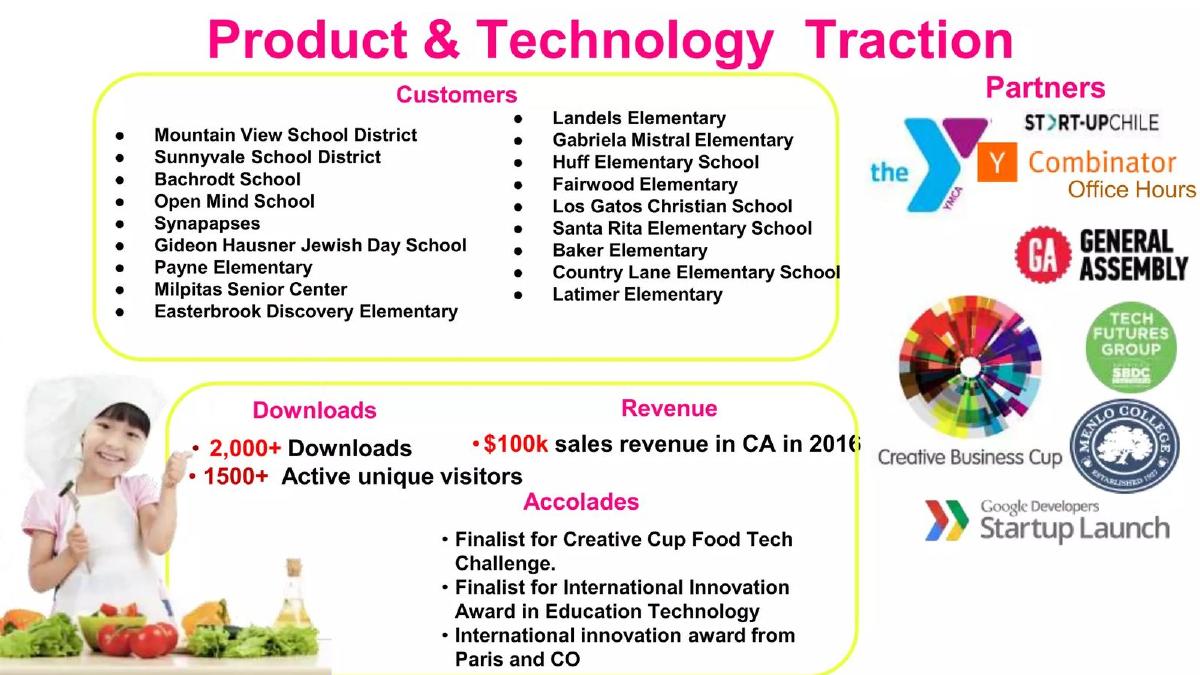
- The company generated $100k in sales revenue in California during 2016 (Slide 3).
- Traction includes 2,000+ downloads and 1,500+ active unique visitors (Slide 3).
- The B2B customer list features major California districts like Mountain View and Sunnyvale School District (Slide 3).
- The startup has raised $120k to date, sourced from Start-Up Chile ($30k), Indiegogo ($40k), and an unspecified source ($50k) (Slide 6).
- Strategic partners include the YMCA, Y Combinator Office Hours, and Google Developers Startup Launch (Slide 3).
- The product roadmap includes an 'Educational ARG' (Augmented Reality Game) to bring the experience into homes (Slide 5).
- Competitive positioning places the brand at the high end of both 'STEM Enrichment' and 'Healthy Cooking' (Slide 4).
- The deck uses a 'Future is Now' comparison to Airbnb and Uber to frame its ambition as the 'World's Largest Science Learning Lab' (Slide 7).
Chef Koochooloo: Blending Culinary Arts with STEM Education
The Chef Koochooloo pitch deck, dated March 2017, presents a specialized EdTech solution that addresses two growing concerns in early childhood development: STEM (Science, Technology, Engineering, and Math) literacy and healthy eating habits. By combining these two fields, the company carves out a niche that appeals to both school administrators and health-conscious parents. The deck focuses heavily on validated traction within the California school system to justify its expansion plans.
Slide 1: Title and Leadership
The opening slide introduces the brand with a colorful, cartoon-based aesthetic consistent with children's educational media. It features the company logo and three 'Little Chef' characters in a kitchen setting. The slide identifies Layla Sabourian-Tarwe as the 'Chief Chef Officer.' While the aesthetic is playful, the 'Confidential' watermark and slide numbering indicate a formal investor presentation. However, this slide serves as the only mention of leadership in the provided sequence, omitting a broader team overview or professional backgrounds.
Slide 2: Tech Demo
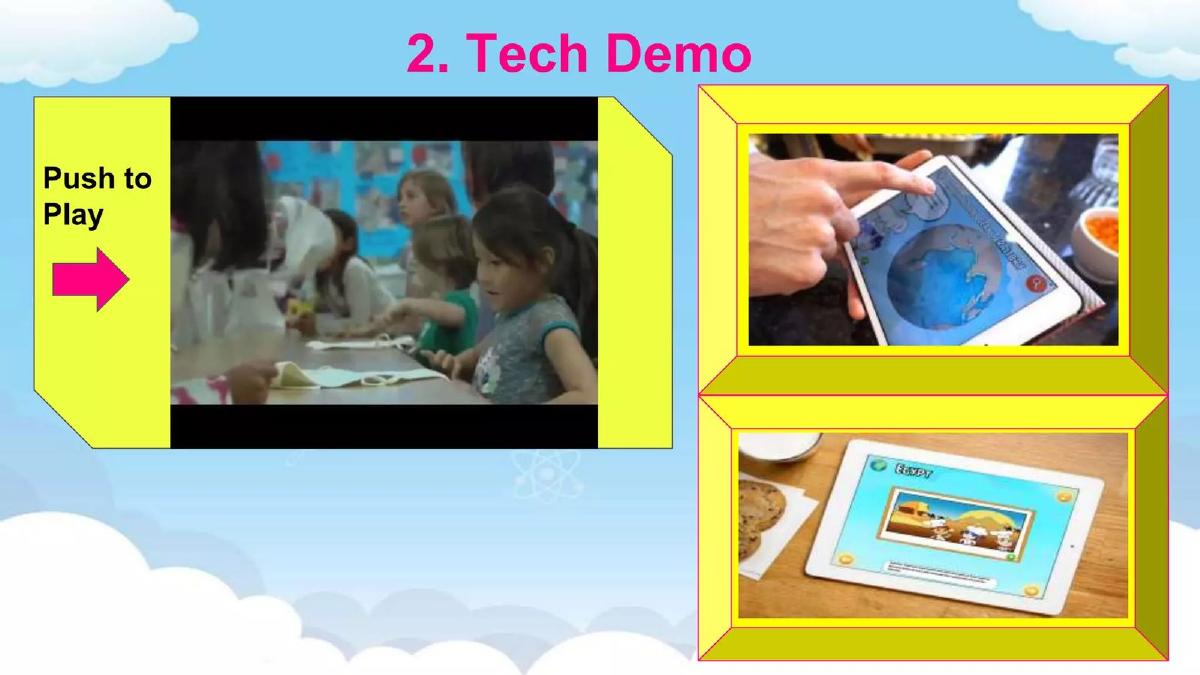
Slide 2 is a functional placeholder for a product demonstration. It features three frames: a video window titled 'Push to Play' showing children in a classroom setting, and two static images of the software running on a tablet. The tablet interface shows a globe and a module focused on 'Egypt,' suggesting a geographical or cultural component to the recipes and science lessons. This slide emphasizes that the product is not just a concept but a deployed technology currently being used by children.
Slide 3: Product & Technology Traction
This is the most data-dense slide in the deck and serves as the core of the company's valuation argument. It is divided into four sections:
Customers: A list of 18 entities, including the Mountain View School District, Sunnyvale School District, and various elementary schools like Landels and Fairwood. The inclusion of the Milpitas Senior Center suggests the platform may have applications beyond early childhood. · Partners: Logos for the YMCA, Start-Up Chile, Y Combinator Office Hours, General Assembly, and Google Developers Startup Launch are displayed. These logos provide significant social proof and institutional backing. · Metrics: The slide claims 2,000+ downloads, 1,500+ active unique visitors, and $100k in sales revenue in California for the year 2016. · Accolades: The company notes it was a finalist for the Creative Cup Food Tech Challenge and received an international innovation award from Paris and CO.
Slide 4: Competition
The competitive landscape is visualized using a standard four-quadrant matrix. The Y-axis measures 'STEM Enrichment' and the X-axis measures 'Healthy Cooking.' Chef Koochooloo places itself in the top-right corner (High STEM, High Healthy Cooking). Competitors like Hello Fresh are placed in the high-cooking/low-STEM quadrant, while 'The Little Engineer' is placed in high-STEM/low-cooking. General gaming apps like Toca Kitchen and various 'Candy' makers are relegated to the bottom-left quadrant, framed as having low educational and nutritional value.
Slide 5: Next Release Potential Demo
This slide shifts the focus toward future growth and technological evolution. It introduces the concept of an 'Educational ARG' (Augmented Reality Game). The text states the goal is to 'Invite Chef Koochooloo into your home,' signaling a move from a B2B school-based model to a B2C household model. The visual shows a smartphone displaying a VR/AR interface in front of a temple, suggesting that the AR component will involve global exploration and cultural education alongside cooking.
Slide 6: Funding Raised to Date
The funding slide uses a pie chart to break down the $120,000 raised by the company at the time of the deck's creation. The breakdown is as follows:
$30k from Start-Up Chile. · $40k from Indiegogo (crowdfunding). · $50k associated with the Chef Koochooloo logo, which typically represents founder equity, friends and family, or an initial angel check.
This slide demonstrates that the company has been capital-efficient, achieving $100k in annual revenue on just $120k of total raised capital.
Slide 7: The Future is Now
The final slide in the sequence uses a 'World's Largest' comparison framework to establish the company's long-term vision. It places Chef Koochooloo in the center of a group containing Airbnb, Facebook, University of Phoenix, and Uber. The slide characterizes Chef Koochooloo as 'The world’s Largest Science Learning Lab.' This is a common pitch deck trope used to signal massive scalability, suggesting that just as Uber owns no cars and Airbnb owns no real estate, Chef Koochooloo can become a global educational powerhouse without physical classrooms.
What Chef Koochooloo Does Well
The deck excels at demonstrating local market penetration . By listing specific school districts in the heart of Silicon Valley (Mountain View, Sunnyvale), the founders prove they can navigate the complex sales cycles of the US public school system. The $100,000 revenue figure on Slide 3 is a critical milestone for a seed-stage startup, showing that the product has moved beyond the 'free pilot' stage into a paid service.
The partnership logos are also well-utilized. Being associated with Y Combinator (even via Office Hours) and Google Developers provides a level of technical and business credibility that helps offset the 'playful' cartoon branding, which might otherwise seem too informal for some institutional investors.
What is Missing from the Deck
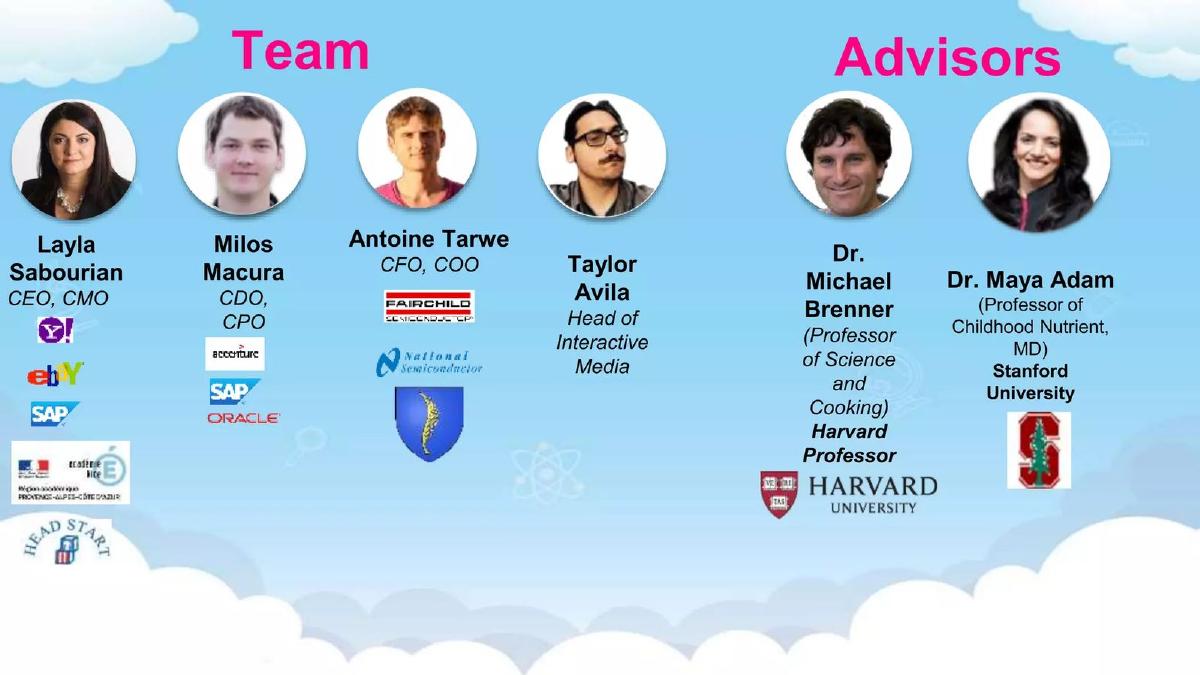
The most glaring omission in the provided slides is a detailed Team slide . While the founder is mentioned on the title page, there is no information regarding the pedagogical experts, software developers, or sales leads required to scale a dual-market (B2B and B2C) company. Investors in EdTech typically look for deep experience in curriculum development or school district sales.
Furthermore, the deck lacks a specific 'Ask' . While it mentions how much has been raised previously, it does not state how much the company is currently seeking, the valuation, or the specific milestones that the new capital will fund. There is also no mention of unit economics —specifically, the cost to acquire a new school district versus the lifetime value of that contract—which is essential for understanding the scalability of the $100k revenue base.
Founder Takeaways: What to Copy
Use a Competition Matrix to Define a New Category: Chef Koochooloo effectively uses Slide 4 to show that while many apps do 'cooking' and many do 'STEM,' almost no one does both. If your startup sits at the intersection of two popular but separate trends, use a matrix to show the 'white space' you occupy.
Validate with Names, Not Just Numbers: Instead of just saying 'we are in 18 schools,' the deck lists the schools by name. For early-stage startups, specific names carry more weight than vague aggregates because they allow investors to perform due diligence and understand the caliber of the early adopters.
Show the Evolution from B2B to B2C: The transition from Slide 3 (School customers) to Slide 5 (Home AR game) shows a logical growth path. Startups often get stuck in the 'low ceiling' of school budgets; showing a plan to enter the home market demonstrates a path to a much larger Total Addressable Market (TAM).
Frequently asked questions
- What is the primary business model for Chef Koochooloo?
- Based on the customer list on Slide 3, the primary model appears to be B2B sales to school districts and elementary schools. The slide lists 18 specific educational institutions and centers, including Mountain View and Sunnyvale School Districts, suggesting a licensing or service-based revenue stream within the public and private school systems.
- How much revenue has the company generated?
- Slide 3 explicitly states that Chef Koochooloo achieved $100,000 in sales revenue in California in 2016. This is paired with user metrics showing over 2,000 downloads and 1,500 active unique visitors, indicating a high revenue-per-user or a model driven by institutional contracts rather than individual app purchases.
- Who are the main competitors identified in the deck?
- Slide 4 maps several competitors across STEM and cooking axes. Notable mentions include Hello Fresh (positioned as high healthy cooking but low STEM), The Little Engineer (high STEM, low cooking), and various mobile apps like Toca Kitchen and Candy Maker, which are positioned as low in both STEM and healthy cooking enrichment.
- What is the company's funding history?
- According to Slide 6, the company has raised a total of $120,000. This capital came from three distinct sources: $30,000 from the Start-Up Chile accelerator, $40,000 via a crowdfunding campaign on Indiegogo, and a $50,000 portion represented by the company logo, which likely signifies founder investment or an undisclosed angel.
- What technology is the company planning to develop next?
- Slide 5 outlines a 'Next Release Potential Demo' focused on an Educational ARG (Augmented Reality Game). The goal is to move the product from the classroom into the home, allowing parents and children to engage with STEM and healthy cooking through a mobile AR interface.