Cheerapp’s 2014 pitch deck outlines a mobile application designed for anonymous, location-based interactions, such as sharing leftovers or selling old furniture without requiring a user profile or permanent data storage. The company positions itself against giants like Facebook and WhatsApp, arguing that its 'no login' and 'data expires' features better emulate natural human behavior. Financially, the deck is highly speculative, projecting a $4.2 billion valuation by 2020 based solely on reaching 100 million users, using a $42-per-user metric derived from the WhatsApp sale. While the deck pro…
Key takeaways
- The app operates on a 'no login / no profile' model to ensure user anonymity (Slide 2, 12).
- Data is ephemeral, with posts designed to disappear after 30 minutes to encourage 'here and now' interactions (Slide 4, 6, 7).
- The platform targets hyper-local use cases like sharing party leftovers or finding local help without existing relationships (Slide 3, 5).
- Cheerapp benchmarks its future valuation against the $19 billion WhatsApp acquisition, valuing each user at $42 (Slide 13).
- Revenue is projected to come from in-app purchases and native API advertisements, starting in 2015 (Slide 13).
- The team consists of 3 founders, 2 designers, 7 developers, and 1 marketing professional (Slide 16).
- The deck claims a seed round of $220,000 was completed by June 27, 2014 (Slide 13).
- The competitive matrix highlights 'no login' and 'local/close by' as the primary differentiators against Facebook and Twitter (Slide 11).
Slide-by-Slide Analysis
Slide 1: Title Slide
The deck opens with the logo for cheerapp , featuring a yellow map pin icon over a folded map. The tagline is "THE APP THAT CHANGES THE WOLRD" [sic]. The typo in "world" on the very first slide is a significant oversight that may impact initial investor perception regarding attention to detail.
Slide 2: Anonymous
A simple yellow transition slide with the word "ANONYMOUS" in light text. This establishes one of the three core pillars of the product: the lack of user profiles or identity tracking.
Slide 3: The Pitch Letter
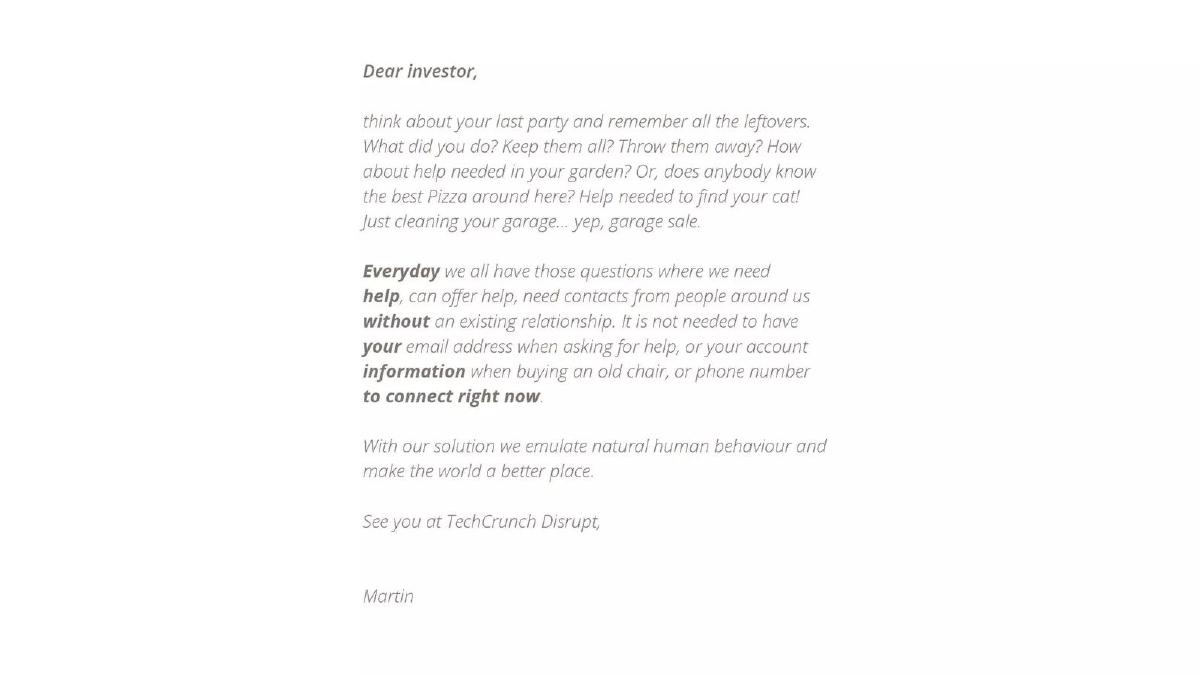
Formatted as a letter from "Martin," this slide sets the scene. It uses relatable scenarios: party leftovers, garden help, finding a local pizza place, or a lost cat. The core argument is that people need help from those around them "without an existing relationship." It emphasizes that email addresses and account information are unnecessary friction for these types of local transactions.
Slide 4: Data Expires
Another transition slide highlighting "DATA EXPIRES." This introduces the ephemeral nature of the platform, positioning it alongside 2014-era trends like Snapchat, but for local utility rather than social messaging.
Slide 5: How Does It Work? (Part 1)
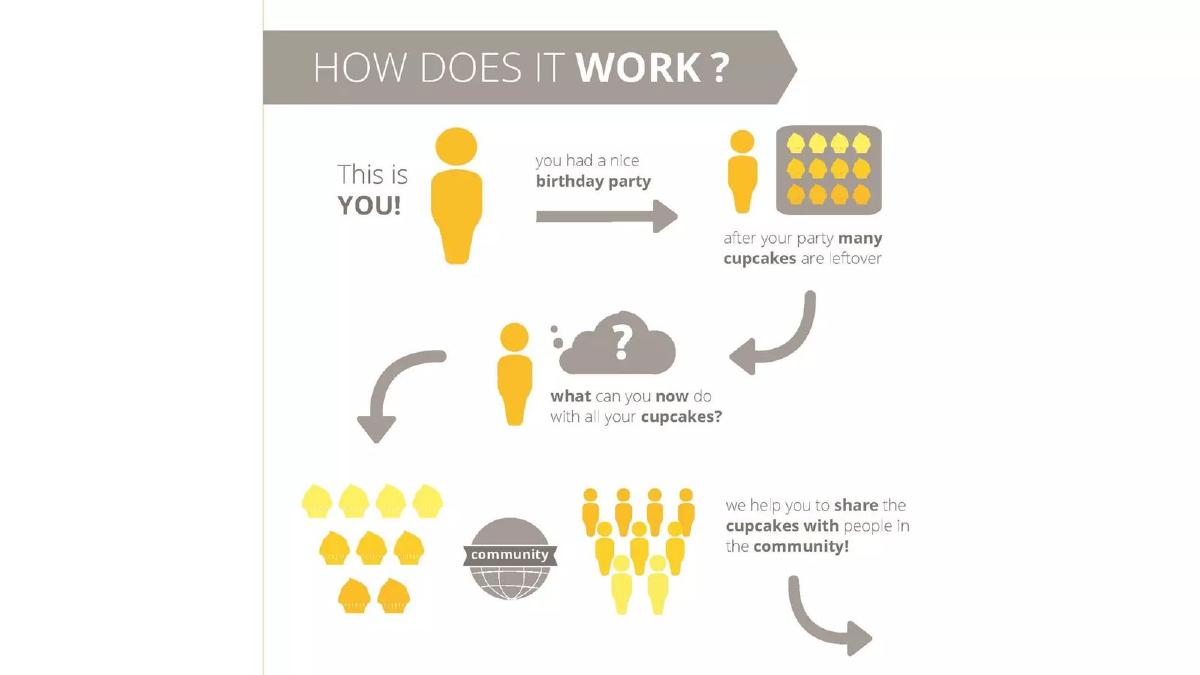
This slide uses a cupcake analogy to explain the user flow. A user has leftovers from a party and wants to share them with the community. It visualizes the transition from an individual having a surplus to the community receiving it, though it does not yet explain the technology.
Slide 6: How Does It Work? (Part 2)
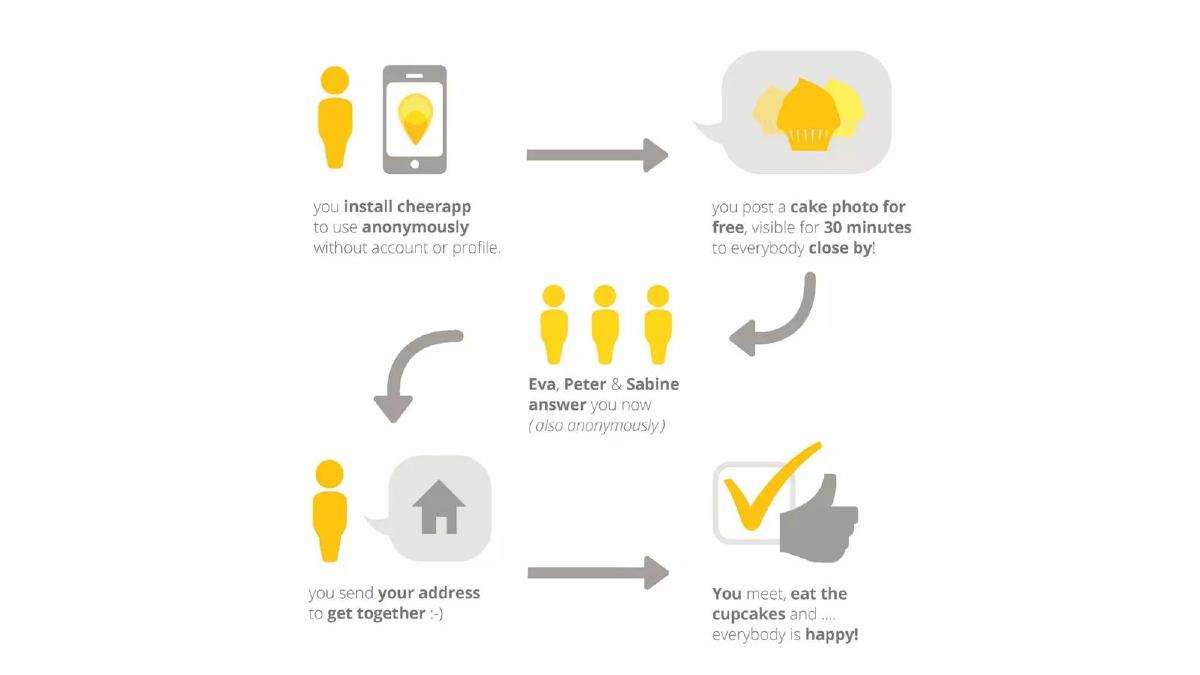
This slide details the technical flow. A user installs the app and uses it anonymously without an account . They post a photo (in this case, cupcakes) which is visible for 30 minutes to everyone close by. Interested neighbors (Eva, Peter, and Sabine) answer anonymously. The poster then sends an address to "get together." The slide ends with a smiley face and the note "everybody is happy!"
Slide 7: Here & Now
A transition slide emphasizing the real-time nature of the application. This reinforces the 30-minute expiration window mentioned previously.
Slide 8: App Mockup
A high-fidelity mockup of the app on an iPhone. The UI shows a grid of photos with heart icons and timers. A banner states: "In the radius of 2 miles there are 261 active posts." This gives investors a clear sense of the intended user experience and the density required for the app to feel "alive."
Slide 9: Detailed Screenshots
Three screens are shown: a "private conversation" view, a "detailed post" view of a car with a "Connect now" button, and a "local radius" map view showing San Jose and surrounding areas. The map view includes a slider to adjust the radius up to 5 miles.
Slide 10: Get Help
A transition slide for the next section of the deck, focusing on the utility aspect of the platform.
Slide 11: Our Competition
A competitive matrix comparing Cheerapp to Secret, Whisper, WhatsApp, Yik Yak, Facebook, and Twitter. Cheerapp claims to be the only one that offers no login/profile, anonymity, private conversation, local proximity, visual real-time pictures, 30-minute expiration, and categorized posts . The text below argues that Cheerapp emulates "natural human behavior" better than competitors by leaving "no trace behind."
Slide 12: No Profile
A final transition slide reinforcing the lack of user accounts as a primary feature.
Slide 13: Future Outlook (Financials)
This is the most data-heavy slide. It lists projections from 2014 to 2020. For 2014, it claims 300,000 users and a $220,000 seed round already completed. It targets a $1 million investment for a $13 million valuation . By 2020, it projects 100 million users , $370 million in total revenue , and a $4.2 billion valuation . A footnote explains the valuation is based on the WhatsApp sale at $42 per user, noting this is still lower than the $130-$150 per user valuation of Twitter or Facebook.
Slide 14: Offer Services
A transition slide suggesting that the app can be used for labor or professional services, not just physical items.
Slide 15: Our Conclusion
The summary slide claims the app has "global significance" and can be used by "anybody, anywhere." It reiterates the mission to "improve society" and "make the world a better place, one Smartphone at a time."
Slide 16: About Us (Team Stats)
This slide provides a headcount rather than bios. It mentions the idea started in February 2014. The team consists of 3 founders, 2 designers, 7 developers, 1 marketing, and 5 investors . It mentions "international relations" including China and Russia, suggesting a global ambition for a local app.
Slide 17: Sell Items
A transition slide highlighting the marketplace aspect of the app.
Slide 18: The Founders
The final slide shows photos of the three founders: Martin Obert , Martin Carfrae , and Guy Ayika . No professional backgrounds or past successes are listed, which is a notable omission for a seed-stage deck.
What Cheerapp Does Well
The deck is visually consistent, using a bright yellow and gray color palette that feels modern for 2014. The use of a single, clear analogy (the cupcakes) makes the product's utility immediately understandable to anyone, regardless of their technical background. By walking through the user journey step-by-step, the founders successfully demystify how an anonymous app would actually function in a real-world scenario.
Furthermore, the inclusion of high-fidelity mockups (Slide 8 and 9) is a strength. It shows that the product is not just a concept but has undergone significant design and potentially development work. The competitive matrix is also well-structured, clearly defining the specific feature set that the founders believe separates them from the social media giants of the era.
What is Missing from the Deck
The most glaring omission is a Go-To-Market (GTM) strategy . While the deck projects 100 million users by 2020, it offers zero explanation of how they will acquire those users. For a local network, the "cold start" problem is immense; an anonymous app with no users in a specific neighborhood is useless. The deck does not address how they plan to achieve the density shown in their mockups.
The Team slide is also weak. While it lists headcount, it fails to provide any credentials for the founders. Investors at the seed stage are primarily betting on the team's ability to execute. Without knowing if these founders have built successful apps or scaled businesses before, the $4.2 billion valuation projection feels entirely arbitrary. Finally, the Revenue model is vague. "In-app purchases" in an anonymous utility app are difficult to implement, and the deck doesn't explain what a user would actually be buying.
Founder Takeaways
Avoid typos on the title slide: The misspelling of "world" on Slide 1 is a preventable error that signals a lack of polish. · Anchor valuations in reality: Using a single outlier acquisition (WhatsApp) to justify your own valuation is a common but risky tactic. Investors prefer to see valuations based on your own unit economics or comparable companies in your specific niche, rather than just a "dollars per user" calculation. · Show, don't just tell, the team's strength: If you have 7 developers and 2 designers, highlight their past work. Headcounts are less impressive than a track record of shipping successful products. · Address the 'Cold Start' problem: For any location-based app, the most important slide is the one explaining how you will win your first city or neighborhood. Cheerapp ignores this entirely, which is a major red flag for sophisticated investors. · Use transition slides sparingly: This deck has six transition slides (Slides 2, 4, 7, 10, 12, 14, 17) that contain only one or two words. While they help with pacing, they often take up space that could be used for more substantive data on user retention or acquisition costs.
Frequently asked questions
- What is the core value proposition of Cheerapp?
- Cheerapp aims to facilitate spontaneous, anonymous interactions between neighbors. By removing the friction of creating a profile or sharing permanent contact info, it allows users to post items (like cupcakes) or requests (like garden help) that are visible only to people within a 2-mile radius for 30 minutes. It seeks to digitize 'natural human behavior' in local communities.
- How does Cheerapp plan to make money?
- According to Slide 13, the company planned to introduce revenue streams in 2015. These included 'revenue through in-App purchase' and 'revenue through native API advertisements.' By 2020, they projected $70 million from in-app purchases and $300 million from advertisements, though the specific nature of these purchases is not detailed in the deck.
- What is the significance of the WhatsApp mention in the deck?
- The founders use the $19 billion WhatsApp acquisition as a primary valuation anchor. They calculate that WhatsApp was valued at $42 per user. By applying this same multiple to their own user growth projections, they justify a $13 million valuation for 300,000 users and a $4.2 billion valuation for 100 million users.
- Who are the founders and what is the team structure?
- The deck identifies three founders: Martin Obert, Martin Carfrae, and Guy Ayika. As of the deck's publication, the broader team included 2 designers, 7 developers, and 1 marketing person. They also mention having 5 existing investors and international relations in China and Russia, though no specific names for these partners are provided.
- What are the main risks associated with this business model?
- The primary risks involve the 'anonymous' and 'no login' nature of the app, which complicates user retention and safety. Additionally, the revenue model is entirely dependent on reaching massive scale (100M users) to be viable. The deck also lacks a clear plan for how they will acquire these users in a crowded social media landscape.