AppVirality entered the market in 2014 with a clear value proposition: giving every app developer the growth tools used by industry leaders. Their 21-slide deck is heavily weighted toward product functionality, utilizing a 'problem-solution-demo' flow that occupies nearly half the presentation. While the deck excels at explaining the technical ease of integration—highlighting a 120 KB SDK and a 10-minute setup—it is notably light on business traction and competitive analysis. The pricing model is transparently laid out as a 'pay as you grow' subscription, and the team slide leverages strong c…
Key takeaways
- The deck emphasizes a 'No coding required' solution for complex growth hacks on Slide 8.
- Technical efficiency is a core selling point, boasting a 120 KB SDK that integrates in under 10 minutes on Slide 10.
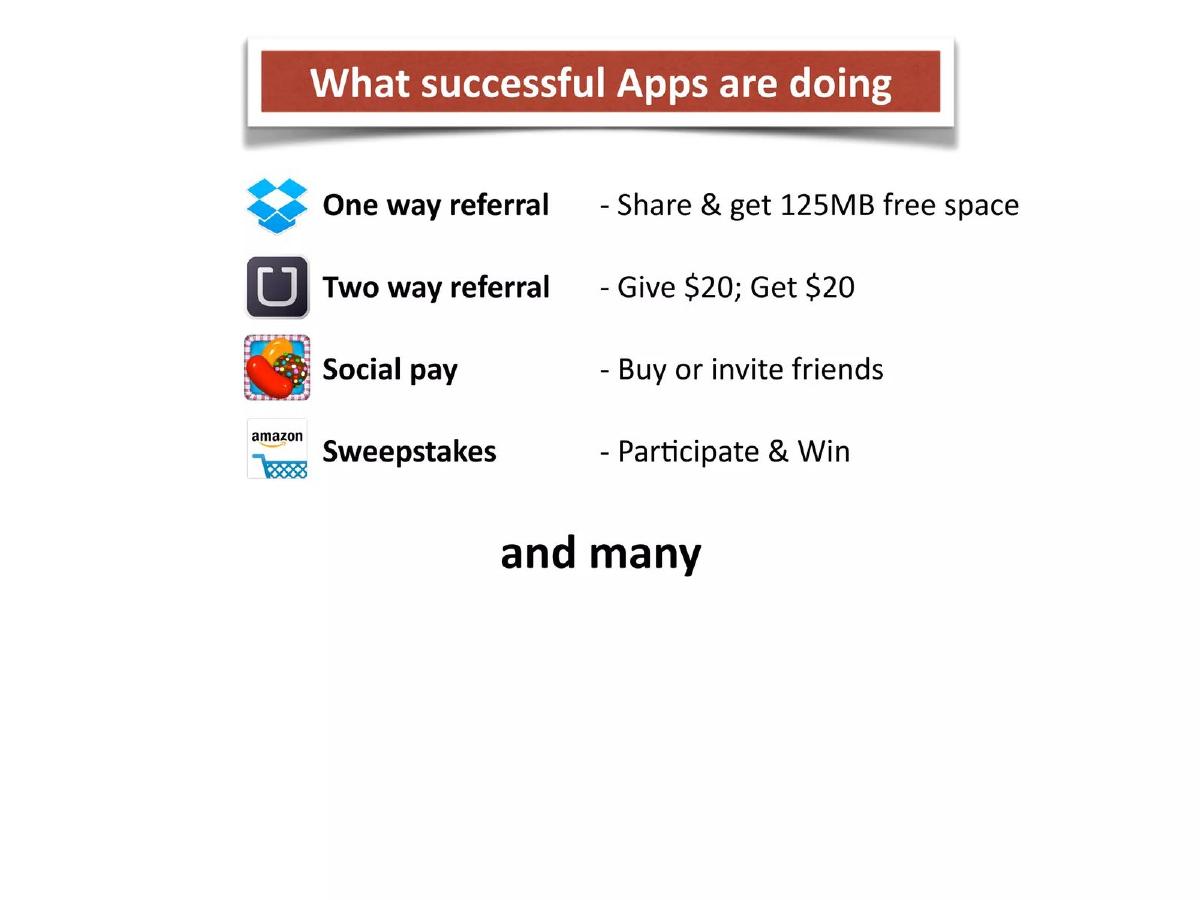
- The product narrative uses established giants like Dropbox and Uber as benchmarks for successful referral models on Slide 6.
- Market sizing is focused on the $18B mobile ad spend and rising download costs of $1 to $3 per user on Slide 18.
- The pricing model is explicitly defined as $2 for every 1,000 MAUs after the first 10,000 on Slide 19.
- The team highlights a mix of experience including '1 exit & 1 failed venture' on Slide 16.
- The deck lacks a traditional traction slide with historical growth charts or current revenue figures.
- A significant portion of the deck (Slides 10-14) is dedicated to a step-by-step walkthrough of the user dashboard and analytics.
The Narrative: Democratizing Growth Hacking
AppVirality’s 2014 deck is a product-centric pitch that focuses on the 'how' rather than the 'how much.' In an era where mobile app acquisition costs were skyrocketing, the company positioned itself as the essential toolkit for organic growth. The deck follows a logical progression: identifying the desire for organic downloads, showing what the 'big players' do, and then demonstrating how AppVirality makes those same tools accessible to any developer without a massive engineering budget.
Slides 1-4: The Hook and the Goal
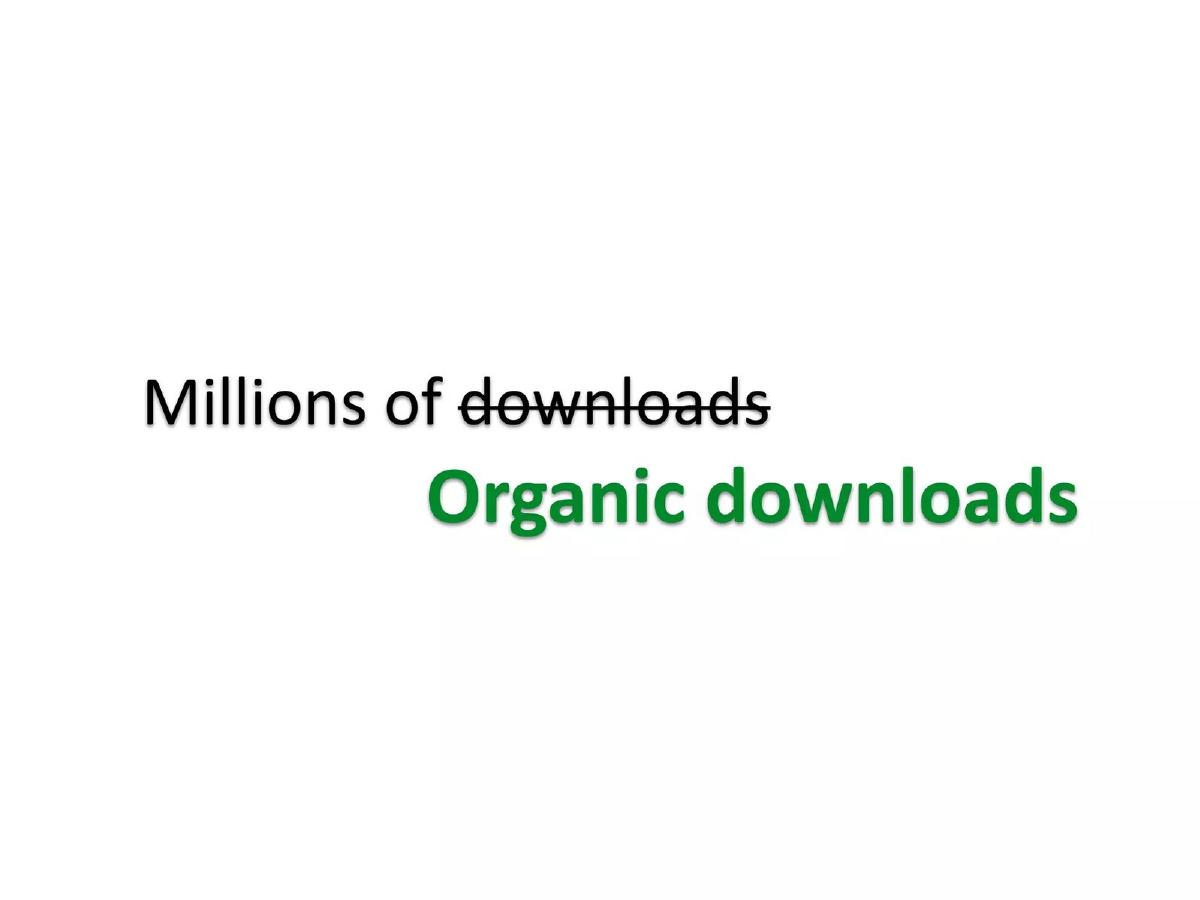
The presentation opens with a simple title slide (Slide 1) defining the company as a 'Growth Hacking Toolkit For Mobile Apps.' Slides 2 through 4 set the stage by asking what a developer wants. The answer is framed as 'Organic downloads' (Slide 3) and 'User engagement and retention' (Slide 4). By crossing out 'Millions of downloads' and replacing it with 'Organic downloads,' the founders signal that they understand quality and cost-efficiency are more important than raw volume.
Slides 5-7: The Gap in the Market
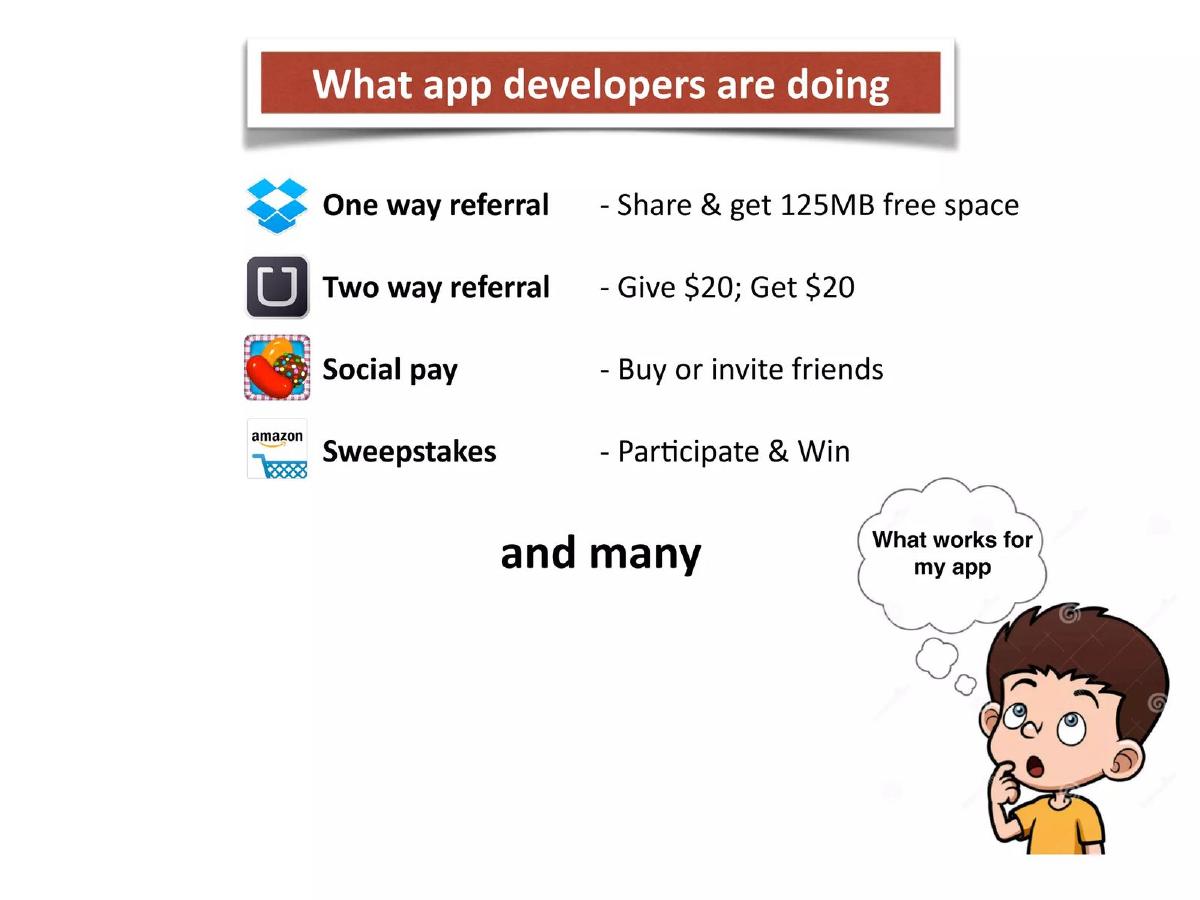
Slide 5 and 6 use high-profile examples to validate the product's purpose. They cite Dropbox (one-way referral), Uber (two-way referral), Candy Crush (social pay), and Amazon (sweepstakes). Slide 7 introduces the friction point: a cartoon developer wondering 'What works for my app?' This establishes the need for a recommendation engine and an easy implementation tool, as most developers lack the resources to build these custom growth loops from scratch.
Slides 8-9: The Solution and Process
Slide 8 introduces AppVirality as the solution that helps developers 'identify and implement the right growth techniques, within minutes' with 'No coding required.' It lists the core components: a lightweight SDK, WYSIWYG dashboard, recommendation engine, analytics, and A/B testing. Slide 9 acts as a transition, promising a 'simple 4 step process' to explain the product's functionality.
Slides 10-14: The Product Walkthrough
This section is the meat of the deck. Slide 10 emphasizes the technical 'lightness' of the product, noting a 120 KB SDK that integrates in 10 minutes. Slide 11 shows the 'Recommendation engine' where users can select growth hacks like 'Customer Retention' or 'Refer-A-Friend.' Slides 12 and 13 demonstrate the dashboard's customization features, showing how a business can change colors, messages, and social actions (Facebook, Twitter, WhatsApp) without touching code. Slide 14 showcases the analytics suite, providing data on shares, impressions, clicks, and downloads. This level of detail is intended to de-risk the investment by proving the product is fully built and functional.
Slide 15: Feature Summary
The 'Key Features' slide summarizes the platform's utility. It highlights 'Fraud Detection' and 'User Targeting' as sophisticated additions to the basic referral mechanics. This slide serves as a final checklist for investors to see the breadth of the 'toolkit' mentioned on the cover.
Slides 16-17: Team and Validation
The team slide (Slide 16) is strong on corporate pedigree, listing logos from Oracle, Infosys, and TATA. The mention of '1 exit & 1 failed venture' adds a layer of 'founder maturity' that investors value. Slide 17 highlights their participation in the Microsoft Ventures Accelerator in Bangalore and lists advisors from InMobi and Tech Jini, providing external validation for a young company.
Slides 18-21: Market, Business Model, and Strategy
Slide 18 addresses market size, citing an $18B mobile ad spend by 2014 and download costs ranging from $1 to $3. This justifies the need for a cheaper, organic alternative. Slide 19 outlines the pricing: a freemium model that scales at $2 per 1,000 MAUs. Slide 20 details the 'Customer acquisition route,' which includes SEO/SEM, developer groups, and direct sales through partnerships with platforms like Appery.io and BiznessApps. The deck concludes on Slide 21 with contact information and a link to their AngelList profile.
What Works
Product Clarity: The step-by-step walkthrough (Slides 10-14) leaves no doubt about what the product does or how it is used. For a technical SaaS product, this clarity is vital. Technical Specs: Highlighting the 120 KB size and 10-minute integration time (Slide 10) directly addresses the biggest fear of app developers: 'SDK bloat' and integration friction. Pricing Transparency: The 'Pay as you grow' model on Slide 19 is simple, easy to calculate, and aligns the company's success with the customer's success.
What is Missing
Traction Data: There are no slides showing how many developers are currently using the SDK, how many 'growth hacks' have been launched, or any month-over-month growth metrics. This is a significant omission for a 2014 raise. Competitive Landscape: The deck assumes AppVirality is the only solution. It fails to mention competitors or explain why their 'no-code' approach is superior to other marketing automation tools. The Ask: The deck never specifies how much capital is being sought or what the milestones for the next 12-18 months are. This usually suggests the deck was used for initial conversations rather than a final pitch.
What a Founder Should Copy
The 'Problem by Example' Slide: Using Dropbox and Uber (Slide 5) to define the product category is a brilliant way to build instant mental models for investors. The 'No-Code' Value Prop: Explicitly stating 'No coding required' (Slide 8) and showing the visual editor (Slide 12) is a powerful way to sell to non-technical stakeholders or busy product managers. Honest Team History: Admitting to a 'failed venture' (Slide 16) alongside an exit shows resilience and experience, which can be more attractive to VCs than a perfectly curated, 'never-failed' resume.
Final Summary
AppVirality’s deck is a highly effective 'Product Pitch.' It identifies a massive shift in the mobile economy (rising acquisition costs) and offers a plug-and-play solution. While it lacks the financial and traction-based rigor of a later-stage deck, its focus on ease of use and technical efficiency made it a compelling case for early-stage investors in the burgeoning SaaS-for-mobile market.
Frequently asked questions
- What is the core problem AppVirality addresses?
- AppVirality addresses the difficulty app developers face in achieving organic growth and user retention. According to Slides 2 through 7, while developers want millions of downloads and high engagement, implementing the complex referral and reward systems used by companies like Uber and Dropbox is technically challenging and time-consuming. AppVirality provides a 'no coding' toolkit to implement these growth hacks quickly.
- How does AppVirality make money?
- The company uses a SaaS subscription model described on Slide 19 as 'Pay as you grow.' It offers a free tier for apps with up to 10,000 Monthly Active Users (MAUs). Beyond that threshold, the cost is $2 for every 1,000 MAUs. For example, an app with 300,000 MAUs would pay $600 monthly or $7,200 annually.
- What are the key technical features of the platform?
- As detailed on Slide 15, the key features include a WYSIWYG (What You See Is What You Get) dashboard, user targeting based on behavior and location, multiple social actions (polls, surveys, feedback), installation tracking, fraud detection for referrals, and built-in A/B testing capabilities.
- Who is the team behind the company?
- The leadership consists of Laxman Papineni (Founder & Business), Ram Papineni (Co-founder & Product), and Madhu Manne (First hire & Product). Slide 16 highlights their backgrounds with major tech firms like Oracle, Infosys, and Wipro, and notes that the team has experience with both a successful exit and a failed venture.
- What is missing from this pitch deck?
- The deck is notably missing a dedicated 'Traction' slide showing current user numbers, revenue growth, or case studies of existing clients. It also lacks a 'Competition' slide to explain how AppVirality differs from other marketing SDKs. Finally, there is no specific 'The Ask' slide detailing how much money they are raising or how the funds will be allocated.