Antares Pharma’s 2012 deck is a textbook example of a 'platform-plus-pipeline' strategy. Instead of betting the company on a single molecule, Antares utilized its proprietary VIBEX and pen injector technologies to create a diversified portfolio of self-administered drugs. The deck highlights three approved products and a deep bench of candidates in advanced development, significantly de-risking the investment through partnerships with industry leaders like Teva, Pfizer, and Watson Pharmaceuticals. By focusing on the transition of biologics to self-injection and the growing biosimilar market—p…
Key takeaways
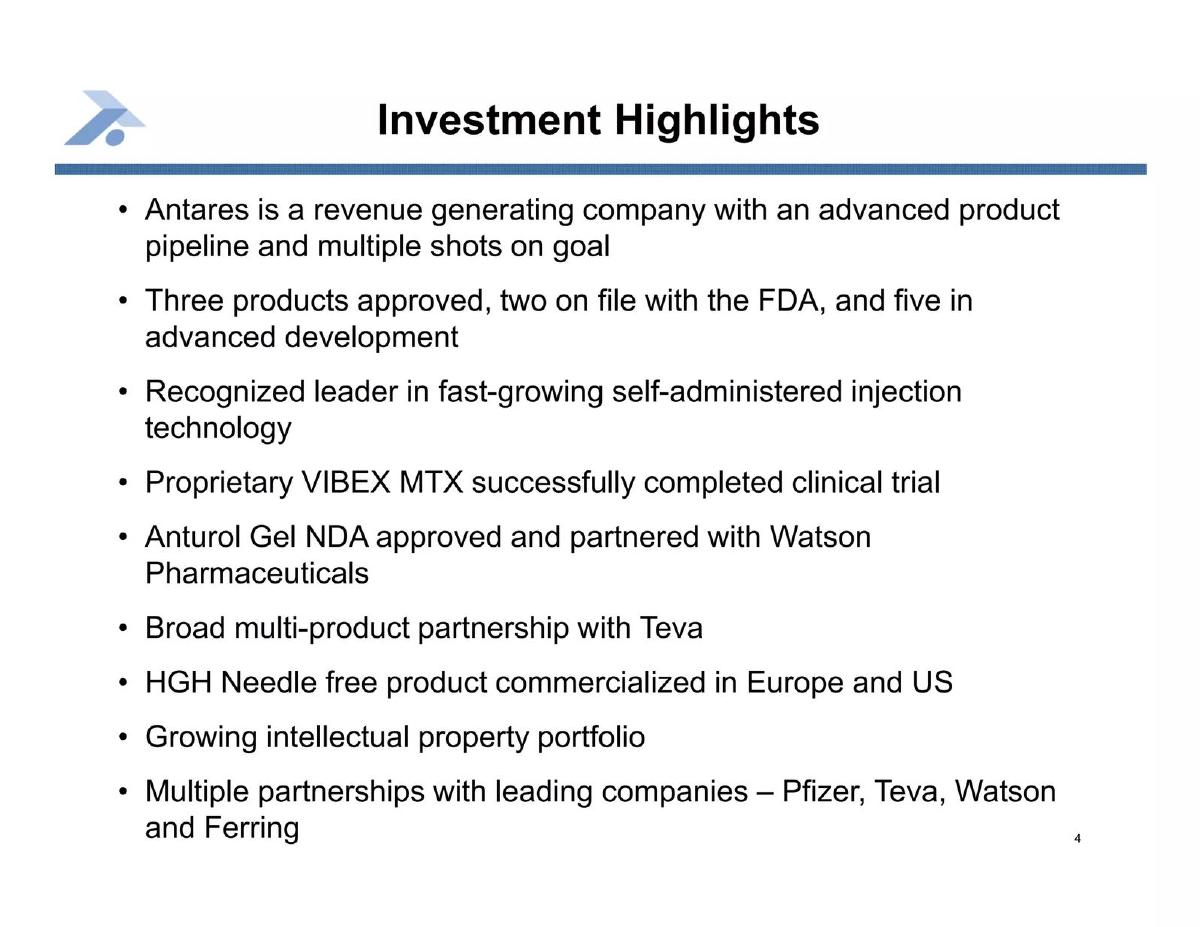
- Antares identifies as a revenue-generating company with three FDA-approved products as of April 2012 (Slide 4).
- The company employs a heavy partnership model, listing Teva, Pfizer, Watson, and Ferring as key collaborators (Slide 4).
- A comprehensive pipeline chart shows 11 distinct product lines ranging from preclinical to marketed stages (Slide 7).
- The Teva collaboration alone covers products with nearly $3 billion in U.S. sales, providing Antares with mid-to-high single-digit royalties (Slide 10).
- The VIBEX MTX auto-injector is positioned as a superior alternative to oral MTX, offering better efficacy and tolerability for RA patients (Slide 13).
- Antares targets the $50 billion branded biologic market by focusing on the shift toward self-injection and biosimilars (Slide 16).
- The Anturol Gel product, approved in December 2011, targeted a U.S. OAB market projected to exceed $2.3 billion by 2014 (Slide 19).
- The deck concludes with six specific operational milestones for the upcoming 12-18 months, including the VIBEX MTX NDA filing (Slide 22).
Introduction and Strategy
The April 2012 investor presentation for Antares Pharma (AMEX: AIS) serves as a comprehensive status report for a specialty pharmaceutical company at a major inflection point. Presented by CEO Paul Wotton, Ph.D., the deck moves quickly from high-level investment highlights to granular pipeline data. The overarching theme is diversification; Antares is not a 'binary' biotech play dependent on a single clinical trial, but rather a technology platform with multiple 'shots on goal' through high-tier partnerships.
Slide 1: Title Slide
The title slide establishes the company identity with the tagline "making medicines better." It identifies the presenter as Paul Wotton, Ph.D., President and CEO, and clearly displays the ticker symbol AMEX: AIS, signaling to investors that this is a publicly traded entity seeking to communicate its growth trajectory as of April 2012.
Slide 4: Investment Highlights
This slide functions as the executive summary. It explicitly states that Antares is a "revenue generating company." Key proof points include three approved products, two filed with the FDA, and five in advanced development. The slide emphasizes their leadership in self-administered injection technology and highlights their "broad multi-product partnership with Teva." By listing Pfizer, Watson, and Ferring alongside Teva, the company establishes immediate institutional credibility.
Slide 7: Diverse and Advanced Product Pipeline
Slide 7 is the most data-dense slide in the deck, providing a visual map of 11 different product programs. It categorizes them by Partner, Product, and Stage (Preclinical through Marketed). Notable entries include Tev-Tropin and Elestrin in the 'Marketed' column, and Anturol in the 'Approved' column. The slide shows a heavy concentration of products in the 'Filed' and 'Clinical' stages, particularly with Teva, illustrating a pipeline that is weighted toward near-term commercialization rather than early-stage R&D.
Slide 10: Teva and Antares Collaboration
This slide focuses on the company's most significant relationship. It notes that the collaboration covers products with "nearly $3 billion in U.S. sales." It breaks down the economics: Antares receives margins on device sales plus royalties on overall product sales. For the Tev-Tropin Tjet, royalties are mid-to-high single digits. For the pen injector programs, which include a generic (ANDA) and a branded (505B2) product with $1.5 billion in current sales, Antares receives royalties in the "single digit to-mid teens %." This slide is crucial for valuation, as it provides the specific percentages investors need to model future cash flows.
Slide 13: The VIBEX MTX Advantage
Antares shifts from corporate strategy to product-specific benefits here. The VIBEX MTX is presented as the first auto-injector for Methotrexate (MTX) for at-home use by Rheumatoid Arthritis (RA) patients. The slide lists clinical benefits (better efficacy/tolerability vs. oral MTX), convenience (3-second injection), and safety (locking needle shield). This slide justifies why a patient or physician would switch from a cheap oral generic to a proprietary injected device.
Slide 16: Biosimilars and Long-Term Growth
This slide addresses the total addressable market (TAM). It notes that branded biologic products compatible with self-injection technology exceed $50 billion in sales. It specifically calls out the biosimilar/biobetter market, projected to be $2-3 billion by 2015. The slide lists drivers for this growth, including patent expirations and mounting pressure on healthcare budgets, positioning Antares as a solution for affordable, accessible medicine.
Slide 19: Oxybutynin Gel (Anturol)
Focusing on a specific recent success, this slide details the FDA approval of Anturol Gel in December 2011. It highlights a partnership with Watson Pharma for a U.S. launch in Q2 2012. The slide quantifies the Overactive Bladder (OAB) market at $2.1 billion in 2010, growing to $2.3 billion by 2014. It also mentions that Antares will receive royalties on combined sales of Anturol and Watson’s existing Gelnique product, showing a strategic consolidation of the transdermal OAB segment.
Slide 22: Potential Milestones for Next 12-18 Months
The final slide in the provided set provides a checklist for investors to track progress. It lists six specific goals: the launch of Anturol, approval of VIBEX EPI and VIBEX 2, filing of the first pen product ANDA, filing of the VIBEX MTX NDA, securing a European partner for VIBEX MTX, and initiating the VIBEX QS program. This creates accountability and a clear roadmap for news flow.
What Antares Pharma Does Well
The deck is exceptionally strong at demonstrating commercial validation . By naming partners like Pfizer and Teva and providing specific royalty ranges (Slide 10), Antares moves beyond the typical 'blue sky' projections of biotech and into the realm of predictable business development. The use of a comprehensive pipeline chart (Slide 7) is a best practice for any multi-product company, as it allows investors to visualize the 'conveyor belt' of assets moving toward the market. Furthermore, the deck does a good job of explaining the clinical 'Why' —specifically on Slide 13, where it explains why an auto-injector is superior to oral medication, providing a clear rationale for market adoption.
What is Missing from the Deck
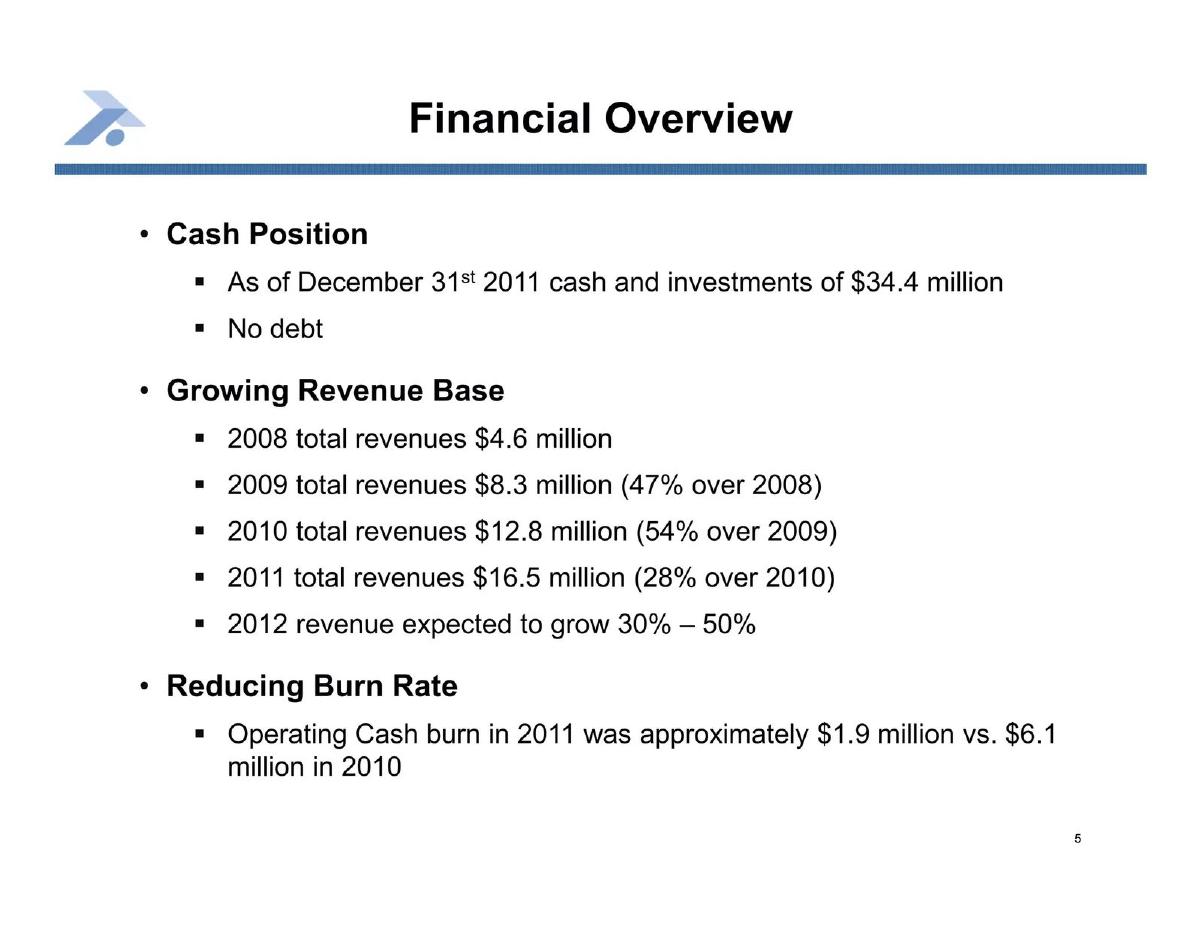
Despite the strong pipeline data, the provided slides are missing a few critical components for a complete investor picture. First, there is no financial summary slide showing historical revenue, burn rate, or cash on hand. While Slide 4 mentions they are "revenue generating," it doesn't quantify the current top line. Second, there is no team slide in this selection; investors generally want to see the bios of the leadership team managing these complex partnerships. Third, while competitors are alluded to in the biosimilar space, there is no direct competitive landscape analysis comparing VIBEX to other auto-injector technologies from companies like BD or SHL Group. Finally, the specific 'Ask' is missing—it is unclear if the company is looking to raise capital or is simply providing a quarterly update to existing shareholders.
Founder Takeaways: What to Copy
Quantify Partnerships: Don't just say you have partners; list the specific brands and, if possible, the economic terms (royalties/margins) as seen on Slide 10. · Use a Pipeline Visual: A horizontal bar chart showing stages from Preclinical to Marketed (Slide 7) is the standard for a reason—it communicates volume and progress simultaneously. · Define the Market Drivers: Slide 16 effectively uses macro trends (patent expirations, healthcare budgets) to explain why the company's specific niche is poised for growth. · Set Clear Milestones: Ending with a 12-18 month roadmap (Slide 22) gives investors a reason to keep following the story and provides a framework for future success. · Focus on User Benefits: Slide 13 translates technical specs into patient benefits (convenience, safety, efficacy), which is vital for understanding commercial viability.
Frequently asked questions
- What is Antares Pharma's primary value proposition?
- Antares Pharma focuses on 'making medicines better' through proprietary self-administered injection technology. Their value proposition lies in taking existing drugs (like Methotrexate or Oxybutynin) and improving their delivery via auto-injectors or gels to enhance patient compliance, efficacy, and safety, while simultaneously creating new patent-protected revenue streams for themselves and their partners.
- How does the company generate revenue according to the deck?
- The company utilizes a multi-stream revenue model. As stated on Slide 10, they receive margins on the sale of their proprietary devices (like the Tjet and VIBEX injectors) and earn royalties on the overall product sales. These royalties range from mid-to-high single digits for some products to mid-teens for others, such as their pen injector global programs.
- Which major pharmaceutical companies are partnering with Antares?
- Slide 4 and Slide 7 list several high-profile partners, including Teva (US and global), Pfizer (undisclosed project), Watson Pharmaceuticals (Anturol Gel), Ferring (EU), Jazz Pharmaceuticals (Elestrin), and the Population Council (NestraGel). The Teva relationship is the most prominent, covering multiple auto-injector and pen injector programs.
- What specific clinical advantages does their VIBEX MTX product offer?
- According to Slide 13, the VIBEX MTX auto-injector removes the variable absorption issues associated with oral Methotrexate (MTX). It enables titration to higher doses, provides better efficacy and tolerability compared to oral versions, and features a hidden needle to reduce patient apprehension and accidental needle sticks.
- What was the immediate commercial outlook for the company in 2012?
- The outlook was focused on commercial launches and regulatory filings. Slide 19 notes the FDA approval of Anturol Gel with a planned launch in Q2 2012. Slide 22 outlines milestones including the approval of VIBEX EPI, the filing of the VIBEX MTX NDA, and the initiation of new pipeline programs like VIBEX QS.