Fuzzie’s 10-slide deck, dated August 2013, outlines a mobile application targeting the 18-24 traveler demographic. The product aims to break the 'social bubble' of travelers by connecting them with others in their immediate vicinity and providing curated, shareable maps. The business model relies on location-based advertising (LBA), specifically pay-per-view and pay-per-click models for 'featured nodes' on a map. While the deck identifies a significant market opportunity in the 6 million people traveling at any given moment, it lacks critical financial data, user traction metrics, and a speci…
Key takeaways
- The company identifies a market of 6 million people traveling globally at any given moment (Slide 3).
- Fuzzie targets a specific demographic of 18-24 year olds who are moderate to heavy social media users (Slide 4).
- The core value proposition is breaking the 'social bubble' created by travelers staying connected only to friends back home (Slide 5).
- The product features include instant messaging for nearby travelers and the creation of custom, shareable maps (Slide 6).
- Revenue is projected through Pay Per View (PPV) and Pay Per Click (PPC) for map nodes, plus future in-app purchases (Slide 8).
- The deck cites a projected growth of the Location Based Advertising (LBA) market to 6.2bn by 2015 (Slide 3).
- The team consists of Diarmuid O’Keeffe (Vision/Biz Dev) and Pat Browne (Product/Realism), both with engineering degrees (Slide 10).
- There is no mention of current user numbers, revenue to date, or a specific capital requirement (omitted throughout).
Deck Overview
The Fuzzie pitch deck, presented at Start Tel Aviv in August 2013, is a 10-slide presentation for a geo-social mobile application. The deck focuses on the intersection of travel, social networking, and location-based services. It follows a traditional structure: Title, Vision, Opportunity, Problem, Solution, Use Case, Business Model, Strategy, and Team. However, it lacks the quantitative data and competitive analysis typically required for a successful seed or Series A round.
Slide 1: Title Slide
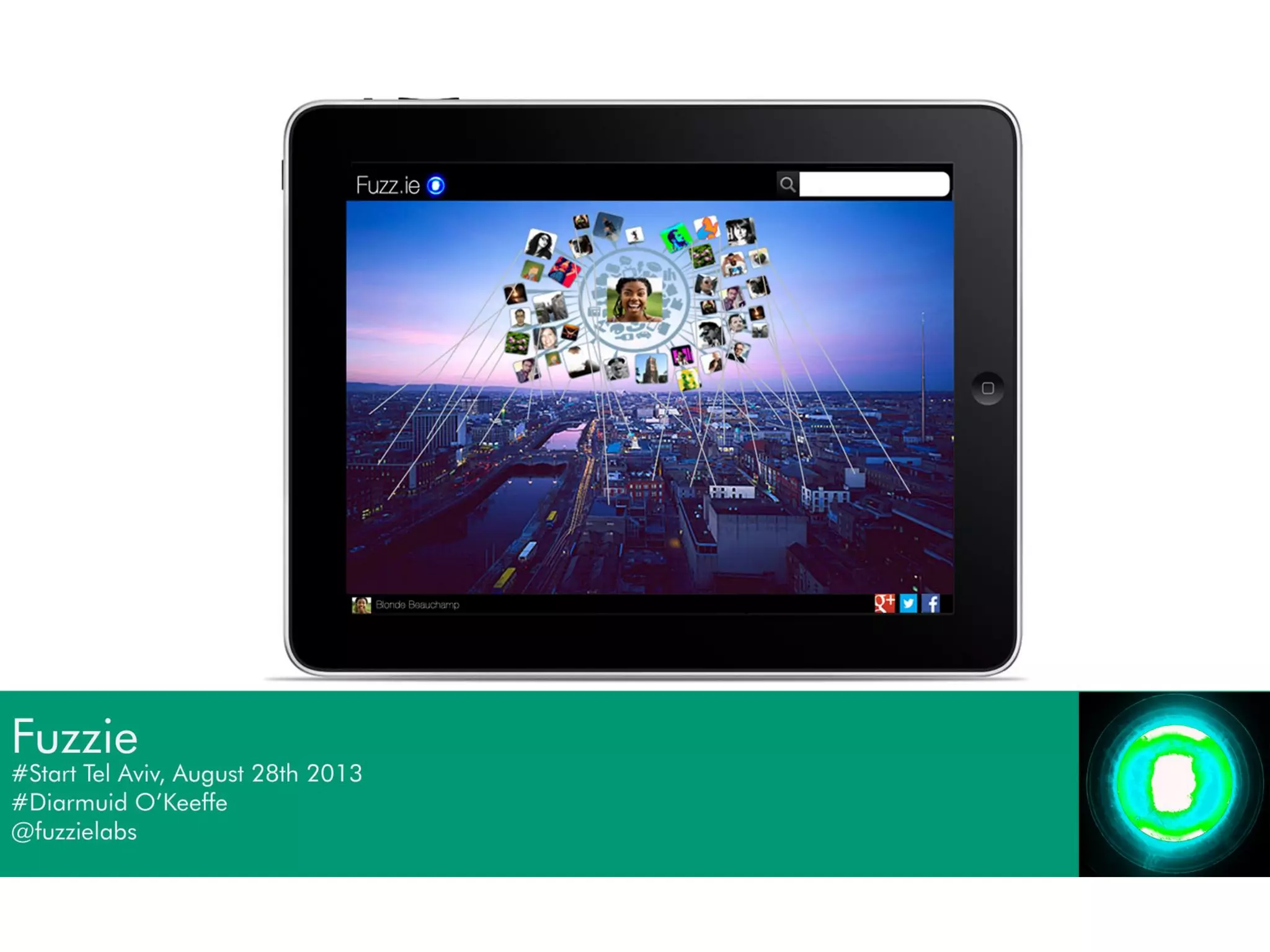
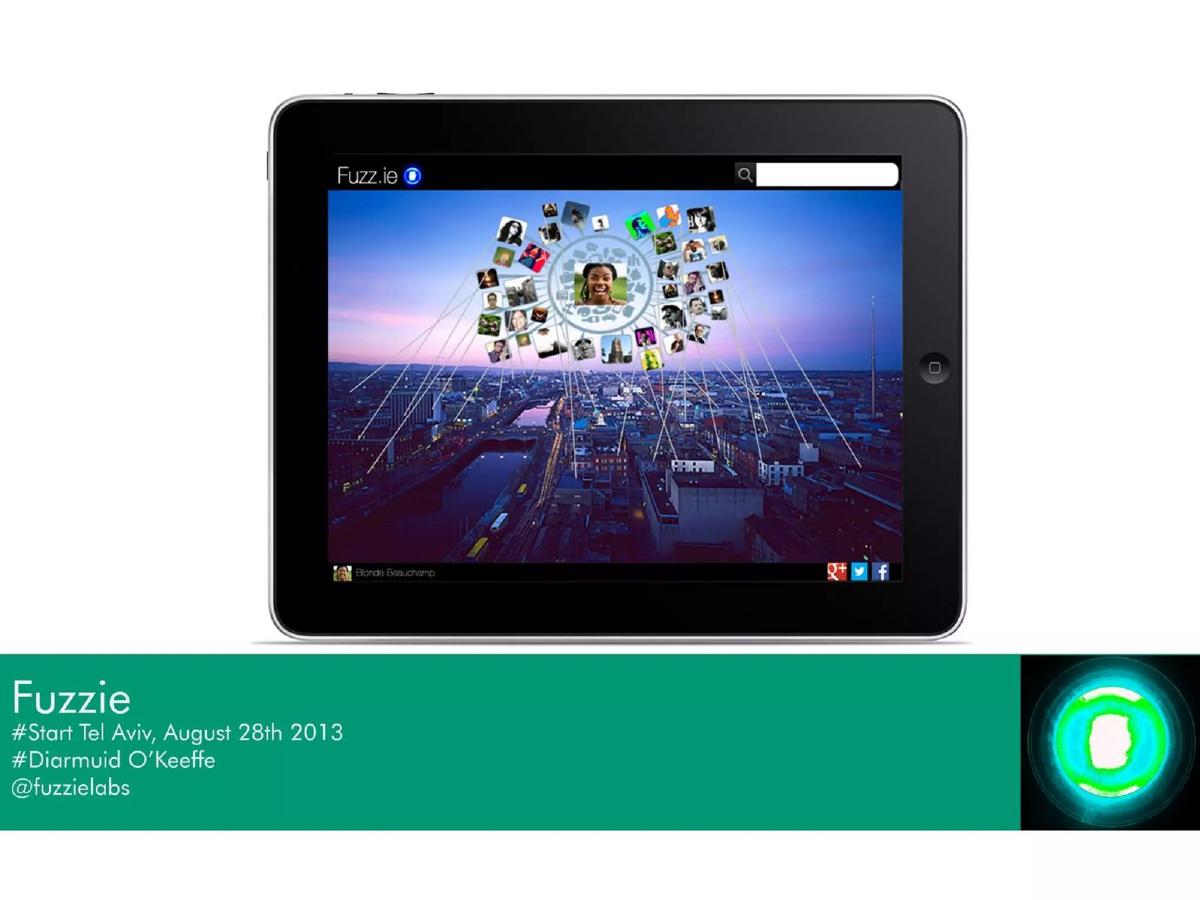
The title slide features a high-resolution image of a city at dusk (Dublin, based on later map slides) displayed on a tablet. An overlay shows a network of user profile pictures connected to a central hub, illustrating the 'geo-social' concept. The footer includes the company name, the event (Start Tel Aviv, August 28th 2013), the founder's name (Diarmuid O’Keeffe), and a Twitter handle (@fuzzielabs).
Slide 2: The Vision
Slide 2 provides a concise one-sentence description of the product: "Fuzzie is a mobile application that helps travellers meet new people and discover the world around them." This is a standard 'elevator pitch' slide that clearly defines the target user (travellers) and the primary utility (social discovery).
Slide 3: The Opportunity (Market)
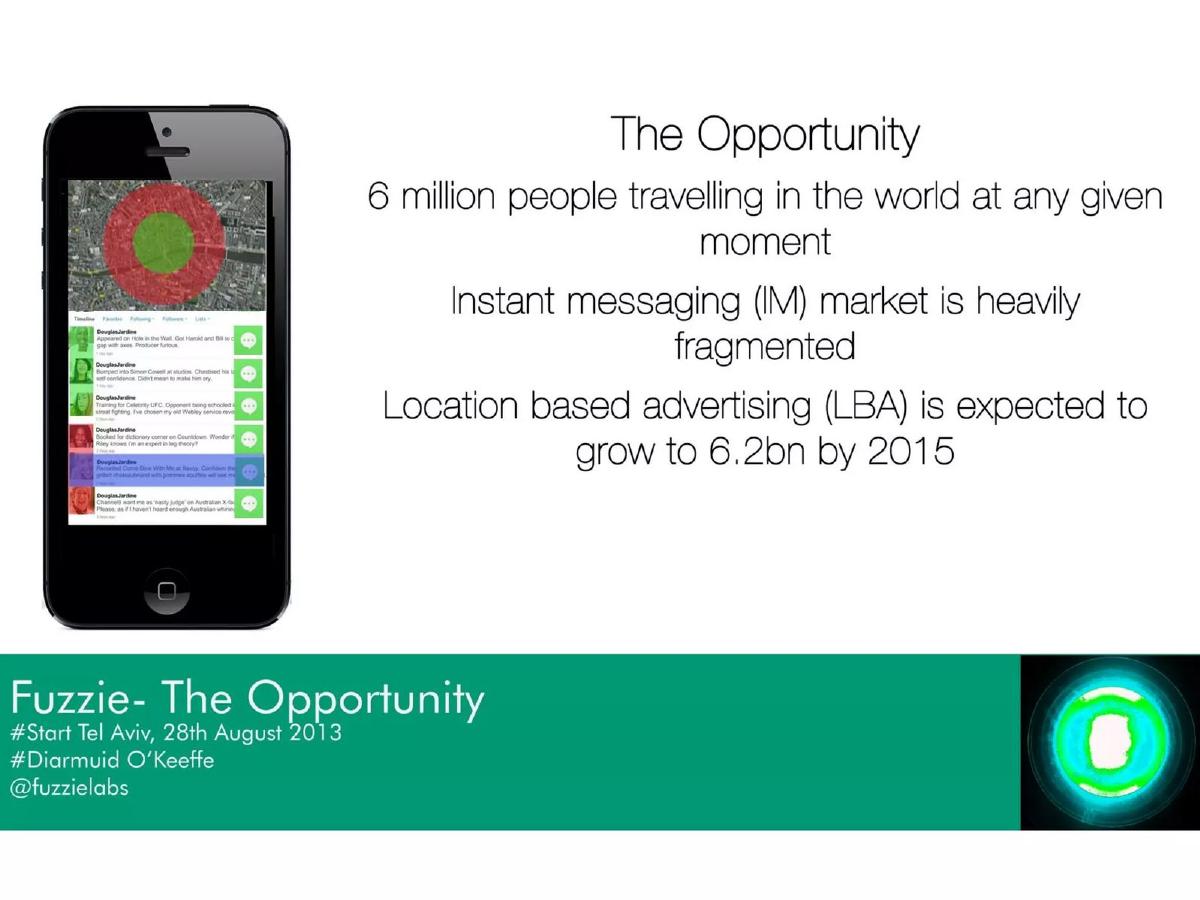
This slide attempts to quantify the market. It lists three key data points:
6 million people travelling in the world at any given moment. · Instant messaging (IM) market is heavily fragmented. · Location based advertising (LBA) is expected to grow to 6.2bn by 2015.
The slide includes a mockup of the app showing a map with a red and green proximity radius and a list of nearby users. The 6.2bn figure provides a target for the revenue model, though it does not specify the currency (presumably USD).
Slide 4: The Opportunity (Target Demographic)
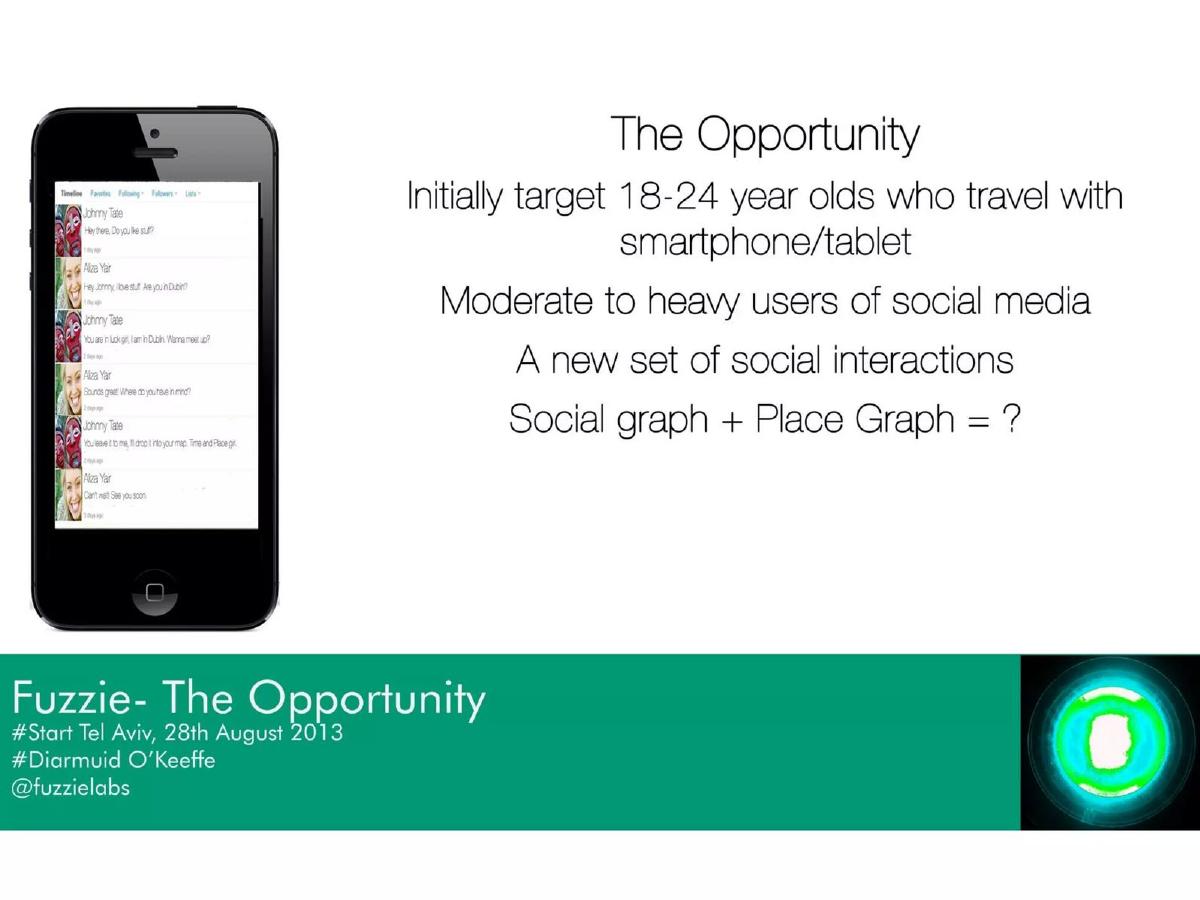
Fuzzie narrows its focus here, stating they will "Initially target 18-24 year olds who travel with smartphone/tablet." They describe these users as moderate to heavy social media users. The slide introduces a conceptual formula: "Social graph + Place Graph = ?" , suggesting that the value lies in combining who you know with where you are. A mockup shows a chat interface between users 'Johnny Tate' and 'Aliza Yair'.
Slide 5: The Problem
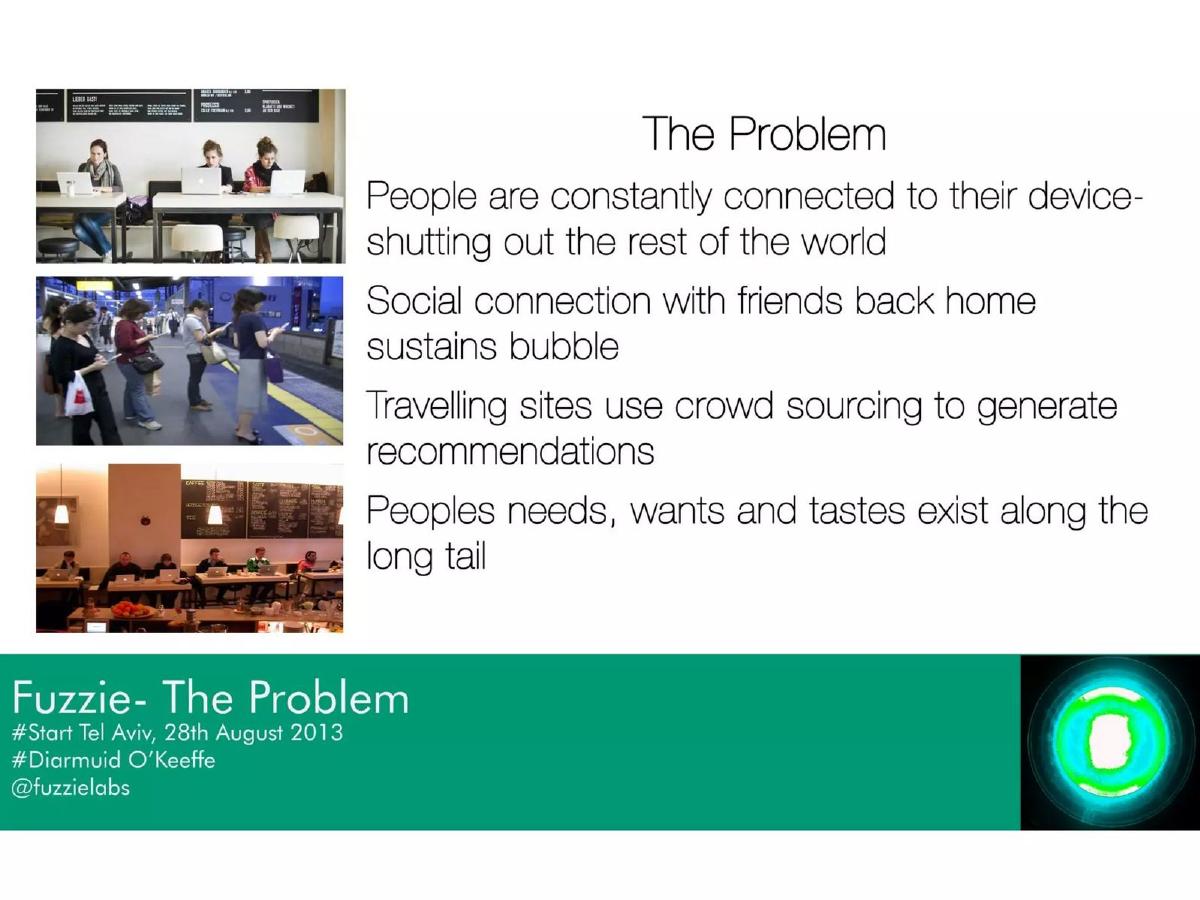
The problem is framed as a social one. The deck argues that people are "constantly connected to their device—shutting out the rest of the world." It notes that social connections with friends back home sustain a 'bubble' that prevents travelers from engaging with their current environment. It also critiques existing travel sites for relying on crowdsourced recommendations that may not meet the specific 'long tail' needs of individual travelers.
Slide 6: The Solution
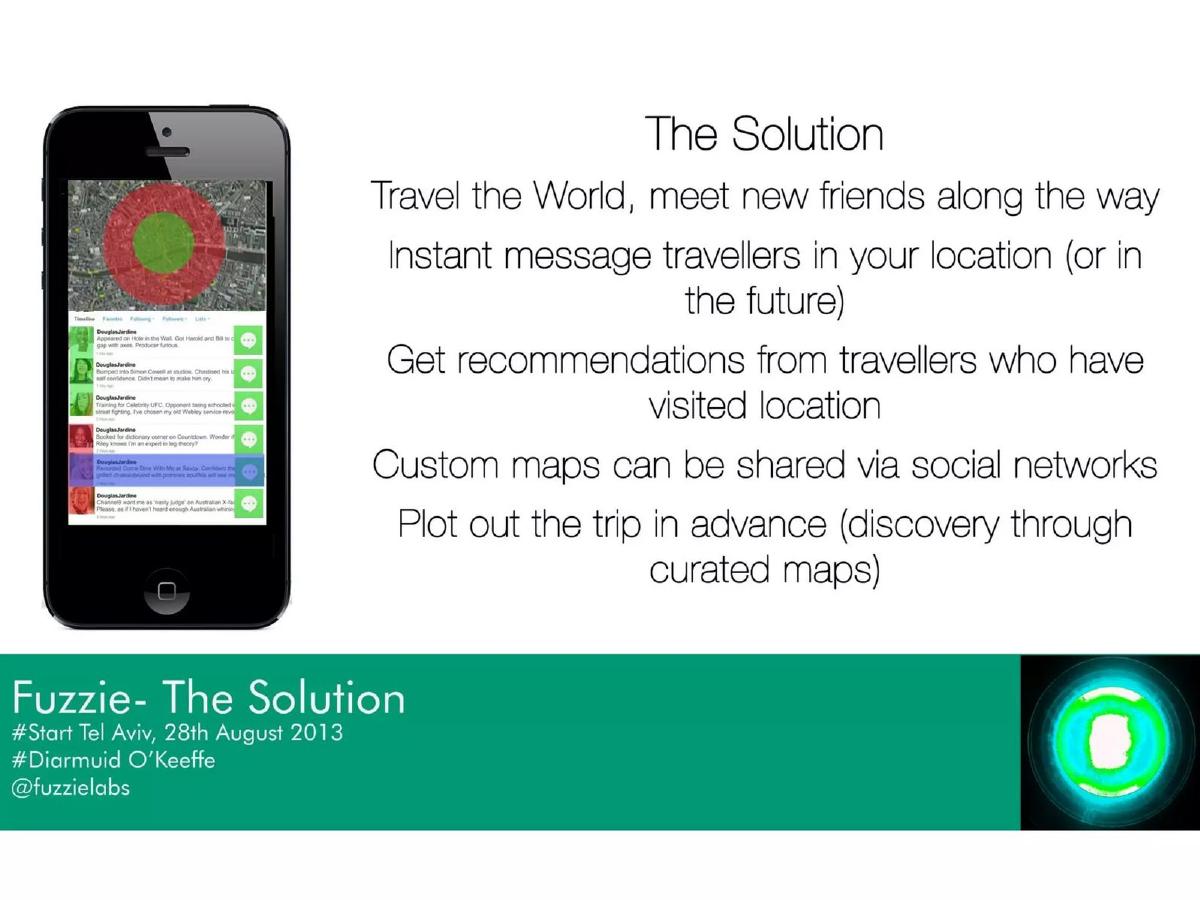
Travel the world and meet new friends. · Instant message travellers in your location (or in the future). · Get recommendations from travellers who have visited the location. · Share custom maps via social networks. · Plot out trips in advance through curated maps.
This slide clarifies that the app is not just for real-time interaction but also for planning and sharing experiences.
Slide 7: Use Case
This slide uses a three-step visual flow to demonstrate the app's utility. Step 1: A user sees a list of people nearby on a map. Step 2: The user initiates a chat (mockup shows a conversation about meeting up in Dublin). Step 3: A location pin ('Jennys Coffee Shop') is shared with a specific time (8:00pm). This effectively illustrates the transition from digital discovery to physical meeting.
Slide 8: The Business Model
Pay Per View (PPV): Triggered when a node is clicked on a map, leading to recommendations of similar nodes. · Pay Per Click (PPC): Charging for 'Featured' nodes on the map that users click. · Future In-app purchase: Specifically for voice/video communication.
A tablet mockup shows a map of Dublin with a 'Featured: Gormet Burger' node, providing a concrete example of the PPC model.
Slide 9: Strategy
The strategy slide outlines growth and optimization tactics. It mentions using analytics on IM messaging to make location-based advertising 'smarter.' It also lists marketing channels: location-based email campaigns, AdWord marketing, Facebook ads, SEO landing pages, and mobile banner ads. Interestingly, it mentions 'Slideshare' as a marketing channel. The final point is 'Map sharing (viral content),' suggesting a product-led growth loop.
Slide 10: The Team
Diarmuid O’Keeffe: MBA, BE (Comp Eng), Solution Architect. Responsible for Business Development/Vision. · Pat Browne: MEng C&CS, BSC, Management Consultant. Responsible for Product Development/Realism.
The team appears to have a strong technical and consulting background, though no specific prior startup successes or industry-specific travel experience is mentioned.
What Fuzzie Does Well
The deck is visually clean and uses mockups effectively to explain a concept that could otherwise be abstract. The 'Use Case' slide (Slide 7) is particularly strong because it walks the investor through the user journey from discovery to an offline meeting. By focusing on the 'social bubble' problem, the founders identify a specific psychological pain point of modern travel rather than just listing features. The business model is also clearly tied to the product's core interface—the map—making the path to revenue easy to visualize.
What is Missing from the Deck
The most glaring omission is traction . In 2013, the mobile app market was already crowded, and investors would have wanted to see beta user numbers, retention rates, or at least a sign-up list. There is also no competitive landscape slide. In 2013, apps like Foursquare, Highlight, and even Tinder were already exploring geo-social networking; Fuzzie does not explain how it differentiates from these established players. Furthermore, there is no financial ask or use of funds slide. An investor finishing this deck would not know how much capital the team is seeking or what milestones that capital would achieve. Finally, the 'Strategy' slide (Slide 9) is a list of generic marketing channels rather than a cohesive go-to-market plan.
Founder Takeaways
Define the 'Graph': Fuzzie’s mention of a 'Place Graph' (Slide 4) is a smart way to frame their data advantage. Founders should look for ways to name their unique data sets to make them feel like proprietary assets. Visual Use Cases: If your product relies on a sequence of actions, use a slide like Slide 7 to show the flow. It reduces the cognitive load for the investor. Avoid Generic Marketing Lists: Slide 9 lists almost every digital marketing channel available in 2013. Founders should instead focus on the one or two channels that are most likely to provide a low Customer Acquisition Cost (CAC) for their specific niche. Don't Forget the Ask: Never end a pitch deck without stating what you need. Whether it is $500k for product development or introductions to travel partners, the 'Ask' is the purpose of the presentation.
Frequently asked questions
- What is the primary problem Fuzzie is trying to solve?
- Fuzzie addresses the 'social bubble' effect where travelers remain digitally connected to their home social circles, effectively shutting out the world around them. Slide 5 notes that people are constantly connected to their devices but lack meaningful local social discovery. The app aims to facilitate real-time connections with other travelers in the same physical location.
- How does Fuzzie plan to make money?
- The business model is primarily advertising-driven. Slide 8 details a Pay Per View (PPV) model where similar nodes are recommended when a user clicks a map location, and a Pay Per Click (PPC) model for 'Featured' nodes. They also mention future revenue from in-app purchases for voice and video communication features.
- Who is the target audience for this application?
- According to Slide 4, the initial target is 18-24 year olds who travel with smartphones or tablets. These users are described as moderate to heavy social media users who are looking for a new set of social interactions based on a combination of their social graph and a 'Place Graph'.
- What technical expertise does the founding team have?
- The team has a strong engineering foundation. Diarmuid O’Keeffe holds an MBA and a BE in Computer Engineering, serving as a Solution Architect. Pat Browne holds an MEng in C&CS and a BSC, with experience as a Management Consultant. This suggests the founders have the technical background to oversee product development (Slide 10).
- What is missing from the Fuzzie pitch deck?
- The deck is missing several standard components for a venture capital pitch. There is no 'Ask' slide detailing how much money they are raising. It lacks a competition slide, a financial roadmap, and any evidence of traction (such as beta user numbers or download stats). It also omits a clear timeline for product launch or expansion.