The Fyre Festival pitch deck, comprising 43 slides (9 analyzed here), represents a unique moment in startup history where influencer reach was treated as a primary asset. The deck frames the 'problem' as a lack of transparency in talent booking, yet the 'solution' presented is a luxury music festival. It leans heavily on vanity metrics, claiming a reach of 300 million people in 24 hours through 400 influencers. Notably, the deck claims ownership of $8.4 million worth of land in the Bahamas, a point of significant later contention. While the visual aesthetic is high-end, the deck is entirely d…
Key takeaways
- The deck identifies a legitimate market gap in the inefficiency of accessing and booking talent (Slide 2).
- Marketing strategy relied on 400 'Fyre Starters' to launch a coordinated influencer campaign (Slide 5).
- The founders claimed an 'ambiguous orange tile' reached 300 million people within 24 hours (Slide 5).
- Press traction is presented as a primary validator, citing 1.5 million media impressions in 48 hours (Slide 6).
- The company claimed to have been given $8.4 million in market value land on Black Point, Exuma (Slide 7).
- Founder Billy McFarland's bio highlights previous ventures Magnises and Spling as successes (Slide 8).
- Founder Ja Rule is positioned as a bridge between the tech space and the entertainment industry (Slide 8).
- The deck uses high-fashion lifestyle imagery to sell a 'life-changing experience' rather than a service (Slide 9).
The Illusion of Traction: Analyzing the Fyre Festival Pitch
The Fyre Festival pitch deck is perhaps the most infamous document in modern venture capital history. It serves as a case study in how brand aesthetics and influencer metrics can be used to obscure a total lack of operational substance. While the full deck contains 43 slides, the 9 slides analyzed here provide the core narrative used to solicit millions of dollars from investors. The deck attempts to bridge the gap between a software product (the Fyre App) and a physical event, using the latter to generate the hype necessary to fund the former.
Slide 1: Cover Page
The cover slide is minimalist, featuring the Fyre logo—a flame icon above a serrated line—and the URL 'FYREAPP.COM'. This is a critical distinction; the company was ostensibly a tech platform for booking talent, not just a festival promoter. The branding is clean and high-end, signaling a luxury market positioning from the outset.
Slide 2: The Problem
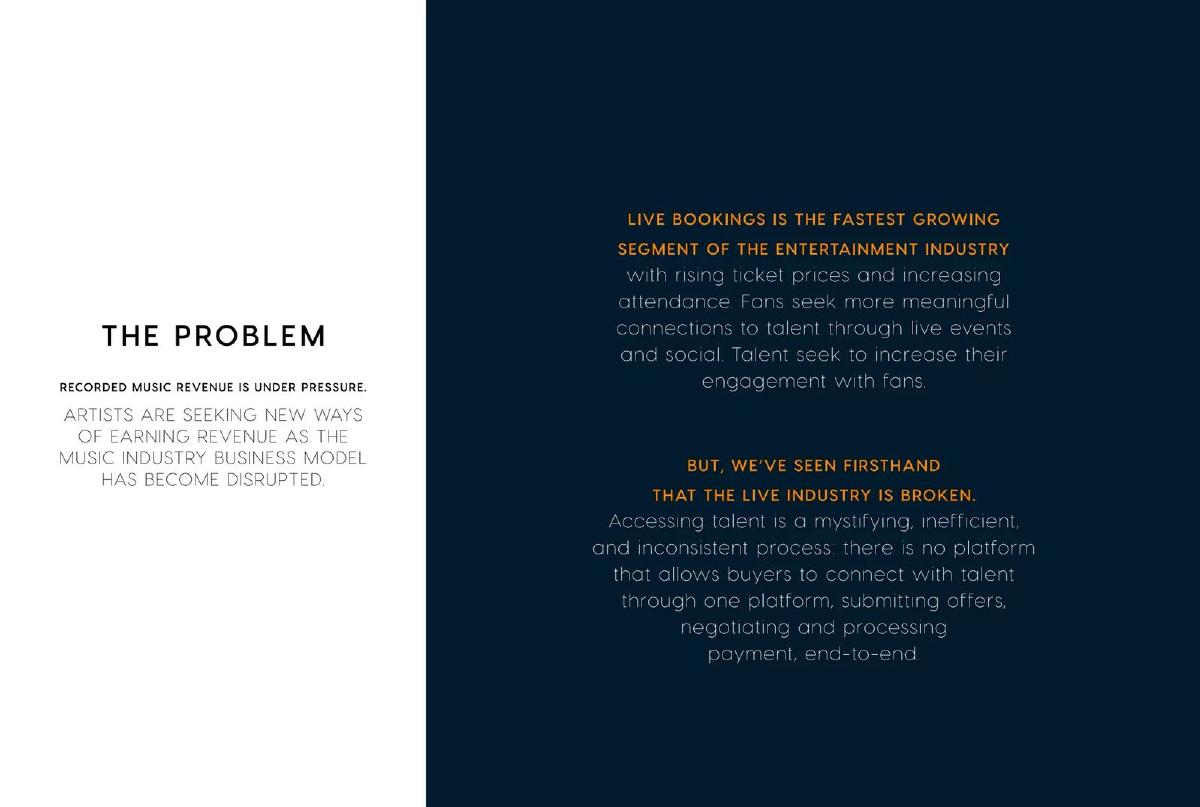
Slide 2 attempts to define the market opportunity. It correctly identifies that 'Recorded music revenue is under pressure' and that the 'Live industry is broken.' The slide claims that accessing talent is a 'mystifying, inefficient, and inconsistent process.' The stated solution is a platform that allows buyers to connect with talent, submit offers, and process payments end-to-end. This is a classic 'marketplace' pitch, identifying friction in a high-value industry. However, this is the last time the deck focuses on the software's utility before pivoting entirely to the festival.
Slide 3 & 4: The Pivot to the Festival
Slides 3 and 4 introduce 'Fyre Festival' and 'Year 1: Water.' These slides act as dividers, signaling a shift from the 'Problem' to the 'Marketing Event.' The use of 'Year 1' suggests a long-term franchise model, implying that this is not a one-off event but the start of a recurring revenue stream and a global brand movement.
Slide 5: Fyre Starters and Influencer Reach
This is the 'traction' slide of the deck. It details a 'coordinated influencer marketing campaign' involving 400 personalities. The slide claims that an 'ambiguous orange tile' reached 300 million people in 24 hours. It features headshots and follower counts for 14 celebrities, including Kendall Jenner (72.5m followers), Bella Thorne (14.8m followers), and Emily Ratajkowski (10.6m followers). By listing 'likes' alongside 'followers,' the deck attempts to prove engagement. The text explicitly states these ambassadors are 'representative of the Fyre Tribe' and are 'your potential brand partners,' essentially selling the investor on the idea that they are buying into an elite social circle.
Slide 6: Press Validation
Slide 6, titled 'What the Press is Saying,' uses logos from Vogue, Elle, Cosmopolitan, and GQ to create an aura of legitimacy. It claims 1.5 million media impressions within 48 hours of launch. The quotes included are highly aspirational, such as 'Think Coachella x 1000' and 'The next BIG destination event.' Notably, these quotes are about the marketing of the event, not the event itself, yet they are used as proof of concept.
Slide 7: Land Ownership Claims
Slide 7 is the most controversial from a due diligence perspective. It features an aerial shot of a tropical coastline with the heading 'Land Ownership.' The text states: 'Fyre has been given $8.4mm of market value land on Black Point, Exuma in exchange for hosting the festival and advertising the island.' For an investor, this represents a massive de-risking of the project, as it suggests the company has a multi-million dollar physical asset. History revealed this claim to be significantly misrepresented, but within the deck, it serves as the primary 'moat.'
Slide 8: The Founders
The founder slide focuses on Billy McFarland and Ja Rule. McFarland is described as the 'Founder and CEO' with mentions of his previous companies, Magnises and Spling. Ja Rule is positioned as a 'three time Grammy Nominee' with 'over 60 million records sold.' The bio for Ja Rule also notes his role as an investor and advisor to Magnises. The emphasis here is on 'overall business strategy' and 'creative direction.' There is no mention of a COO, a Head of Logistics, or anyone with experience in large-scale event production, which, in hindsight, was the company's fatal flaw.
Slide 9: The Aesthetic Vision
The final slide in this set is a mood board of high-resolution lifestyle photography: models in the water, surfing, and tropical landscapes. There is no text on this slide. Its purpose is purely emotional, reinforcing the 'luxury' and 'FOMO' (Fear Of Missing Out) that the brand relied upon to drive ticket sales and investor interest.
What Works in This Deck
From a purely persuasive standpoint, the deck is highly effective at building a narrative of inevitability. The 'Fyre Starters' slide (Slide 5) is a powerful demonstration of how to visualize reach. Instead of just saying 'we have a lot of followers,' the founders showed the faces and specific numbers of the people driving the brand. This creates a sense of 'social proof' that is hard for investors to ignore. Additionally, the deck is visually cohesive; it looks like a luxury magazine, which aligns perfectly with the $1,000+ ticket prices they were targeting.
What is Missing
The omissions in this deck are staggering. A standard Series A or Seed deck for a marketplace or event business should include:
Unit Economics: What is the cost to acquire a customer (CAC) versus the ticket price? · Revenue Model: How does the Fyre App take a cut of the talent bookings? What are the projected margins for the festival? · Logistics and Operations: Who is actually building the festival? What is the timeline for infrastructure? · The Ask: How much money is being raised, and what is the specific use of funds? · Competition: How does the Fyre App compete with established agencies like CAA or WME?
By omitting these, the founders forced investors to rely entirely on the 'hype' metrics of Slide 5 and the 'asset' claim of Slide 7.
Lessons for Founders
Founders can learn two very different lessons from this deck. First, the power of a clear, high-end brand identity cannot be overstated; it opened doors that a dry, text-heavy deck would not have. Second, and more importantly, 'traction' must be meaningful. 300 million impressions (Slide 6) mean nothing if the underlying business cannot deliver the product. Founders should ensure that for every 'hype' slide, there is a corresponding 'reality' slide that explains how the business will scale, survive, and generate profit. Fyre sold the sizzle, but as the world eventually found out, there was no steak.
Frequently asked questions
- What was the actual product Fyre was selling to investors?
- The deck is split between two concepts: a talent booking platform (the Fyre App) and a luxury event (Fyre Festival). Slide 2 frames the problem as a lack of an end-to-end platform for negotiating talent payments. However, the subsequent slides focus almost exclusively on the festival as a marketing vehicle for the 'Fyre Tribe,' suggesting the festival was the primary investment hook.
- How did the deck use influencer metrics to justify its value?
- Slide 5 lists specific 'ambassadors' like Kendall Jenner (72.5m followers) and Bella Hadid (9.7m followers). It claims that a coordinated post of an orange tile reached 300 million people in 24 hours. By quantifying 'likes' and 'followers' for 14 specific individuals, the deck attempts to turn social media clout into a tangible, bankable asset.
- What were the major red flags in the land ownership claims?
- Slide 7 states that Fyre was 'given $8.4mm of market value land on Black Point, Exuma' in exchange for hosting the festival. In retrospect, this was a critical exaggeration or falsehood, as the festival lacked permanent infrastructure and the land was not owned by the entity in the way the slide implies to a potential investor.
- How did the founders position their backgrounds?
- Billy McFarland is described on Slide 8 as the founder of Magnises and Spling, as well as two non-profits. Ja Rule is positioned as a 'three time Grammy Nominee' and an investor/advisor to Magnises. The deck emphasizes their ability to 'guide creative' and 'facilitate artist relations' rather than their experience in large-scale logistics or event management.
- What is missing from this deck that a standard pitch requires?
- The deck is missing almost every standard financial and operational slide. There are no mentions of ticket prices, projected revenue, cost of goods sold (COGS), festival capacity, security plans, or a breakdown of how the investment funds would be spent. It relies entirely on 'FOMO' and brand associations.