Fyodor Biotechnologies' pitch deck is a lean, 7-slide presentation that successfully raised $1.5 million in 2008. The company addresses a massive global health crisis—212 million malaria cases annually—with a disruptive, non-invasive Urine Malaria Test (UMT). The deck excels by moving quickly from the global problem to specific, localized traction, noting that regulatory approvals were already secured in Nigeria and Liberia. Despite its brevity, the deck provides clear market sizing ($789M by 2022) and showcases a high-pedigree team with experience at Amgen, Merck, and Johns Hopkins. While it…
Key takeaways
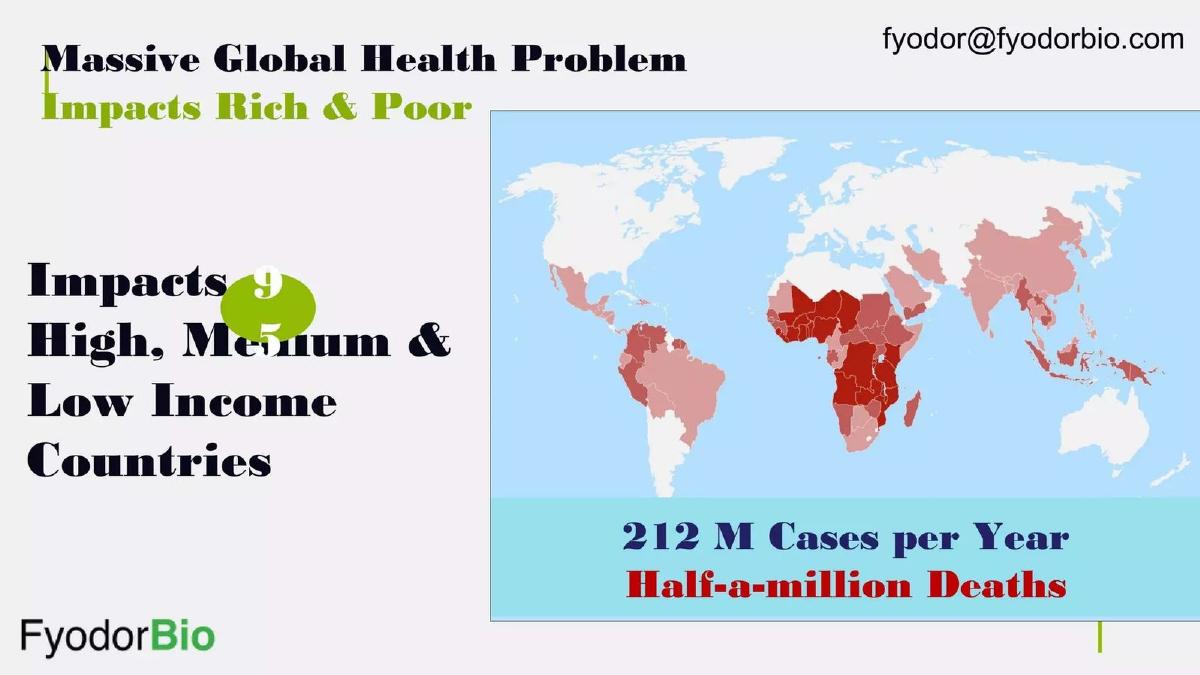
- The company identifies a massive total addressable market with 212 million cases and 500,000 deaths annually (Slide 2).
- Fyodor's Urine Malaria Test (UMT) is positioned as the first non-blood rapid test, requiring no reagents or equipment (Slide 1).
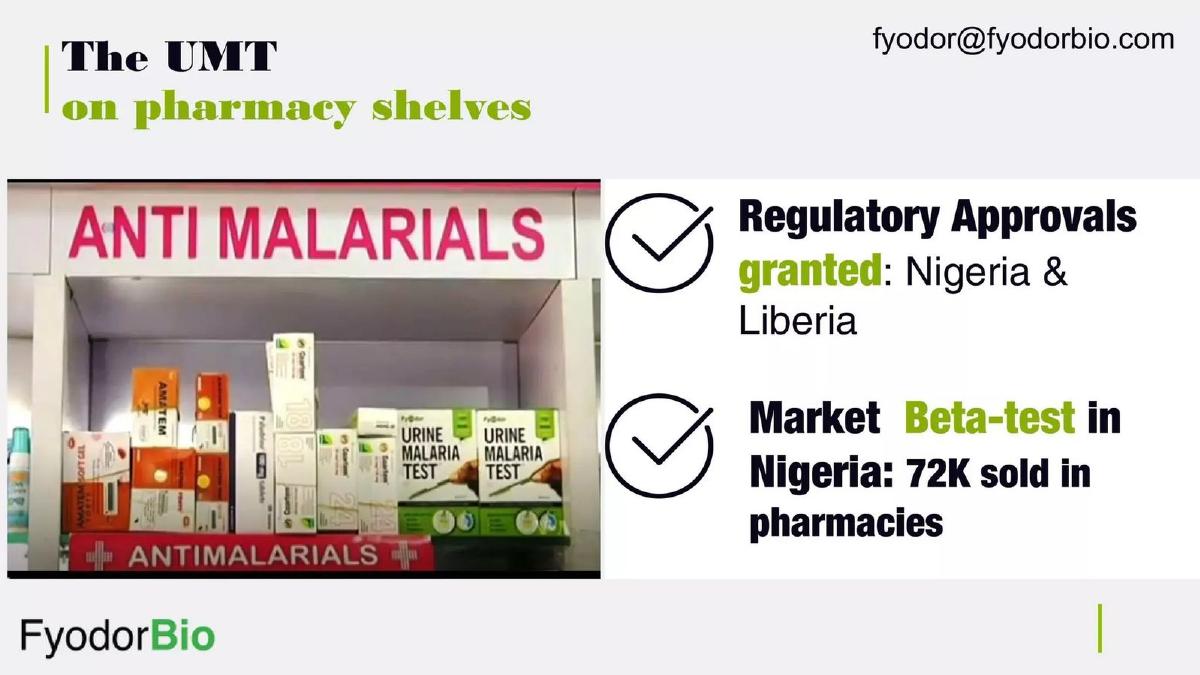
- The deck highlights significant early traction with 72,000 units sold during a market beta-test in Nigerian pharmacies (Slide 4).
- Regulatory hurdles are addressed early, confirming approvals in both Nigeria and Liberia (Slide 4).
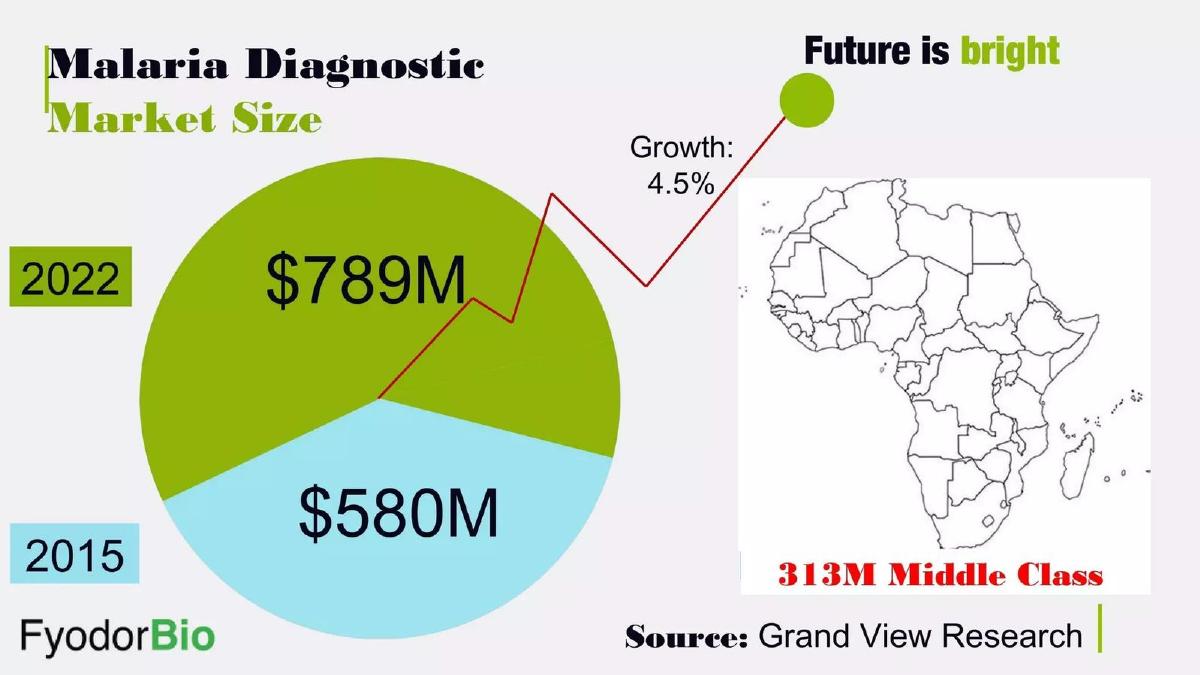
- Market projections estimate the malaria diagnostic market will grow to $789 million by 2022 at a 4.5% CAGR (Slide 5).
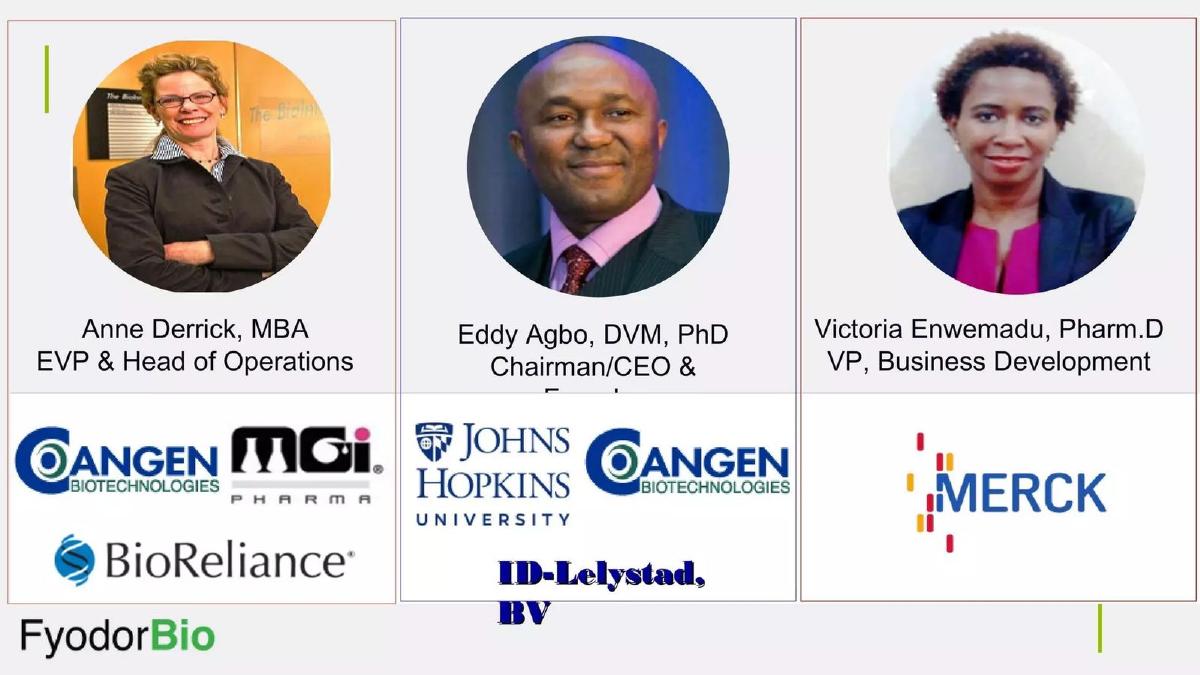
- The team slide leverages heavy-hitting industry logos including Amgen, Merck, and Johns Hopkins University (Slide 6).
- The product is designed for the '313M Middle Class' in Africa, suggesting a commercial rather than purely philanthropic model (Slide 5).
- The deck omits a formal 'Ask' slide, failing to specify the amount of capital sought or the intended use of funds (Slide 7).
Introduction: The Power of a 7-Slide Narrative
Fyodor Biotechnologies provides a masterclass in brevity. In just seven slides, this 2008 seed deck manages to define a global health crisis, present a proprietary technological solution, prove market demand through a 72,000-unit beta test, and showcase a team capable of institutional-grade execution. While modern decks often bloat to 20+ slides, Fyodor focuses on the 'Urine Malaria Test' (UMT) as a singular, disruptive product.
Slide 1: The Hook
The cover slide immediately identifies the value proposition: 'Malaria Diagnosis in Minutes.' It features a high-quality product shot of the UMT packaging, which prominently lists the benefits: 'No blood, No reagents, No equipment.' By placing the CEO's contact information and the 'First non-blood test for malaria' tagline on the front page, Fyodor ensures the investor knows exactly what the company does within three seconds of opening the file.
Slides 2-3: The Problem and the Current State
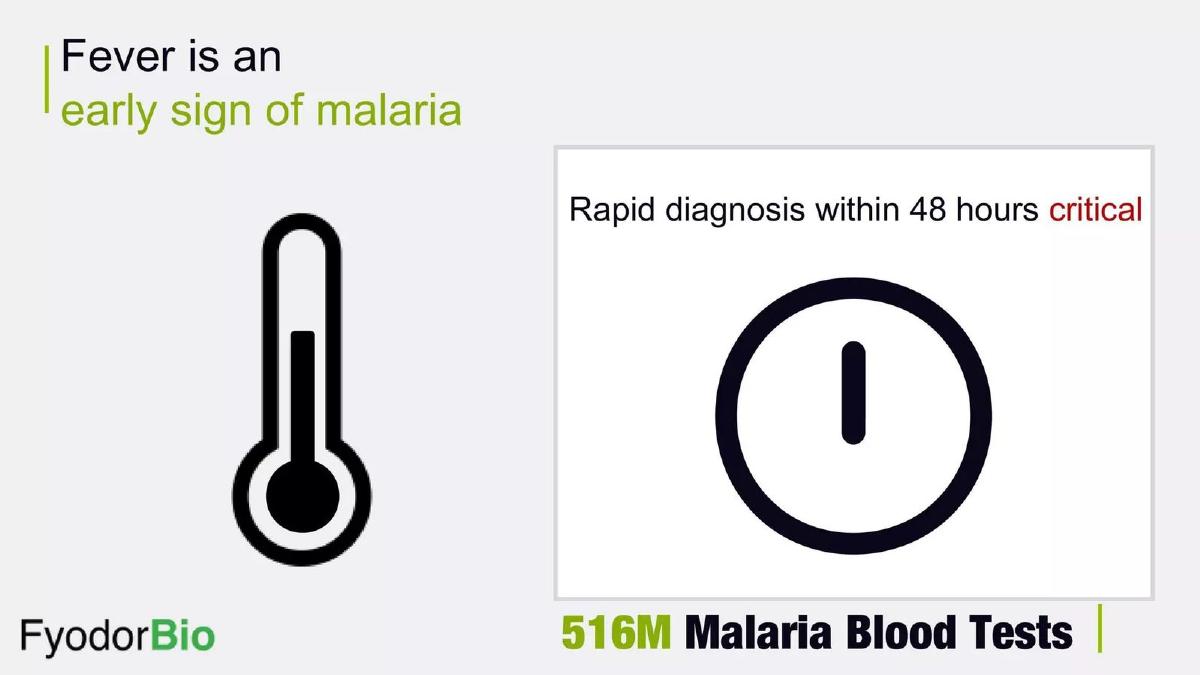
Slide 2 quantifies the 'Massive Global Health Problem.' It cites 212 million cases per year and half-a-million deaths. The map highlights that while the problem is global, the concentration is heaviest in Africa and Southeast Asia. Slide 3 focuses on the clinical urgency, stating that 'Rapid diagnosis within 48 hours [is] critical.' It also identifies the current market standard: 516 million malaria blood tests. This sets the stage for a 'better, faster, cheaper' replacement play.
Slide 4: Traction and Regulatory De-risking
This is the strongest slide in the deck. It moves the conversation from theory to reality. It shows the UMT product physically sitting on pharmacy shelves under an 'Anti Malarials' sign. The slide lists two major milestones: regulatory approvals in Nigeria and Liberia, and a market beta-test in Nigeria resulting in 72,000 units sold. For a seed-stage medical device company, having 72k units of real-world sales data is an exceptional validator that bypasses many typical investor concerns regarding adoption.
Slide 5: Market Size and Growth
Fyodor uses data from Grand View Research to project a market size of $789 million by 2022, up from $580 million in 2015. Interestingly, the slide includes a map of Africa with the text '313M Middle Class.' This suggests that Fyodor is not just looking for government or NGO contracts but is targeting a burgeoning private consumer market capable of out-of-pocket purchases in pharmacies.
Slide 6: The Team
The team slide is a 'logo-heavy' display of credibility. CEO Eddy Agbo’s background includes Johns Hopkins and Amgen. EVP Anne Derrick brings experience from Amgen and MGI Pharma, while VP Victoria Enwemadu brings a Pharm.D and experience from Merck. This combination of high-level academic research and 'Big Pharma' operational experience suggests the company has the expertise to scale a regulated medical product.
Slide 7: The Conclusion
The deck ends on a mission statement: 'Democratizing Malaria Testing.' It provides clear contact information, including a phone number and website. However, it notably lacks a final 'Ask' or a roadmap of what the company intends to do next.
What Works in This Deck
Specific Traction: The mention of 72,000 units sold is the 'killer metric.' It proves that the product works, the price point is acceptable to the market, and the distribution channel (pharmacies) is viable. Regulatory Clarity: By stating that approvals are already granted in Nigeria and Liberia, the founders remove a massive 'if' from the investor's mind. Visual Communication: The product packaging is shown early and often, making the 'Urine Malaria Test' feel like a tangible, ready-to-scale consumer good rather than a laboratory experiment.
What Is Missing
The Ask: The deck never specifies how much money is being raised or what the milestones for the next 18 months are. While the catalogue facts state they raised $1.5 million, an investor reading this deck in isolation wouldn't know the terms or the target. Unit Economics: There is no mention of the cost to manufacture a test versus the retail price. In a high-volume diagnostic market, margins are everything. Competitive Landscape: While they mention blood tests generally, they don't address other rapid diagnostic tests (RDTs) that might be competing for the same pharmacy shelf space.
What a Founder Should Copy
The 'Problem-Solution' Speed: Fyodor gets through the problem, the solution, and the traction in the first four slides. Founders should copy this pace; don't spend ten slides on 'why malaria is bad' when the investor already knows it's a global crisis. The Pharmacy Shot: If you have a physical product, show it in the wild. The photo of the UMT on a shelf next to other medications is worth more than a dozen diagrams of how the technology works. It proves the 'last mile' of the business model has been solved.
Frequently asked questions
- What is the primary innovation of Fyodor Biotechnologies?
- The primary innovation is the Urine Malaria Test (UMT). As described on Slide 1, it is the first non-blood rapid test for malaria. It is a one-step, visually read test that provides results in 25 minutes or less without the need for reagents, specialized equipment, or painful blood draws.
- What evidence of market traction does the deck provide?
- Slide 4 provides the most compelling traction data: the company successfully completed a market beta-test in Nigeria where 72,000 UMT units were sold through pharmacies. This demonstrates both consumer demand and the viability of their retail distribution strategy.
- Which geographic markets is Fyodor targeting?
- While Slide 2 shows a global heat map of malaria, Slide 4 and Slide 5 narrow the focus to Africa, specifically Nigeria and Liberia, where regulatory approvals have already been granted. Slide 5 also highlights the 313 million members of the African middle class as a key demographic.
- Does the deck mention any competitors?
- The deck does not name specific corporate competitors. However, Slide 3 references the '516M Malaria Blood Tests' currently performed, positioning traditional blood-based diagnostics as the primary incumbent technology they intend to disrupt.
- Who are the key members of the leadership team?
- The team is led by Eddy Agbo (Chairman/CEO), who holds a DVM and PhD with ties to Johns Hopkins and Amgen. He is supported by Anne Derrick (EVP & Head of Operations) with experience at Amgen and BioReliance, and Victoria Enwemadu (VP, Business Development) who previously worked at Merck (Slide 6).