The clare&me pitch deck is a masterclass in establishing a 'Why Now' narrative by highlighting the massive gap between the growing demand for mental health services and the stagnant supply of human therapists. By positioning their solution as a tech-only coach that guides users through Cognitive Behavioral Therapy (CBT) via phone calls, they differentiate themselves from a crowded field of text-based bots and mindfulness apps. The deck leans heavily on early traction from a closed MVP, showing an impressive 9.2 NPS and quantifiable symptom reduction over a six-week period. While it lacks deta…
Key takeaways
- The company targets a $186BN market with an AI-powered automated mental health coach (Slide 1).
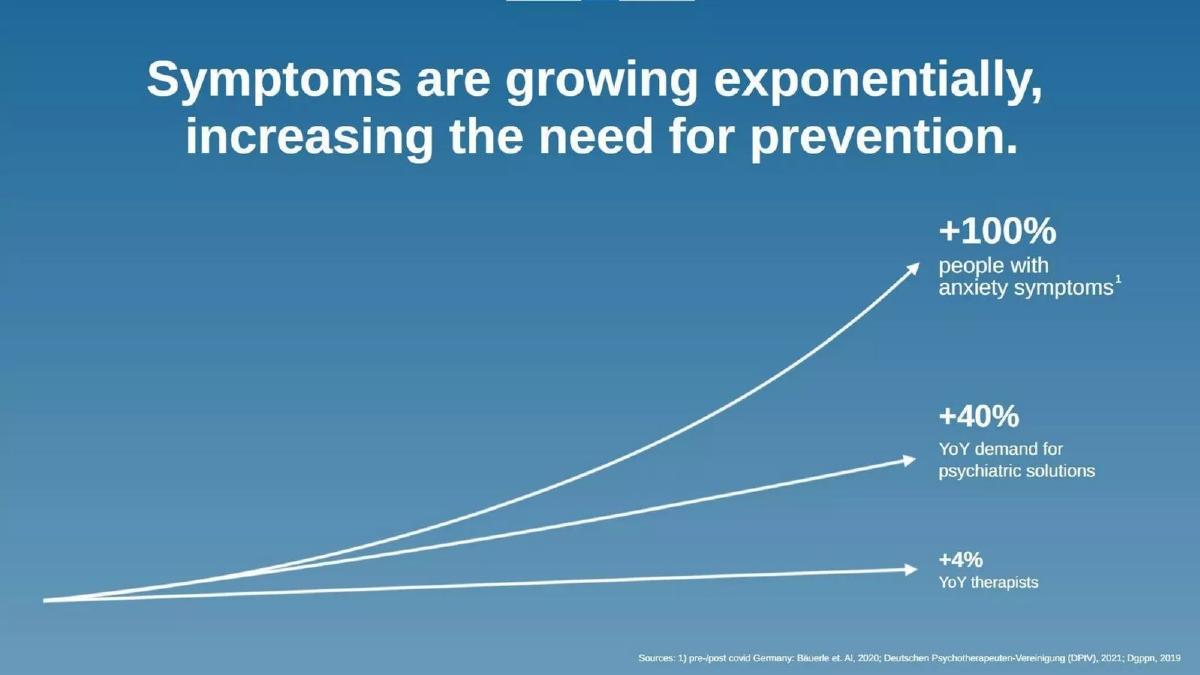
- The 'Why Now' is driven by a 100% increase in people with anxiety symptoms vs. only a 4% increase in therapists (Slide 3).
- clare&me differentiates itself from competitors like Woebot and Wysa by being 'audio first' rather than text-based (Slide 15).
- Early MVP data shows strong engagement with over 3,500 minutes spent with the bot and a 9.2 NPS (Slide 12).
- Clinical efficacy is demonstrated through symptom score charts showing a drop from 20 to 5 over six weeks for a test user (Slide 13).
- The business model starts with D2C subscriptions (€12.99/month) before expanding to B2B and insurance (Slide 14).
- The team consists of two female founders with backgrounds at Google, Jung v. Matt, and TUM, plus a 'virtual founder' (Slide 17).
- The roadmap targets full product-market fit and B2B licensing by Q1 2023 (Slide 18).
The clare&me Pitch Deck: A Voice-First Approach to Mental Health
In 2021, clare&me raised $1,100,000 in a Pre-Seed round to tackle the global mental health crisis. Their approach is distinct: rather than another meditation app or a text-based chatbot, they built an AI-powered audio bot that conducts therapy-like sessions over the phone. This teardown explores how the founders used a combination of clinical data and a clear 'Why Now' narrative to secure early-stage funding.
Slides 1-4: The Macro Problem and the Scarcity Gap
Slide 1 introduces clare&me as an "AI-powered automated mental health coach serving a $186BN market." This immediately establishes the scale of the opportunity. The visual design is clean, using a blue gradient that evokes a sense of calm, fitting for a mental health startup.
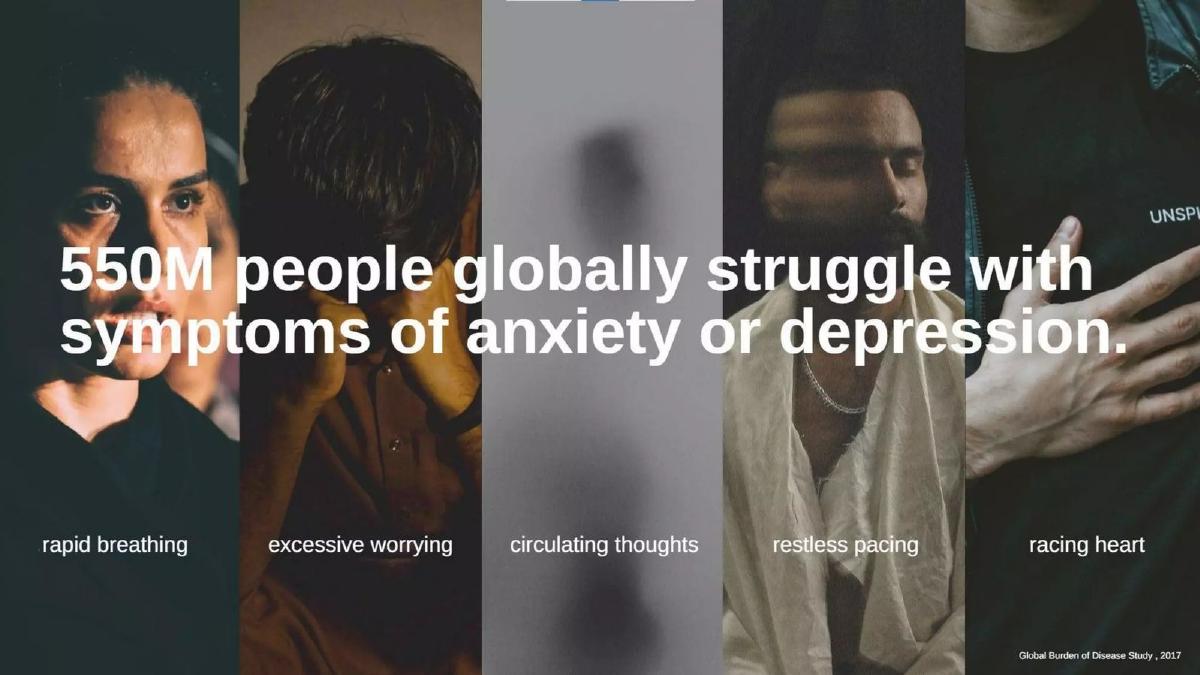
Slide 2 humanizes the problem. It states that "550M people globally struggle with symptoms of anxiety or depression," accompanied by visceral imagery of people experiencing rapid breathing, excessive worrying, and racing hearts. This slide moves the deck from abstract market numbers to the reality of the user experience.
Slide 3 is perhaps the most important slide for establishing urgency. It uses a three-line growth chart to show that while people with anxiety symptoms have increased by 100% and demand for psychiatric solutions has grown by 40%, the supply of therapists has only grown by 4%. This "scarcity gap" is the core thesis of the investment: human capital cannot scale to meet the crisis.
Slide 4 concludes the problem section with a bold statement: "Human capital is a scarcity - without tech to bridge the gap the mental health crisis will grow." This sets the stage for a tech-only solution.
Slides 5-8: Introducing the Solution and Product Features
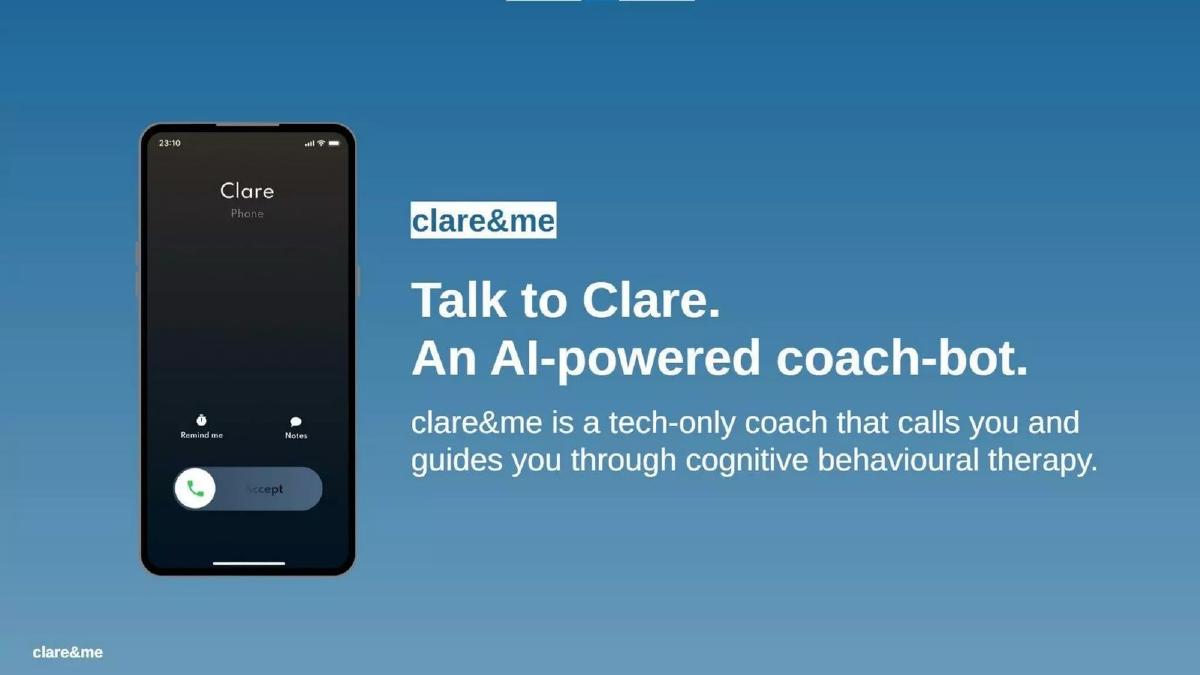
Slide 5 introduces the product: "Talk to Clare. An AI-powered coach-bot." It specifies that the bot calls the user and guides them through Cognitive Behavioral Therapy (CBT). The inclusion of a smartphone mockup showing an incoming call from "Clare" makes the concept tangible.
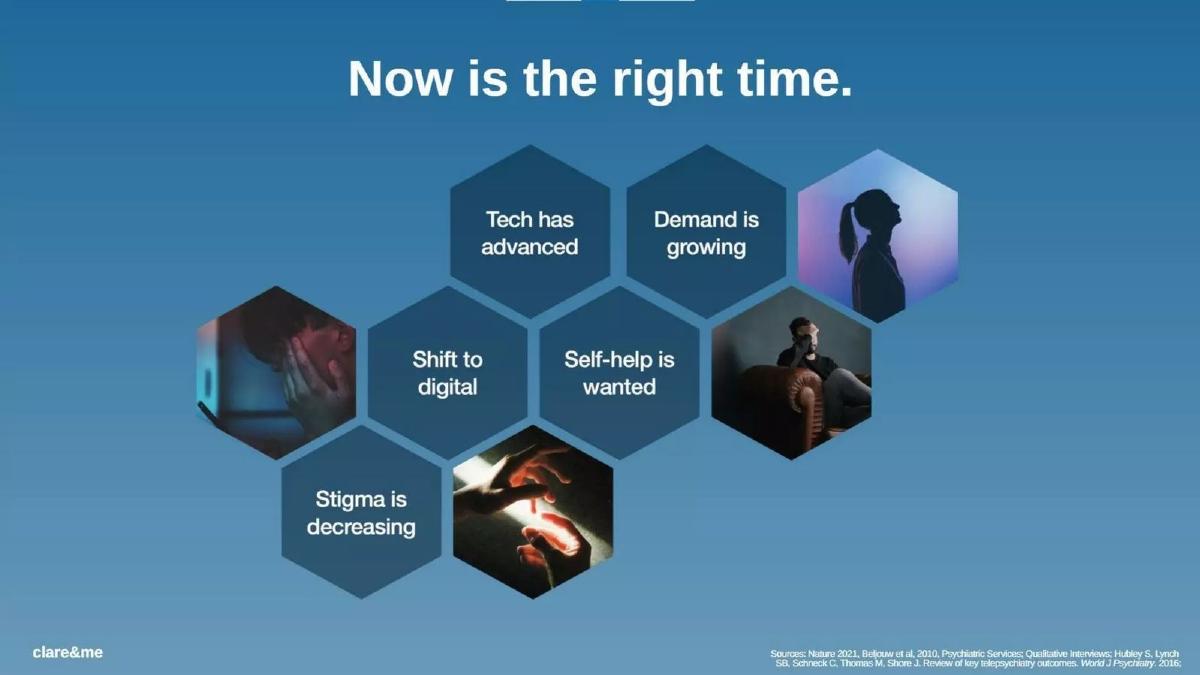
Slide 6 addresses the "Why Now" through a hexagonal grid of factors: tech advancement, growing demand, shift to digital, decreasing stigma, and the desire for self-help. This reinforces that the market is finally ready for an automated solution.
Slide 7 and Slide 8 dive into the product features. Key highlights include onboarding and symptom identification, personalization with human voices, individual modules (e.g., "Boost Self-Confidence," "Sleep Better"), and mood tracking. Slide 8 emphasizes the benefits: availability anytime/anywhere, reduced stigma, low costs, and a proactive nature (the bot calls you).
Slides 9-11: The User Experience and AI Logic
Slide 9 is a placeholder for a video demo, featuring a QR code and a link to YouTube. For a voice-based product, hearing the bot is critical for investors to judge the quality of the AI interaction.
Slide 10 and Slide 11 explain the interaction cycle. The bot "hears," "responds," and "stores" information. It builds a relationship, provides individualized coaching, and helps set daily routines. Slide 11 adds future capabilities: conversing in native languages, handling different symptoms, and incorporating additional therapy types.
Slides 12-13: Traction and Clinical Efficacy
Slide 12 presents the results of the "Closed MVP 1.0." The metrics are impressive for a pre-seed stage: 160 primary test users, >80 daily users after 11 weeks, and a 9.2 NPS. The fact that users spent >3,500 minutes with Clare suggests high engagement, and the mention of >1,200 active decision tree routes demonstrates the depth of the product's logic.
Slide 13 provides the clinical proof. It shows two charts of "Symptom reduction with talking to Clare." One user’s score dropped from 20 to 5 over six weeks. This is a critical slide for any health-tech company; proving that the tool actually works to reduce symptoms is the difference between a lifestyle app and a medical solution.
Slides 14-16: Business Model and Competition
Slide 14 outlines the "D2C first" strategy. It lists three tiers: a free version, a €12.99 monthly plan, and a €7.99/month annual plan. The slide notes that payment tests were set to start in January 2022. It also mentions that B2B and insurance will be sales channels later, following the user.
Slide 15 is a standard 2x2 competitive matrix. clare&me positions itself in the top-right quadrant (Individualized by AI + Clinical Protocol). It differentiates itself from "mindfulness" apps like Calm and Headspace and "human-driven" services like Talkspace. The specific callout is "DIFFERENTIATED BY AUDIO FIRST," which separates them from text-bots like Woebot.
Slide 16 zooms in on the top-right quadrant to further emphasize their unique approach to dialogue logic and personalization through data compared to other clinical bots.
Slides 17-20: Team, Roadmap, and Use of Funds
Slide 17 introduces the founders: Celina (Product & Business) and Emilia (Psychology & Strategy). Their backgrounds include Google, EBS Universität, Jung v. Matt, and TUM. Interestingly, they list "Clare" as a "virtual founder" responsible for CBT & Voice, which reinforces the brand identity.
Slide 18 provides a timeline from June 2021 to Q1 2023. It shows a clear path from alpha launch to monetization, full product launch, and eventually B2B licensing and insurance accreditation.
Slide 19 details the use of funds. The largest allocation is for HR (39%), followed by Product & Tech (35%). Key milestones include 10x user growth, first effectiveness trials with research partners, and hiring mobile/back-end developers. This is a very standard and logical allocation for a tech-heavy pre-seed startup.
Slide 20 ends with a simple call to action: "CALL CLARE. GET THERAPY." and a link to try the prototype.
What Works in this Deck
The Scarcity Narrative: Slide 3 is a powerful visual representation of why a tech solution is mandatory, not just optional. It frames the investment as a solution to a supply-chain problem in healthcare. · Clinical Evidence: Including symptom reduction scores (Slide 13) moves the conversation from "engagement" to "outcomes." In mental health, outcomes are the ultimate currency. · Clear Differentiation: By repeatedly emphasizing "Audio First," the founders avoid being lumped in with the dozens of text-based chatbots that investors had already seen by 2021. · High NPS: A 9.2 NPS (Slide 12) is exceptionally high for an automated tool, suggesting that the "human-like" voice personalization is effectively building rapport with users.
What is Missing from this Deck
Detailed Unit Economics: While the pricing is listed, there is no mention of Customer Acquisition Cost (CAC) or Lifetime Value (LTV) projections. Even in a pre-seed deck, some indication of how they plan to acquire users profitably is helpful. · Technical Moat: The deck mentions "1,200 active decision tree routes," but it doesn't go deep into the proprietary nature of their AI or how they prevent others from simply building a similar voice interface on top of existing LLMs (though in 2021, this was less of a concern than it is today). · The Specific Ask: The deck does not state the exact amount of money being raised on the final slides (though the catalogue confirms it was $1.1M). Usually, a "The Ask" slide is helpful to set the terms of the conversation.
What a Founder Should Copy
The 'Why Now' Slide: Copy the logic of Slide 3. Find the two diverging lines in your industry—where demand is skyrocketing but the traditional supply is flatlining—and visualize that gap. · Outcome-Based Traction: If you are in a regulated or health-adjacent space, don't just show how many people use your app. Show that your app actually solves the problem it claims to solve using industry-standard metrics (like the symptom scores on Slide 13). · The Competitive Quadrant: Slide 15 is a great example of how to use a competitive matrix to highlight a specific feature (Audio First) as a primary axis of differentiation. · Roadmap Clarity: The curve on Slide 18 is a great way to show that you aren't just building an app, but a sequence of milestones that lead to a much larger B2B/Insurance play.
Frequently asked questions
- What is clare&me's primary product offering?
- clare&me is an AI-powered audio bot designed to act as a mental health coach. Unlike many competitors that use text-based chat, clare&me uses voice interaction to guide users through Cognitive Behavioral Therapy (CBT). The product includes features like mood tracking, personalized human-like voices, and individual modules for specific issues like self-confidence or sleep, accessible via scheduled or on-demand phone calls.
- How does the company prove the effectiveness of its AI coach?
- The deck provides clinical evidence from its closed MVP on Slide 13. It displays two case studies showing symptom reduction over a six-week period. One 20-year-old female user saw her symptom score drop from 20 to 5, while a 33-year-old male saw a reduction from 11 to 7. These metrics are supported by a high Net Promoter Score (NPS) of 9.2 from daily users.
- What is the competitive advantage mentioned in the deck?
- The core differentiator is being 'audio first.' On Slide 15, clare&me maps the competitive landscape, placing itself in the top-right quadrant for being 'individualized by AI' and following 'clinical protocols.' It distinguishes itself from text-bots like Woebot and Wysa and mindfulness apps like Headspace by focusing on the therapeutic power of voice and automated CBT dialogue logic.
- What is the go-to-market strategy for clare&me?
- The company follows a 'D2C first' strategy to build a user base and prove retention before moving into B2B and insurance channels. The initial pricing model includes a free tier with limited calls, a €12.99 monthly subscription, and a €7.99/month annual plan. The long-term goal, as shown on Slide 18, is to achieve accreditation for insurance reimbursement and B2B licensing by 2023.
- How does clare&me plan to use the $1.1M raised?
- According to Slide 19, the funds are focused on strengthening product-market fit and retention. The budget is split between HR (39%), Product & Tech (35%), Operations (14%), and Marketing (12%). Key hires include mobile and back-end developers and a product designer. Milestones include launching a native app, achieving 10x user growth, and conducting the first effectiveness trials with research partners.