Clanbeat’s seed deck is a masterclass in brevity and founder-led credibility. Spanning just 8 slides, the presentation focuses heavily on the 'Who' and the 'Why.' By leading with a founding team that includes a co-founder of Pipedrive, the deck establishes immediate trust. It then pivots to a high-stakes financial problem: the $40,000 cost of losing a single employee. While the deck is light on traditional metrics like CAC, LTV, or detailed financial projections, it compensates with a strong list of early enterprise clients like Volvo and Ericsson. The deck successfully positions 1-on-1 meeti…
Key takeaways
- The cover slide establishes a clear, persona-driven value proposition: 'Be a Better Manager with 1-on-1s' (Slide 1).
- Founder pedigree is the primary trust signal, highlighting Ragnar Sass as a founder of Pipedrive and Garage 48 (Slide 2).
- The problem is quantified with a specific, high-impact figure: losing one employee costs approximately $40,000 (Slide 3).
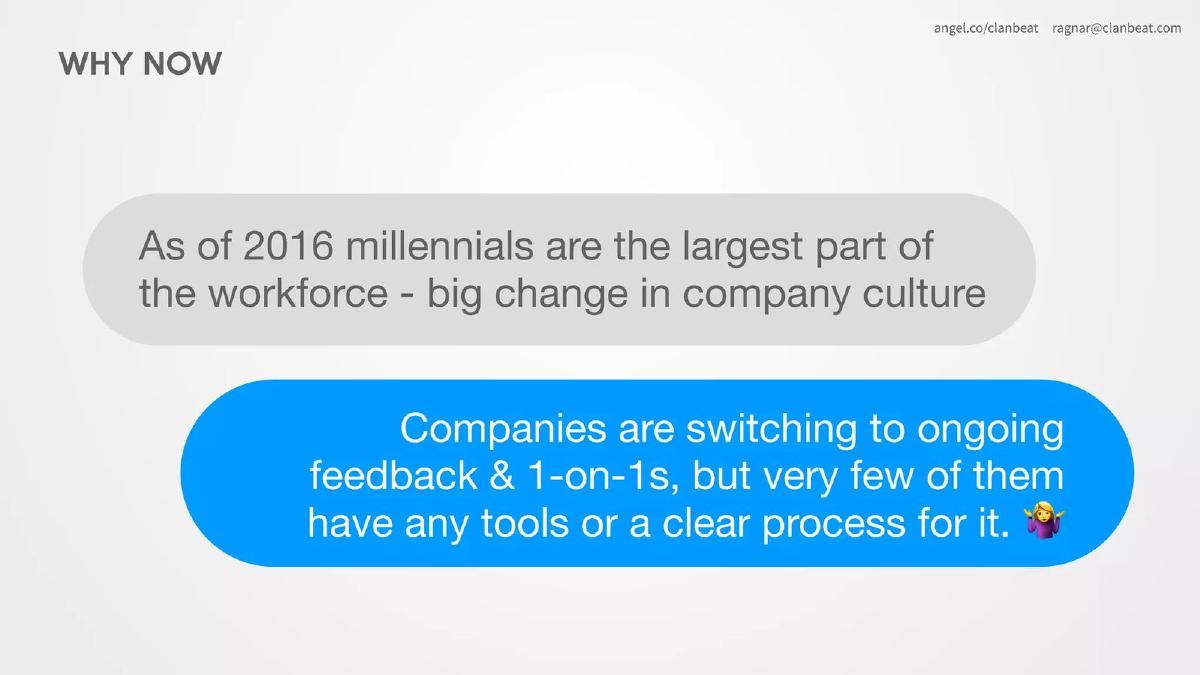
- Market timing is justified by the shift in workforce demographics, noting millennials became the largest workforce segment in 2016 (Slide 4).
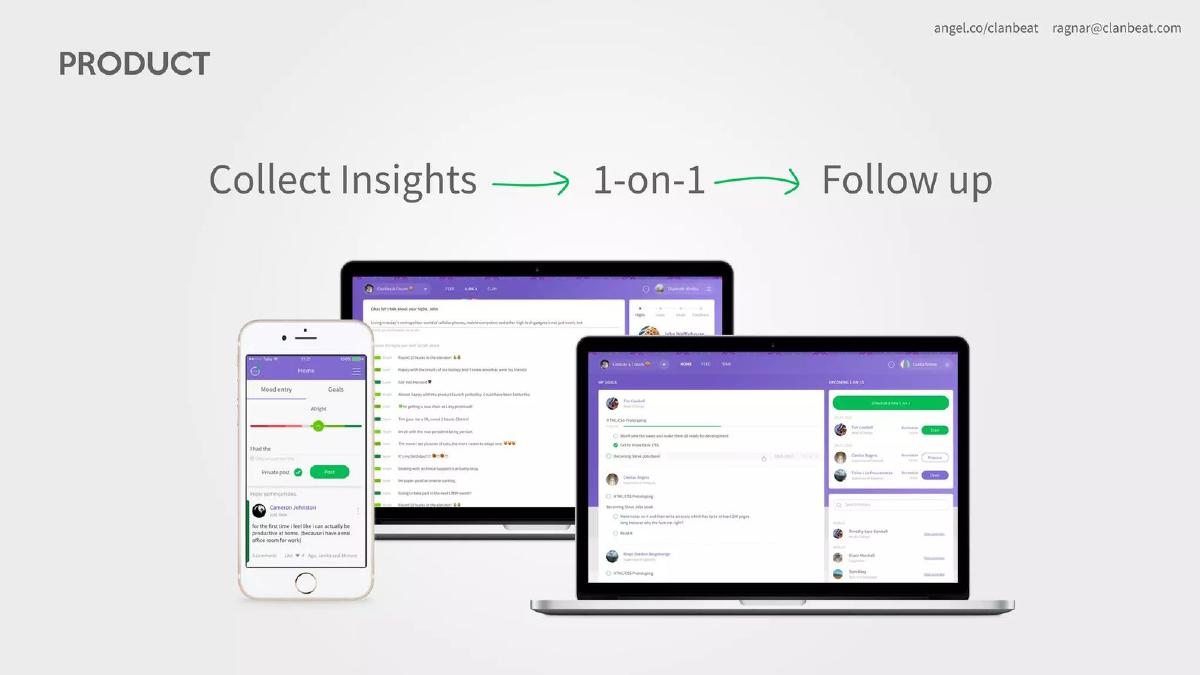
- The product workflow is simplified into three clear steps: Collect Insights, 1-on-1, and Follow up (Slide 6).
- Early traction is demonstrated through high-profile logos including Volvo, Ericsson, and Telia (Slide 7).
- The deck completely omits a formal 'Ask' slide, financial forecasts, and a competitive landscape analysis.
- The team slide mentions '5 other geniuses' beyond the core four, suggesting a total headcount of nine at the time of the pitch (Slide 2).
The Power of Pedigree: Clanbeat’s 8-Slide Seed Deck
Clanbeat’s 2019 seed deck is a fascinating example of how a high-signal founding team can raise significant capital ($1.2M) with a remarkably brief presentation. The deck does not follow the standard 15-20 slide template. Instead, it focuses on the emotional and financial pain of poor management and the credibility of the people solving it. By looking at the slides, it is clear that Clanbeat isn't just selling a productivity tool; they are selling a solution to the 'millennial turnover' problem that was peaking in the late 2010s.
Slide 1: The Hook
The cover slide is minimalist, featuring the Clanbeat logo and a bold tagline: "BE A BETTER MANAGER WITH 1-ON-1S" . This is a classic benefit-driven headline. It identifies the user (managers) and the specific mechanism of improvement (1-on-1s). There is no ambiguity here. An investor knows within three seconds exactly what the product does and who it is for.
Slide 2: The Founders
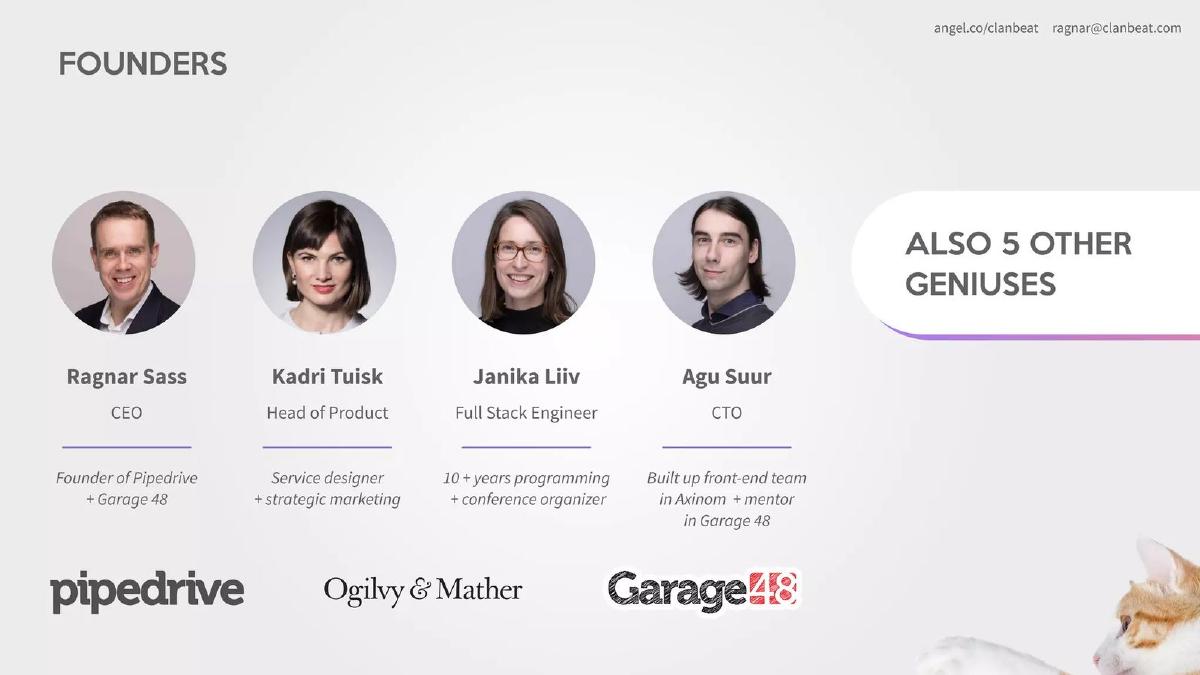
In many seed-stage decks, the team slide is buried at the end. Clanbeat puts it second. This is a strategic move. Ragnar Sass is listed as the CEO, with the explicit credit of being a "Founder of Pipedrive + Garage 48." Pipedrive is a massive success story in the CRM space, and leveraging that exit/growth experience immediately lowers the perceived risk for investors. The rest of the team—Kadri Tuisk, Janika Liiv, and Agu Suur—bring a mix of design, 10+ years of programming, and engineering leadership. They also mention "ALSO 5 OTHER GENIUSES," indicating a team of nine. The inclusion of the Pipedrive logo at the bottom of the slide does more heavy lifting than any metric could at this stage.
Slide 3: The Cost of the Problem
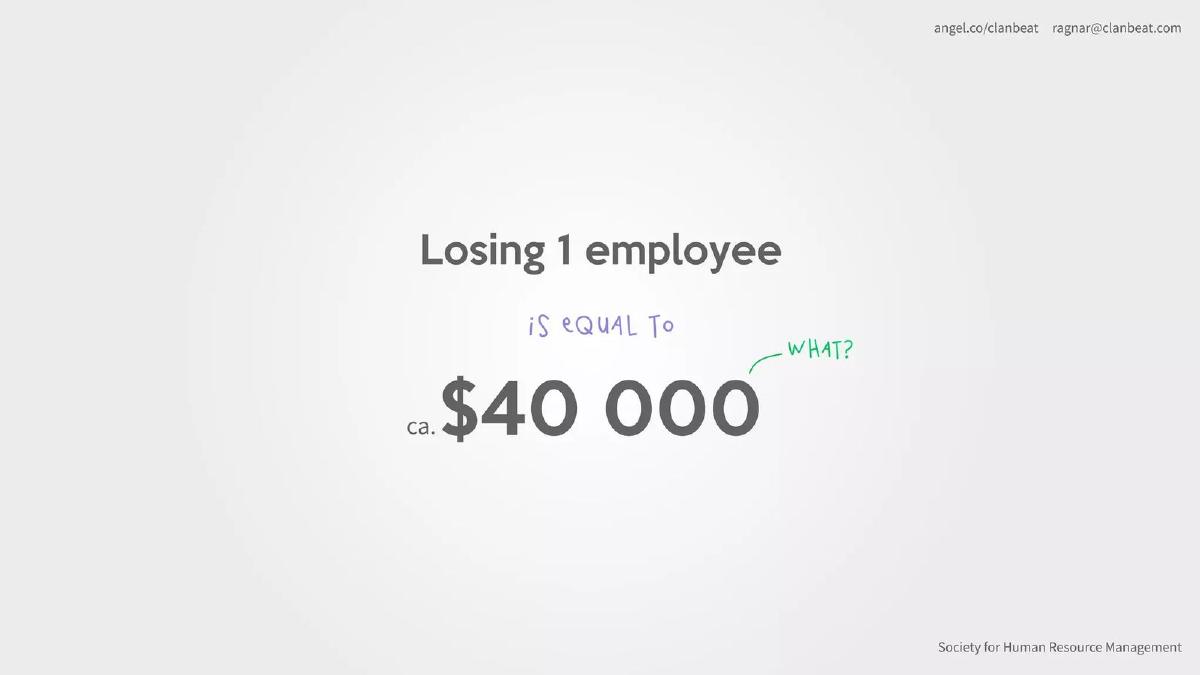
Slide 3 is a 'gut punch' slide. It features a single, large number: "$40,000." The text explains that "Losing 1 employee is eQUAL To ca. $40,000." By citing the Society for Human Resource Management, Clanbeat anchors the value of their product in hard currency. If the software can prevent even a handful of resignations, it pays for itself many times over. This transforms the product from a 'nice-to-have' HR tool into a 'must-have' financial safeguard.
Slide 4: Why Now?
The 'Why Now' slide uses a text-bubble aesthetic to explain market timing. It notes that "As of 2016 millennials are the largest part of the workforce." This demographic shift is presented as the catalyst for a "big change in company culture." The second bubble points out a market gap: companies are switching to 1-on-1s but lack the "tools or a clear process for it." This slide successfully argues that the old way of managing (annual reviews) is dead, and the new way (ongoing feedback) is currently unmanaged chaos.
Slide 5: The Solution
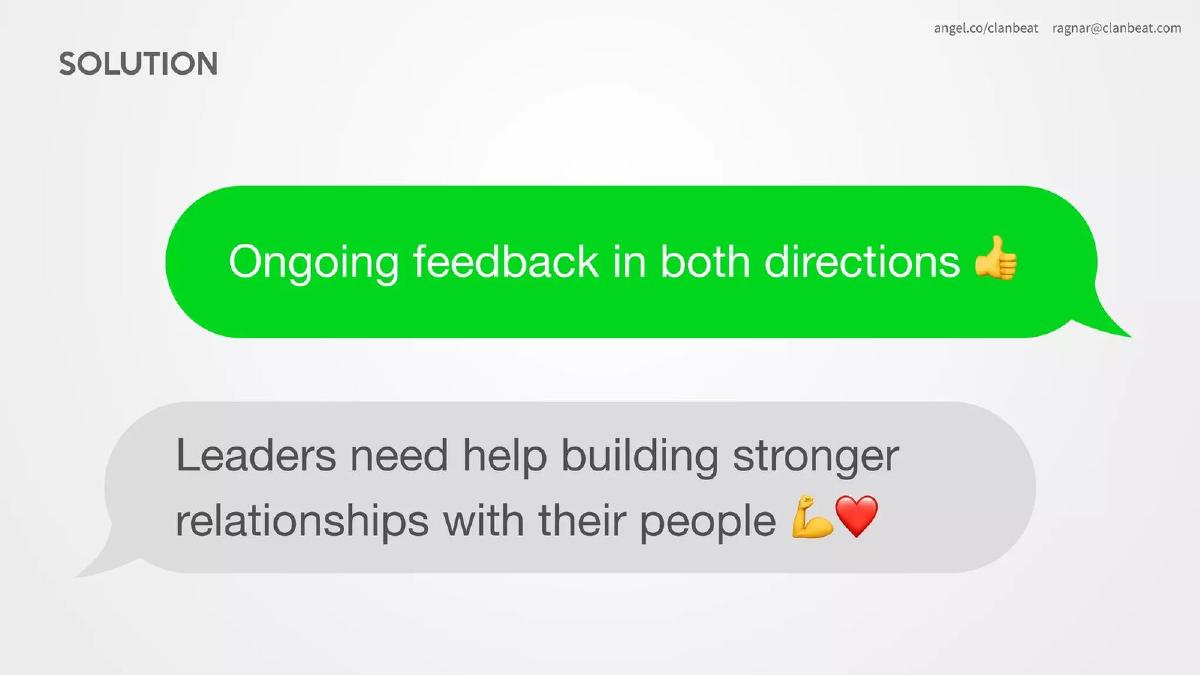
Continuing the text-bubble theme, Slide 5 defines the solution as "Ongoing feedback in both directions." It emphasizes the human element, stating that "Leaders need help building stronger relationships with their people." This slide is less about features and more about the philosophy of the product—moving management from a transactional process to a relational one.
Slide 6: Product Workflow
Slide 6 provides the only look at the actual interface. It breaks the product down into a simple three-step linear process: "Collect Insights —> 1-on-1 —> Follow up." The screenshots show a mobile app with a 'Mood entry' slider and a 'Private post' option, alongside a desktop view that manages 'Upcoming 1-on-1s.' This confirms the product is cross-platform and handles the entire lifecycle of a manager-employee interaction, not just the meeting itself.
Slide 7: Traction and Social Proof
For a seed round, the client list on Slide 7 is exceptionally strong. It features global giants like VOLVO and ERICSSON , alongside Telia, testlio, jura, brand manual, and THORGATE. Having enterprise-grade clients like Volvo and Ericsson using a seed-stage tool is a massive validation of the product's enterprise readiness and the team's ability to sell into complex organizations.
Slide 8: The Close
The final slide is a simple 'Thank You' with contact information for Ragnar Sass. Interestingly, his title is listed as "Co-Founder / Chief Energy Officer." The slide features a playful image of a cat wearing a hand-drawn crown and cape, chasing a toy. This maintains the 'Clan' brand's friendly, approachable vibe, which contrasts with the stiff, corporate nature of the HR industry they are disrupting.
What Clanbeat Does Well
Founder-Market Fit: By highlighting the Pipedrive connection early, they prove they know how to build and scale SaaS tools for business users. · Quantified Pain: The $40,000 turnover cost is a specific, memorable figure that makes the ROI calculation easy for an investor. · Simplicity: The deck is devoid of jargon. It uses simple language and clear visuals to explain a straightforward value proposition. · Enterprise Validation: Leading with Volvo and Ericsson logos immediately removes the 'will anyone buy this?' doubt.
What is Missing from the Clanbeat Deck
The Ask: There is no slide stating how much money they are raising or what the milestones for that capital will be. (We know from catalogue facts they raised $1.2M, but it isn't on the slides). · Market Size: There is no mention of the TAM (Total Addressable Market). Investors usually want to see that this could be a billion-dollar category. · Competition: The deck ignores competitors like Lattice, 15Five, or Culture Amp, which were active in the space in 2019. · Business Model: While the catalogue facts state it is SaaS, the deck doesn't explain the pricing tiers or how they land and expand within an organization.
What Founders Should Copy
Founders should emulate Clanbeat’s problem-anchoring . Don't just say 'employees are unhappy'; say 'unhappy employees cost you $40,000 each.' This turns a qualitative problem into a quantitative one. Additionally, the three-step product workflow (Collect -> Meet -> Follow up) is an excellent way to show product utility without getting bogged down in a feature list. Finally, if you have a 'star' founder or high-profile early clients, do not bury them. Put them at the front of the deck to establish the 'trust floor' immediately.
Frequently asked questions
- How does Clanbeat justify its market necessity?
- Clanbeat justifies its existence by citing a massive shift in workforce demographics. On Slide 4, they point out that as of 2016, millennials became the largest part of the workforce, bringing a 'big change in company culture.' They argue that while companies are moving toward ongoing feedback, they lack the tools to execute it, creating a gap that Clanbeat fills.
- What is the core financial argument for the product?
- The core financial argument is employee retention. Slide 3 explicitly states that losing a single employee costs a company roughly $40,000, citing the Society for Human Resource Management. By framing 1-on-1s as a tool to prevent this turnover, Clanbeat transforms a 'soft' HR tool into a 'hard' cost-saving solution.
- Who are the key members of the Clanbeat team?
- The team is led by CEO Ragnar Sass, a co-founder of Pipedrive and Garage 48. He is joined by Kadri Tuisk (Head of Product), Janika Liiv (Full Stack Engineer with 10+ years experience), and Agu Suur (CTO). The slide also mentions five additional unnamed employees, referred to as 'geniuses' (Slide 2).
- What does the product actually do?
- According to Slide 6, the product facilitates a three-step management loop: 'Collect Insights,' '1-on-1,' and 'Follow up.' Visuals show a mobile app for 'Mood entry' and goals, and a desktop dashboard for scheduling 1-on-1s and reviewing feedback history, aiming to build stronger relationships between leaders and their teams.
- What major components are missing from this pitch deck?
- This is a very lean deck that skips several standard sections. It lacks a 'Market Size' (TAM/SAM/SOM) slide, a 'Competition' slide, 'Unit Economics' (LTV/CAC), and a specific 'Funding Ask.' It relies almost entirely on the team's past success and the logos of early clients to prove viability.