Cladwell’s 8-slide deck is an exercise in extreme minimalism, mirroring the company’s core value proposition of 'buying less.' The presentation leans heavily on two primary pillars: a strong moral stance against fast fashion and undeniable growth metrics. By leading with an $815k ARR figure on the second slide, the founders immediately validate a counter-intuitive business model—a styling app that makes money by telling users not to shop. While the deck lacks traditional sections like a detailed competitive landscape, market sizing (TAM), or a specific financial ask, it compensates with high-…
Key takeaways
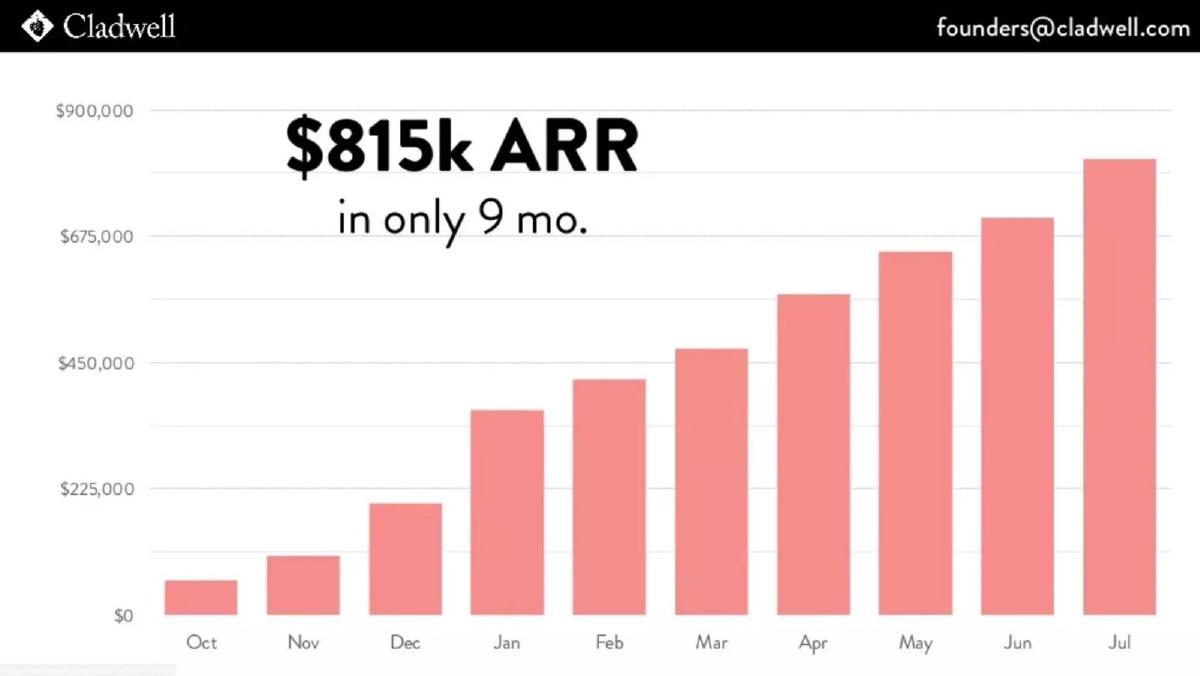
- The company reached $815k ARR within only 9 months of operation as shown on slide 2.
- The business model is built on a subscription service that helps users 'buy less clothing' by styling what they already own (slide 1).
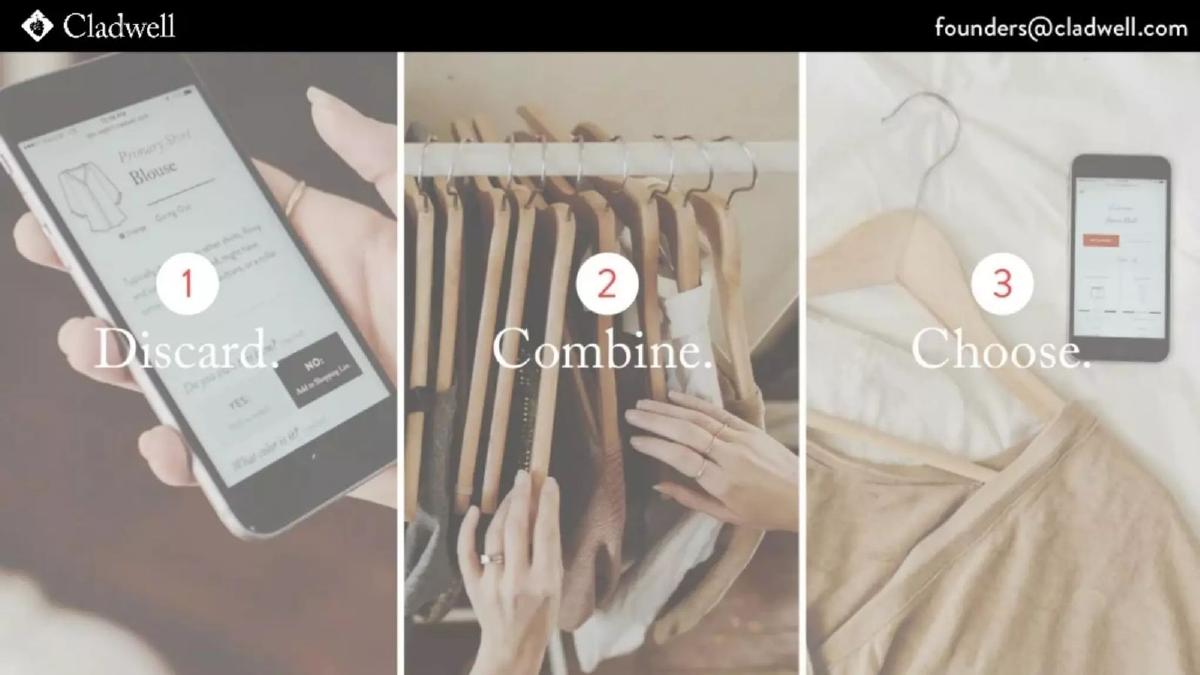
- The product workflow is simplified into three steps: Discard, Combine, and Choose (slide 4).
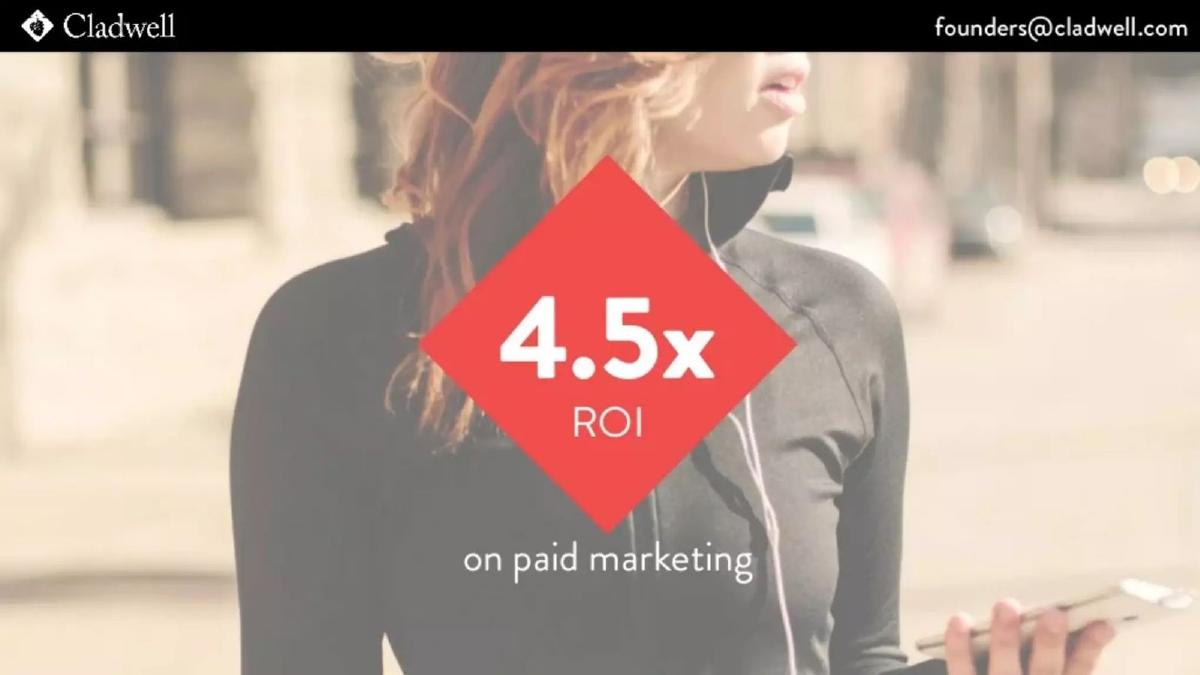
- Cladwell demonstrates high capital efficiency with a 4.5x ROI on paid marketing efforts (slide 5).
- The founding team leverages significant corporate experience with logos from P&G, Walmart, Macy's, and Elle Magazine (slide 6).
- The deck positions the company against the 'Fast Fashion' industry, using social impact imagery to support its mission (slide 7).
- Traction is summarized on the final slide with $815k ARR and 36% Month-over-Month growth (slide 8).
- The deck completely omits a slide detailing the specific investment amount being sought or the planned use of funds.
The Minimalism of Growth: Cladwell's 8-Slide Strategy
Cladwell’s pitch deck is a rare example of a 'traction-first' presentation. In an industry—fashion—often bloated with aesthetic fluff, this deck uses a lean, 8-slide structure to prove that a counter-cultural message ('Buy less') can result in traditional venture-scale growth. The deck was used in 2013 to support a company that eventually raised $2.8 million, positioning itself as the antithesis to the fast-fashion giants.
The Hook and the Numbers (Slides 1-2)
Slide 1: Title The cover slide is remarkably simple. It features the Cladwell logo and the tagline 'Buy less clothing.' The background image of a minimalist clothing rack immediately sets the tone for the brand's aesthetic and mission. There are no mentions of 'disruption' or 'AI-driven platforms,' just a clear, provocative value proposition.
Slide 2: Traction Cladwell makes a bold move by placing their most impressive metric on the second slide. The slide features a bar chart showing consistent growth from October to July, culminating in $815k ARR in only 9 mo. By leading with revenue, the founders pre-emptively answer the question of whether people will pay for an app that tells them not to shop. The chart shows a steady upward trajectory, moving from near-zero to nearly $900k in annualized revenue in less than a year.
The Problem and the Solution (Slides 3-4)
Slide 3: The Target Audience This slide serves as a transition, stating 'With millennials, less is more.' It identifies the target demographic and their shifting values toward minimalism and sustainability. It is a 'soft' problem slide that relies on the investor's understanding of current cultural shifts rather than citing specific pain points like 'cluttered closets' or 'decision fatigue.'
Slide 4: The Product Workflow Instead of a complex feature list, Cladwell uses three images to explain the user journey: 1. Discard, 2. Combine, 3. Choose. This slide demonstrates how the software works in practice—helping users audit their clothes, see new combinations, and pick an outfit. The use of actual app screenshots within the lifestyle photography helps ground the abstract concept of 'styling software' into a tangible tool.
Efficiency and Expertise (Slides 5-6)
Slide 5: Marketing Efficiency Growth is only impressive if it is sustainable. Slide 5 features a large red diamond with 4.5x ROI on paid marketing printed in the center. This is a vital piece of data for a later-stage deck. It tells investors that the $815k ARR wasn't bought at an unsustainable cost, but rather generated through an efficient acquisition engine that is ready for more capital.
Slide 6: The Team The team slide features three founders but focuses heavily on their professional pedigree via logos. The logos for Elle Magazine, Lacoste, P&G, Walmart, Huff Post, Macy's, and Abercrombie & Fitch are displayed prominently. This suggests a blend of high-fashion editorial experience (Elle), massive retail distribution (Walmart, Macy's), and consumer brand building (P&G). It is a 'heavyweight' team slide that compensates for the lack of biographical text.
Mission and Summary (Slides 7-8)
Slide 7: The 'Why' Slide 7 takes a political and social stance with the text 'Fast fashion is over.' The background image shows garment workers at sewing machines, highlighting the human cost of the industry Cladwell is fighting. This slide aims to capture the 'moral high ground,' framing the investment not just as a financial opportunity, but as a stake in a necessary global shift.
Slide 8: The Closing Traction Summary The final slide brings the focus back to the business. It shows a smartphone displaying the app interface (noting '25 items in your closet' and '75% of items worn') alongside three key metrics: $815k ARR, 36% MoM, and 4.5x ROI. It ends with a call to action to visit their AngelList profile. Notably, there is no mention of how much they are raising or what the valuation is, which is typical for decks designed to spark a conversation rather than close a deal on the spot.
What Works in the Cladwell Deck
The primary strength of this deck is its clarity of purpose. Many founders feel the need to fill 20 slides with market research and technical specifications. Cladwell assumes the investor understands that fashion is a large market and instead focuses entirely on their unique 'Buy Less' angle and the revenue it has generated. The 4.5x ROI metric is the star of the show; it transforms a 'lifestyle app' into a 'growth machine' in the eyes of an analyst. Furthermore, the visual consistency is excellent. The deck feels like the product: clean, uncluttered, and intentional.
What is Missing from the Cladwell Deck
While the minimalism works for the brand, the deck leaves several critical questions unanswered for a professional investor. First, there is no competitive analysis. While Cladwell claims to be the 'first to monetize' this trend in their catalogue description, the deck doesn't mention how they differ from Pinterest, Stitch Fix, or simple wardrobe tracking apps. Second, the lack of an 'Ask' slide is a significant omission. An investor looking at this deck doesn't know if the company is looking for $500k or $5 million. Finally, there is no Total Addressable Market (TAM) calculation. While the 'millennial' slide hints at a large audience, it doesn't quantify the dollar value of the 'anti-fast fashion' movement.
What a Founder Should Copy
Founders should emulate Cladwell's 'Traction First' approach. If you have nearly $1 million in ARR and high growth rates, you don't need to spend five slides explaining why the problem exists—the revenue proves the problem is being solved. Additionally, the three-step product explanation on slide 4 is a perfect way to handle a 'How it Works' slide. It avoids the 'wall of text' trap and uses imagery to convey the user experience. Lastly, the use of bold, singular metrics (like the 4.5x ROI) ensures that the most important data points are remembered long after the presentation ends. This deck proves that if your numbers are strong enough, you can afford to be brief.
Frequently asked questions
- What is Cladwell's core business model according to the deck?
- Cladwell operates as a styling app that charges users a subscription fee ($5/mo according to catalogue facts) to organize their existing wardrobe. Unlike traditional fashion tech that profits from affiliate sales or new purchases, Cladwell’s software provides daily outfit recommendations from a user's current closet to discourage unnecessary consumption.
- How does the deck demonstrate market validation?
- Validation is presented through rapid financial growth rather than theoretical market research. Slide 2 shows a bar chart documenting a climb to $815k ARR in just nine months. This is reinforced on slide 8, which notes a 36% Month-over-Month growth rate, proving that consumers are willing to pay for minimalist styling services.
- What information is missing from the Cladwell pitch deck?
- The deck is missing several standard components: a specific 'Ask' slide (how much money they want), a 'Use of Funds' breakdown, a 'Competitor' matrix, and a 'Market Size' slide. It also lacks a detailed breakdown of unit economics beyond the mention of marketing ROI.
- What is the significance of the 4.5x ROI mentioned on slide 5?
- The 4.5x ROI on paid marketing is a critical metric for investors. It suggests that for every dollar spent on customer acquisition, the company generates $4.50 in value. This indicates a highly efficient growth engine and suggests that additional capital could be effectively deployed to scale the user base.
- How does the team slide establish credibility?
- Slide 6 uses high-quality headshots and a row of prestigious corporate logos including P&G, Walmart, and Macy's. This signals to investors that the founders have deep roots in retail, consumer goods, and fashion media, providing the necessary domain expertise to disrupt the traditional apparel market.