Claap’s 2022 seed deck is a masterclass in category design and narrative-driven fundraising. By framing the problem as 'calendar hell' and 'Zoom fatigue,' the company positioned its asynchronous video platform not just as a tool, but as a fundamental shift in how remote teams operate. The deck leans heavily on the 'Why Now'—citing the post-pandemic shift to work-from-anywhere—and provides a clear roadmap for virality through a freemium model. While the deck is light on hard financial historicals, it compensates with strong social proof from high-growth tech companies and a team with deep expe…
Key takeaways
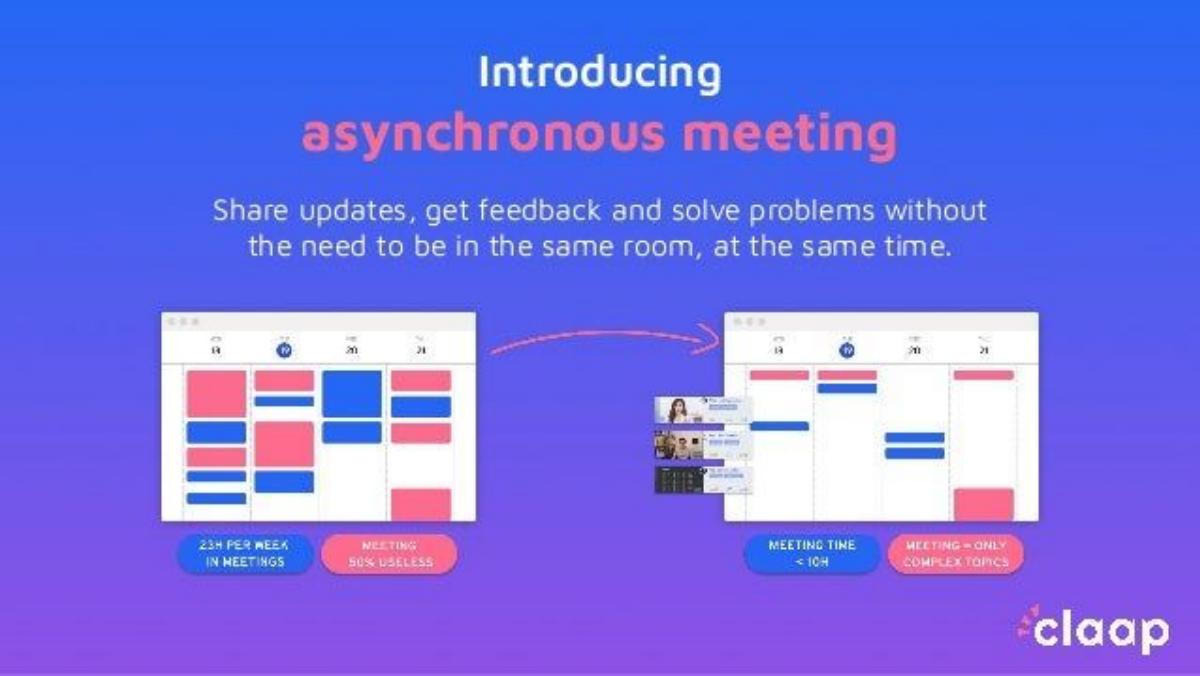
- The deck explicitly defines a new category called 'Asynchronous Meeting' to differentiate from standard video conferencing (Slide 6).
- Claap uses a 'Before vs. After' comparison to highlight the transition from 'Calendar hell' to 'Short & actionable' video updates (Slide 8).
- The product strategy focuses on 'product teams' use cases' to maximize initial virality and usage (Slide 9).
- Market timing is justified by the fact that 1 billion workers now have jobs that can be done from anywhere (Slide 12).
- The growth strategy relies on a viral coefficient (K) formula where K = i x conv% (Slide 16).
- The roadmap targets a specific milestone of 180k free users and $1M ARR by December 2022 (Slide 17).
- Early traction is demonstrated through social media engagement, including 42k viewers from just 4 LinkedIn posts (Slide 18).
- The team slide highlights significant scaling experience, with the CEO having grown a previous team from 50 to 450 employees (Slide 19).
The Narrative: Moving Beyond the Meeting
Claap’s pitch deck is built on a single, powerful premise: the way we work is broken. By 2022, the 'Zoom fatigue' narrative was well-established, and Claap used this cultural momentum to pitch a structural solution. The deck doesn't just sell a feature; it sells a new category of work called the 'Asynchronous Meeting.' This is a classic strategic move for seed-stage startups—if you can't be the best in an old category, define a new one where you are the only player.
Slides 1-2: The Hook
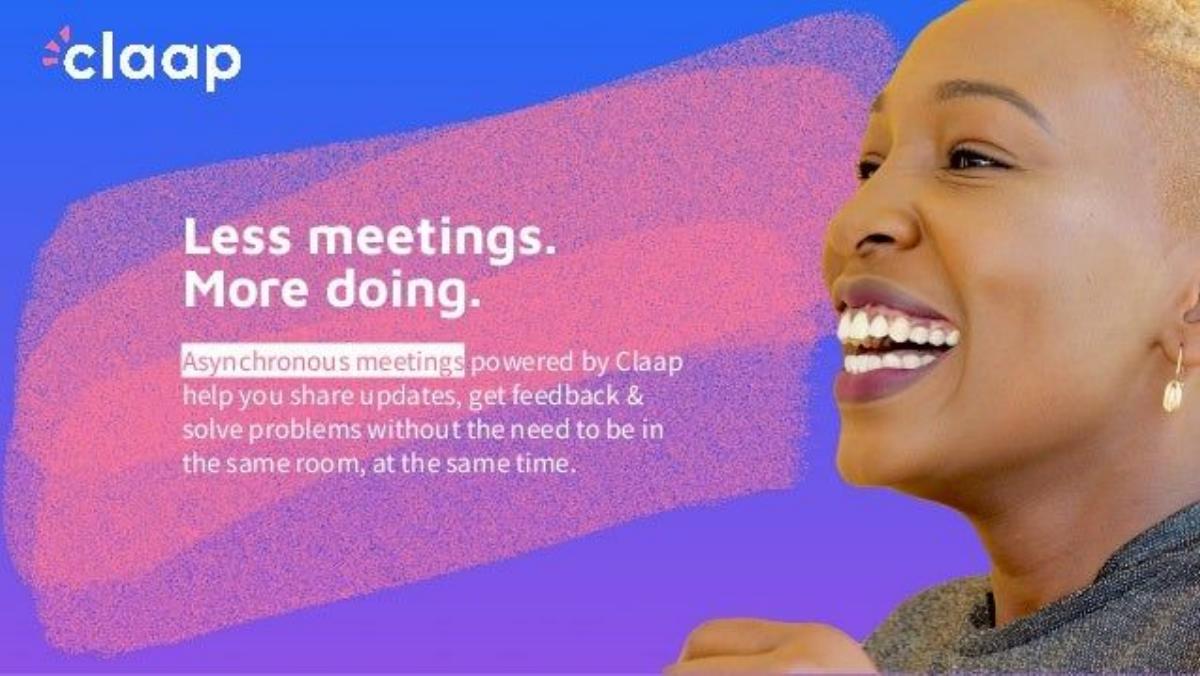
The deck opens with a clean, brand-forward title slide. Slide 2 immediately delivers the value proposition: "Less meetings. More doing." This is a high-level emotional hook that appeals to the primary pain point of their target audience (knowledge workers). It defines asynchronous meetings as a way to share updates and solve problems without being in the same room at the same time.
Slides 3-5: Establishing the Problem and 'The Shift'
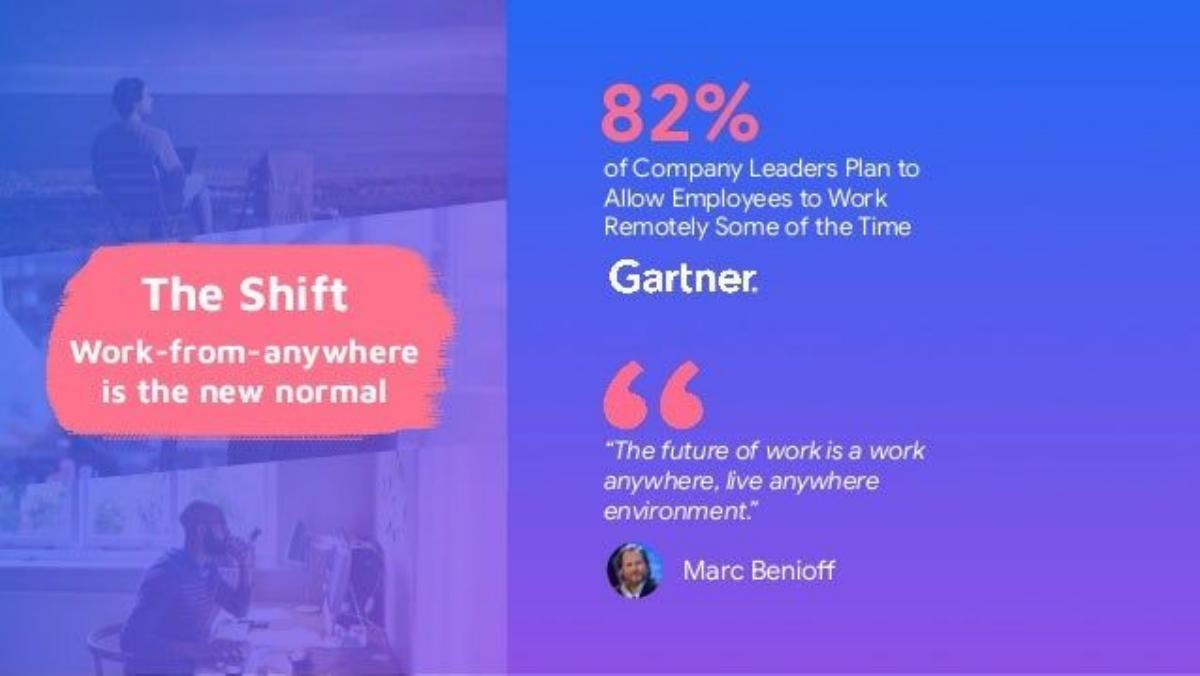
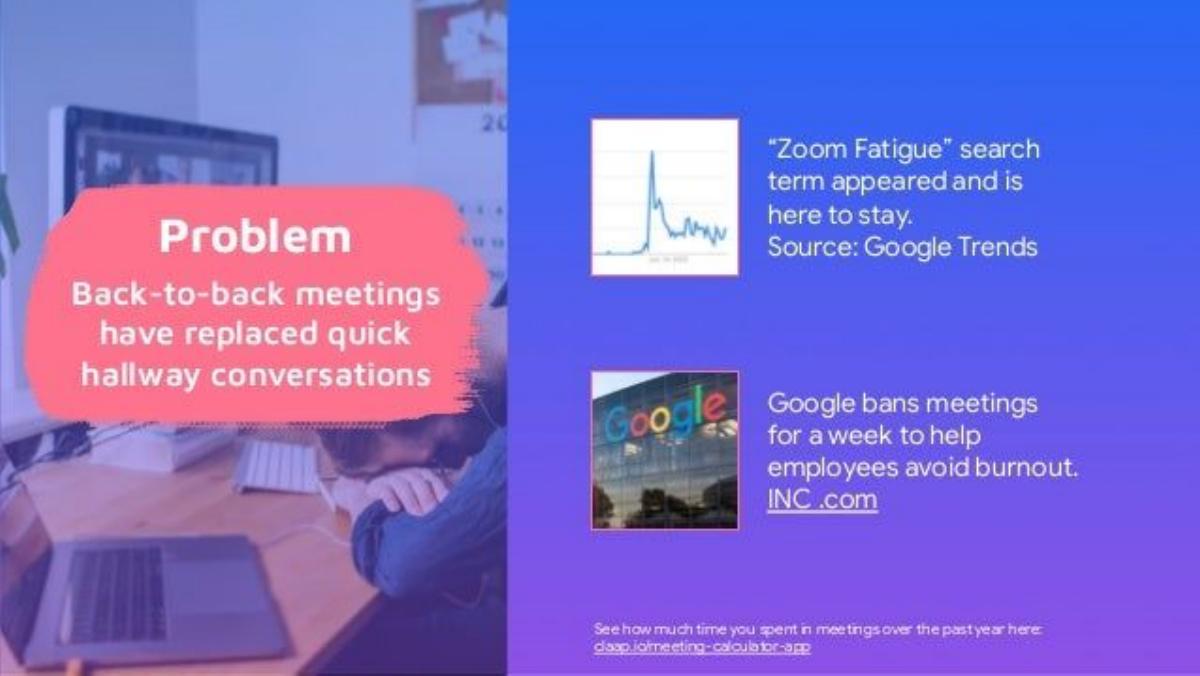
Slide 3 uses a Gartner stat (82% of leaders plan to allow remote work) and a Marc Benioff quote to establish that remote work is not a fad but the 'new normal.' Slide 4 gets specific about the pain: "Back-to-back meetings have replaced quick hallway conversations." It cites Google Trends for 'Zoom Fatigue' and an INC.com article about Google banning meetings for a week. Slide 5 serves as a transition, stating that our current work habits are suited for a world that no longer exists. This builds a sense of urgency for a new solution.
Slides 6-8: The Solution and Category Definition
Slide 6 introduces the 'Asynchronous Meeting' category. It uses a visual comparison of a calendar: the 'Before' is a wall of blue and pink blocks (23h per week in meetings), while the 'After' shows a clear calendar with meeting time reduced to less than 10 hours. Slide 7 explains how Claap integrates with existing tools like Figma, Trello, and GitHub, describing itself as a "layer of feedback." Slide 8 uses a 'Before vs. After' table to contrast 'Calendar hell' and 'Information black boxes' with 'Short & actionable' video topics that are 'Transparent & in-context.'
Slides 9-10: Product and Use Cases
Slide 9 identifies six specific use cases to drive adoption: Technical Brainstorming, Design Reviews, Product Demos, Issue Qualification, Performance Reporting, and Customer Updates. By focusing on product teams, Claap targets the most 'collaborative' units within a company to maximize virality. Slide 10 provides a high-fidelity product screenshot, showing a video recording with a timestamped comment thread on the right, demonstrating how the feedback loop actually looks in practice.
Slides 11-12: Validation and Market Timing
Slide 11 provides social proof through 'consulting missions.' It features testimonials from CEOs and CPOs at companies like Capcar, MoovOne, and Kactus. This is a clever way to show product-market fit before having a fully scaled user base. Slide 12 addresses 'Why Now?' through a Venn diagram of Market, Technology, and Behavior. It claims 1 billion workers now have jobs that can be done from anywhere and notes that video has become the #1 media format.
Slides 13-15: Go-To-Market and Competition
Slide 13 outlines the target segments (Digital SMBs for launch, Distributed Tech for growth) and channels (Inbound, Chrome App Store, and Integrations). Slide 14 places Claap in the top-right quadrant of a 2x2 matrix, defined by 'Asynchronous communication' and 'Human Bandwidth.' It positions Claap against Zoom (synchronous) and Slack (low bandwidth). Slide 15 is a direct competitor comparison chart, claiming Claap is the only tool that covers the full spectrum from 'Recording Experience' to 'Collaborative Workspace,' specifically outperforming Loom and Fellow in the latter categories.
Slides 16-18: Business Model and Traction
Slide 16 explains the viral growth loop with a formula for the viral coefficient (K). It shows how a video shared by a product team can move through revenue teams and eventually to external clients. Slide 17 provides the roadmap: 10k free users by Dec 2021 and 180k free users/$1M ARR by Dec 2022. Slide 18 shows pre-launch traction, citing 42k viewers from 4 LinkedIn posts and a list of 'subscriber' logos including Revolut, Uber, and Miro.
Slides 19-21: Team and Summary
Slide 19 introduces the founders, Robin Bonduelle (CEO) and Pierre Touzeau (COO). Their bios emphasize scaling experience, specifically mentioning growth from 50 to 450 employees and 20 to 200 employees at previous ventures. Slide 20 summarizes the company's goals: building a work-from-anywhere company, creating the 'Asynchronous Meeting' category, and executing a product-led growth playbook. Slide 21 is a simple 'Thank you' slide.
What Works in This Deck
Category Design: Claap doesn't call itself a 'video recorder.' By using the term 'Asynchronous Meeting,' they elevate the product's perceived value from a utility to a strategic necessity. This helps justify a higher valuation and differentiates them in a crowded market.
The 'Before vs. After' Narrative: The deck is highly effective at visualizing the 'pain' of the current state. The calendar comparison on Slide 6 is a visceral image that any manager or executive can immediately relate to.
Viral Loop Logic: Instead of just saying they will grow, Slide 16 explains how . Showing the path from a PM to a Client creates a logical argument for low-cost customer acquisition, which is highly attractive to Seed investors.
What is Missing
The Ask: While the catalogue facts state they raised $3M, the deck itself does not include a slide detailing how much they are raising or how they plan to allocate the capital (e.g., % to engineering vs. % to marketing).
Unit Economics: There is no mention of LTV (Lifetime Value) or CAC (Customer Acquisition Cost). While common for early seed decks to lack these, the mention of a 'predictable viral coefficient' invites questions about the underlying math that aren't fully answered.
Technical Moat: The deck focuses heavily on workflow and category. It doesn't explain if there is any proprietary technology behind the video processing or integrations that would prevent a larger player like Slack or Zoom from simply adding a 'Claap-like' feature.
Founder's Playbook: What to Copy
Use Social Proof Early: If you don't have 1,000 paying customers, do what Claap did on Slide 11. Run 'consulting missions' or pilot programs and get high-quality testimonials from recognizable titles (CEO, CPO). This de-risks the 'Problem' part of your deck.
Focus on a Power User Segment: Claap didn't say 'everyone' should use this. They specifically targeted 'Product Teams' (Slide 9). By winning the most collaborative group first, you ensure your product gets shared naturally across the rest of the organization.
Visual Simplicity: The deck uses a consistent color palette and very little text. It relies on diagrams and screenshots to tell the story. Founders should aim for this level of 'glanceability'—an investor should understand the point of a slide within 3 seconds.
Frequently asked questions
- What is Claap's core value proposition?
- Claap positions itself as a 'layer of feedback' on top of existing tools like Figma, Slack, and GitHub. According to slide 7, it adds context through voice and video, streamlines decisions via dedicated channels, and provides accessibility to stakeholders who may not have seats on specialized design or technical tools.
- How does Claap plan to compete with established players like Loom?
- On slide 15, Claap differentiates itself from Loom and Bubbles by claiming a superior 'Collaborative Workspace' and 'Follow-Up & Tracking' experience. While Loom is framed as a recording tool, Claap positions itself as a full asynchronous meeting platform that owns the entire feedback workflow.
- What are the primary target markets for Claap?
- The company targets the US and Europe simultaneously. Slide 13 outlines a two-phase approach: launching with digital SMBs and agencies (20-200 employees) and growing into medium-to-large distributed tech companies (100-1000 employees).
- What is the 'viral loop' mentioned in the deck?
- Slide 16 details a freemium business model where internal usage naturally leads to external sharing. A product team (PM, Design, Dev) shares a 'claap' with revenue or support teams, who then share it with clients, creating a cross-company expansion loop intended to keep the viral coefficient above 1.
- Does the deck include financial projections?
- The deck includes a high-level goal on slide 17 to reach $1M ARR by December 2022 with a 4% conversion rate from free to paid users. However, it does not provide a detailed P&L, burn rate analysis, or specific breakdown of expenses.