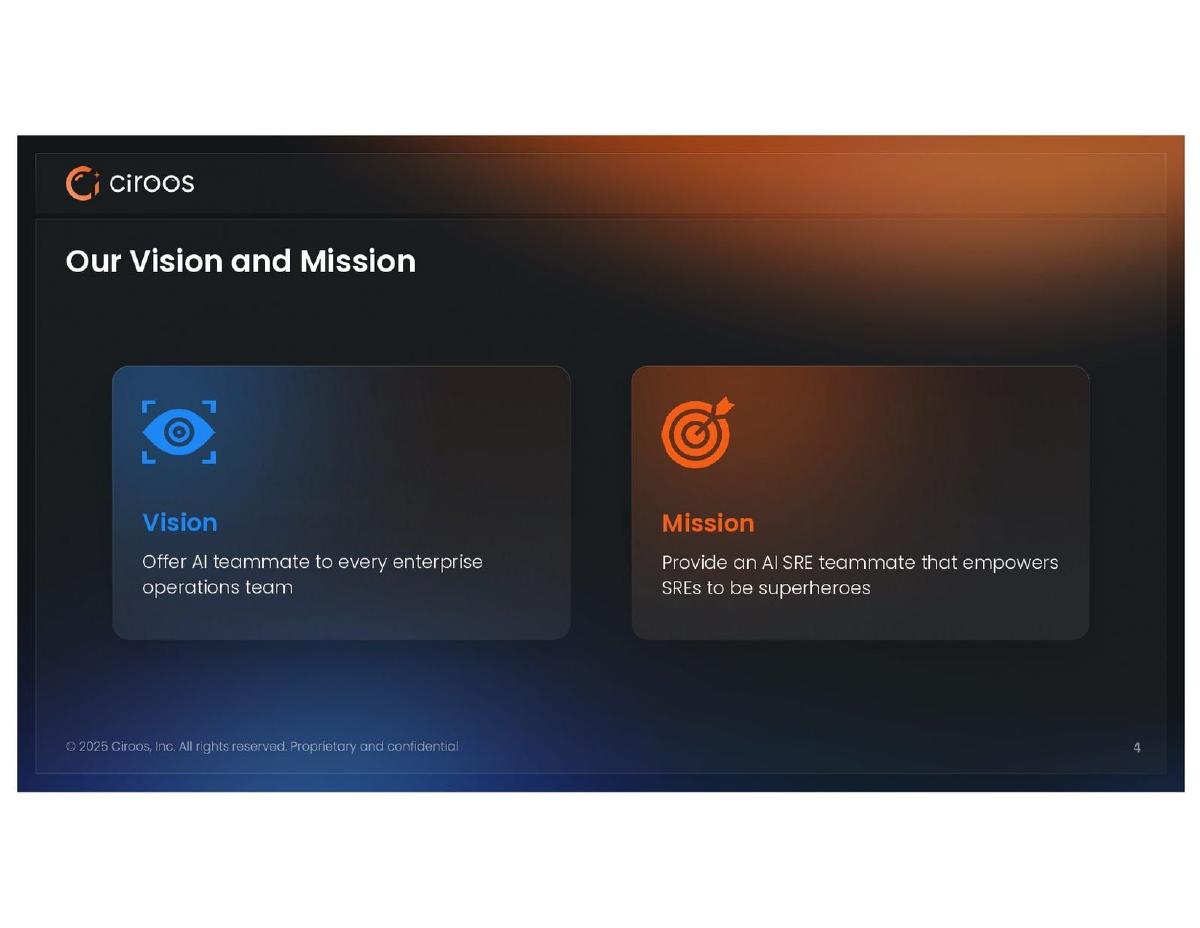
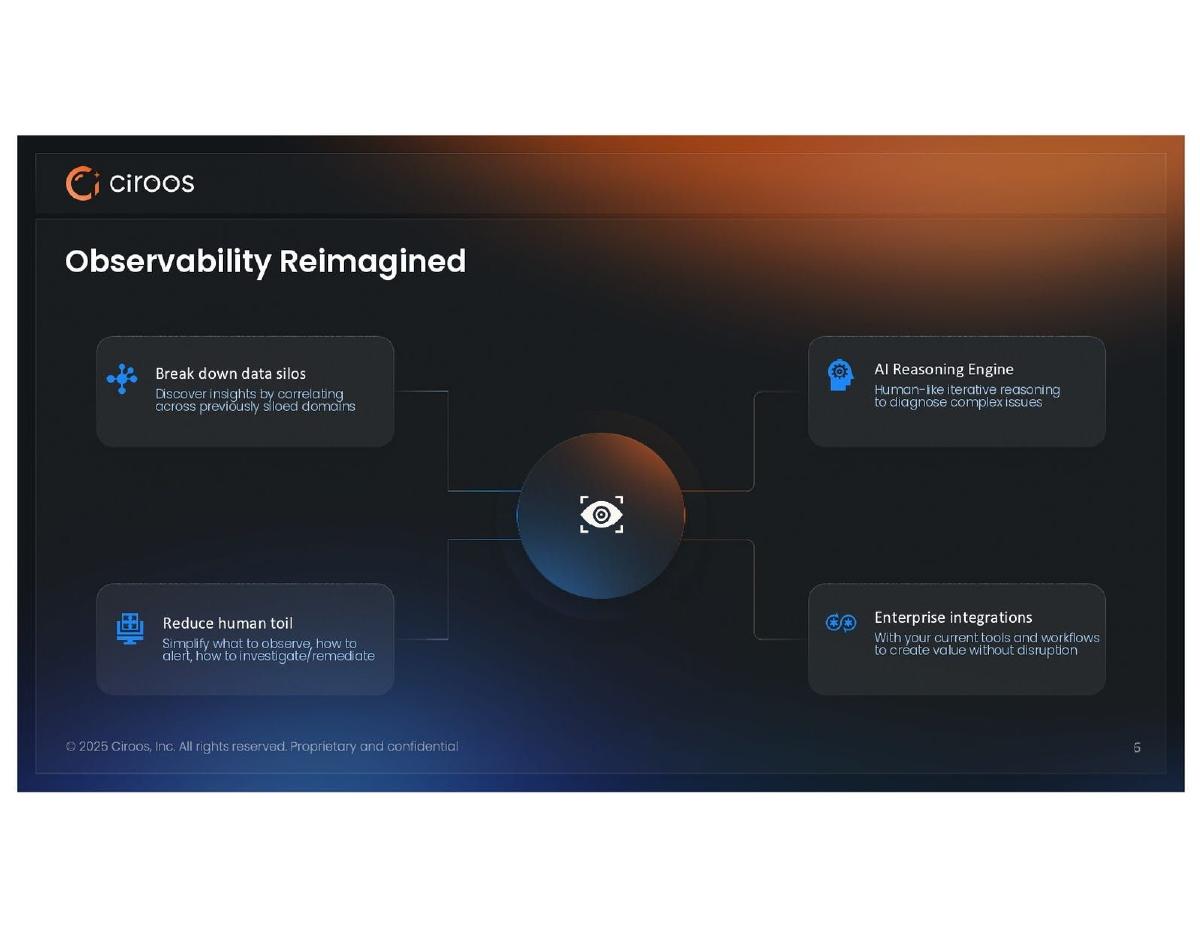
Ciroos secured a significant $21M Seed round in 2024 by positioning themselves as the autonomous future of Site Reliability Engineering (SRE). The 11-slide deck is a lean, professional presentation that leans heavily on the founders' deep experience at AppDynamics and Cisco. By identifying a specific bottleneck—the 'click ops' nature of modern incident investigation—Ciroos promises to reduce Root Cause Analysis (RCA) from over 40 minutes to just 3 minutes. The deck lacks traditional financial projections, a competitive landscape, or a specific 'ask' slide, suggesting the round was driven by t…
Key takeaways
- The deck relies on a massive reduction in Root Cause Analysis (RCA) time, claiming a drop from 40-60+ minutes to ~3 minutes on slide 9.
- Founder pedigree is the primary trust signal, with all three founders citing leadership roles at AppDynamics and Cisco on slide 3.
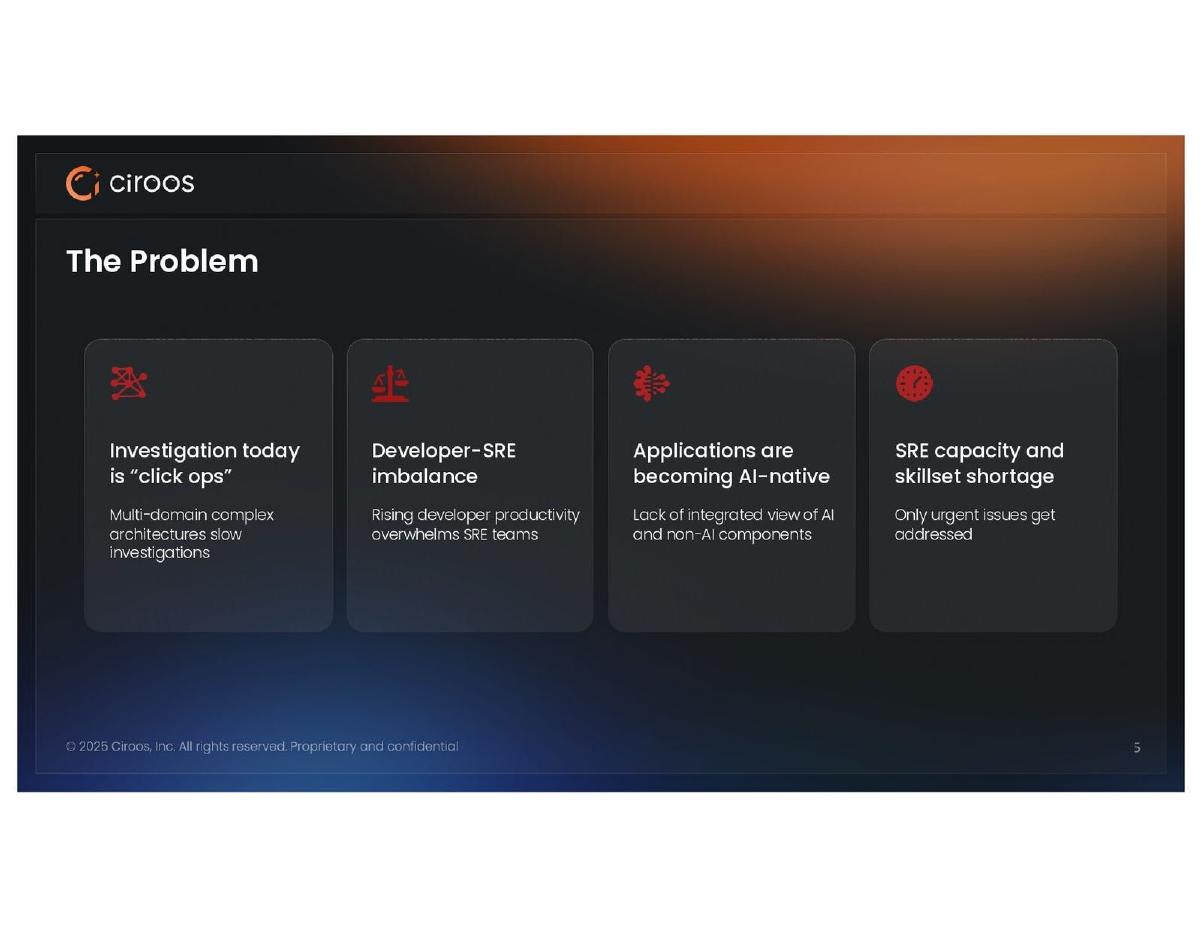
- The problem is framed as a 'Developer-SRE imbalance' where rising productivity overwhelms operations teams, as stated on slide 5.
- The solution is described as a 'multi-agentic platform' that maintains a 'human in the loop' for alert resolution on slide 7.
- Ciroos targets eight specific technical domains including Kubernetes, GPU, and Serverless to provide cross-domain correlation on slide 7.
- The deck omits a business model, go-to-market strategy, and a specific funding request.
- The company uses the term 'click ops' on slide 5 to describe the inefficiency of current manual investigation processes.
- Reported by Business Insider, the company successfully raised $21M in 2024 for this North American enterprise tech venture.
Ciroos: The $21M Seed Deck Analysis
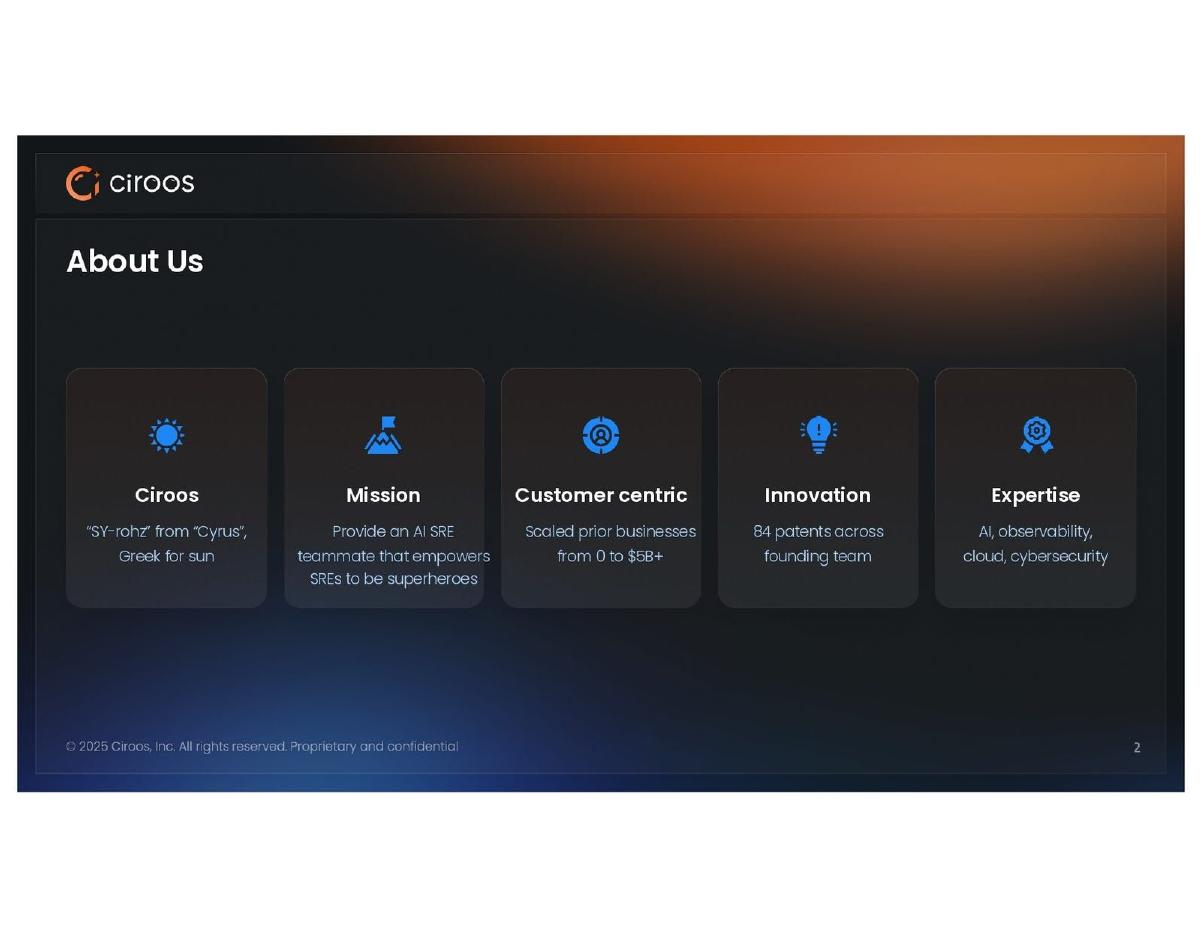
Ciroos entered the market in 2024 with a high-conviction Seed round of $21M, as reported by Business Insider. In the world of enterprise tech, a Seed round of this magnitude usually signals one of two things: a breakthrough technology or a team with an impeccable track record. In the case of Ciroos, it is both. The deck is a lean 11 slides, focusing on the transition from manual 'click ops' to autonomous AI agents for Site Reliability Engineering (SRE).
Slide 1: Title Slide
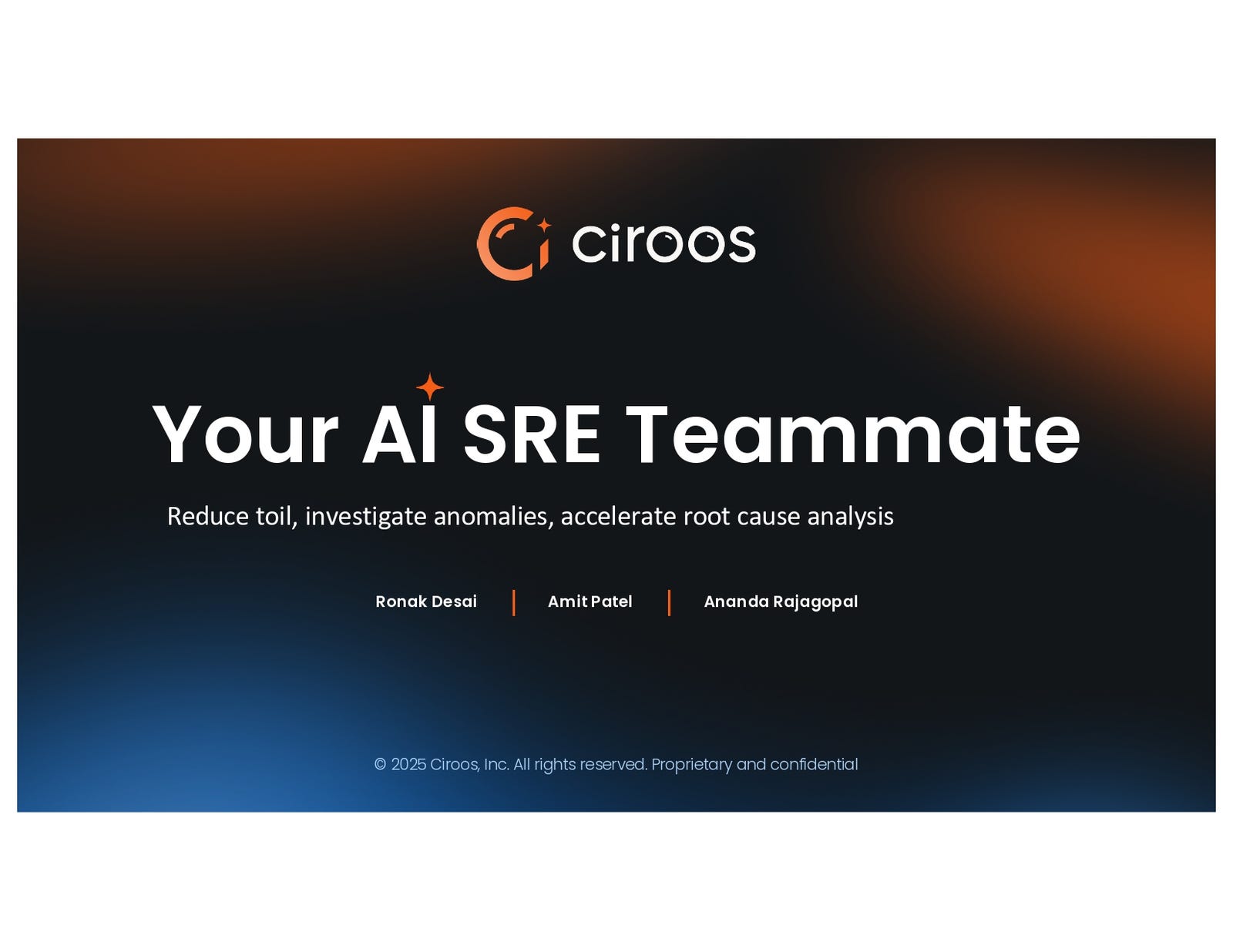
The deck opens with a clean, dark-themed title slide. It introduces the company name, Ciroos, and the three founders: Ronak Desai, Amit Patel, and Ananda Rajagopal. The subtitle, 'Your AI SRE Teammate,' immediately establishes the product category. It also lists three core functions: 'Reduce toil, investigate anomalies, accelerate root cause analysis.' This slide sets a professional, enterprise-grade tone from the outset.
Slide 3: The Founders
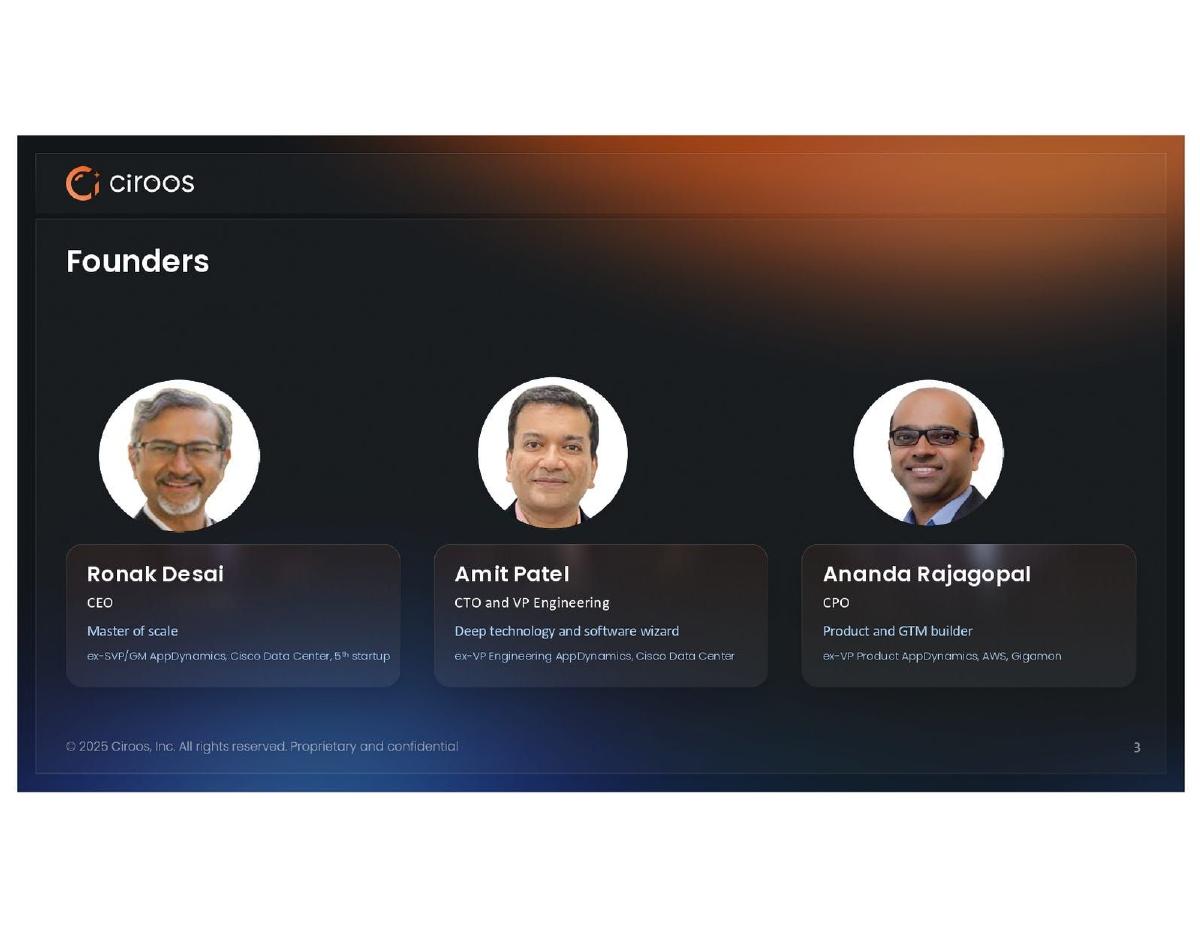
Slide 3 is arguably the most important slide in this specific deck. It details the pedigree of the three founders, which explains the high valuation and round size. Ronak Desai (CEO) is described as a 'Master of scale' and was formerly the SVP/GM at AppDynamics and Cisco Data Center. Amit Patel (CTO) is labeled a 'Deep technology and software wizard,' also coming from VP Engineering roles at AppDynamics and Cisco. Ananda Rajagopal (CPO) is a 'Product and GTM builder' with experience at AppDynamics, AWS, and Gigamon. The combined experience at AppDynamics—a pioneer in application performance monitoring—gives the team instant credibility in the SRE space.
Slide 5: The Problem
Slide 5 identifies four distinct pain points in modern software operations. First, it characterizes current investigation methods as 'click ops,' where complex architectures slow down manual human efforts. Second, it notes a 'Developer-SRE imbalance,' suggesting that as developers become more productive (likely due to AI coding tools), they overwhelm the SRE teams responsible for maintaining those systems. Third, it highlights that 'Applications are becoming AI-native,' creating a need for an integrated view of both AI and non-AI components. Finally, it points to a 'SRE capacity and skillset shortage,' where only the most urgent issues receive attention.
Slide 7: The Solution - Your Ciroos AI SRE Teammate
This slide introduces the product architecture. It describes Ciroos as a 'Multi-agentic platform with human expert-like reasoning.' The visual component shows a central Ciroos hub connected to eight nodes: Network, Security, Serverless, GPU, Kubernetes, Database, Messaging, and Compute. The slide emphasizes 'cross-domain correlation' and 'AI-driven alert resolution with human in the loop.' The inclusion of 'GPU' and 'Serverless' as specific nodes highlights the platform's readiness for modern, AI-heavy infrastructure.
Slide 9: The Value Proposition - Faster RCA
Slide 9 provides the 'killer metric' for the pitch. It compares a 'Human SRE only' workflow against the 'Ciroos AI SRE Teammate.' According to the slide, a human takes 40 - 60+ minutes for Root Cause Analysis (RCA) in a best-case scenario. Ciroos claims to perform the same task in ~3 minutes . This is labeled as a '10x SRE' improvement. For enterprise customers, reducing downtime by 90% or more is a massive financial incentive, making this the primary economic driver of the pitch.
Slide 11: Questions & Next Steps
The deck concludes with a standard 'Questions & Next Steps' slide. It does not include a specific 'Ask' (e.g., 'We are raising $X million'). This suggests that the deck was likely used as a presentation tool for a round that was already in high demand or that the specific terms were handled in separate documentation.
What Works in the Ciroos Deck
Pedigree-Driven Authority: The founders do not bury their experience. By placing the team slide early (Slide 3) and highlighting their leadership roles at AppDynamics and Cisco, they eliminate the need to prove they understand the market. They are the market experts.
Clear Quantification of Value: Slide 9 is the strongest slide in the deck. By comparing 60 minutes of human labor to 3 minutes of AI labor, they provide a clear, visceral reason for a CTO to buy the product. It moves the conversation from 'this is cool technology' to 'this saves us millions in downtime.'
Modern Problem Framing: The mention of 'AI-native applications' and 'GPU' nodes shows that Ciroos is not just solving yesterday's problems. They are positioning themselves as the necessary infrastructure for the next wave of software development.
What is Missing from the Ciroos Deck
Business Model and Pricing: There is no mention of how Ciroos intends to make money. While common in early-stage Seed decks for highly technical products, investors usually want to see a path to monetization, whether it is per-node, per-agent, or seat-based pricing.
Competitive Landscape: The observability and SRE space is crowded with incumbents (Datadog, New Relic, Dynatrace) and new AI startups. The deck does not explicitly state how Ciroos differentiates itself from these players, other than the 'multi-agentic' approach.
Go-To-Market (GTM) Strategy: There is no information on how the company plans to acquire its first 10 or 100 enterprise customers. Given the $21M raise, a significant portion of that capital will likely go toward sales and marketing, yet the strategy is absent from these slides.
What Other Founders Should Copy
The 'Teammate' Positioning: Rather than positioning the AI as a replacement for humans—which can cause internal friction within a prospect's organization—Ciroos calls it an 'AI SRE Teammate.' This 'human-in-the-loop' messaging is much easier for enterprise organizations to adopt.
Focus on a Single, High-Value Metric: Many founders try to list twenty different benefits. Ciroos focuses heavily on RCA time. By winning on one critical metric that everyone in the industry understands (Mean Time to Resolution), they create a compelling hook that makes the rest of the platform's features feel like a bonus.
Minimalist Design: The deck uses a consistent, dark, high-contrast design that feels 'tech-forward.' It avoids clutter and uses icons effectively to communicate complex infrastructure concepts (Slide 7). This professional polish is essential when pitching to top-tier VCs for an eight-figure Seed round.
Frequently asked questions
- How much did Ciroos raise and at what stage?
- According to publisher-reported facts from Business Insider, Ciroos raised $21M in a Seed round in 2024. This is a notably large Seed round, likely reflecting the high level of experience of the founding team and the capital-intensive nature of building multi-agentic AI for enterprise infrastructure.
- What is the core value proposition of the Ciroos platform?
- The core value proposition is the autonomous detection, diagnosis, and resolution of software system failures. Slide 9 quantifies this as a '10x SRE' efficiency gain, reducing the time for Root Cause Analysis (RCA) from a best-case scenario of 40-60 minutes for humans down to approximately 3 minutes for the AI agent.
- Who are the founders of Ciroos?
- The team consists of Ronak Desai (CEO), Amit Patel (CTO), and Ananda Rajagopal (CPO). As shown on slide 3, the trio shares a deep history in the observability and data center space, with all three previously serving as VPs or SVPs at AppDynamics and Cisco Data Center.
- What technical domains does the Ciroos AI agent cover?
- Slide 7 illustrates a 'multi-agentic platform' that correlates data across eight specific domains: Compute, Network, Security, Serverless, GPU, Kubernetes, Database, and Messaging. This cross-domain correlation is presented as a solution to the 'multi-domain complex architectures' mentioned in the problem slide.
- What is missing from the Ciroos pitch deck?
- The 11-slide deck is missing several standard components: there is no slide detailing the business model (pricing), no competitive analysis, no go-to-market strategy, and no financial projections. Additionally, the deck does not explicitly state how the $21M will be spent or what the specific 'ask' was during the pitch.