SmartRecruiters raised $50M in 2019 with a deck that prioritizes product architecture and customer validation over traditional financial modeling. The 16-slide presentation, which contributed to a total of $105M raised across five rounds, positions the company as a 'Recruiting Platform' rather than a legacy ATS. By dedicating nearly a third of the deck to specific enterprise case studies—including AOL, Napa Auto Parts, and 1-800-Flowers—the company demonstrates product-market fit across diverse industries. While it notably lacks a dedicated team slide or detailed financial projections, the de…
Key takeaways
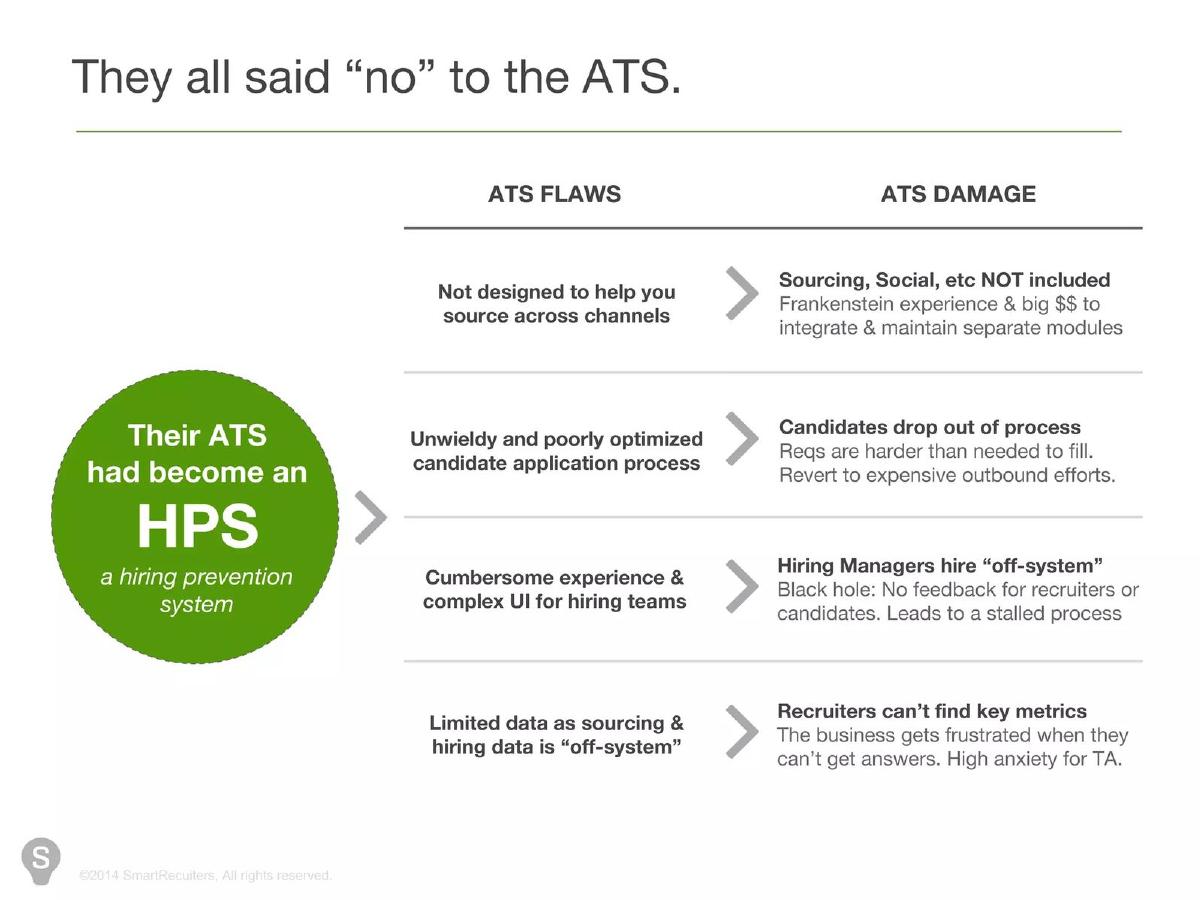
- The deck positions the legacy ATS as an 'HPS' or Hiring Prevention System on slide 3.
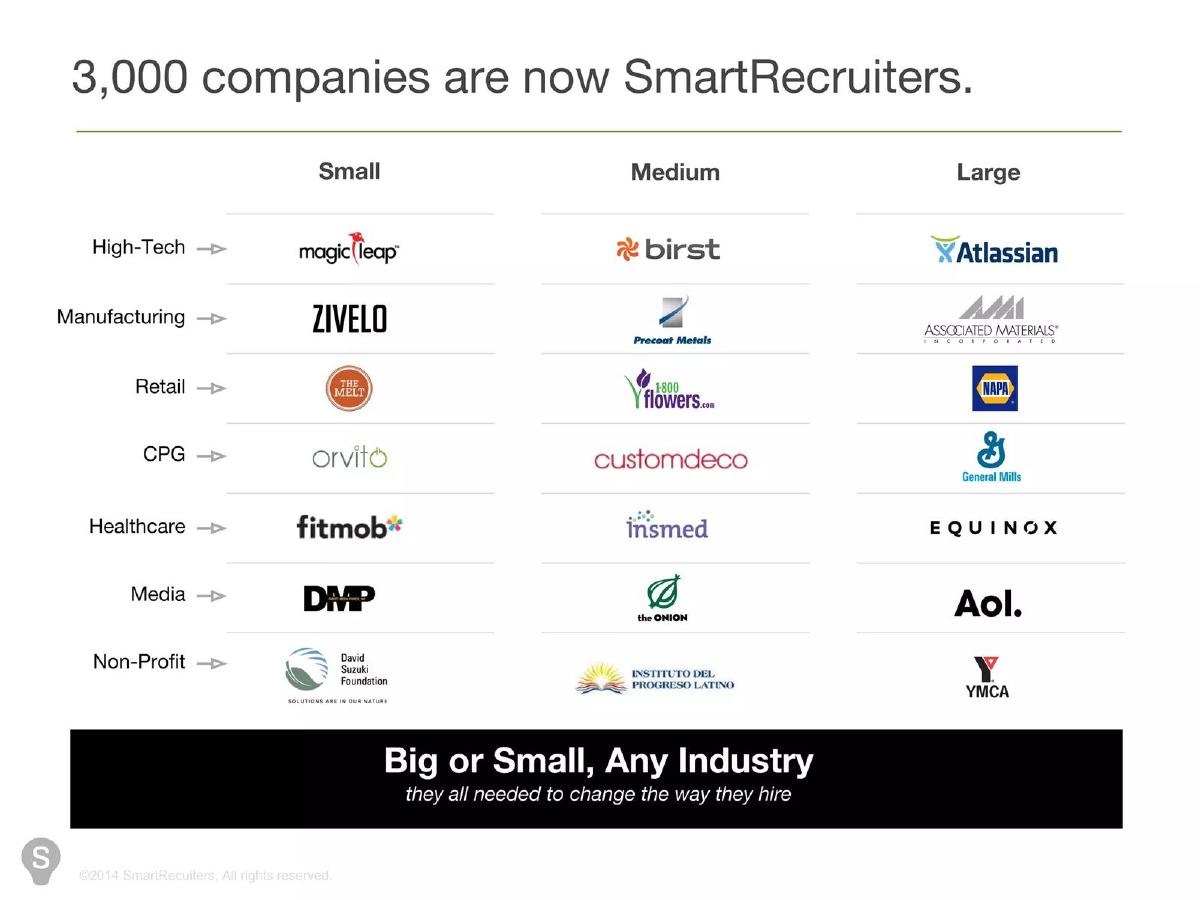
- Social proof is the primary driver, with 3,000 companies listed as customers across small, medium, and large segments on slide 2.
- Product velocity is quantified by a roadmap showing one major release every month from July to November on slide 7.
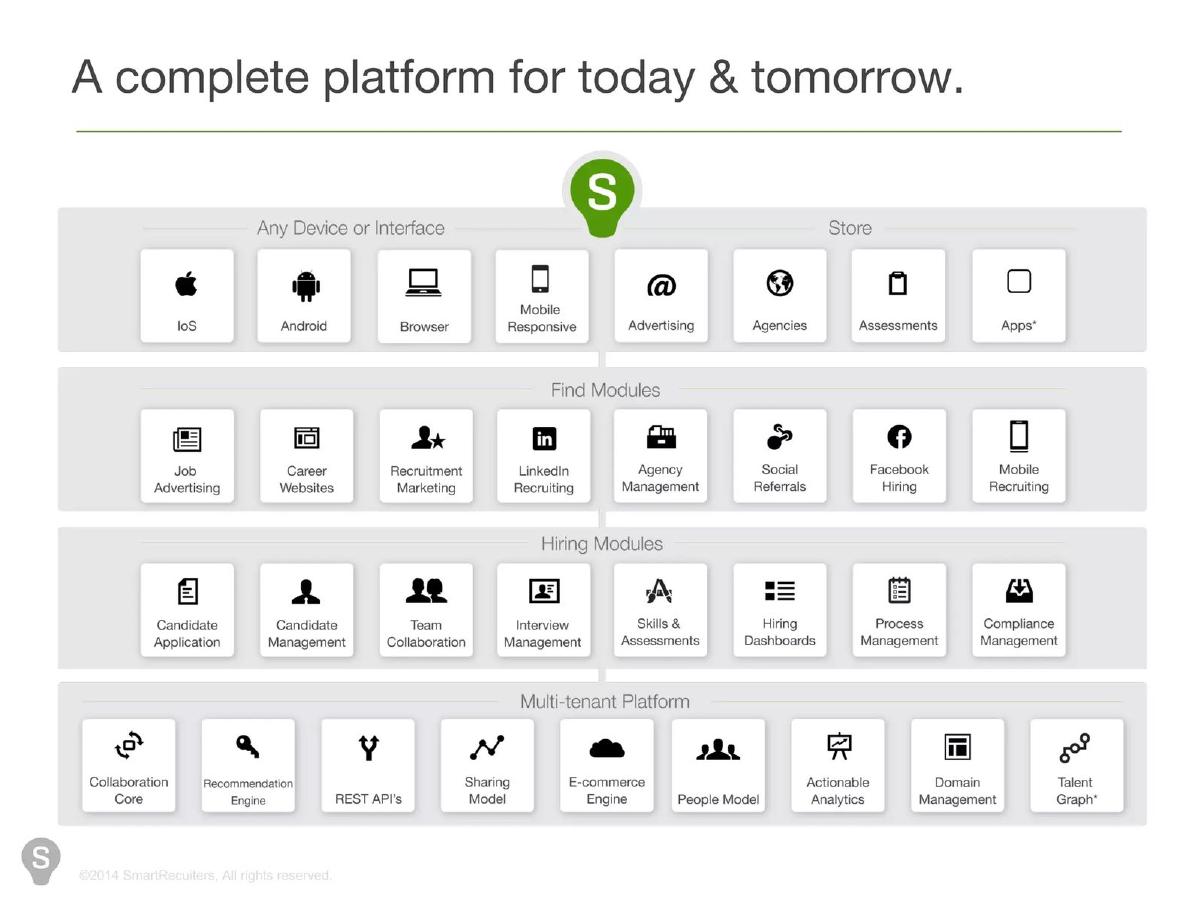
- The platform architecture is detailed through a four-layer multi-tenant model including 'Find' and 'Hiring' modules on slide 6.
- Enterprise validation is provided by five dedicated profile slides (10-14) featuring specific metrics like a 50% reduction in cost per hire for The Onion.
- The pricing model is transparently displayed for small businesses, citing $250/month for 50 employees on slide 15.
- The deck omits a traditional team slide, focusing entirely on the product and the customer base.
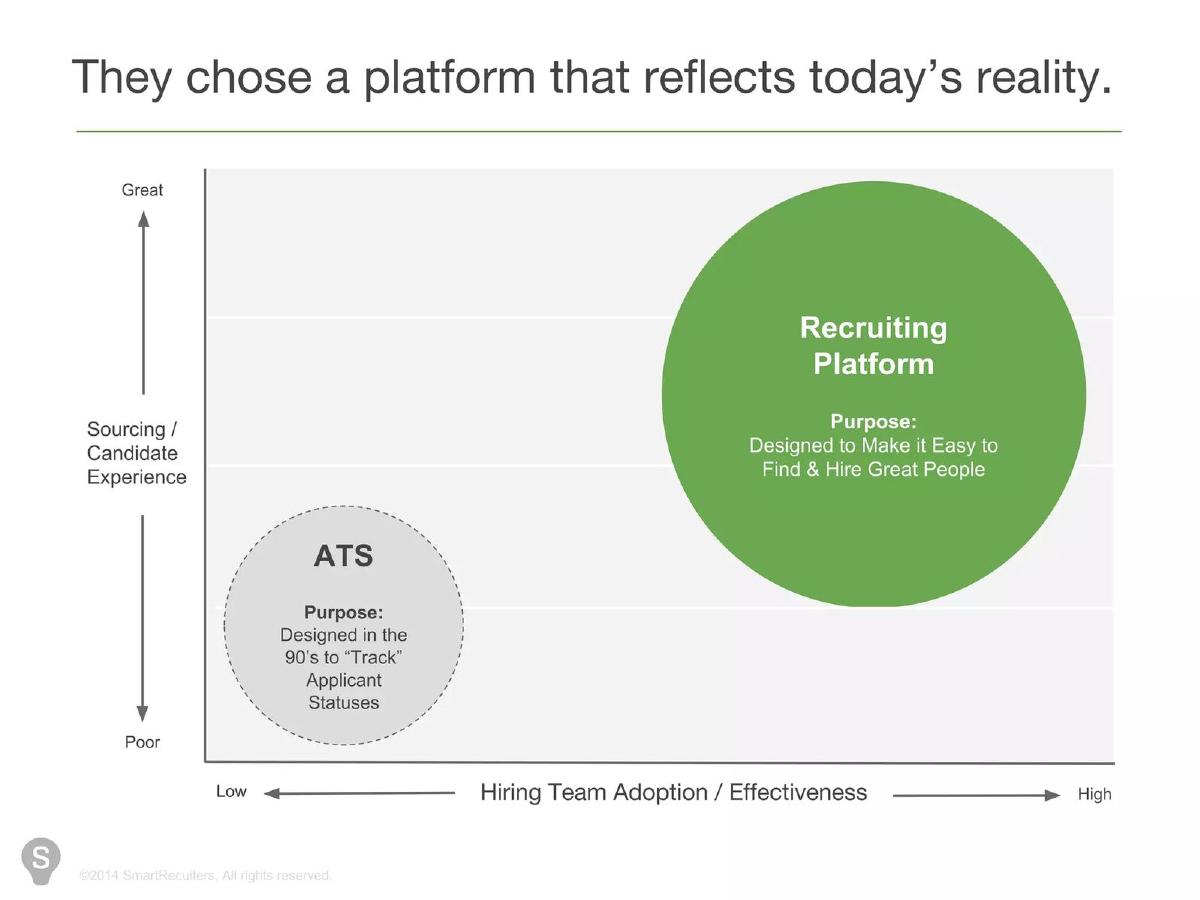
- The 'Recruiting Platform' is differentiated from legacy systems by high 'Hiring Team Adoption' and 'Sourcing Experience' on slide 4.
Introduction: The $50M Pivot from ATS to Platform
SmartRecruiters, a SaaS company in the HR tech space, utilized this 16-slide deck to raise a $50M round in 2019. The round was led by Insight Partners, bringing their total funding to $105M. The deck is a masterclass in aggressive positioning. It doesn't just present a solution; it declares war on the existing category—the Applicant Tracking System (ATS)—labeling it a 'Hiring Prevention System' (HPS).
The Hook and Social Proof (Slides 1-2)
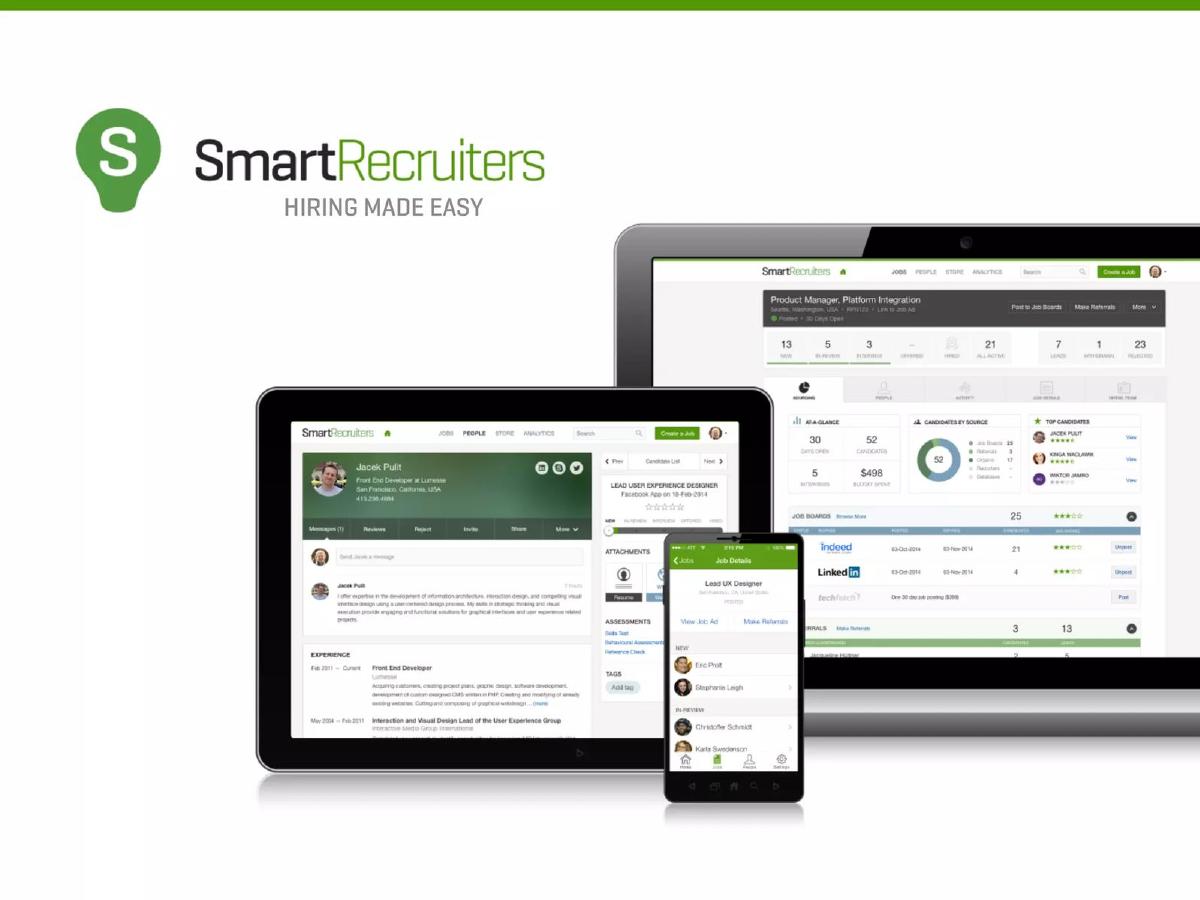
Slide 1 is a standard title slide featuring the company logo and the tagline 'HIRING MADE EASY,' overlaid on a multi-device mockup. This immediately establishes the product's cross-platform nature (Desktop, Tablet, Mobile).
Slide 2 is the 'Social Proof' heavy hitter. It lists 3,000 companies using the platform, categorized by size (Small, Medium, Large) and industry (High-Tech, Manufacturing, Retail, CPG, Healthcare, Media, Non-Profit). Notable logos include Atlassian, General Mills, Equinox, and AOL. By showing breadth across both company size and industry vertical, SmartRecruiters eliminates the 'niche' concern early in the presentation.
Defining the Enemy (Slides 3-4)
Slide 3 is the most aggressive slide in the deck. It uses a two-column table to contrast 'ATS Flaws' with 'ATS Damage.' It claims that legacy systems are 'not designed to help you source across channels,' which results in a 'Frankenstein experience.' The most striking visual is the green circle on the left that rebrands the ATS as an 'HPS: a hiring prevention system.' This creates a sense of urgency for the investor: the current market standard is failing.
Slide 4 uses a standard 2x2 matrix, though without the traditional four quadrants. It plots 'Hiring Team Adoption / Effectiveness' against 'Sourcing / Candidate Experience.' It places the legacy ATS in the bottom-left (Low/Poor) and the SmartRecruiters 'Recruiting Platform' in the top-right (High/Great). The slide explicitly states the purpose of an ATS was designed in the 90s to 'Track' statuses, whereas their platform is designed to 'Find & Hire Great People.'
Product Architecture and Innovation Velocity (Slides 5-7)
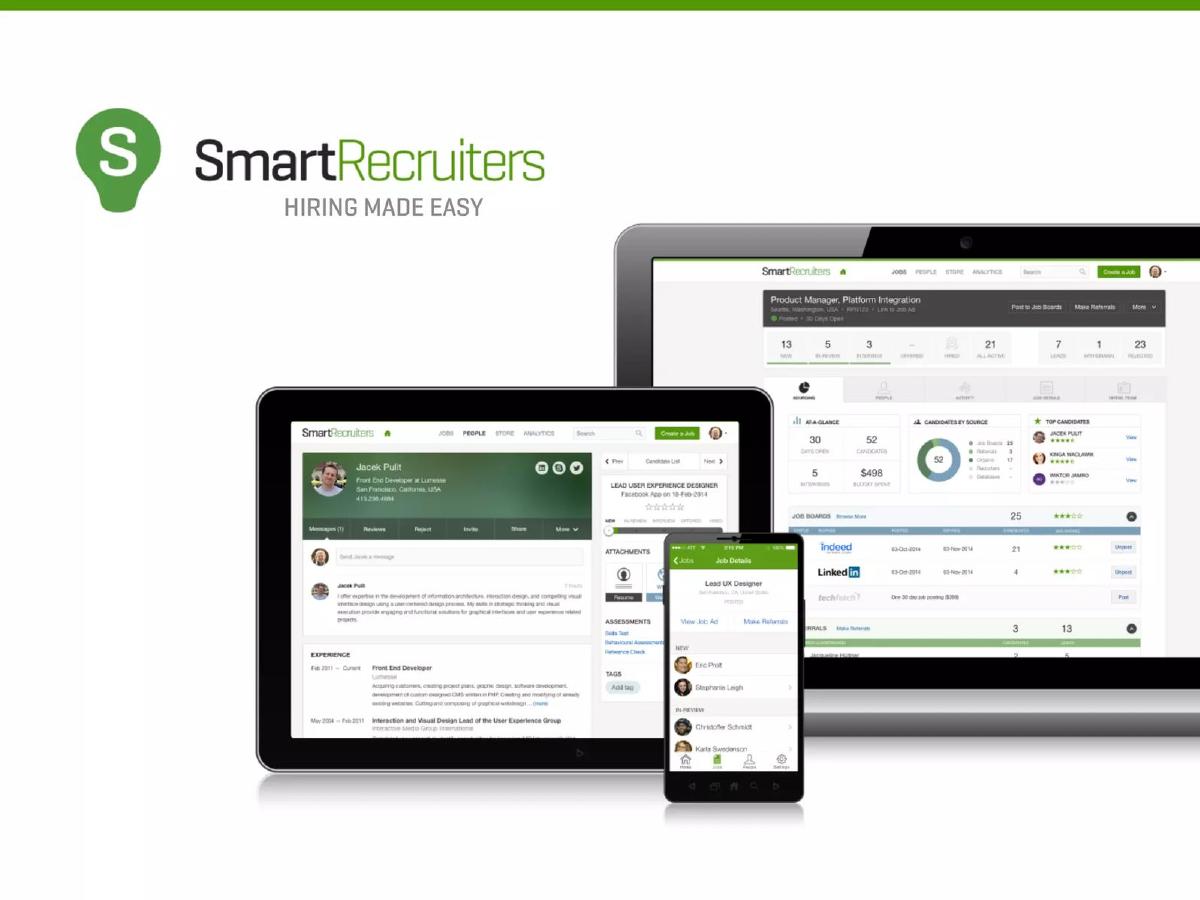
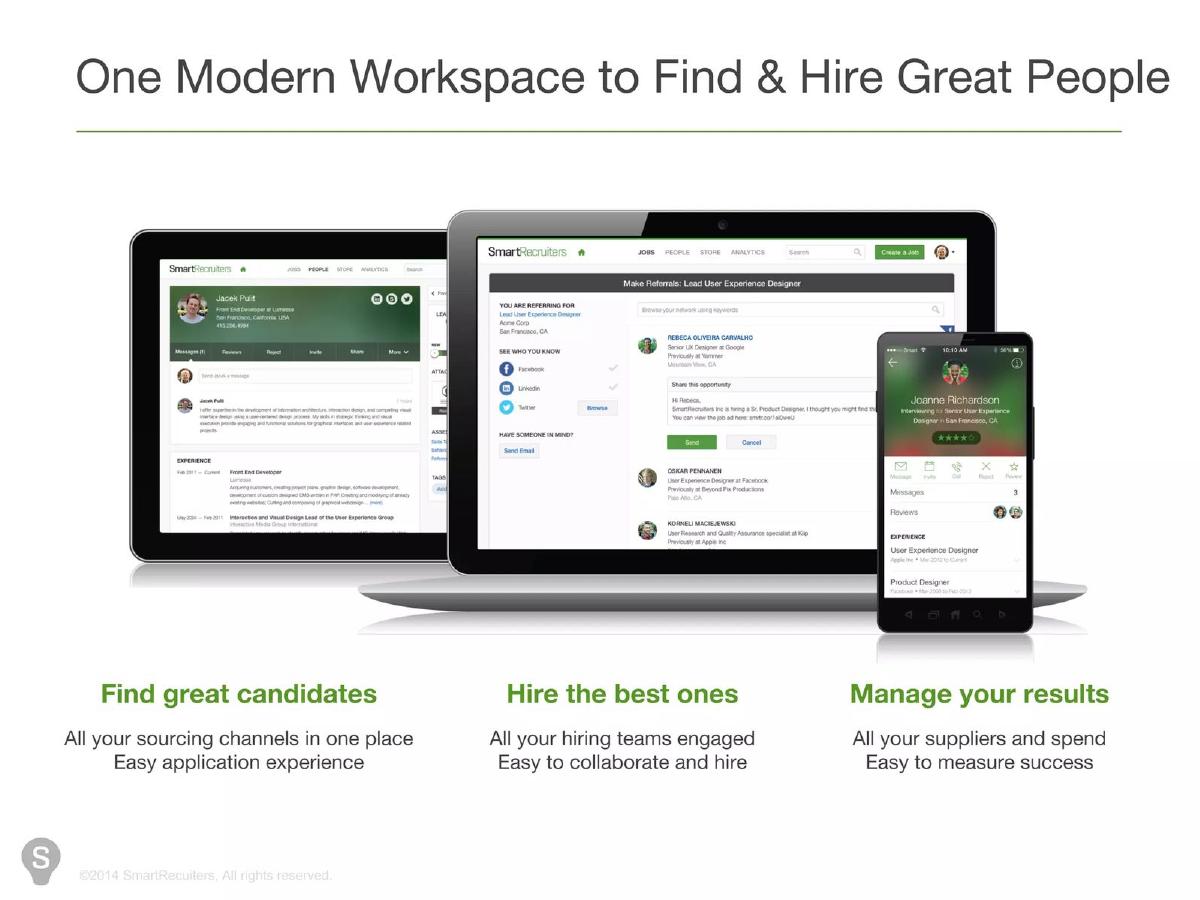
Slide 5 introduces the 'One Modern Workspace' with high-fidelity screenshots of the interface on a laptop, tablet, and smartphone. It breaks the value proposition into three pillars: Find great candidates, Hire the best ones, and Manage your results.
Slide 6 is a technical architecture slide. It is titled 'A complete platform for today & tomorrow.' It visualizes the stack in four horizontal layers: Any Device or Interface (including iOS and Android), Store (Agencies, Assessments, Apps), Modules (Job Advertising, Social Referrals, Interview Management, Compliance), and the Multi-tenant Platform (Collaboration Core, Recommendation Engine, REST APIs, Talent Graph). This slide is designed to show the complexity and defensibility of the build.
Slide 7 addresses 'Speed of innovation.' It provides a monthly calendar from July to November, listing specific features released each month. For example, July included 'Social referrals' and 'New job page,' while November included 'Career page builder' and 'Candidate API.' The headline 'One major release every month' backed by '50+ Developers' signals a high-output engineering culture.
Integration and Customer Success (Slides 8-9)
Slide 8 focuses on the 'Ease of integration,' showcasing their 'Modern rest api’s.' This is a critical point for enterprise SaaS, as it addresses the 'integration bottleneck' mentioned in the earlier 'ATS Damage' slide. The visual shows API documentation, reinforcing that this is a developer-friendly, open platform.
Slide 9 outlines the post-sale experience, divided into four stages: Activation Success, Education & Training, Account Management, and World Class Support. It promises 'Hiring success in weeks, not months,' and highlights '24 x 7 dedicated support.' This slide aims to de-risk the transition for large enterprise clients.
The Case Study Deep-Dive (Slides 10-14)
The deck spends a significant amount of time—five full slides—on individual customer profiles. This is a high ratio for a 16-slide deck, indicating that at this stage, the company’s strongest argument was its existing enterprise traction.
Slide 10 (AOL): Focuses on replacing 'outdated Brassring ATS' and driving hiring across 36 brands. · Slide 11 (BlaBlaCar): Highlights centralizing hiring across 8 million members in 12 countries. · Slide 12 (The Onion): Provides hard ROI, citing a 'Reduced cost per hire by 50%' and a 300% increase in company size over two years. · Slide 13 (1-800-Flowers): Mentions hiring 600 seasonal employees in less than 4 months and reducing time/cost to hire by 'nearly 100%.' · Slide 14 (Napa Auto Parts): Focuses on the scale of '1000+ independently owned NAPA stores' and '10,000+ quality candidates sourced.'
Pricing and Closing (Slides 15-16)
Slide 15, titled 'Let’s get started,' shows the pricing model. It features a 'Pro Plan' for businesses under 100 employees starting at '$250 / month' with a '$750 activation kit.' For larger companies (100 - 100,000+ employees), it directs them to contact sales. It also mentions a 'Free Plan' to 'Make a hire today.' This suggests a 'land and expand' strategy where small teams can start for free or low cost, creating a pipeline for enterprise deals.
Slide 16 is a simple 'Thank you' slide with a call to action to 'GET A DEMO' or 'SIGN UP FOR FREE,' alongside a mobile mockup of the app.
What Works in the SmartRecruiters Deck
1. Aggressive Category Re-definition: By labeling the competition as a 'Hiring Prevention System,' SmartRecruiters creates a 'villain' in the narrative. This makes their solution feel not just better, but necessary for survival.
2. Granular Social Proof: Many decks just show a logo wall. SmartRecruiters dedicates 30% of the deck to detailed case studies that include specific metrics (e.g., 50% cost reduction). This provides a level of credibility that a simple logo cannot achieve.
3. Technical Transparency: Slide 6 (Platform Architecture) and Slide 8 (APIs) speak directly to the technical due diligence that a lead investor like Insight Partners would perform. It shows that the product is a platform, not just a feature.
4. Innovation as a Metric: Quantifying innovation by the number of developers (50+) and the frequency of releases (monthly) is a clever way to demonstrate momentum without sharing sensitive internal KPIs.
What is Missing from the SmartRecruiters Deck
1. The Team Slide: There is no mention of the founders, the executive leadership, or the board. While this may be omitted because the company was already well-known to the investors, it is a glaring absence for a standard pitch deck teardown. Investors typically want to see who is steering the ship, especially in a $50M round.
2. Financial Projections: The deck contains no revenue figures, growth percentages (other than for individual clients), or burn rate information. It is purely a product and market-traction deck.
3. The Ask: There is no slide detailing how much they are raising or what the funds will be used for. This information is usually included in a 'The Ask' or 'Use of Funds' slide.
4. Unit Economics: While the pricing slide shows a $250/month plan, there is no data on Customer Acquisition Cost (CAC), Lifetime Value (LTV), or churn rates, which are standard for SaaS fundraising at the Series D stage.
What a Founder Should Copy
1. The 'Problem/Damage' Framework: Instead of just listing problems, show the 'damage' those problems cause to the business. Slide 3 is a perfect template for this.
2. The Platform Map: If you are building a complex SaaS product, use a slide like Slide 6 to show how different modules interact and how the core platform supports them. It helps investors visualize the 'completeness' of your solution.
3. Industry-Specific Social Proof: If you sell to multiple industries, copy Slide 2’s layout. It proves that your product isn't just a 'tech tool for tech companies' but has broad market utility.
4. The Monthly Roadmap: Showing what you actually shipped in the last six months (Slide 7) is much more powerful than showing a vague roadmap of what you plan to ship in the next six months.
Frequently asked questions
- Why does the deck lack a team slide?
- At the later stage (Series D/2019), SmartRecruiters likely relied on their established reputation and the existing knowledge of lead investor Insight Partners. The deck focuses on scaling evidence—3,000 customers and a robust API ecosystem—rather than founder pedigree, which is common when a company has already reached significant market maturity.
- How does SmartRecruiters define its competitive advantage?
- The deck uses a 'flaws vs. damage' framework on slide 3. It argues that legacy ATS are not designed for multi-channel sourcing, leading to 'Frankenstein experiences.' By contrast, SmartRecruiters positions itself as a modern workspace that integrates sourcing, hiring, and results management into a single mobile-responsive interface.
- What specific metrics are used to prove ROI?
- Unlike many decks that use vague percentages, SmartRecruiters provides hard numbers in its case studies. For example, slide 12 shows The Onion increased company size by 300% in two years, and slide 13 shows 1-800-Flowers hired 600 seasonal employees in less than four months.
- Is the pricing slide effective for a $50M round?
- Slide 15 is unusual for a growth-stage deck as it shows a $250/month 'Pro Plan.' This suggests a high-velocity, bottom-up sales motion alongside their enterprise deals. It signals to investors that the company has a scalable, self-service acquisition channel in addition to the large-scale contracts mentioned in the case studies.
- How is the technology stack presented to investors?
- Slide 6 provides a comprehensive 'platform for today & tomorrow' map. It breaks the software down into four tiers: Interface (iOS/Android), Store (Apps/Assessments), Modules (Find/Hiring), and the Multi-tenant Platform (Core/REST APIs). This visualizes the 'moat' created by their technical infrastructure.