Reflexivity's Series B deck is a sophisticated example of how to pitch complex AI solutions to institutional investors. By rebranding from Toggle AI, the company shifted its narrative from a single tool to a comprehensive 'investment analysis lifecycle' platform. The deck excels by providing a granular architectural overview, detailing exactly how LLMs like GPT-4 Turbo interact with proprietary knowledge graphs and vector databases. Most importantly, it anchors its $30M raise in massive social proof, citing integrations with OpenAI and Interactive Brokers, alongside a beta terminal user base…
Key takeaways
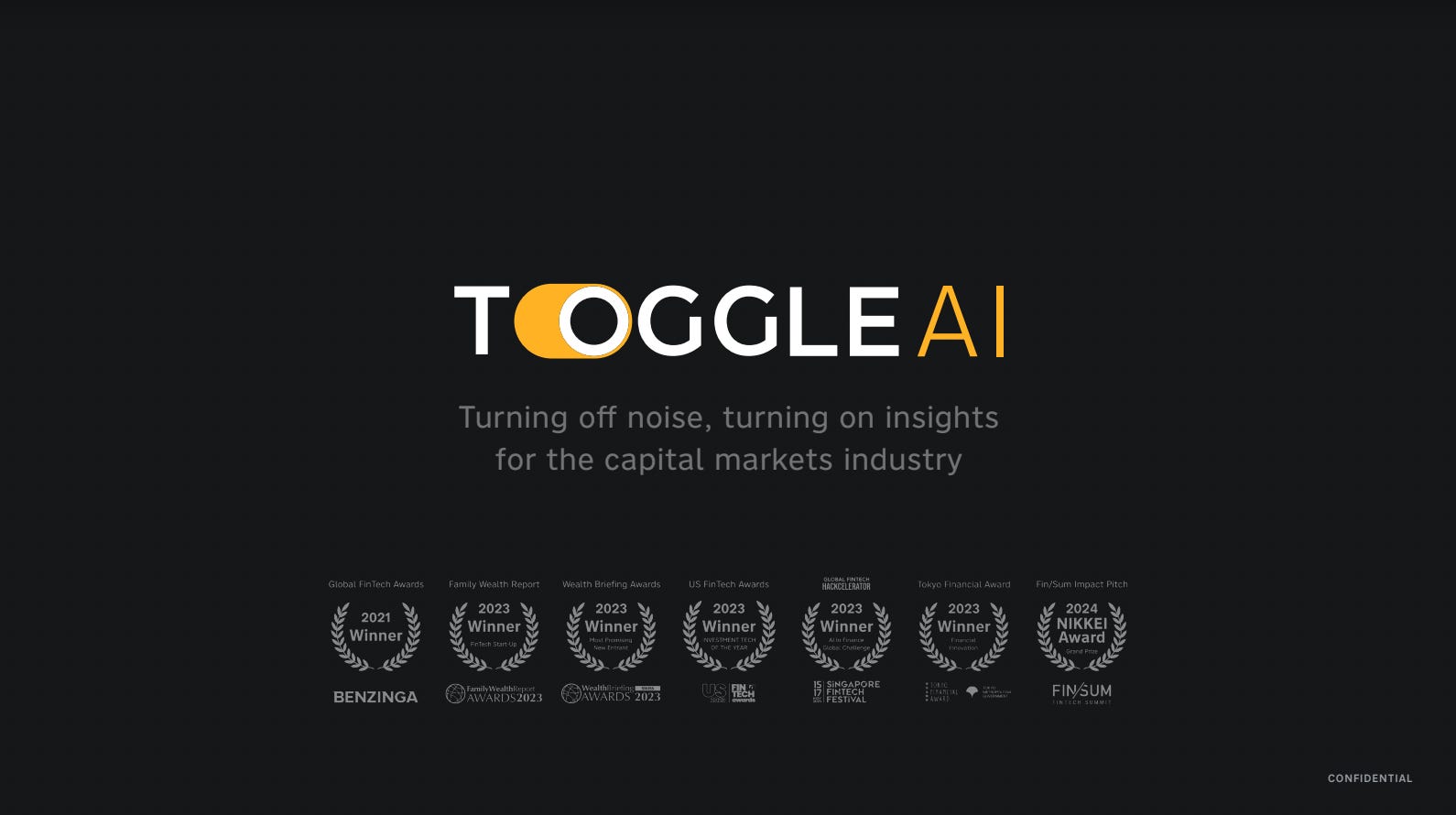
- The deck highlights a significant rebranding from Toggle AI to Reflexivity, positioning the company as a platform rather than a feature (Slide 1).
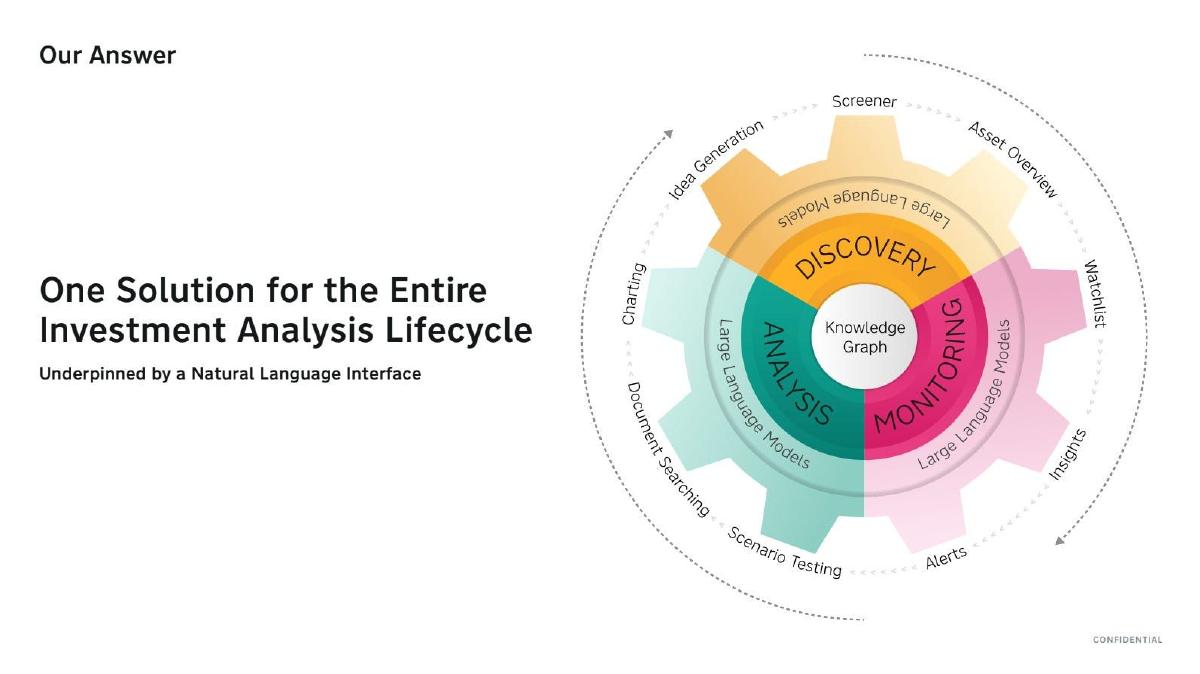
- Reflexivity defines its value proposition across three core pillars: Discovery, Analysis, and Monitoring, all underpinned by a Knowledge Graph (Slide 2).
- The product features a Natural Language Interface that allows users to query the terminal using conversational commands (Slide 3).
- A detailed architectural map reveals the use of Go, Python, and Next.js, alongside specific models like DistilBERT and GPT-4 Turbo (Slide 6).
- The company reports its API service is integrated into platforms with 'millions of clients,' including MUFG, UBS, and Interactive Brokers (Slide 8).
- Beta terminal customers represent a combined $250BN in Assets under Management (AuM), featuring names like Soros Fund Management and Millennium (Slide 8).
- The Serviceable Obtainable Market (SOM) is heavily weighted toward the Americas and the 'Buy Side' of the financial industry (Slide 7).
- The deck explicitly mentions interest from non-capital market sectors, including insurers and credit card companies, to signal future expansion (Slide 9).
Reflexivity Pitch Deck: The Series B Blueprint for Institutional AI
Reflexivity, formerly known as Toggle AI, raised $30M in 2023 for its Series B round. The deck used for this raise is a clinical, high-transparency document that avoids the typical 'AI hype' in favor of architectural depth and institutional validation. In a market saturated with generic wrappers, Reflexivity uses its 25 slides to prove it has built a defensible moat through a proprietary knowledge graph and deep integration with the world's largest financial institutions.
Slide 1: The Rebrand and Recognition
The cover slide introduces the new branding while maintaining the legacy 'Toggle AI' name to ensure continuity for investors familiar with their Series A. The most striking element of this slide is the footer, which displays seven distinct industry awards from 2021 to 2024, including the Nikkei Award and the Tokyo Financial Award. This immediately establishes the company as a vetted player in the global fintech ecosystem before a single product feature is mentioned.
Slide 2: The Investment Analysis Lifecycle
Slide 2, titled 'Our Answer,' provides a conceptual framework for the product. It visualizes the 'Investment Analysis Lifecycle' as a continuous loop of Discovery, Analysis, and Monitoring. By placing the 'Knowledge Graph' at the center and 'Large Language Models' in the outer ring, Reflexivity signals that while they use LLMs, their proprietary data structure is the core engine. This is a crucial distinction for Series B investors who are wary of companies that are merely 'GPT wrappers.'
Slide 3: Core Product Features
This slide breaks down the platform into six functional areas: Natural Language Interface, AI-Driven Analysis Engine, Automated Insights, Knowledge Graph, Document Retrieval, and Advanced Screening. The copy is dense but specific. For example, under 'Advanced Screening,' it mentions the ability to filter securities on 'thousands of variables,' moving beyond the standard technical indicators found in retail trading platforms.
Slide 4: Feature Highlight - Analysis Engine
Slide 4 provides the first look at the actual user interface. The screenshot shows a query: 'How do fast food restaurants do after gas prices drop 10% in a week?' The platform returns a bar chart showing the median performance of companies like Wendy's and McDonald's. This slide effectively demonstrates 'Product-Market Fit' by showing a specific, high-value use case for a hedge fund analyst: backtesting macro correlations in seconds rather than hours.
Slide 5: The Proprietary Moat - Knowledge Graph
Reflexivity dedicates a full slide to its Knowledge Graph, describing it as a 'self-learning matrix.' The screenshot shows how the system maps a company like Autodesk (ADSK) to its themes (3D Modeling, BIM Services), its brands (AutoCAD, Revit), its competitors (Adobe), and its suppliers (Microsoft). This slide is designed to prove 'defensibility.' It shows that the AI isn't just guessing; it understands the structural relationships of the global economy.
Slide 6: Architectural Transparency
This is perhaps the most important slide for a technical due diligence process. Reflexivity maps out its entire stack, from the user interface (Next.js, React) to the backend (Go, Python) and the orchestration layer (Kafka, Redis). It specifically names the models used for different tasks: DistilBERT and RoBERTa for 'Gatekeeping' (intent classification) and GPT-4 Turbo for 'Charting' and 'Event Resolution.' This level of transparency builds immense trust with sophisticated investors who want to know exactly how the 'magic' happens.
Slide 7: Market Segmentation (SOM)
Slide 7 breaks down the Serviceable Obtainable Market (SOM) by geography and end-user type. The data shows a heavy concentration in the Americas and a dominant focus on the 'Buy Side' (hedge funds, asset managers). This suggests that while the company has global ambitions (as evidenced by its Tokyo awards), it is currently focused on the deepest pockets in the financial world. The 'Wealth' and 'Sell Side' segments are shown as smaller slices, representing expansion opportunities.
Slide 8: The 'Traction' Slide
This is the 'mic drop' slide of the deck. It is split into two categories: API Service and Beta Terminal Customers. The API section lists OpenAI, UBS, and Interactive Brokers, claiming integration into platforms with 'millions of clients.' The Beta Terminal section lists legendary investment firms like Soros Fund Management, Millennium, and Viking, noting a 'combined $250BN AuM.' For a Series B, this level of social proof is almost impossible to ignore. It proves that the world's most sophisticated capital allocators are already using the tool.
Slide 9: Future Vision and Expansion
The final slide in this sequence uses a rocket graphic to signal the transition from capital markets to broader industries. It mentions interest from 'private market investors, physical commodity traders, insurers, and credit card companies.' This is a standard 'TAM expansion' play, intended to show that Reflexivity isn't just a niche tool for hedge funds, but a horizontal data synthesis platform for any industry with complex data needs.
What Reflexivity Does Well
Institutional Credibility: The deck is saturated with logos that carry immense weight in finance. Listing Soros, Millennium, and UBS on a single slide (Slide 8) does more to de-risk the investment than any amount of financial modeling could.
Technical Depth: By including a detailed architectural diagram (Slide 6), the founders preemptively answer the 'how does it work' questions that often derail AI pitches. They show a sophisticated multi-agent system rather than a single prompt-response loop.
Clarity of Use Case: Slide 4 is a perfect example of 'show, don't tell.' Instead of saying the AI is 'powerful,' they show it answering a complex, multi-variable financial question that would traditionally require a junior analyst and a Bloomberg terminal.
What is Missing from the Deck
Unit Economics: While the deck mentions 'millions of clients' via API, it does not disclose the revenue per user, churn rates, or the cost of serving these AI queries. At Series B, investors typically look for a clear path to profitability or at least a stable LTV/CAC ratio.
The Team: The provided slides do not include a team slide. For a company handling institutional financial data, the pedigree of the engineering and compliance teams is paramount. (Note: This may have been in the 16 slides not included in this teardown).
The Ask: There is no slide detailing how the $30M will be spent. A typical Series B deck should outline the allocation between R&D, sales expansion, and international growth.
Founder Takeaways
Lead with Traction: If you have blue-chip customers, don't hide them at the end. Reflexivity uses awards on Slide 1 and major logos on Slide 8 to bookend the technical content with social proof. · Explain the 'AI Stack': In the current market, you must explain your architecture. Use a slide like Reflexivity’s Slide 6 to show how you combine third-party LLMs with proprietary data (Knowledge Graphs) and specific frameworks (Go, Kafka). · Focus on the 'Lifecycle': Don't pitch a tool; pitch a workflow. By framing the product as the 'Entire Investment Analysis Lifecycle' (Slide 2), Reflexivity positions itself as a 'must-have' platform rather than a 'nice-to-have' utility. · Use Specific Queries: When showing your UI, use a query that reflects the actual day-to-day pain of your target user. The 'gas prices vs. fast food' example on Slide 4 is perfectly calibrated for a macro hedge fund audience.
Frequently asked questions
- What is the primary problem Reflexivity solves?
- Reflexivity addresses the 'noise' in capital markets by using AI to synthesize structured and unstructured data. According to Slide 4, it mines for statistically significant patterns and anomalies to produce fundamental, macro, and market insights that are otherwise buried in massive datasets.
- How does Reflexivity use Large Language Models (LLMs)?
- As shown in Slide 6, the platform uses a multi-agent architecture. It employs DistilBERT and RoBERTa for 'Gatekeeping' (intent classification) and GPT-4 Turbo for specific tasks like charting, event resolution, and natural language articulation of insights.
- Who are the key customers mentioned in the deck?
- The deck lists two tiers of customers on Slide 8. API partners include OpenAI, UBS, and Samsung Securities. Beta Terminal customers include high-profile hedge funds and asset managers such as Soros Fund Management, Millennium, and Viking.
- What is the 'Knowledge Graph' mentioned throughout the deck?
- Slide 5 describes the Knowledge Graph as a 'self-learning matrix of relationship networks.' It links assets by class, themes, supply chain, and stakeholders, allowing the AI to understand how a change in one variable (like gas prices) impacts specific companies (like fast food restaurants).
- Does the deck include a team slide or financial ask?
- In the provided 9-slide sequence, there is no team slide, specific revenue figures, or a detailed breakdown of the $30M ask. These were likely contained in the remaining 16 slides of the full 25-slide deck or handled in a separate data room.