RegioHelden’s Series B deck is a masterclass in operational transparency and metric-driven storytelling. By the time this deck was circulated, the company had already reached a revenue run rate of over 6 million EUR and served more than 1,000 active customers. The narrative focuses on the transition from a service-heavy agency model to a highly automated technology platform. It provides granular detail on customer acquisition costs (1,500 EUR) versus lifetime value (3,800 EUR), giving investors a clear 'money-in, money-out' formula for growth. While the design is utilitarian, the inclusion of…
Key takeaways
- The company achieved a revenue run rate exceeding 6 million EUR p.a. with a 40% gross margin (DB1) before seeking this round (Slide 11).
- RegioHelden maintains a customer retention rate of over 80% after the initial test phase (Slide 11).
- Unit economics are clearly defined with a CAC of 1,500 EUR and a discounted 3-year LTV of 3,800 EUR, yielding a 2.5x ratio (Slide 17).
- The deck explicitly targets a Series C round of 3-4 million EUR with a valuation target of 18-20 million EUR (Slide 18).
- Market sizing is calculated using a bottom-up approach, identifying a 607 million EUR p.a. potential in Germany alone (Slide 15).
- The product strategy emphasizes automation, moving from 20% automated setup to a goal of over 80% (Slide 4).
- A dedicated 'Exit Option' slide lists specific potential acquirers across seven categories, including Deutsche Telekom and Axel Springer (Slide 19).
- The cap table is fully transparent, showing founder Feliks Eyser holding 26% and BDMI at 21% (Slide 21).
Introduction: The $10M Blueprint for Local AdTech
RegioHelden’s pitch deck is a functional, data-heavy document that prioritizes clarity over aesthetic flair. Operating in the Media and AdTech sector, the company focuses on a perennially difficult segment: small and medium-sized enterprises (SMEs). This teardown examines the 22 slides that helped Feliks Eyser raise $10M, focusing on how the company proved scalability in a market often dismissed as too fragmented to serve profitably.
The Foundation: Mission and Problem
Slide 1: Title The deck opens with a simple title slide. The tagline "Lokale & messbare Internetwerbung" (Local & measurable internet advertising) immediately defines the value proposition.
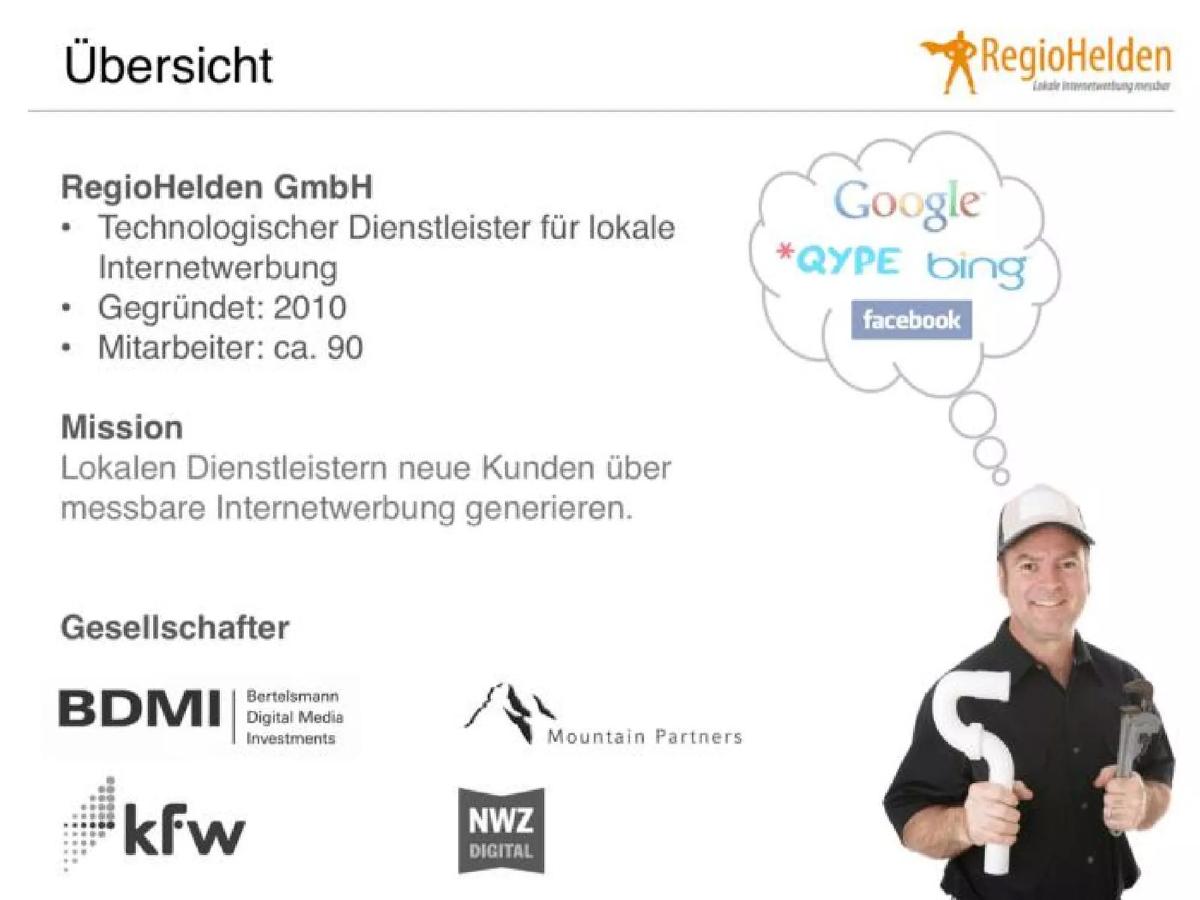
Slide 2: Overview This slide acts as a summary. It establishes the company's age (founded 2010), size (approx. 90 employees), and mission. Crucially, it lists high-profile existing shareholders like BDMI (Bertelsmann) and KfW, which provides immediate institutional credibility.
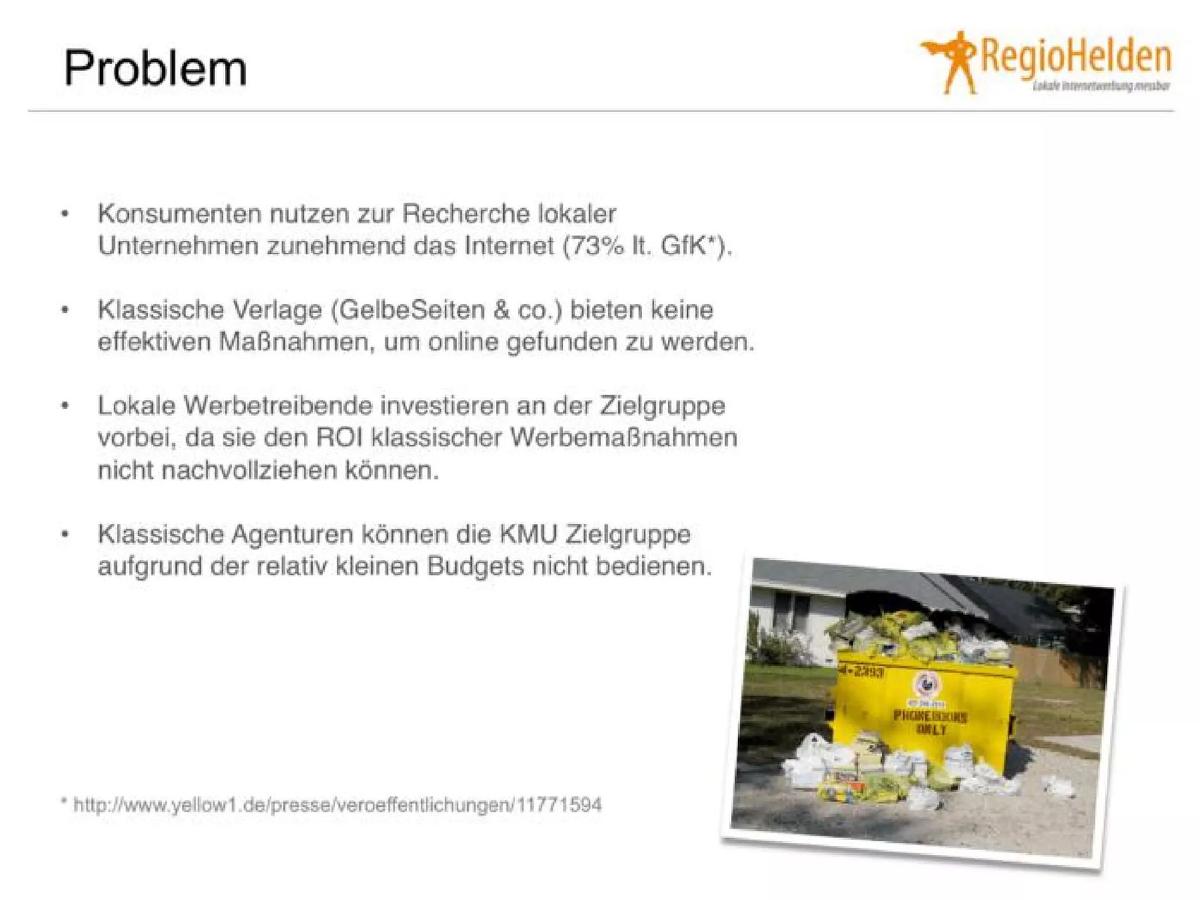
Slide 3: Problem The problem is framed through four lenses: consumer behavior (73% search online), the failure of traditional publishers (Yellow Pages), the lack of ROI tracking in local ads, and the inability of traditional agencies to serve small budgets. The visual of a dumpster full of discarded phone books serves as a powerful, if unrefined, metaphor for the dying legacy industry.
The Product: From Service to Automation
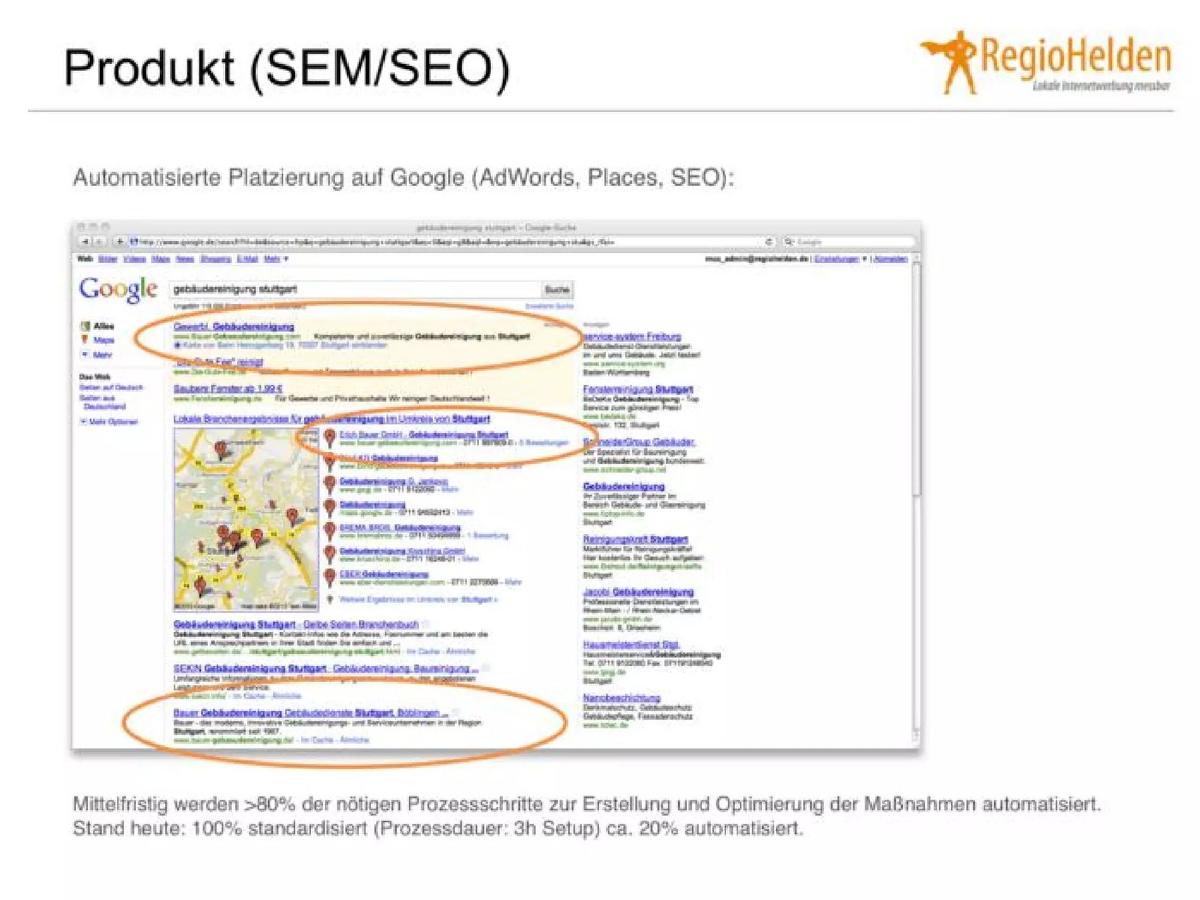
Slide 4: Product (SEM/SEO) RegioHelden shows exactly where they play: Google AdWords, Places, and SEO. The most important metric here is the automation claim: currently 20% automated with a 3-hour setup time, but aiming for >80% automation in the medium term. This signals to investors that the business is moving from a low-margin agency model to a high-margin tech model.
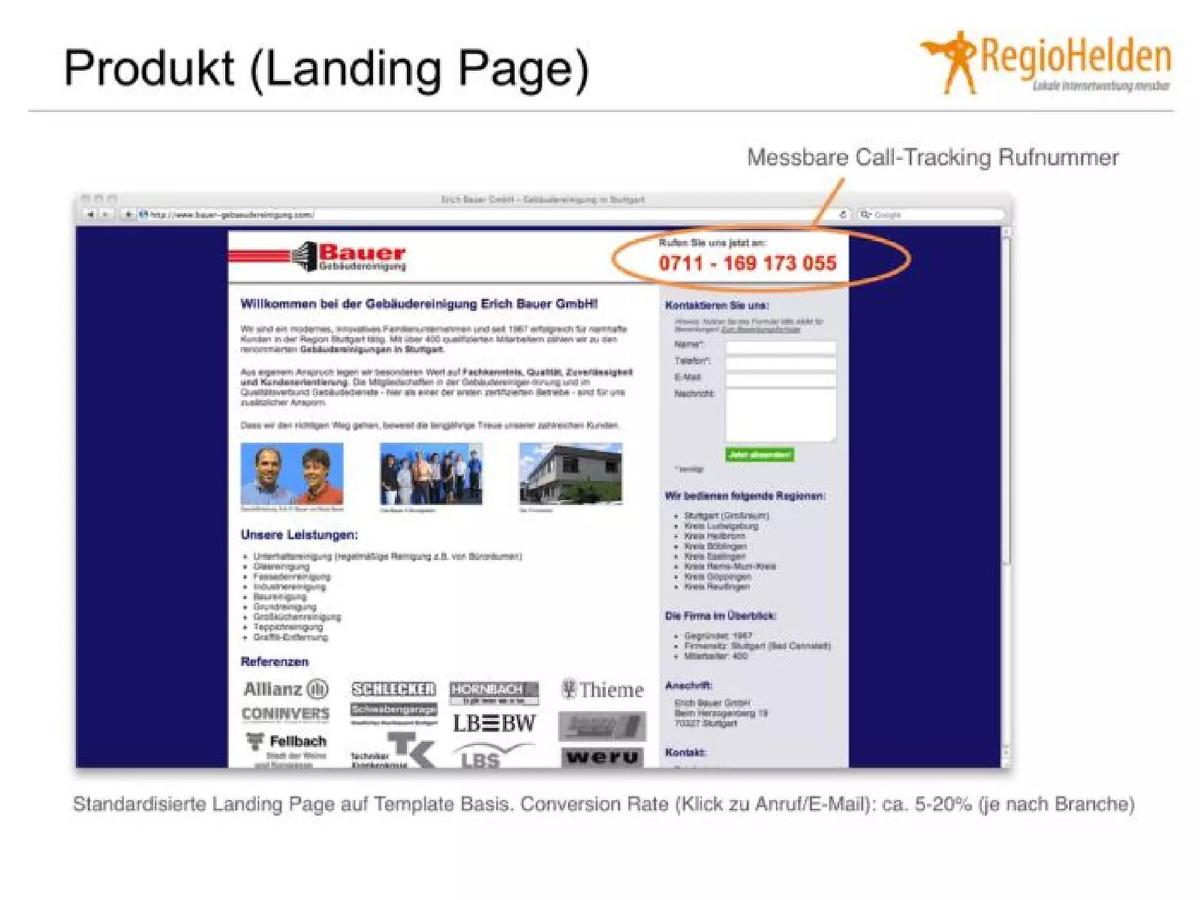
Slide 5: Product (Landing Page) The company highlights its use of standardized landing page templates. They cite a conversion rate (click to call/email) of 5-20%. The inclusion of a "Call-Tracking" number demonstrates how they solve the "measurability" problem mentioned on slide 1.
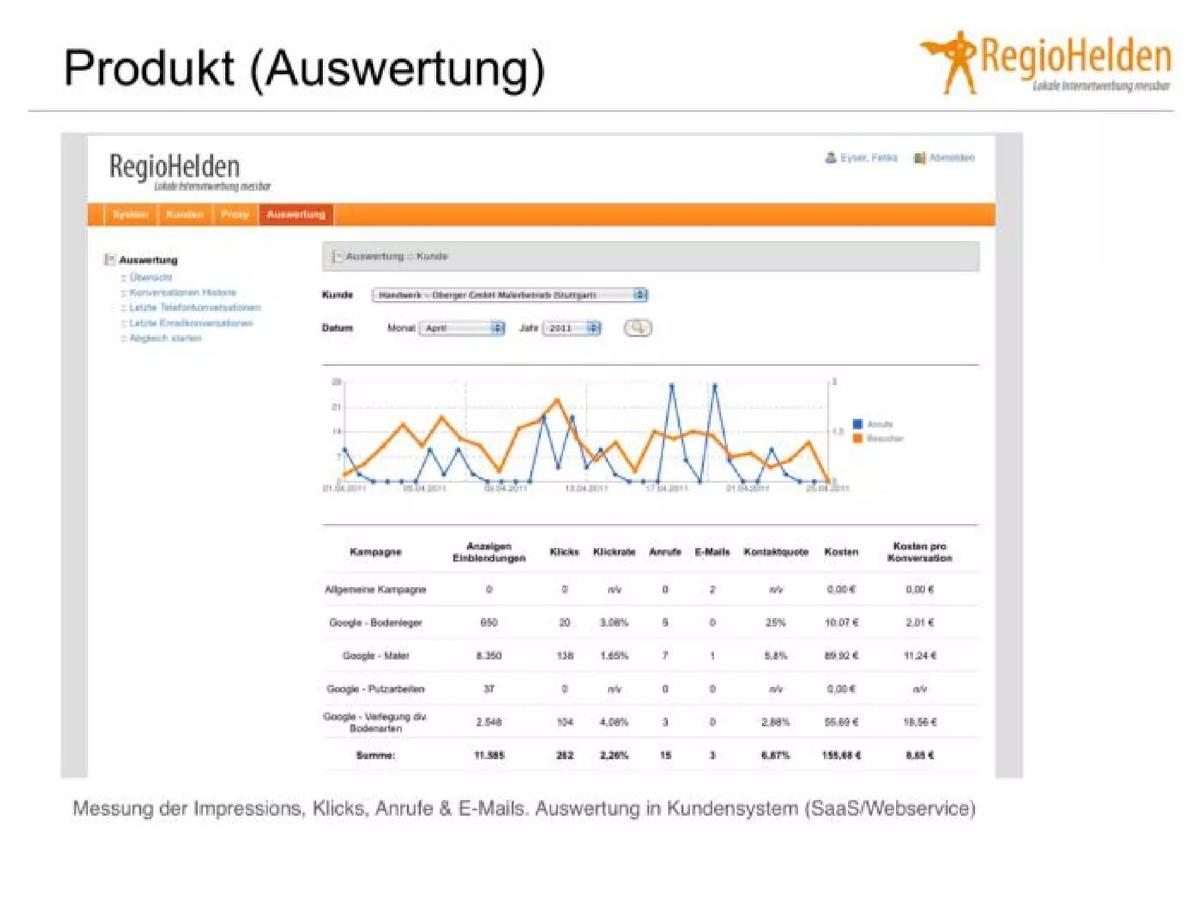
Slide 6: Product (Evaluation) A screenshot of their SaaS/Webservice dashboard shows how they report impressions, clicks, calls, and emails to the customer. This transparency is positioned as a key retention tool.
Proof of Concept: Case Studies and Results
Slide 7 & 8: Case Studies Slide 7 focuses on a single customer (Mobile Phone Repair) showing a direct correlation between increased budget and increased inquiries (1,231 inquiries total). It notes that 80-90% of inquiries become actual orders. Slide 8 provides a gallery of six additional case studies across different budgets (200 EUR to 800 EUR), proving the model works across various price points and industries.
The Engine: Business Model and Technology
Slide 9: Business Model This diagram shows the flow of money and data. SMEs pay RegioHelden, which uses its platform technology (bid management, automation, conversion optimization) to buy ads from Google and Facebook, delivering leads back to the SMEs. The "RegioHelden Tracking" layer at the bottom is the proprietary glue holding the model together.
Slide 10: Technology The deck showcases their "Proprietary ERP System" for managing campaigns. By showing internal screenshots, they prove that the "automation" mentioned earlier isn't just a roadmap item—it's a functional tool used by their 90 employees to manage the 1,000+ customers mentioned later.
Traction: The Growth Story
Slide 11: Status Quo This is a high-impact slide. It lists over 1,000 active customers, an annual revenue per customer of >6,000 EUR, and a retention rate of >80%. Most impressively, it notes a revenue run rate of >6 million EUR and a contribution margin (DB1) of 40%. They also highlight their status as one of only 14 "Google AdWords Premium KMU Partners" in Germany.
Slide 12: Development of Customers + Revenue A classic "up and to the right" chart showing the correlation between customer count (shaded area) and monthly revenue (orange line). It marks key milestones like the Series A closing and the Series B closing, providing a historical context for the current raise.
Market Opportunity: Bottom-Up vs. Top-Down
Slide 13: US Role Models By citing ReachLocal, Yodle, and Yext, RegioHelden shows that this model has already reached massive scale in the US (ReachLocal at >500MM USD revenue). This de-risks the business model by showing it is a proven category elsewhere.
Slide 14 & 15: Market and Market Volume Slide 14 highlights the "gap" between online search behavior (73%) and online ad spend (only 5%). Slide 15 is a standout for its bottom-up calculation. Instead of just saying "the market is billions," they calculate a 607 million EUR potential based on 81 cities and 100 industries. This level of specificity is highly attractive to Series B/C investors.
Operations and Unit Economics
Slide 16: Sales Overview The deck breaks down sales channels by efficiency and scalability. It reveals they have 35 employees in sales across 5 cities, using a structured recruitment and coaching process. They also mention using a self-developed crawler for lead generation, further emphasizing their tech-first approach to a traditionally human-heavy task.
Slide 17: Unit Economics This is arguably the most important slide in the deck. It breaks down the 1,500 EUR CAC into five specific cost buckets. It then compares this to a 3,800 EUR LTV (discounted over 3 years). The 2.5x LTV/CAC ratio is presented as a "profitable growth investment." They also note that high-budget customers can have an LTV of up to 75,000 EUR.
The Ask and the Exit
Slide 18: Financing Round Series C The slide explicitly asks for 3-4 million EUR (with 1.5 million already committed by existing shareholders). It sets a valuation target of 18-20 million EUR (3x revenue) and projects a future valuation of 45-75 million EUR by 2017 based on reaching 5,000 customers and 30 million EUR in revenue.
Slide 19: Exit Options A comprehensive table listing potential acquirers. It doesn't just list names; it provides "Remarks" on why each (e.g., Axel Springer, Deutsche Telekom, US providers) would be interested. This shows the founders are thinking about the investor's eventual liquidity event.
Team and Cap Table
Slide 20: Team / Management The slide features CEO Feliks Eyser and COO Dr. Stefan Detscher, highlighting their previous startup exits and consulting backgrounds. The board of advisors includes heavy hitters like the ex-CEO of telegate and the ex-CEO of Groupon DE.
Slide 21: Share Distribution A transparent pie chart showing the cap table. Feliks Eyser retains 26%, while institutional investors BDMI and MSA hold 21% each. This level of transparency in a pitch deck is rare but helpful for late-stage investors to understand the governance and incentive structure.
Slide 22: Contact A standard closing slide with contact details.
What Works in This Deck
Granular Unit Economics: Slide 17 provides a level of financial detail that proves the founders understand their levers for growth. · Bottom-Up Market Sizing: By calculating the market city-by-city and industry-by-industry, they avoid the "1% of a trillion-dollar market" fallacy. · Automation Roadmap: They honestly state their current automation level (20%) while showing the internal tools (Slide 10) that will help them reach 80%. · Exit Strategy: Slide 19 is exceptionally well-researched, moving beyond a list of logos to explain the strategic rationale for an acquisition.
What Is Missing
Competitive Landscape: While they mention US role models, there is no slide comparing RegioHelden to other German or European competitors. · Product Roadmap: Beyond "more automation," the deck doesn't detail what new features or services (e.g., social media management, reputation management) will drive the projected LTV growth. · Risk Factors: The deck is very optimistic. It doesn't address platform risk (dependence on Google/Facebook) or the high churn typical of the SME market.
What a Founder Should Copy
The 'Status Quo' Slide: Use a single slide to summarize your most impressive traction metrics (revenue, customers, retention, margins). · The LTV/CAC Breakdown: Don't just give the ratio; show the components of the cost. It builds trust in your numbers. · The Exit Table: If you are at Series B or C, showing you understand the M&A landscape in your sector is a sign of maturity. · Institutional Validation: If you have notable investors or partners (like the Google Premium Partnership), feature their logos prominently and early.
Frequently asked questions
- What stage was RegioHelden at when using this deck?
- The deck is labeled for a 'Finanzierungsrunde Serie C' on slide 18, though catalogue facts suggest it was part of the broader $10M Series B journey. At this point, they had over 1,000 customers and a 6M+ EUR revenue run rate, indicating a late-growth stage company looking to scale proven sales channels.
- How does RegioHelden justify its market size?
- They use a rigorous bottom-up calculation on slide 15: 81 major cities x 100 focus industries x 15 companies per industry x 5,000 EUR annual budget. This results in a 607 million EUR addressable market in Germany, which is more persuasive than generic top-down industry reports.
- What is the core technology 'hook' in the deck?
- The hook is the transition from manual agency work to a 'Proprietary ERP System' (Slide 10) and an automated platform (Slide 9). They claim 100% standardization of processes and a goal to automate over 80% of the optimization steps to drive down costs and improve margins.
- How transparent is the company about its financials?
- Highly transparent. Unlike many decks that hide margins, slide 11 explicitly states a 'DB1' (Contribution Margin 1) of approximately 40%. Slide 17 breaks down CAC into fixed personnel, variable personnel, marketing, and infrastructure, providing a level of detail rarely seen in public decks.
- Who were the existing investors at the time of this deck?
- Slide 2 and slide 21 identify several key shareholders: BDMI (Bertelsmann Digital Media Investments), Mountain Partners, KfW, and NWZ Digital. The cap table on slide 21 shows BDMI and MSA each holding 21% of the company.