Remark raised $100,000 in 2012 with a 10-slide deck that prioritizes visual communication over dense data. The deck effectively illustrates the 'chaos' of traditional video feedback loops (Slide 2) and presents a clean, browser-based solution for time-stamped annotations (Slide 4). By leaning heavily on brand logos like TED and Georgetown University, the company establishes immediate credibility without needing long-form testimonials. However, the deck is notably light on traditional venture capital requirements: there is no dedicated team slide, no explicit financial 'ask,' and no detailed b…
Key takeaways
- The deck uses a minimalist 10-slide structure that focuses almost entirely on product visuals and market scale.
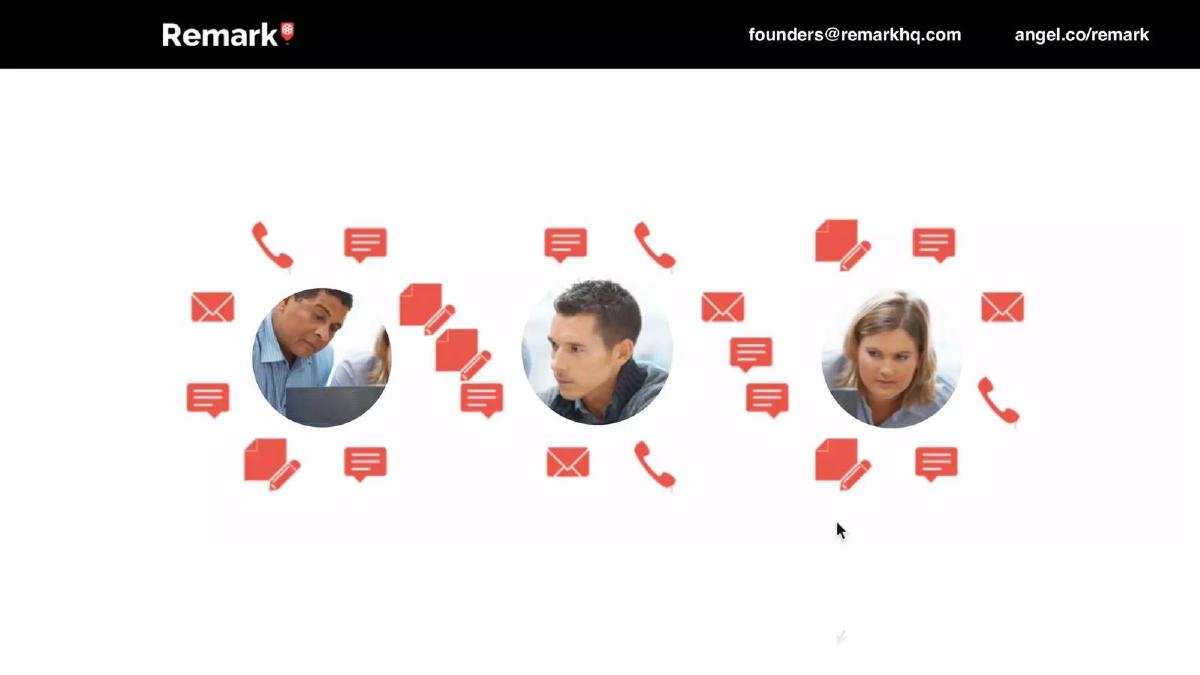
- Slide 2 uses iconography to represent the fragmented nature of current communication methods (email, phone, notes) in video production.
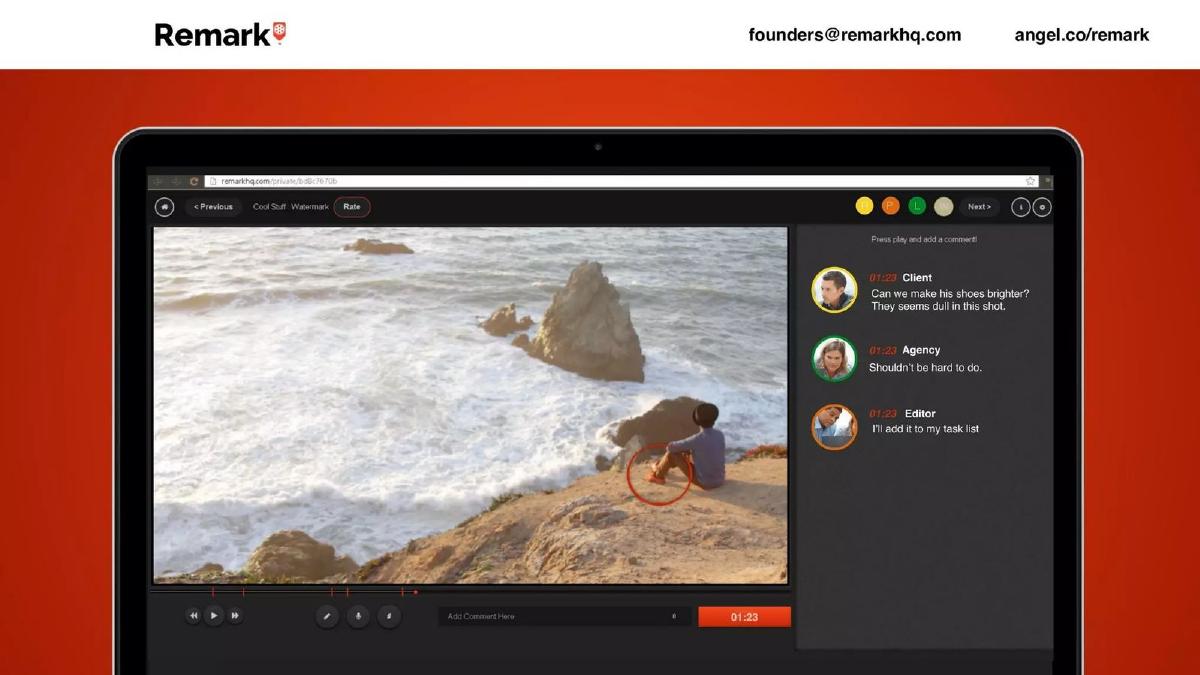
- Slide 4 provides a high-fidelity product mockup showing time-stamped comments from 'Client,' 'Agency,' and 'Editor.'
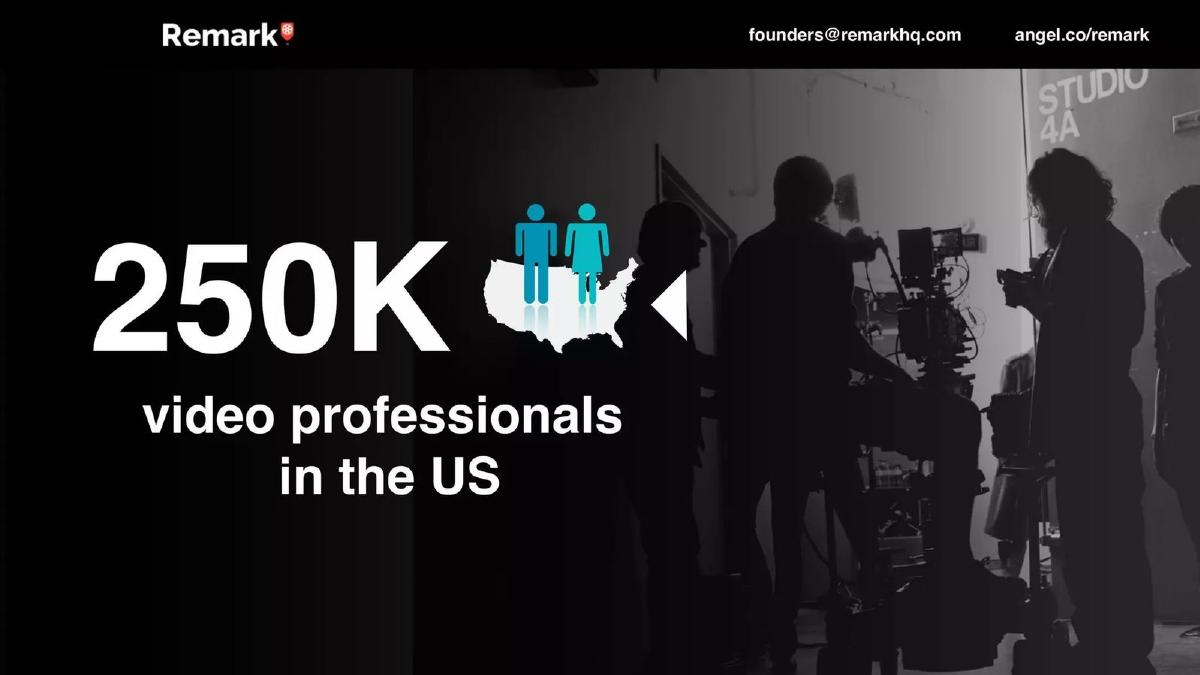
- Market size is defined on Slide 5 as 250,000 video professionals in the US, a specific but relatively narrow niche.
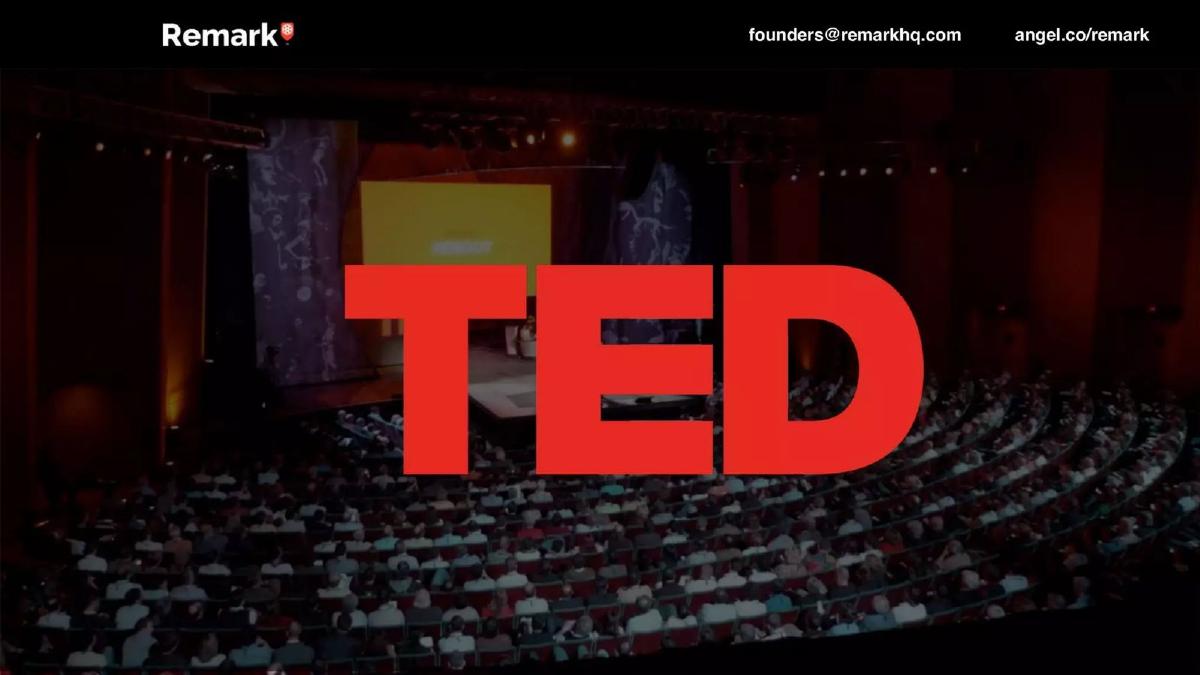
- Traction is demonstrated through full-slide logos for TED (Slide 6), Georgetown University (Slide 7), and Maker (Slide 8).
- The deck identifies a macro trend on Slide 9, noting that 86% of brands intended to increase video ad spend in 2014.
- There is no team slide included in the 10-slide sequence, leaving the founders' expertise to be inferred.
- The deck lacks a formal 'Ask' slide detailing how much capital is being raised or the intended use of funds.
The Remark Pitch Deck: A Study in Visual Minimalism
Remark's 2012 seed deck is a fascinating artifact from the early days of the SaaS explosion. At only 10 slides, it is remarkably brief. It eschews the text-heavy style of the era in favor of a 'show, don't tell' philosophy. While this approach is effective for demonstrating product-market fit and user experience, it leaves many business-critical questions unanswered. The company eventually raised $100,000, a modest seed round by today's standards, which aligns with the deck's focus on product utility over massive financial projections.
Slide 1: The Cover
The deck opens with a clean, professional cover slide. It features the Remark logo, the tagline 'Create Better Videos Together,' and contact information. Notably, it includes a link to their AngelList profile (angel.co/remark), which was a common practice in 2012 to provide investors with a path to deeper due diligence outside the deck itself. The background image of a video editor at a workstation immediately sets the context for the industry.
Slides 2-3: The Problem and The Concept
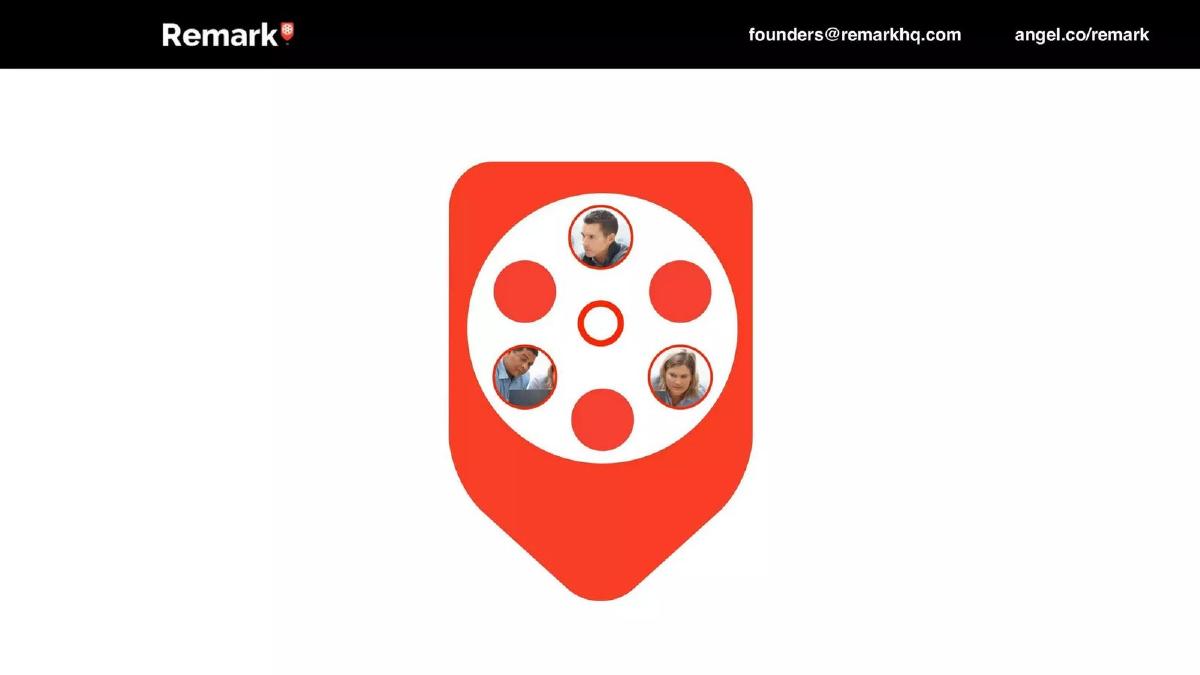
Slide 2 is a purely visual representation of the 'Problem.' It shows three distinct people—likely representing the client, the agency, and the editor—surrounded by a chaotic ring of icons: telephones, envelopes, and notepad-and-pencil symbols. This effectively communicates the fragmentation of feedback in video production without using a single word of bulleted text. Slide 3 follows up by placing these same people inside a film reel icon, which is the Remark logo. This signifies the 'Solution': bringing all stakeholders into a single, unified environment dedicated to the video asset.
Slide 4: The Product in Action
This is the most important slide in the deck. It shows a high-fidelity mockup of the Remark interface. We see a video player with a red circle drawn directly on the frame (annotating a person's shoes). To the right, a comment thread shows time-stamped entries (01:23) from a 'Client,' 'Agency,' and 'Editor.' The client asks, 'Can we make his shoes brighter?' and the editor responds, 'I'll add it to my task list.' This slide proves the product exists and demonstrates its core value proposition: frame-accurate, collaborative feedback.
Slide 5: Market Size
Remark defines its immediate market on Slide 5. It states there are '250K video professionals in the US.' While this number is specific, it is relatively small for a venture-scale pitch. Most modern decks would attempt to calculate a multi-billion dollar TAM (Total Addressable Market). Remark's choice to stay grounded in the actual number of professionals suggests a focus on a niche, high-value user base rather than a mass-market play.
Slides 6-8: Traction and Social Proof
Instead of a slide titled 'Traction' with a line graph, Remark uses three consecutive slides to display the logos of their early adopters. Slide 6 features 'TED,' Slide 7 features 'Georgetown University,' and Slide 8 features 'Maker.' By dedicating a full slide to each logo, the founders emphasize the quality of their user base. For a seed-stage company in 2012, having TED and a major university as users provided significant credibility, suggesting the tool was robust enough for professional-grade workflows.
Slide 9: The Macro Trend
Slide 9 provides the 'Why Now?' argument. It features a large statistic: '86% of Brands to Increase Video Ad Spend in 2014.' This slide attempts to bridge the gap between the 250,000 video professionals mentioned earlier and the larger economic engine of advertising. It suggests that as brands spend more on video, the demand for efficient collaboration tools like Remark will grow proportionally. This is the only slide that hints at a larger commercial opportunity.
Slide 10: The Close
The final slide repeats the cover information, providing the email address and AngelList link once more. It serves as a simple call to action for investors to reach out or visit their profile for more details.
What Works in This Deck
Visual Clarity: The deck is incredibly easy to digest. A viewer can flip through all 10 slides in under 60 seconds and have a perfect understanding of what the product does and who uses it. In a world of over-crowded slides, Remark's minimalism is a strength.
Product-Centricity: Slide 4 is a perfect product slide. It doesn't just list features; it shows a real-world use case that any creative professional would immediately recognize as a solution to a common pain point.
Credibility Through Association: By highlighting TED and Georgetown, the deck bypasses the need for complex growth metrics. If these organizations are using the tool, it implies the technology is functional and the value proposition is real.
What Is Missing
The Team: There is no mention of who is building Remark. In seed-stage investing, the team is often more important than the product. The omission of founder bios, past successes, or technical expertise is a significant gap that would require an investor to look elsewhere (like the AngelList link) to find the 'who' behind the 'what.'
The Business Model: The deck never explains how Remark makes money. Is it a per-seat SaaS model? A per-project fee? A freemium play? Without a business model slide, it is impossible to evaluate the investment's potential return or scalability.
The Ask: A pitch deck is a tool for a transaction. Remark fails to state what that transaction is. There is no mention of how much money they are raising, what the valuation is, or what milestones they intend to hit with the capital. While the catalogue facts state they raised $100,000, an investor reading this deck in isolation would not know if they were looking for $50k or $5M.
Competition: The deck operates in a vacuum. In 2012, other video collaboration tools were emerging. Failing to acknowledge the competitive landscape or explain Remark's unique 'moat' (such as its browser-based drawings or voice notes mentioned in the self-description) is a missed opportunity to define their edge.
What a Founder Should Copy
The Problem Visualization: Founders should look at Slide 2 as a template for explaining 'chaos.' Using icons to represent fragmented communication is far more effective than a list of bullet points saying 'Email is slow' or 'Phone calls are hard to track.'
The Use of Mockups: Slide 4 is a masterclass in showing a workflow. If your product is a tool, show the tool being used by the specific personas you are targeting. The labels 'Client,' 'Agency,' and 'Editor' on the comment thread make the target market crystal clear.
Logo Dominance: If you have high-profile users, don't hide them in a corner. Remark's decision to give TED its own slide is bold and effective. It forces the investor to register the brand's endorsement before moving on.
Final Analysis
Remark's deck is a 'teaser' deck rather than a 'full' pitch deck. It is designed to generate interest and secure a meeting, not to close a deal on its own. Its success in raising $100,000 likely stemmed from the clarity of the product vision and the high quality of its early traction. However, for a modern founder, this deck should be viewed as a starting point. To raise in today's market, you would need to take this visual foundation and layer on the missing pieces: a strong team narrative, a clear path to revenue, and a well-defined funding ask.
Frequently asked questions
- What is the primary problem Remark is solving?
- Remark addresses the fragmented and inefficient feedback loop in video post-production. Slide 2 illustrates this by showing multiple stakeholders (Client, Agency, Editor) surrounded by disparate communication icons like phones, emails, and notes. The solution, shown on Slide 4, centralizes these 'remarks' into a single, time-stamped, browser-based video player where all parties can annotate specific frames.
- How does Remark demonstrate market validation?
- Instead of using a traditional 'Traction' slide with growth charts, Remark uses three consecutive slides (6, 7, and 8) featuring large logos of high-profile users: TED, Georgetown University, and Maker. This visual shorthand suggests that the product is already being utilized by major institutions and content creators, providing social proof without disclosing specific user counts or revenue.
- What are the biggest omissions in this pitch deck?
- The deck is missing several standard components: a Team slide (to show founder-market fit), a Business Model slide (to explain how they make money), and an Ask slide (to state the funding goal). According to the catalogue facts, they raised $100,000, but the deck itself does not mention this figure or what the capital would be used for.
- Who is the target audience for Remark according to the deck?
- The deck identifies two primary targets. Slide 5 quantifies the user base as 250,000 'video professionals in the US.' Slide 9 broadens the scope to 'Brands,' noting that 86% planned to increase video ad spend. This suggests the tool is built for professional editors and the corporate clients or agencies who hire them.
- Is the market size presented in the deck large enough for a VC investment?
- Slide 5 cites 250,000 video professionals in the US. By modern venture standards, this might be considered a small Total Addressable Market (TAM) if the product is priced as a standard SaaS tool. However, Slide 9 attempts to expand this narrative by linking the tool to the broader, rapidly growing video advertising market, which involves much higher spend levels.