REF-Invest aims to democratize access to renewable energy investments through a non-traditional crowdfunding and lending platform. The deck positions the company as a financial instrument designed to lower risk and increase accessibility in the green energy sector. Key strengths include a structured roadmap spanning from 2017 to a projected 2023 global reach and a clear percentage-based breakdown of how raised funds will be utilized. However, the presentation is critically undermined by the absence of a team slide, specific financial asks, and competitive analysis. By relying on a third-party…
Key takeaways
- The company defines itself on Slide 04 as a 'non traditional crowdfunding, investing and landing platform' for renewable energy.
- A detailed roadmap on Slide 06 tracks the company from market investigation in 2017 to a projected global reach in 2023.
- Slide 08 provides a specific 'Funds Break Down' allocating 52% to Development, 25% to Working Capital, 11% to Overheads, 7% to Marketing, and 5% to Legal.
- The platform claims to offer a 'unique financial model with lower financial risk' on Slide 02, though specific risk-mitigation mechanics are not detailed.
- Technical development is outsourced to a partner named Enthuons Technologies, as stated on Slide 10.
- The deck mentions achieving 'FCA Compliance' as a milestone for 2020 on Slide 06, suggesting a UK-centric regulatory focus.
- There is a complete omission of a management or founder team slide across the provided materials.
- No specific dollar amount for the investment 'ask' is mentioned, only the percentage allocation of funds on Slide 08.
Executive Summary: A Conceptual Framework for Green Finance
Renewable Energy Future (REF-Invest) presents a vision for a decentralized financial platform aimed at the green energy sector. The deck is structured to guide an investor through the 'why' and 'how' of their financial instrument, emphasizing accessibility and risk reduction. However, as a fundraising tool, it leans heavily on graphics and high-level strategy while omitting the granular data—such as team expertise, revenue models, and specific funding requirements—that professional investors require for due diligence.
Slide 01: Title and Visual Identity
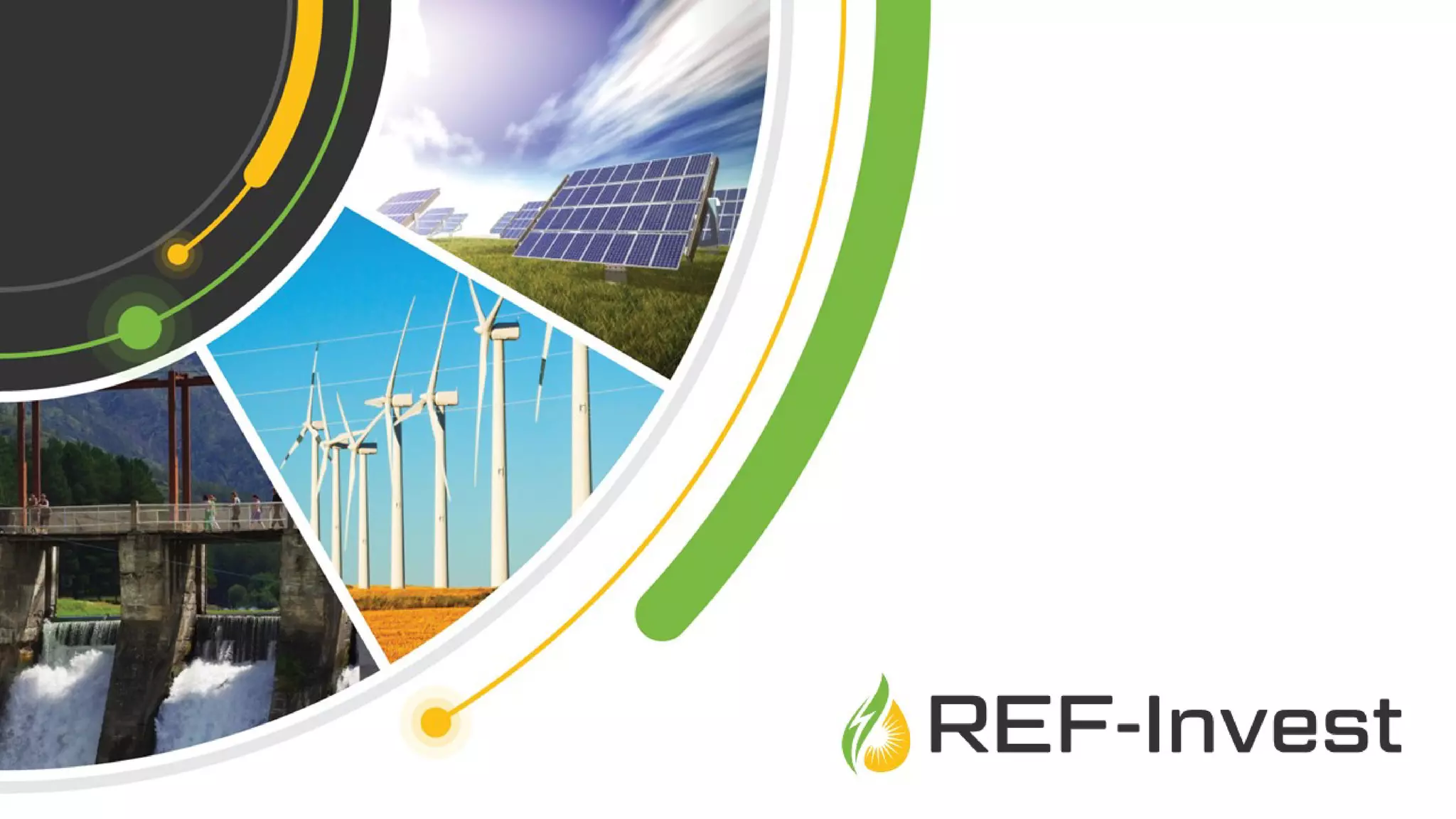
The cover slide establishes the company's focus through a collage of renewable energy sources: solar panels, wind turbines, and hydroelectric dams. The branding 'REF-Invest' is clearly displayed with a logo combining a green leaf, a lightning bolt, and a sun. This slide serves its purpose of immediate sector identification but offers no tagline or unique value proposition (UVP) to hook the reader instantly.
Slide 02: The Solution and Value Proposition
Slide 02 defines the 'Solution' as a 'Financial Instrument that supports in full the clean energy transition.' It breaks this down into three pillars: 01 Enabling a bigger access to renewable for all , 02 Non traditional crowd funding, investing and landing (likely a typo for 'lending'), and 03 Unique financial model with lower financial risk . While these are strong claims, the slide lacks the 'how.' There is no explanation of what makes the financial model unique or how the risk is lowered compared to traditional green bonds or equity crowdfunding.
Slide 04: Product and Features
This slide acts as a placeholder for a 'YouTube Video' and provides a concise definition of the company. It states: 'Renewable Energy Future Invest is a non traditional crowdfunding, investing and landing platform, focused on making renewable energy more accessible to all.' The use of 'landing' instead of 'lending' appears for the second time here. The slide is visually sparse, relying on the promise of a video that is not playable in a static deck format, which is a common pitfall in digital pitch decks.
Slide 06: Road Map and Traction
This is the most information-dense slide in the deck. It uses a winding road graphic to plot milestones from 2017 to 2023. Key points include:
2017: Market investigation and technology trends. · 2018: Identifying market gaps and consulting with fintech specialists. · 2019: Concept definition, whitepaper compilation, and initiating crowdfunding. · 2020: Platform launch, FCA Compliance, and first projects. · 2021: Scaling project diversity within the EU market. · 2022: Expansion into the Middle East and Asia, and scaling head count. · 2023: Worldwide renewable energy investment opportunities.
This timeline suggests a mature project, yet the deck lacks the 'Traction' data (e.g., number of users, total volume of funds raised to date) that usually accompanies such a roadmap.
Slide 08: Funds Break Down
Slide 08 provides a pie chart showing how the company intends to spend its capital. The breakdown is as follows: 52% Development , 25% Working Capital , 11% Overheads , 7% Marketing , and 5% Legal . While the percentages are clear, the omission of a total 'Ask' amount (e.g., $1M or $5M) makes this slide less actionable. An investor cannot judge if 7% for marketing is sufficient without knowing the total budget.
Slide 10: Strategic Partnerships
This slide introduces 'Enthuons Technologies' as the partner responsible for developing the platform. It describes them as a team of 'expert developers and designers' who have created the 'unique renewable energy crowd funding platform.' For a fintech company, relying entirely on a third-party partner for development can be a red flag for investors who prefer to see in-house technical leadership (CTO) to ensure long-term platform stability and IP ownership.
Slide 13: Closing
The final slide is a minimalist graphic featuring the company logo against a dark background with stylized green and yellow energy icons at the bottom. It lacks contact information, a call to action, or a summary of the investment opportunity, which are standard requirements for a closing slide.
What Works in This Deck
The visual consistency is a strength. The color palette of green, yellow, and dark grey reinforces the renewable energy theme without being distracting. The roadmap on Slide 06 is well-structured, showing a logical progression from research to global expansion. It gives the impression of a long-term strategic plan rather than a fly-by-night operation. Additionally, the 'Funds Break Down' on Slide 08 shows that the founders have at least considered their operational priorities, placing a heavy emphasis on product development.
Critical Omissions
The most glaring omission is the Team Slide . In early-stage investing, the 'who' is often more important than the 'what.' There is no mention of the founders, their backgrounds in finance or energy, or their track records. Without this, the deck feels anonymous and lacks credibility. Furthermore, there is no Market Size (TAM/SAM/SOM) slide. Investors need to know the scale of the opportunity in the renewable crowdfunding space. The Business Model is also vague; while it mentions 'investing and lending,' it does not explain how the platform makes money (e.g., transaction fees, management fees, or interest spreads). Finally, the lack of a Competitor Analysis slide is a missed opportunity to explain why REF-Invest is superior to existing platforms like Abundance Investment or Trine.
Founder's Teardown: Lessons to Apply
Founders should look at the roadmap on Slide 06 as a good example of how to visualize a multi-year strategy. It clearly separates research, compliance, launch, and scaling phases. However, they should avoid the mistake of omitting the 'Ask.' If you are showing a fund breakdown, you must state the total amount you are raising. Furthermore, never outsource your entire technical identity to a partner slide without explaining who owns the IP and who on your internal team manages that relationship. A fintech company without a listed CTO or technical lead is a difficult sell to sophisticated VCs. Lastly, ensure that your deck includes a clear way to contact you on the final slide; a pitch deck is a lead-generation tool, and it fails if the lead doesn't know where to go next.
Frequently asked questions
- What is the core product of Renewable Energy Future?
- According to Slide 04, the product is a 'non traditional crowdfunding, investing and landing platform.' It is designed to act as a financial instrument that supports the clean energy transition by enabling broader access to renewable energy projects for all types of investors, as highlighted on Slide 02.
- How does the company plan to use the investment capital?
- Slide 08 outlines a specific percentage-based allocation: 52% for Development, 25% for Working Capital, 11% for Overheads, 7% for Marketing, and 5% for Legal. Notably, the deck does not state the total currency amount they are seeking to raise, only how the eventual funds will be distributed.
- What is the company's regulatory status?
- Slide 06, which covers the 'Road Map / Traction,' lists 'FCA Compliance' as a milestone achieved or targeted for the year 2020. This indicates the company operates or intends to operate under the jurisdiction of the Financial Conduct Authority in the United Kingdom.
- Who is building the technology for REF-Invest?
- Slide 10 identifies 'Enthuons Technologies' as the company's trusted partner. The slide states that Enthuons and its team of developers and designers have partnered with REF-Invest to develop the unique renewable energy crowdfunding platform, suggesting that the core technology is not built in-house.
- What are the major milestones in the company's history?
- The roadmap on Slide 06 shows the company started with market investigation in 2017, defined the concept in 2019, and launched the platform and first projects in 2020. Future goals included EU market scaling in 2021, expansion into the Middle East and Asia in 2022, and achieving global reach by 2023.