Render’s 16-slide Series B deck is a highly disciplined example of a product-led growth narrative. By 2023, the company had established itself as a leading alternative to the complexity of legacy cloud providers like AWS or GCP. The deck focuses heavily on the 'undifferentiated heavy lifting' that engineering teams face when building internal platforms, positioning Render as the 'fully automated, end-to-end' solution. With key metrics like 4x YoY Gross ARR growth and a staggering >200% Net Dollar Retention, the deck moves quickly from problem-solution to a vision of an all-in-one cloud platfo…
Key takeaways
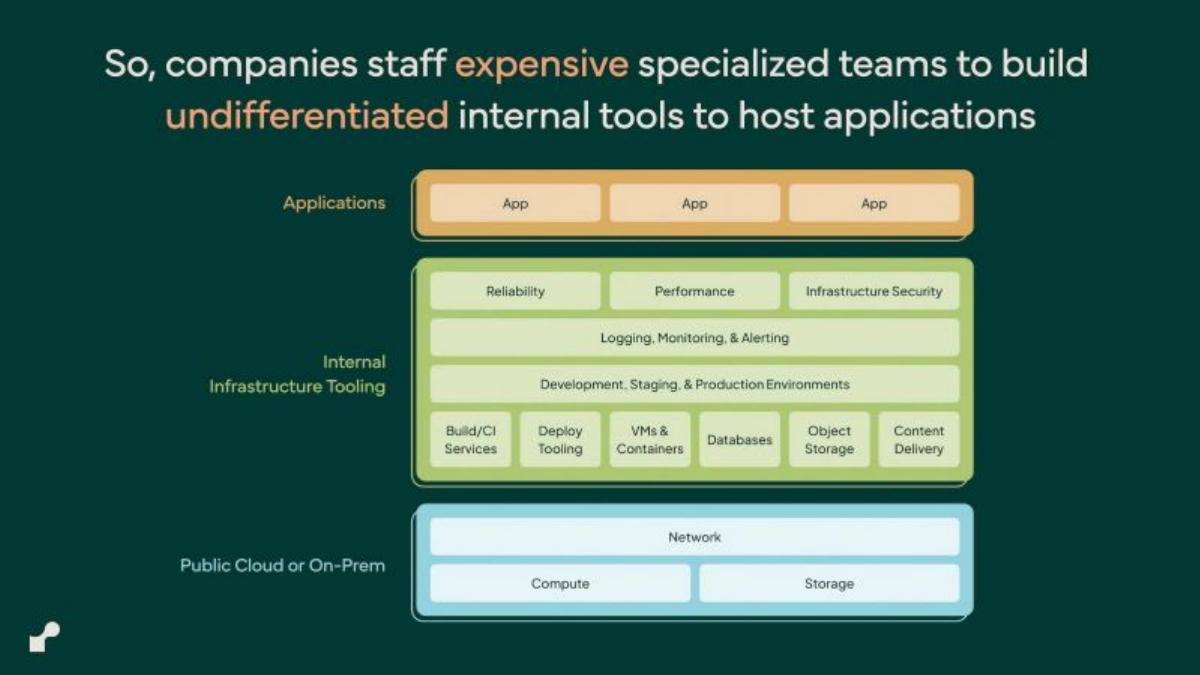
- The problem is framed as companies wasting expensive engineering talent on 'undifferentiated internal tools' (Slide 3).
- Render positions itself as a replacement for the entire internal infrastructure tooling layer, sitting directly between applications and the public cloud (Slide 5).
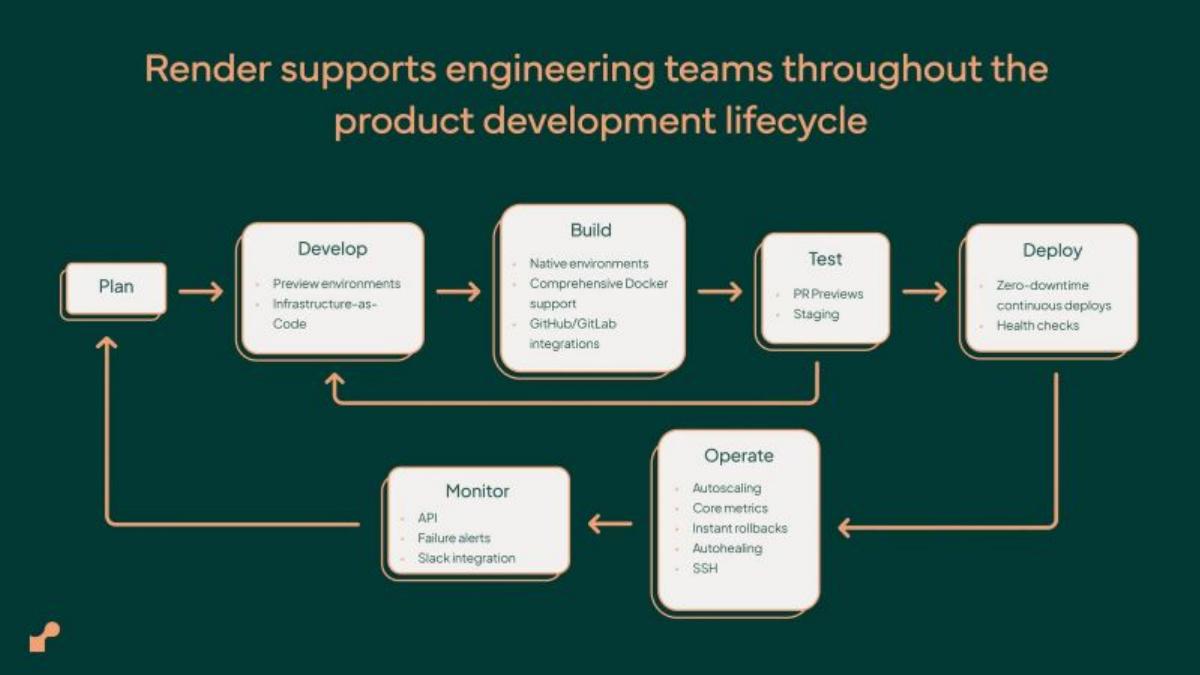
- The product covers the entire development lifecycle, from planning and building to operating and monitoring (Slide 6).
- Growth is described as 'entirely organic' and driven by a flywheel of discovery, experimentation, adoption, and expansion (Slide 8).
- The deck reports significant scale with over 500,000 developers and a Net Dollar Retention rate exceeding 200% (Slide 9).
- Future vision includes expanding into serverless, edge functions, and managed MySQL to become an all-in-one platform (Slide 11).
- The team slide emphasizes deep industry experience with former leaders from Stripe, Webflow, Slack, and Heroku (Slide 14).
- The deck omits a specific 'Ask' slide or detailed financial projections, common in high-demand Series B rounds where terms are often pre-negotiated.
The Narrative: From Infrastructure Primitives to Developer Joy
Render’s Series B deck is a masterclass in identifying a specific, high-cost pain point and offering a comprehensive architectural shift as the solution. In the world of cloud computing, the 'Big Three' (AWS, Azure, GCP) provide the raw materials, but Render argues that the assembly of those materials has become a burden that slows down innovation. The deck is structured to show that Render isn't just a tool, but a replacement for the entire DevOps/Platform Engineering department for many companies.
Slide 1: Title Slide
The deck opens with a minimalist title slide featuring the Render logo, the year 2023, and the location, San Francisco. The visual style is clean and modern, setting the tone for a company focused on 'Developer Experience' (DX).
Slide 2: The Problem with Large Cloud Providers
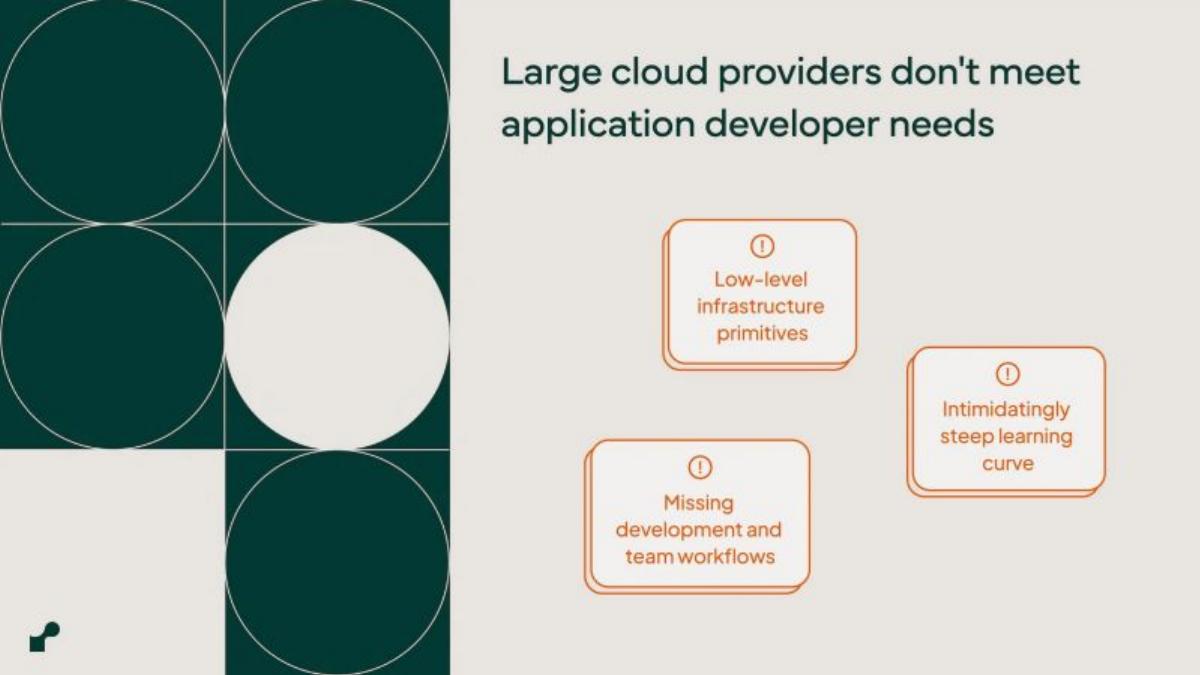
Render immediately targets the incumbents. The slide states that large cloud providers fail application developers because they offer 'low-level infrastructure primitives,' have an 'intimidatingly steep learning curve,' and lack 'development and team workflows.' This frames the problem not as a lack of features, but as a lack of usability.
Slide 3: The Hidden Cost of DevOps
This slide visualizes the consequence of the problem: companies must staff 'expensive specialized teams' to build 'undifferentiated internal tools.' A diagram shows a thick layer of 'Internal Infrastructure Tooling' (covering reliability, logging, CI/CD, etc.) sitting between the applications and the public cloud. The keyword here is 'undifferentiated'—meaning companies are spending millions to build something that doesn't actually make their product better than their competitors'.
Slide 4: The Inefficiency of Reinvention
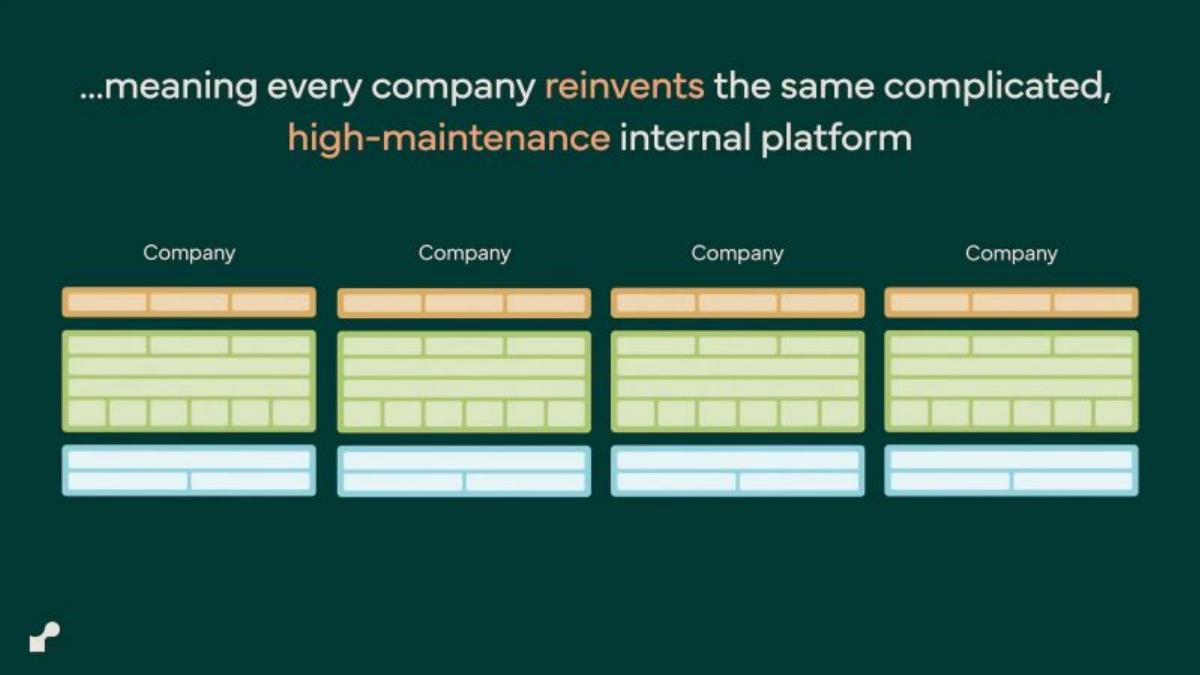
Slide 4 reinforces the previous point by showing four identical stacks across different companies. The headline notes that 'every company reinvents the same complicated, high-maintenance internal platform.' This is a classic 'market inefficiency' argument designed to appeal to investors' desire for horizontal solutions that can serve an entire industry.
Slide 5: The Render Solution
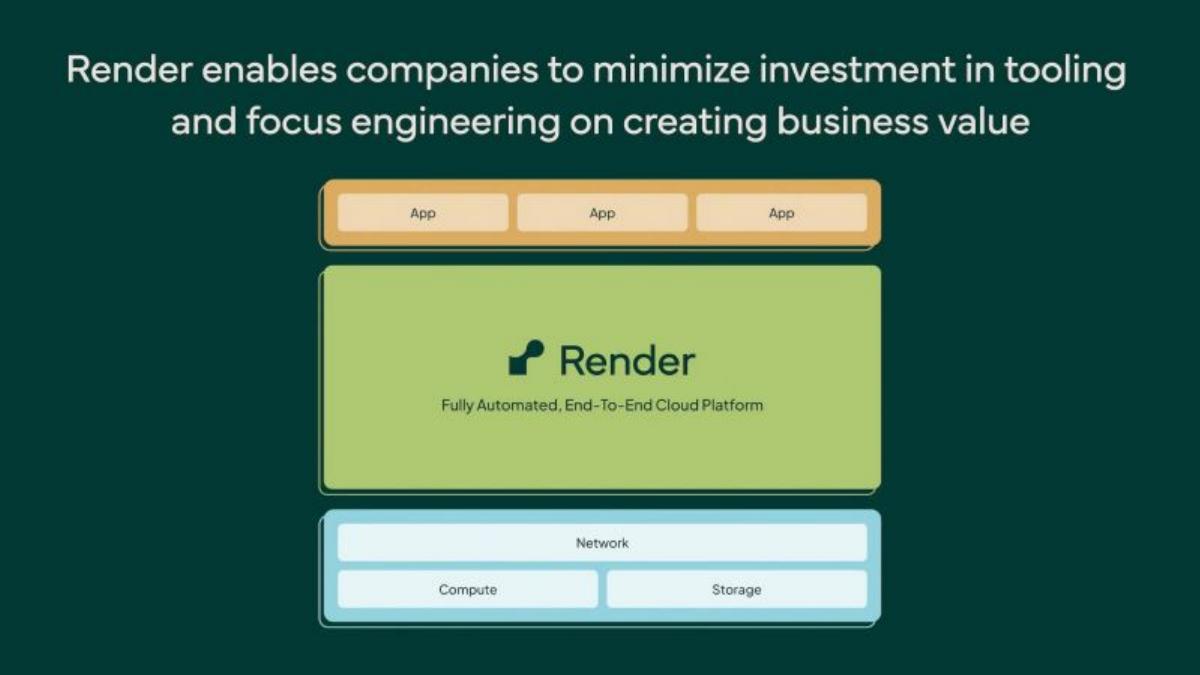
The solution slide replaces the messy 'Internal Infrastructure Tooling' layer from Slide 3 with a single, solid block: Render. It is described as a 'Fully Automated, End-To-End Cloud Platform.' This visual simplicity is the core value proposition: Render collapses a dozen complex tools into one managed service.
Slide 6: The Product Development Lifecycle
Render maps its capabilities across the standard engineering workflow: Plan, Develop, Build, Test, Deploy, Operate, and Monitor. Specific features are listed for each stage, such as 'Preview environments' for development and 'Instant rollbacks' for operations. This demonstrates that Render is a deep product, not just a simple hosting service.
Slide 7: Platform Capabilities and Security
This slide serves as a 'checklist' for enterprise readiness. It lists technical features like Redis, Private Networking, and Cron Jobs alongside security credentials like 'SOC2 Type II Compliant' and 'DDoS Protection.' For a Series B, proving that the platform can handle serious production workloads is essential.
Slide 8: The Organic Growth Flywheel
One of the most important slides for a VC, this explains how Render acquires customers. The 'flywheel' is 'entirely organic and driven by word-of-mouth.' It moves from Discover (social media, OSS docs) to Experiment (Free Tier) to Adopt and finally Expand. This suggests a very low Customer Acquisition Cost (CAC), which is highly attractive at the Series B stage.
Slide 9: Traction and Metrics
This is the 'money slide,' though specific figures for ARR and Signups are redacted in this version of the deck. However, the growth rates are visible: 4x YoY Gross ARR, 10x YoY Signups, and 6x YoY New Services. The most impressive figure is the '>200% Net Dollar Retention,' which indicates that once a developer starts using Render, they rapidly increase their spending as they grow.
Slide 10: Future Vision
The deck shifts from what has been built to what comes next. The vision is three-fold: becoming an all-in-one cloud platform, building workflows for teams of all sizes, and creating a flexible, extensible ecosystem.
Slide 11: Foundational Capabilities Roadmap
This slide lists specific upcoming features, including 'Serverless and edge functions,' 'Object storage,' and 'Managed MySQL.' This shows that Render intends to compete more directly with the full breadth of services offered by AWS, rather than remaining a niche PaaS.
Slide 12: Best-in-Class DX for Teams
Focusing on the 'Workflows' pillar, this slide details how Render will empower larger teams with 'customization, control, and visibility.' It lists features like RBAC (Role-Based Access Control) and SSO, which are necessary for moving up-market into larger enterprise customers.
Slide 13: Extensibility and Ecosystem
The final product-focused slide discusses an 'Add-on Marketplace.' By allowing partners like MongoDB, Datadog, and PagerDuty to integrate directly, Render positions itself as the 'hub' of a developer's stack, making the platform stickier and more valuable.
Slide 14: The Team
The team slide is exceptionally strong, featuring leaders with experience at Stripe, Webflow, Slack, Figma, and Heroku. This 'pedigree' is a major de-risking factor for investors. The slide also prominently features the 'TechCrunch Disrupt 2019 Winner' badge, providing third-party validation of the company's early potential.
Slide 15 & 16: Conclusion
The deck concludes with a simple 'Thank You' slide and a promotional slide for the pitch deck library. Notably, there is no 'Ask' slide in this deck, which is common for high-profile Series B rounds where the round size and valuation are often determined through a competitive process rather than a static request.
What Works in This Deck
Clear Visual Metaphor: The use of the 'layer cake' diagram to show Render replacing a messy internal infrastructure layer is highly effective. It makes a complex technical argument instantly understandable. · Metric-Driven Growth: Reporting a 200% Net Dollar Retention is a massive signal. It proves product-market fit and suggests that the product is 'sticky' and scales naturally with the customer's success. · Focus on Efficiency: By framing the problem as 'wasted engineering time,' Render appeals to the bottom line of every CTO. They aren't just selling a cloud; they are selling engineering velocity. · Strong Team Pedigree: The team’s history at companies like Stripe and Heroku (the original PaaS) gives them immediate credibility in the developer tools space.
What is Missing
The Ask: As noted, there is no slide detailing how much capital is being raised or how it will be allocated. While common in 'hot' rounds, most founders should include a slide on use of proceeds. · Unit Economics: While NDR is mentioned, there is no detail on Gross Margins or CAC/LTV ratios. In a cloud hosting business, margins are a critical concern for long-term viability. · Competitive Landscape: The deck mentions 'Large cloud providers' generally but does not address direct competitors like Fly.io, Railway, or Vercel, which also target the modern developer experience.
What Founders Should Copy
The Flywheel Slide: Every PLG (Product-Led Growth) company should have a slide like Slide 8. It explains the mechanics of growth beyond just 'we hire more sales reps.' · Problem Framing: Don't just say your product is better; show how much money/time the current way of doing things is wasting. Render's focus on 'undifferentiated' work is a brilliant way to devalue the status quo. · Roadmap Alignment: The way Render aligns its roadmap (Slides 11-13) with its vision (Slide 10) shows a logical progression from a startup product to a platform ecosystem.
Frequently asked questions
- How does Render differentiate itself from AWS or Google Cloud?
- According to Slide 2, Render differentiates by addressing the 'low-level infrastructure primitives' and 'intimidatingly steep learning curve' of large providers. While AWS provides the raw compute and storage, Render provides the automated orchestration layer that companies usually have to build themselves using expensive specialized teams.
- What are the key growth metrics shared in the deck?
- Slide 9 highlights several high-growth indicators: Gross ARR grew 4x year-over-year, monthly signups grew 10x, and new services per month grew 6x. Most notably, the company claims a Net Dollar Retention (NDR) of over 200%, indicating massive expansion within their existing customer base.
- What is Render's customer acquisition strategy?
- Render relies on a product-led growth (PLG) model. Slide 8 details an organic flywheel where developers discover the tool via search, forums, and social media, experiment with a Free Tier, and then adopt and expand their usage as they migrate more applications to the platform.
- Who is the target user for Render based on this deck?
- The primary target is the application developer and engineering teams. Slide 2 and Slide 6 specifically mention meeting 'application developer needs' and supporting 'engineering teams throughout the product development lifecycle.' The goal is to allow these teams to focus on 'creating business value' rather than managing infrastructure.
- What is the long-term product roadmap for Render?
- As shown on Slides 11 and 12, Render plans to add foundational capabilities like serverless/edge functions, object storage, and managed MySQL. They also aim to build an 'Add-on Marketplace' to allow third-party integrations with tools like MongoDB, Datadog, and Auth0 (Slide 13).