RemitBee’s 13-slide deck is a study in minimalist, traction-led storytelling for a fintech startup. Founded in 2014, the company identifies a massive $600+ billion global market, narrowing its immediate focus to the $24 billion Canadian remittance sector (Slide 2). The deck effectively uses a competitor comparison to frame the 'expensive and slow' problem (Slide 3) before showcasing a functional product with a built-in wallet (Slide 4). The core strength of the pitch lies in its growth metrics: 45% month-over-month growth in wallet-funded transfers (Slide 8) and over $5 million in total volum…
Key takeaways
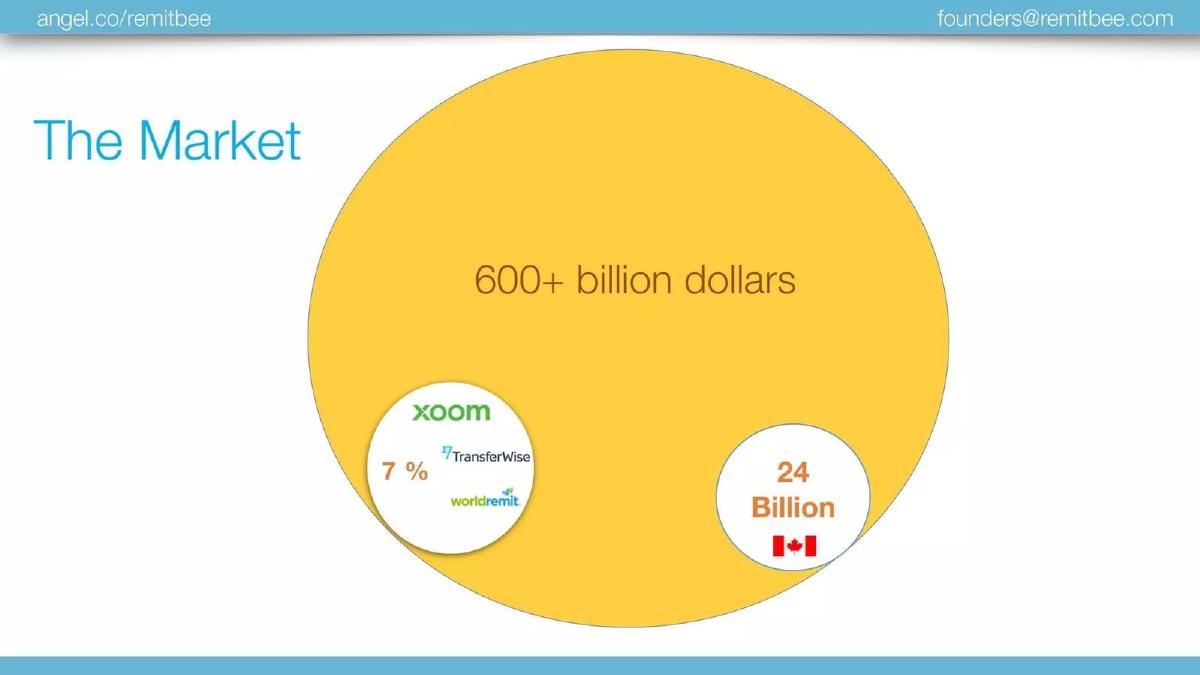
- The total addressable market is cited at over $600 billion globally, with a specific $24 billion opportunity identified in Canada (Slide 2).
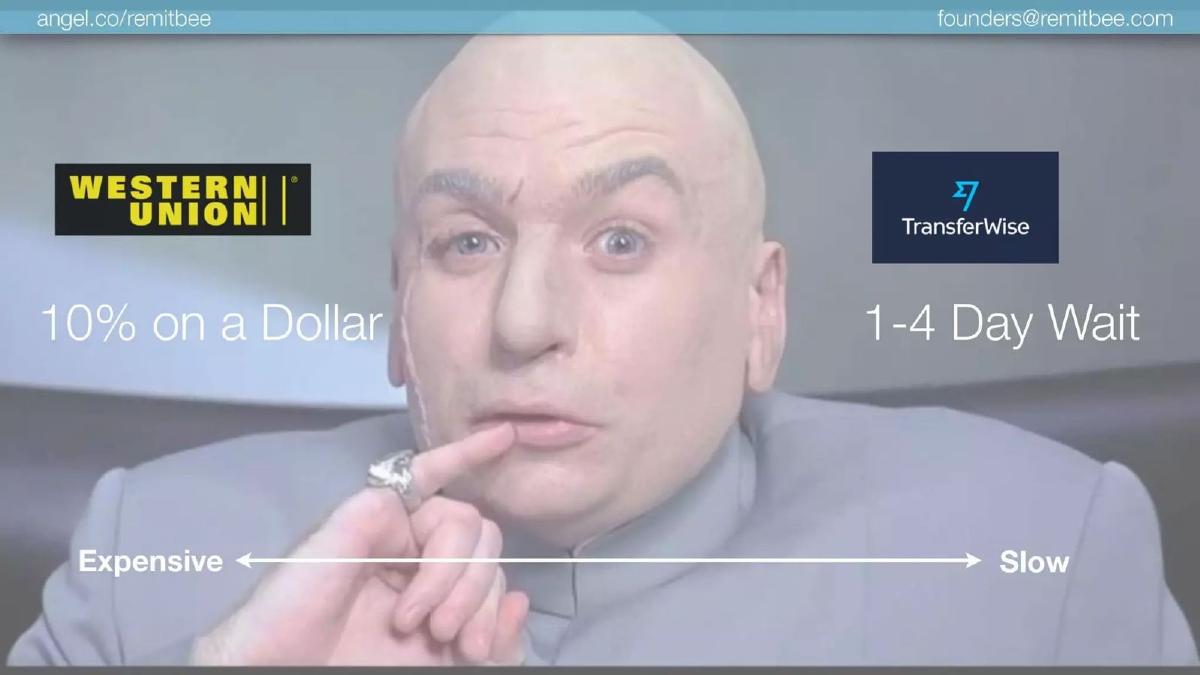
- Competitors like Western Union and TransferWise are framed as 'Expensive' (10% on a dollar) and 'Slow' (1-4 day wait) respectively (Slide 3).
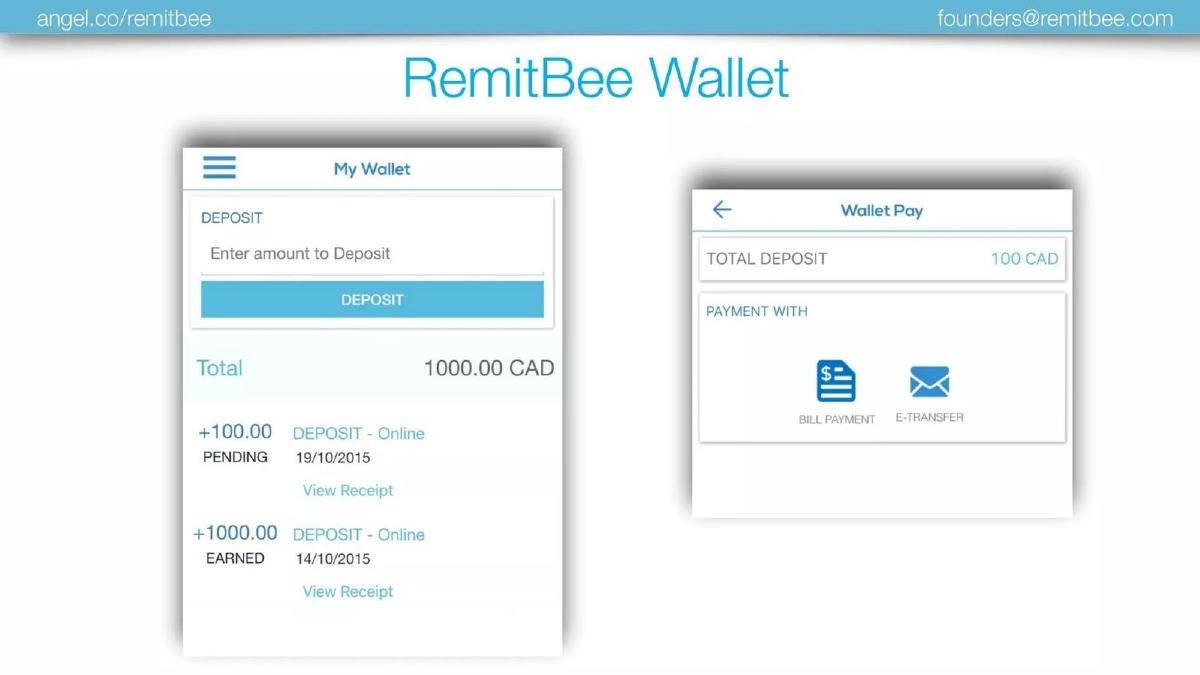
- The product features a 'RemitBee Wallet' that supports deposits via bill payment and e-transfer (Slide 4).
- The startup reports a 45% month-over-month growth rate specifically for wallet-funded transfers (Slide 8).
- Cumulative traction includes over $5 million processed and $200,000+ in revenue as of the deck's creation (Slide 9).
- The company has already established a presence in 7 countries and outlines a roadmap to expand to over 45 countries (Slides 10-11).
- The team, referred to as 'The BeeHive,' consists of five members covering Product, CTO, Compliance, Global Partnerships, and UI/UX (Slide 12).
- The deck omits a specific funding request, valuation, or use of proceeds slide.
Executive Summary
RemitBee is a Canadian-based fintech startup that entered the market in 2014 to disrupt the traditional remittance industry. This 13-slide pitch deck, used during their Seed round, focuses heavily on the friction found in legacy money transfer systems. By highlighting high fees and slow transit times, RemitBee positions its mobile-first wallet as the modern solution for the global diaspora. The deck is characterized by clean visuals, a clear focus on the Canadian market, and strong month-over-month growth metrics.
Slide 1: Title Slide
The deck opens with the RemitBee logo and the tagline "connect the world’s money." It includes contact information for the founders and a link to their AngelList profile. The design is minimalist, utilizing a blue and white color palette that remains consistent throughout the presentation.
Slide 2: The Market
Slide 2 defines the scale of the opportunity. It uses a large yellow circle to represent a 600+ billion dollar global market. Within this, it identifies two sub-segments: a 7% slice representing the digital share occupied by players like Xoom, TransferWise, and WorldRemit, and a 24 Billion circle specifically for the Canadian market, marked with a Canadian flag. This slide effectively communicates that while the global market is massive, the company has a clear, reachable starting point in Canada.
Slide 3: The Problem (Competitor Comparison)
Using a pop-culture reference (Dr. Evil), this slide visualizes the pain points of the current market. It places Western Union on the "Expensive" side of a spectrum, claiming they take 10% on a Dollar . On the other end, it places TransferWise (now Wise) on the "Slow" side, citing a 1-4 Day Wait . This positioning is strategic; it suggests that RemitBee occupies the middle ground—being both cheaper than legacy players and faster than early digital disruptors.
Slide 4: RemitBee Wallet
This slide introduces the product interface. It shows the "My Wallet" screen with a balance of 1000.00 CAD and a history of deposits. Notably, it highlights that users can fund their wallet via "Bill Payment" and "E-Transfer." This is a critical piece of their infrastructure, as it bypasses expensive credit card processing fees, allowing them to maintain the low costs promised in the previous slide.
Slide 5: Solving Problems
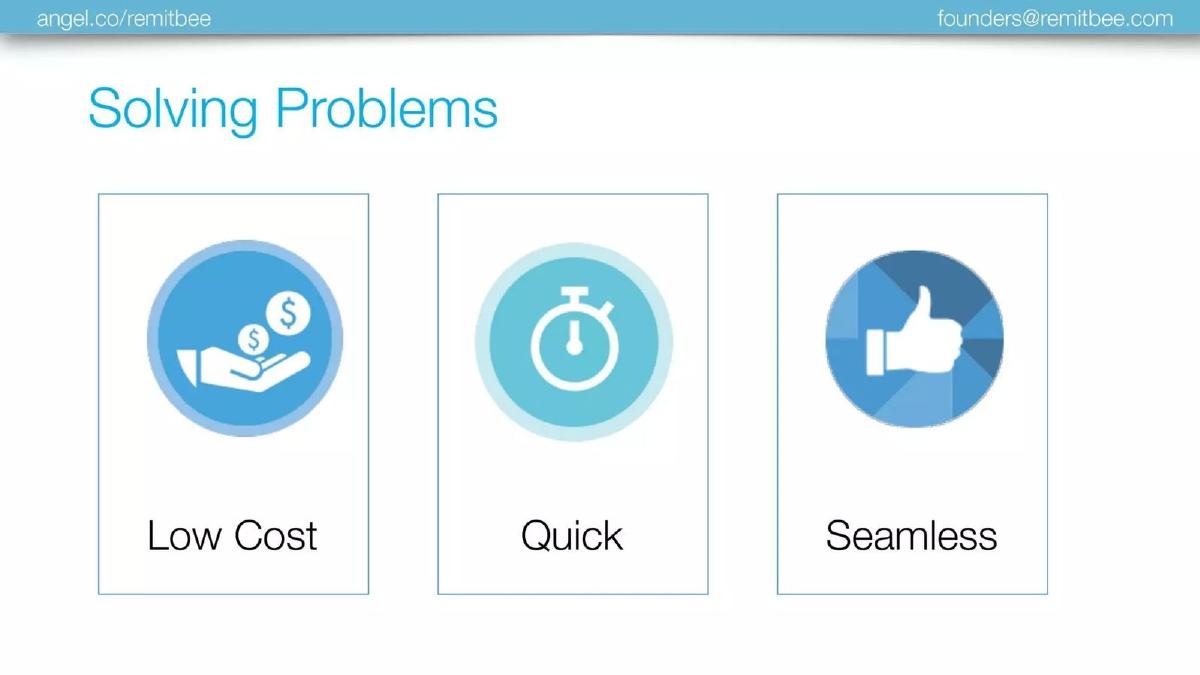
A simple icon-based slide reinforces the value proposition: Low Cost, Quick, and Seamless . While this slide lacks data, it serves as a transition from the product features to the user experience.
Slide 6: Real Customers
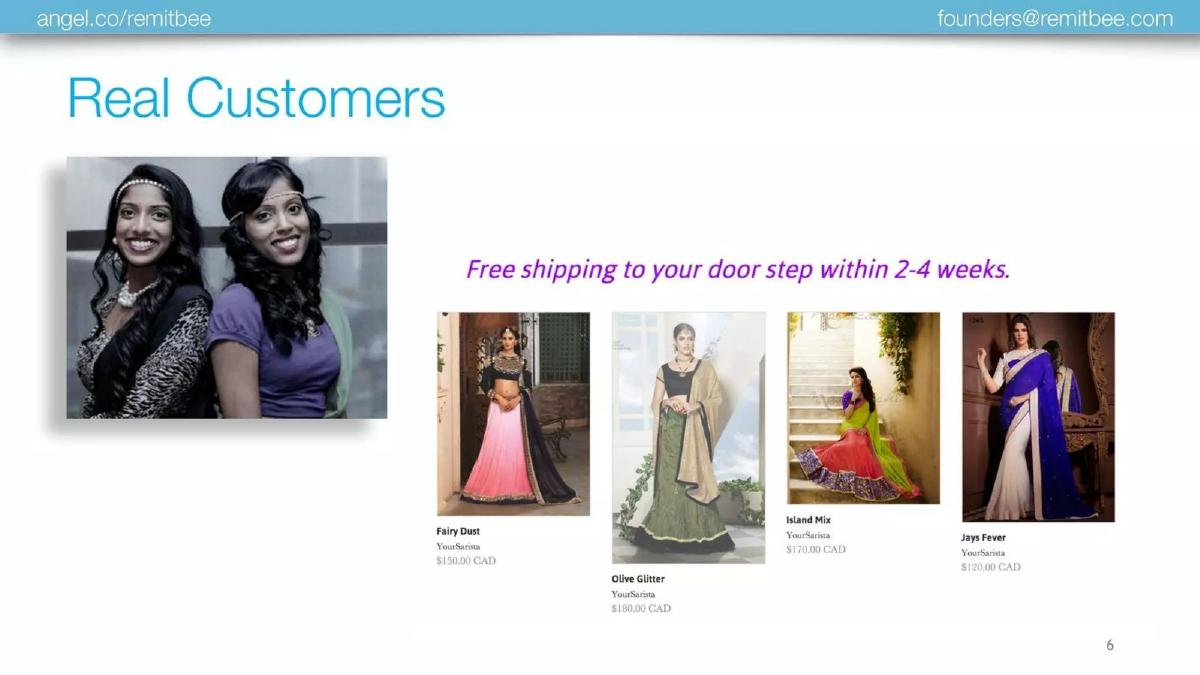
Slide 6 attempts to provide social proof or a use-case scenario. It shows two women and several images of traditional South Asian clothing (saris) with prices in CAD (e.g., "Fairy Dust" for $150.00 CAD). The text mentions "Free shipping to your door step within 2-4 weeks." This slide is somewhat ambiguous; it implies that RemitBee is being used for cross-border e-commerce or that their target demographic is using the service to facilitate these types of purchases back home.
Slide 7: Product Workflow
This slide breaks down the user journey into three steps: 1. Select Recipient, 2. Review Transaction (showing an exchange rate of 1 CAD = 49.75 INR), and 3. Pay Transaction. The interface shows various payment options including Visa Debit, Interac e-Transfer, and the RemitBee Wallet. This demonstrates a high level of product maturity and multi-channel payment integration.
Slide 8: Traction - Growth Rate
The first of two traction slides, Slide 8 focuses on a single impressive metric: 45% MOM Growth in wallet-funded transfers. By isolating wallet-funded transfers, the company is showing that their most efficient and potentially most loyal user base is expanding rapidly.
Slide 9: Traction - Volume and Revenue
Slide 9 provides the hard numbers. It states the company has processed 5+ Million Dollars in total volume and generated 200K+ in Revenue . An area chart shows the growth trajectory from April to the start of 2016, with a significant vertical spike in the final quarter. This suggests the company found a repeatable growth lever late in the year.
Slide 10 & 11: Growth and Expansion
These two slides show a "Before and After" map of the world. Slide 10 shows the current state with 7 Countries served. Slide 11 shows the future state with 45+ Countries . The pins on the map suggest a heavy focus on the corridor between North America and the Global South, particularly India, the Philippines, and parts of Africa and Europe.
Slide 12: The Team
Titled "The BeeHive," this slide introduces five core team members. The roles are clearly defined: Yogi (Product), Manos (Compliance & Payments), Pra Theepan (Global Partnership), Ronak (Founding CTO), and Rajavi (UI/UX Lead). The inclusion of a dedicated "Compliance & Payments" lead is a positive signal for a fintech startup, as regulatory hurdles are often the primary cause of failure in this sector.
Slide 13: Closing Slide
The deck concludes with the logo, the founder's email address, and icons for iOS, Android, and Web platforms. This confirms that the service is cross-platform and ready for a wide range of users.
What Works
Specific Market Focus: By highlighting the $24 billion Canadian market, the founders show they aren't just chasing a vague global number; they have a specific, local beachhead. · Strong Traction Metrics: 45% month-over-month growth is a top-tier metric for a seed-stage startup. Combining this with $200k in revenue proves that the business model is functional and the product has found an audience. · Competitive Positioning: Slide 3 is a bold way to frame the competition. By attacking both the legacy giant (Western Union) and the modern darling (TransferWise), they carve out a unique space for themselves. · Visual Product Walkthrough: The screenshots in Slide 7 are clear and show a polished UI, which reduces investor concern regarding technical execution.
What is Missing
The Ask: This is the most glaring omission. There is no mention of how much money they are looking for, what the valuation is, or what the milestones for the next 18 months will be. · Unit Economics: While they show $200k in revenue, they don't explain the margin. Is that revenue from flat fees, FX spreads, or both? What is the cost to acquire a customer (CAC)? · Regulatory Roadmap: Remittance is a highly regulated industry. The deck mentions a Compliance lead but doesn't list which licenses (like MSB licenses in Canada) they currently hold or need to acquire for their 45-country expansion. · Detailed Team Backgrounds: While we see faces and titles, we don't know if these founders have worked at banks, other fintechs, or have successfully exited a company before.
What a Founder Should Copy
The "Traction Spike" Visualization: Slide 9 uses a simple area chart to show that growth is accelerating. If your recent months are significantly better than your early months, use this format to emphasize momentum. · Corridor-Specific TAM: Don't just say the global market is huge. Follow RemitBee's lead on Slide 2 and identify the specific "slice" you are going after first. It makes the plan feel much more attainable. · Minimalist Design: The deck avoids clutter. Each slide has one main point and a clear visual. This ensures the investor stays focused on the narrative rather than getting lost in bullet points. · Functional Role Clarity: On the team slide, don't just put "Co-Founder." Define the functional area of responsibility (e.g., "Global Partnership" or "Compliance"). It shows you have thought about the operational needs of the business.
Frequently asked questions
- What is RemitBee's primary value proposition?
- RemitBee positions itself as a 'Low Cost, Quick, and Seamless' alternative to traditional money transfer services. According to Slide 3, it aims to solve the high costs associated with incumbents like Western Union (which they claim charges 10% on the dollar) and the slow processing times of digital competitors like TransferWise (which they cite as having a 1-4 day wait time).
- How much revenue has RemitBee generated?
- As shown on Slide 9, the company has generated over $200,000 in revenue. This revenue was earned on a total transaction volume of more than $5 million. The slide uses a steep area chart to illustrate that the majority of this growth occurred between October and the start of 2016.
- What is the company's geographic focus?
- The deck identifies Canada as its primary hub, noting a $24 billion market size for that region on Slide 2. While they started with 7 countries (Slide 10), the growth plan involves expanding to over 45 countries, with map pins indicating a focus on Africa, South Asia, and Southeast Asia (Slide 11).
- Who are the key members of the founding team?
- The team, shown on Slide 12, includes Yogi (Product), Ronak (Founding CTO), Manos (Compliance & Payments), Rajavi (UI/UX Lead), and Pra Theepan (Global Partnership). The deck does not provide specific professional backgrounds or previous company exits for these individuals, focusing instead on their current functional roles.
- What is missing from the RemitBee pitch deck?
- The deck is notably missing a 'The Ask' slide, meaning there is no mention of how much capital they are raising or the terms of the round. It also lacks a detailed slide on unit economics (CAC/LTV), a formal regulatory/licensing roadmap, and a detailed breakdown of how the $200k in revenue was calculated (fees vs. spread).