Rensair’s Series A deck is a comprehensive look at how a hardware startup can leverage global tailwinds to scale rapidly. Raising $7M in 2022, the company successfully argued that air purification is a long-term infrastructure requirement rather than a temporary pandemic response. The deck excels at demonstrating operational maturity, showcasing a complex global supply chain with four warehouses and a clear legal structure across the UK, US, and EU. While the 47-slide length is unusually high, the inclusion of technical patent drawings and specific B2B buyer personas provides the depth requir…
Key takeaways
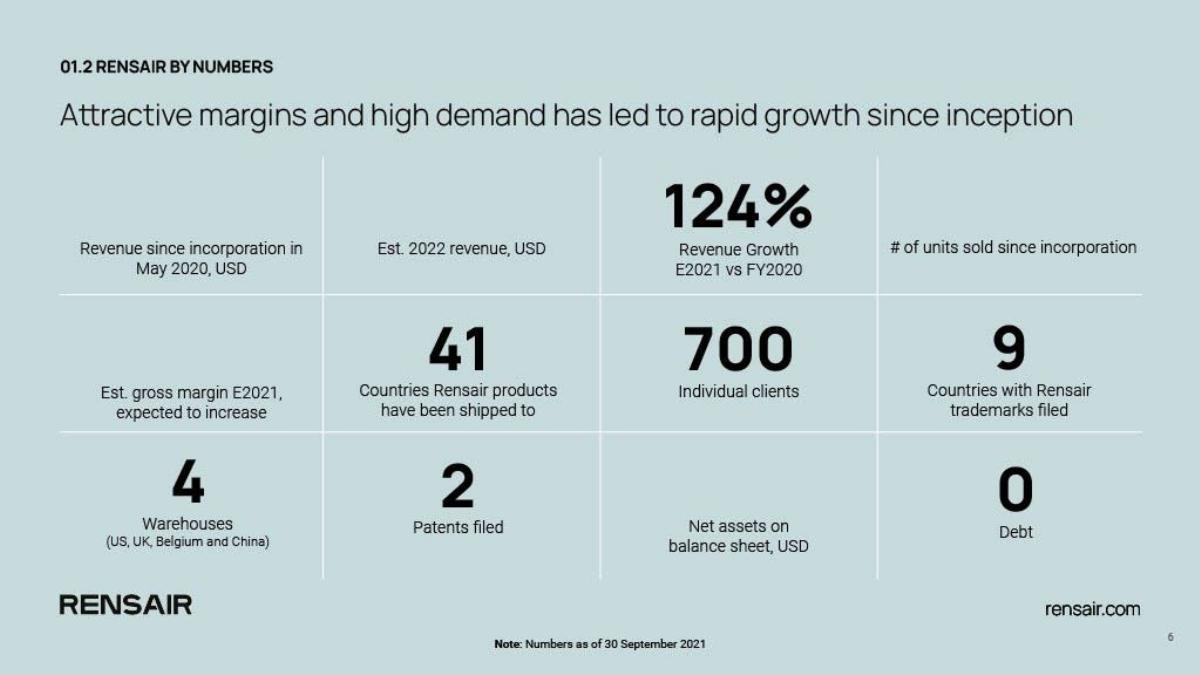
- The company reported 124% revenue growth between FY2020 and E2021 on slide 6.
- Rensair established a global footprint early, shipping to 41 countries with 4 warehouses in the US, UK, Belgium, and China as of slide 6.
- The deck uses Google Search trends to argue that air purification demand is a decade-long trend, not just a Covid-19 phenomenon, on slide 16.
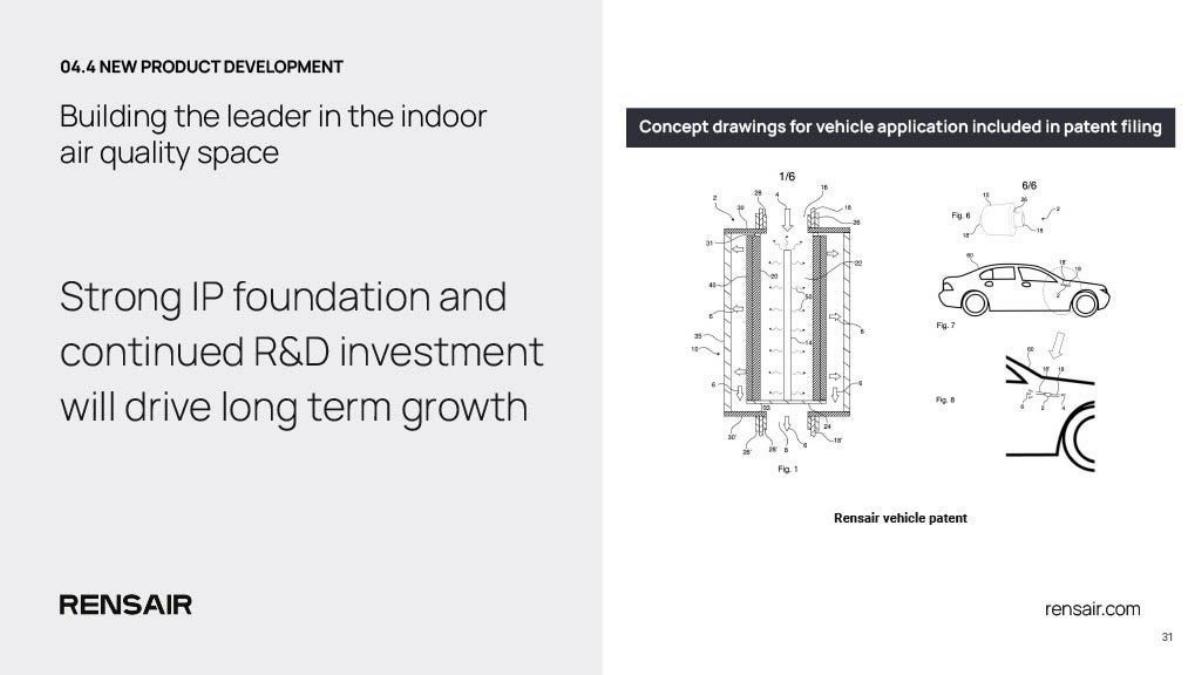
- Technical defensibility is supported by two filed patents, including specific concept drawings for vehicle applications shown on slide 31.
- The product utilizes a combination of H13 HEPA filtration and UVC light, with the UVC lamp specifically designed to inactivate pathogens on the filter as detailed on slide 26.
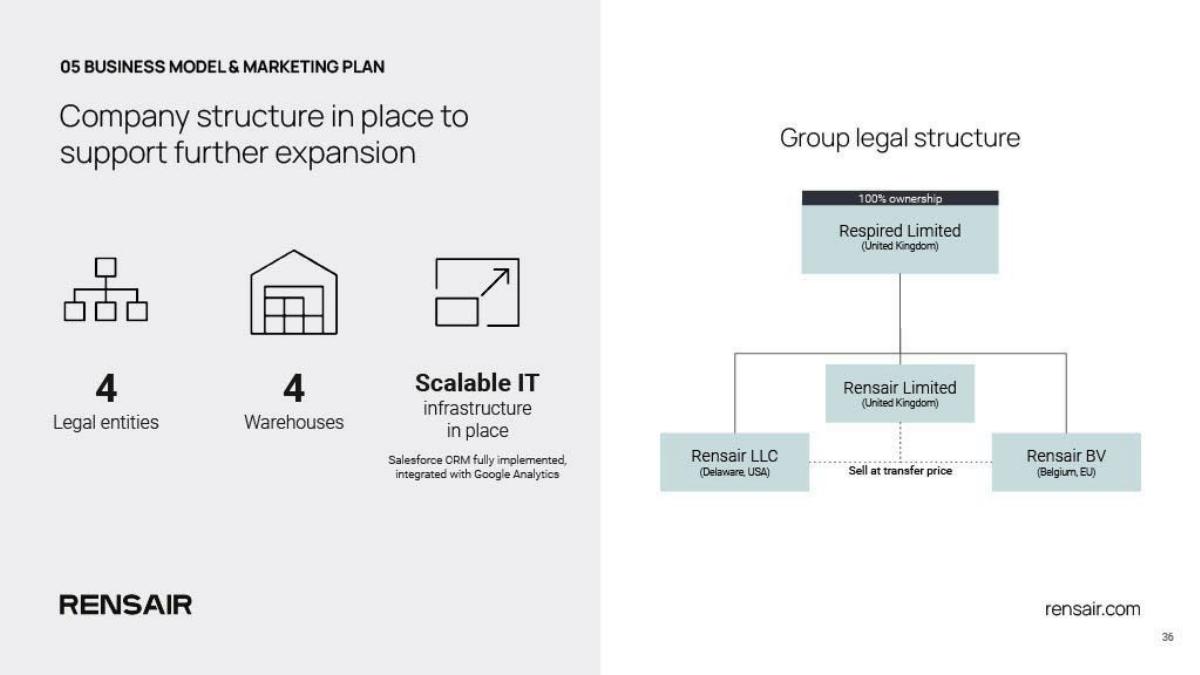
- Operational maturity is demonstrated through a formal group legal structure involving three international subsidiaries under a UK parent company on slide 36.
- The marketing strategy identifies specific B2B personas, such as Heads of Facilities and Heads of Infection Control, on slide 43.
- Despite the large slide count, the deck omits a dedicated team slide with individual bios in the provided selection, though slide 46 references a 'strong management team.'
The 47-Slide Strategy: Depth Over Brevity
Rensair’s Series A deck, which facilitated a $7M raise in 2022, defies the standard advice to keep pitch decks under 15 slides. At 47 slides, this is a deep-dive document intended for serious due diligence. For a hardware company, this length is often necessary to cover technical specifications, international logistics, and intellectual property. The deck is structured into six clear chapters, moving from high-level market numbers to granular technical details and finally to the funding allocation.
Slide 1-5: The Visual Identity
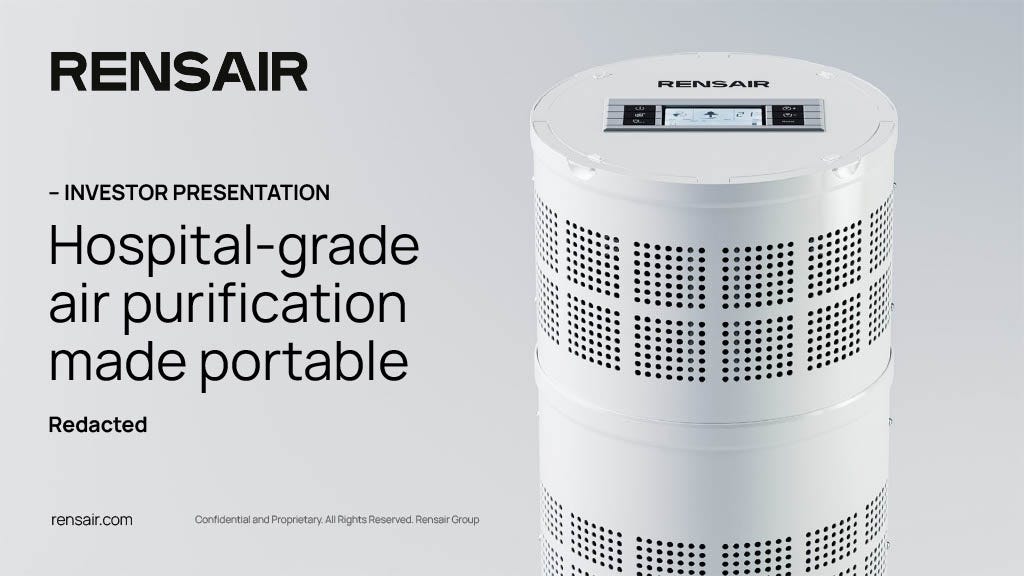
The opening slides are minimalist, focusing on the brand name and the core value proposition: "Hospital-grade air purification made portable." The imagery on Slide 1 is crucial; it shows a high-fidelity render of the Q01B unit, emphasizing its industrial, clean, and robust design. By leading with the physical product, Rensair grounds the investor in the reality of their hardware business immediately.
Slide 6: Traction and Global Footprint
Slide 6, titled "Rensair by Numbers," is the most important slide in the first half of the deck. It presents a snapshot of the business as of September 30, 2021. Key metrics include:
124% Revenue Growth: Comparing E2021 vs FY2020. · Global Reach: Products shipped to 41 countries. · Infrastructure: 4 warehouses across the US, UK, Belgium, and China. · Client Base: 700 individual clients. · Financial Health: 0 debt and a positive net asset position.
This slide effectively communicates that Rensair is not a local experiment but a global operation with established product-market fit and the logistics to support it.
Slide 11-16: Defining the Problem and Market Opportunity
On Slide 11, the company bifurcates the indoor air quality problem into "Airborne Disease Transmission" and "Harmful Particulate Matter." This is a strategic move to ensure the company isn't pigeonholed as a "Covid company." By including smoke, mold, and car pollution as core problems, they expand their Total Addressable Market (TAM).
Slide 16 reinforces this by showing a decade-long trend in search volume for air purifiers. The chart shows that while Covid-19 caused a 400% spike, the baseline interest in air purification has been rising steadily since 2011. This data point is vital for convincing Series A investors that the market won't disappear as the pandemic recedes.
Slide 21-26: The Solution and Technical Defensibility
Hardware investors are notoriously wary of "white-labeled" products. Rensair addresses this on Slide 21 with a high-authority testimonial from a doctor at the University of Oxford, and more importantly, on Slide 26 with a technical breakdown of the Model Q01B. The slide details the "Patented air flow design," explaining how air enters the top, passes through a 4m2 H13 HEPA filter, and is treated by a UVC lamp. The specific mention of the UVC lamp inactivating pathogens on the filter is a key technical differentiator that separates them from standard HEPA-only units.
Slide 31: Future R&D and IP
To justify a Series A valuation, a company must show where the next leg of growth will come from. Slide 31 displays concept drawings from their patent filings for vehicle applications. This suggests that Rensair’s technology is a platform that can be miniaturized or adapted for the automotive industry, providing a clear path for future licensing or product lines beyond standalone units.
Slide 36: Corporate Maturity
Slide 36 outlines the "Group legal structure." It shows the parent company, Respired Limited (UK), owning 100% of subsidiaries in the USA, UK, and Belgium. For an investor, this slide signals that the founders have already done the heavy lifting of setting up international tax and legal frameworks, reducing the friction for deploying capital globally.
Slide 43-46: The Ask and Investment Highlights
Slide 43 details the go-to-market strategy. It identifies performance marketing as the primary engine and lists specific B2B targets: Corporate Office Spaces (Heads of Facilities), Hospitals (Heads of Estates), and Education (Heads of Engineering). This level of specificity shows that Rensair understands their sales cycle and who holds the budget.
The deck concludes on Slide 46 with five "Key investment highlights," summarizing the patented tech, proven track record, market tailwinds, management team, and the use of funds for market entry. It is a concise wrap-up of a very dense presentation.
What Works in This Deck
Operational Transparency: Most startups hide their logistics. Rensair leans into it, showing their four-warehouse setup and global shipping stats. This builds immense trust with investors who understand the complexities of hardware distribution.
Market Contextualization: The use of long-term search data to prove the market isn't just a pandemic fluke is a masterclass in handling the "Why Now?" and "Will it Last?" questions simultaneously.
Technical Detail: The inclusion of patent drawings and specific filter surface areas (4m2) appeals to the technical due diligence required for hardware investments. It moves the conversation from marketing fluff to engineering reality.
What Is Missing
Unit Economics: While the deck mentions "attractive margins" on Slide 6, it does not provide the specific Customer Acquisition Cost (CAC) or Lifetime Value (LTV) metrics. For a company claiming that performance marketing is their primary engine, these numbers are usually expected in a Series A deck.
Detailed Team Bios: Although Slide 46 mentions a "Strong management team," the provided slides do not include the standard team slide with photos and previous exits/experience. In a $7M round, the pedigree of the founders is usually a front-and-center argument.
Competitor Comparison: The deck lacks a traditional "competitor matrix." While they describe their tech as unique, they don't explicitly name or benchmark themselves against industry giants like Dyson, Molekule, or Blueair.
Founder Takeaways
Own your logistics: If you are a hardware founder, don't just talk about your prototype. Talk about your warehouses, your shipping partners, and your international legal entities. Showing that you can move atoms as well as bits is a massive competitive advantage.
Fight the 'Trend' Stigma: If your business was boosted by a specific global event (like a pandemic or a regulatory change), use historical data to prove that the underlying need existed long before the event and will persist long after.
Use 'High-Authority' Validation: A quote from an Oxford doctor carries more weight than ten quotes from generic office managers. When selling technical or medical hardware, your testimonials must match the gravity of the problem you are solving.
Frequently asked questions
- How does Rensair differentiate its hardware from consumer air purifiers?
- Rensair positions itself as 'hospital-grade' technology. Slide 26 highlights a patented air flow design that forces air through a 4m2 H13 HEPA filter while simultaneously using a UVC lamp to continuously disinfect the filter surface. This prevents the filter itself from becoming a reservoir for live pathogens, a common issue in lower-end consumer units.
- Is the company's growth entirely dependent on the pandemic?
- No, and the deck goes to great lengths to prove this. Slide 16 shows a Google Search volume chart for 'Air Purifier' dating back to 2011, illustrating a steady upward trend well before 2020. They categorize the problem into two parts: airborne disease and harmful particulate matter (pollution/smoke), ensuring the product remains relevant post-pandemic.
- What does the deck reveal about Rensair's manufacturing and logistics?
- The company operates a sophisticated global supply chain. Slide 6 and slide 36 confirm they have four warehouses located in the US, UK, Belgium, and China. This infrastructure allowed them to ship to 41 countries by late 2021, suggesting they are a logistics-ready scale-up rather than a prototype-stage startup.
- What is the primary revenue driver according to the deck?
- Slide 43 identifies performance marketing as the 'engine driving client acquisition.' While they utilize distributors and shareholder relationships, the strategy relies heavily on targeted digital spend (Google, LinkedIn, YouTube) to reach specific B2B decision-makers like Heads of Estates and Facilities.
- Does Rensair have intellectual property protection?
- Yes. Slide 6 mentions two patents filed, and slide 31 provides a visual look at these filings. The IP covers their unique air flow design and extends to future applications, such as air purification systems integrated into vehicles.