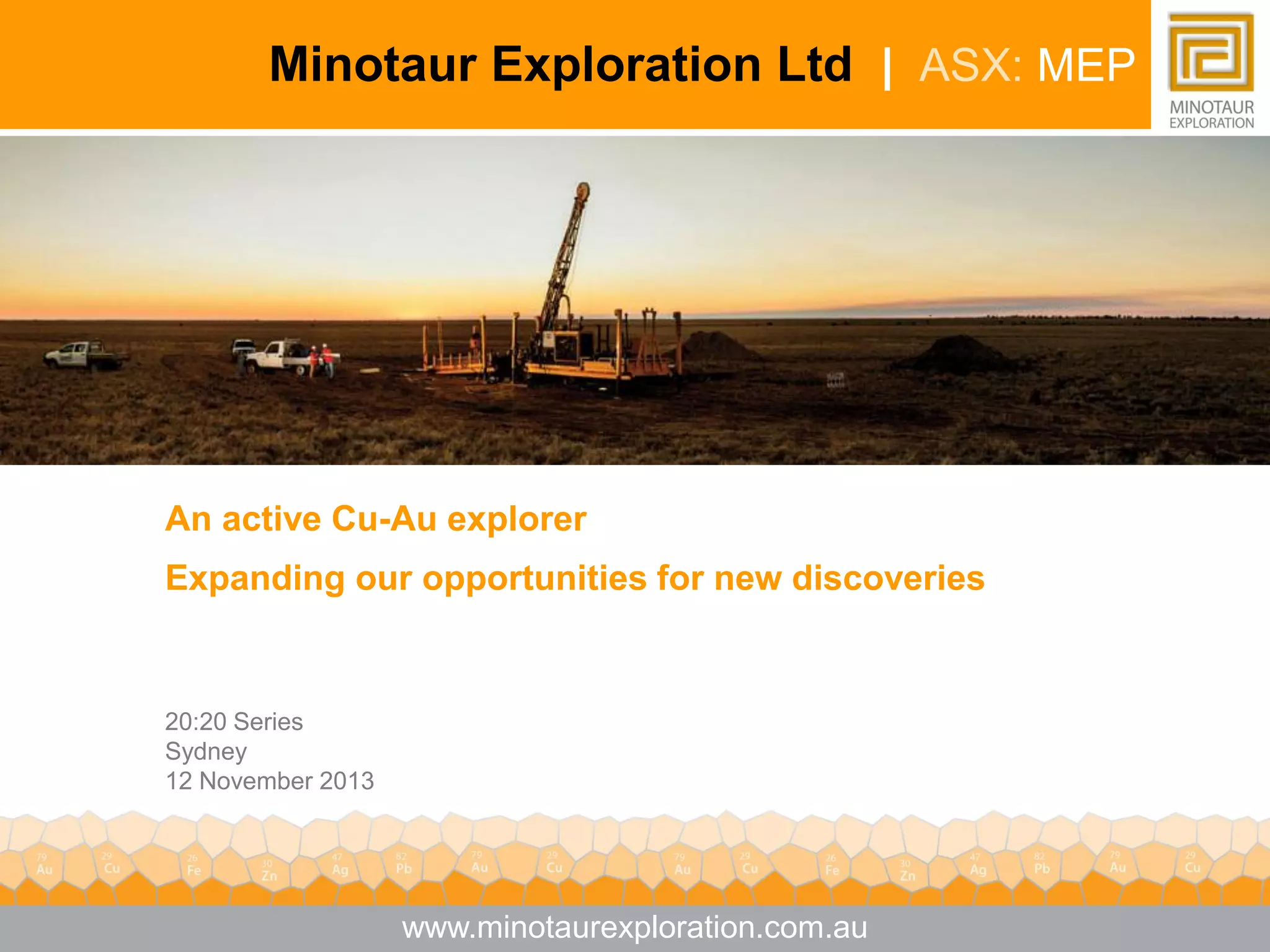
Minotaur Exploration's 2013 investor series deck outlines a strategic pivot toward copper and gold (Cu-Au) exploration across Australia, utilizing a joint venture (JV) model to minimize capital market reliance. The company emphasizes its 'blind' drill target generation and technical management as its primary value drivers. With an enterprise value of $12M at the time of the presentation, the deck argues that the market is underrating its portfolio, which includes significant positions in the Eloise (Queensland) and Leinster (Western Australia) corridors. The presentation is notable for its he…
Key takeaways
- The company operates under the ASX ticker MEP and identifies as an active Cu-Au explorer (Slide 1).
- Minotaur utilizes a JV model to leverage technical expertise beyond its own balance sheet capabilities (Slide 3).
- A June 2013 alliance with a private equity investor secured $9M in partner spending for the Eloise and Leinster projects (Slide 5).
- The Eloise project partner is committed to spending $6M over 4 years for a 50% interest (Slide 5).
- The Leinster project partner is committed to spending $3M over 3 years for a 50% interest (Slide 5).
- The asset base is diversified across Australia, including Cu, Au, and Industrial Minerals projects (Slide 7).
- Minotaur claims an Enterprise Value of $12M, which it asserts underrates its project upside (Slide 13).
- The deck omits a traditional 'Team' slide with biographies, though it mentions 'experienced, credible management' (Slide 3).
Introduction
Minotaur Exploration Ltd (ASX: MEP) produced this presentation for the 20:20 Investor Series in Sydney on November 12, 2013. The deck is a classic example of a resource sector 'project update' rather than a pure startup pitch. It focuses on geological potential, tenement maps, and the financial engineering of joint ventures rather than software metrics or user growth.
Slide 1: Title and Positioning
The cover slide establishes Minotaur as an 'active Cu-Au explorer' (Copper-Gold). It features a prominent photo of a drill rig in a desert landscape, signaling that the company is in the active exploration phase rather than just holding paper assets. The ASX ticker (MEP) is clearly displayed, indicating a publicly traded entity.
Slide 3: The Investment Case
This slide serves as the executive summary. The company lists eight core pillars of its value proposition. Key among these are 'Cash in the bank, no debt,' and a 'solid Top 5 shareholders' list. The most strategically significant point is the final bullet: 'leveraging our technical expertise beyond Minotaur’s own balance sheet capabilities.' This introduces the theme of the deck: Minotaur provides the brains, and partners provide the bulk of the capital.
Slide 5: Alliance with Private Equity Investor
This is the most data-rich financial slide in the deck. It details a June 2013 alliance involving two Joint Ventures (JVs) to fund exploration. The Eloise project in Queensland (Qld) involves a partner spending $6M over 4 years for a 50% interest. The Leinster project in Western Australia (WA) involves a partner spending $3M over 3 years for a 50% interest. The slide also notes that a 50/50 Alliance entity is seeking 'production-ready' gold acquisitions, moving the company closer to cash flow.
Slide 7: Diversified Asset Base
Slide 7 provides a geographic overview of Australia. It categorizes projects into Copper (red circles), Gold (yellow stars), and Industrial Minerals (black diamonds). The map shows heavy concentration in the Gawler Ranges of South Australia, the Cloncurry region of Queensland, and the Yilgarn corridor of Western Australia. This slide is intended to show 'portfolio diversification' to spread exploration risk.
Slide 9: Consolidated Position around Eloise Mine
This slide is a technical geological map focusing on the Eloise project in Queensland. It shows the company's tenements (granted and application) in relation to the Eloise Copper Mine and other major deposits like Ernest Henry and Mount Isa. The map highlights a JV with JOGMEC and another with Sandfire Resources, demonstrating that Minotaur is surrounded by, and partnered with, major industry players.
Slide 11: New Position along Leinster Au-Ni Corridor
Similar to Slide 9, this slide focuses on the Western Australian assets. It describes the Yilgarn corridor as 'highly competitive' and hosting 'major gold and nickel deposits.' The map shows Minotaur's ground (MEP Tenements) strategically located on an ultramafic belt. It lists nearby major deposits like Thunderbox (2Moz gold) and Waterloo (30Kt nickel) to provide geological context and 'near-miss' credibility.
Slide 13: Points of Difference
The final slide summarizes why an investor should buy MEP shares. It reiterates their 'enviable track record' and technical ability to generate 'blind' drill targets. Crucially, it states that MEP 'does not need to access the Capital markets to fund its work plans,' a bold claim for an explorer. Finally, it explicitly states that their Enterprise Value of $12M 'underrates the upside value' of the company.
What Minotaur Exploration Does Well
The deck is exceptionally clear about its business model. Many exploration companies struggle to explain how they will survive the 'valley of death' between discovery and production. Minotaur explicitly points to its JV strategy as the solution. By citing specific dollar amounts ($6M and $3M) and timeframes (3-4 years) for partner spending on Slide 5, they provide concrete evidence of their ability to attract external capital.
The use of geological maps (Slides 9 and 11) is standard for the industry but well-executed here. They don't just show their own land; they show their land in relation to proven mines (like Eloise and Thunderbox). This 'nearology' is a powerful tool in mining investment to suggest that the same mineralizing systems likely extend into the company's own tenements.
What is Missing from the Deck
The most glaring omission is a dedicated 'Team' slide. While Slide 3 mentions 'experienced, credible management,' there are no names, photos, or track records provided for the CEO, Board, or Lead Geologists. In exploration, the 'jockey' is often as important as the 'horse,' and investors want to see who has successfully found and built mines before.
There is also a lack of clear timelines for upcoming catalysts. While the JV spending is spread over years, the deck doesn't specify when the next drill results are expected. For a public company, 'news flow' is the primary driver of share price, and this deck fails to provide a calendar of upcoming events.
Finally, the 'Ask' is missing. While the company claims it doesn't need capital markets, every investor presentation is ultimately a sales pitch. If they aren't raising money, they should be clearer about what they want the viewer to do—buy shares on the open market, or perhaps seek further JV opportunities.
Founder Lessons and Takeaways
For founders in capital-intensive industries (like deep tech, hardware, or resources), Minotaur’s deck offers a masterclass in 'Capital Efficiency through Partnership.' Instead of trying to raise $10M and diluting the founders/early shareholders, they used their intellectual property (the 'blind' drill targets) to get others to pay for the expensive work. If your startup has high R&D costs, look for ways to structure 'Technical Alliances' where a larger partner funds the development in exchange for a stake in a specific project rather than the whole company.
Another takeaway is the importance of 'Contextual Mapping.' Minotaur doesn't just say they have a good project; they show a map where they are literally squeezed between two multi-million-ounce gold mines. In a software pitch, this is the equivalent of showing a market map where your product sits at the intersection of two massive, proven trends. Always show your 'neighborhood' to prove that you are playing in a space where others have already found massive success.
Lastly, the 'Points of Difference' slide (Slide 13) is a strong way to close. It moves away from technical data and speaks directly to the investor's wallet by discussing Enterprise Value and market mispricing. Always end your deck by telling the investor exactly why the current price is a bargain compared to the future potential.
Frequently asked questions
- What is Minotaur Exploration's primary business model according to the deck?
- Minotaur operates as a mineral explorer focused on Copper and Gold. Their primary strategy is to use their technical expertise to identify 'blind' drill targets and then form Joint Ventures (JVs) with larger international groups or private equity. This allows them to fund aggressive exploration plans without constantly diluting shareholders through capital market raises.
- What are the specific terms of their 2013 Private Equity alliance?
- The deck highlights two specific JV deals within a June 2013 alliance. For the Eloise project in Queensland, the partner agreed to spend $6M over four years to earn a 50% interest. For the Leinster project in Western Australia, the partner agreed to spend $3M over three years for a 50% interest.
- Where are the company's primary assets located?
- The company has a diversified Australian asset base. Key clusters include the Cloncurry region in Queensland (Eloise and Osborne projects) and the Yilgarn corridor in Western Australia (Meekatharra, Leinster, and Scotia projects). They also list projects in South Australia like Coober Pedy and Poochera.
- How does the company justify its valuation?
- On Slide 13, the company states its Enterprise Value is $12M. It argues this is an undervaluation because it does not fully account for the upside of its project portfolio or the stability provided by its 'strong' JV partnerships and lack of debt.
- What technical advantages does Minotaur claim to have?
- The company emphasizes its ability to generate 'blind' drill targets—meaning targets not visible on the surface—and its ability to manage complex exploration programs. They position themselves as a technical partner that larger groups trust to execute field operations efficiently.