Goldcast’s 18-slide deck is a masterclass in B2B positioning, shifting the narrative from 'virtual events as a Zoom alternative' to 'events as the new email nurture.' The deck emphasizes deep integration with the modern martech stack, showing how attendee data flows directly into systems like Salesforce and HubSpot to drive sales workflows. With a reported $28M Series A raise in 2024, the company relies heavily on social proof, featuring logos like GitHub and Autodesk alongside specific ROI metrics—such as Drift’s $35M in pipeline. While the deck lacks a traditional competition slide or detai…
Key takeaways
- The deck positions events as a core marketing channel, using the headline 'Events are the new Email Nurture' on Slide 3.
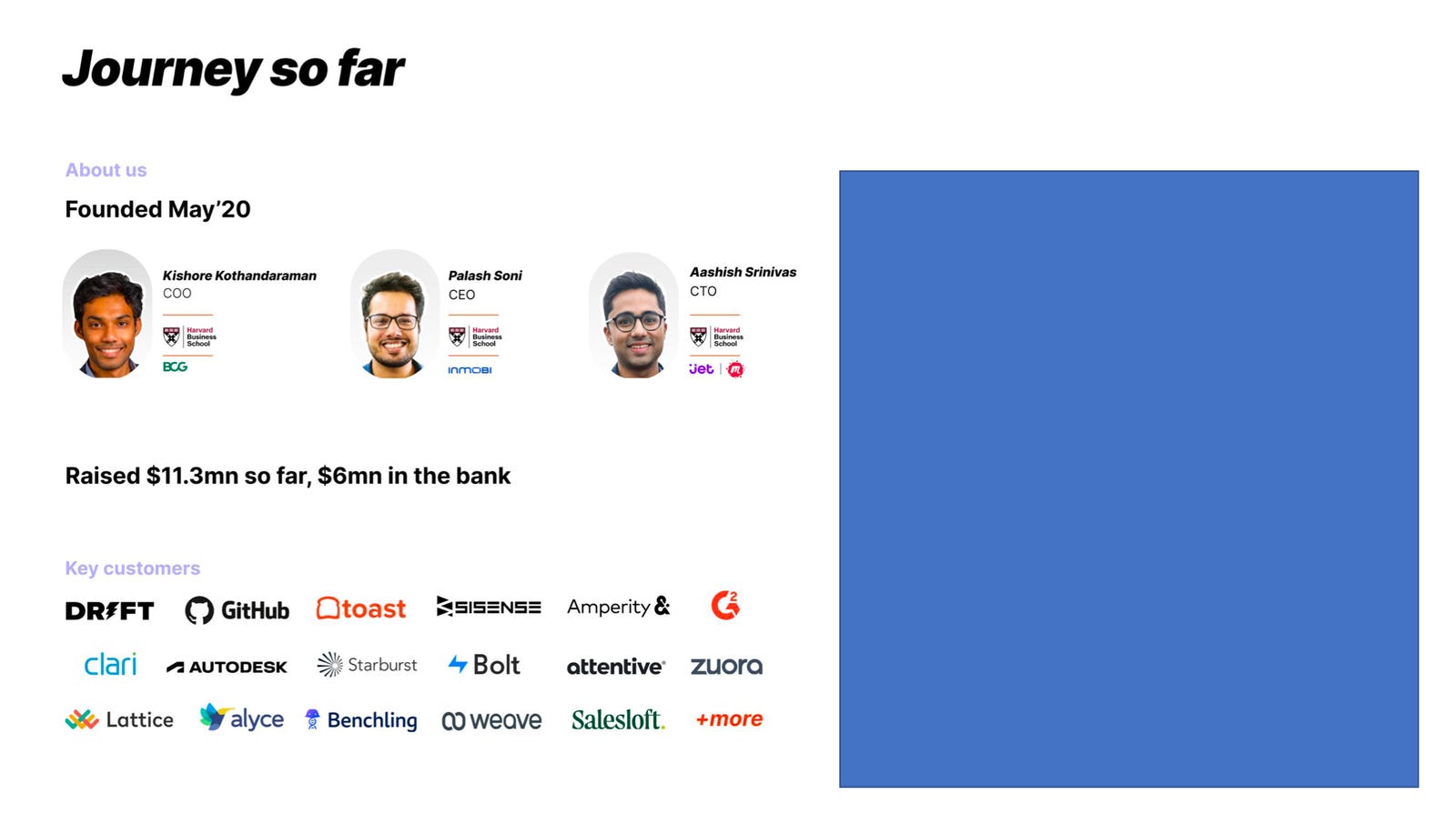
- Goldcast highlights a strong founding team from Harvard Business School with backgrounds at BCG and InMobi on Slide 1.
- The company demonstrates significant enterprise traction with a customer list including GitHub, Autodesk, and Toast (Slide 1).
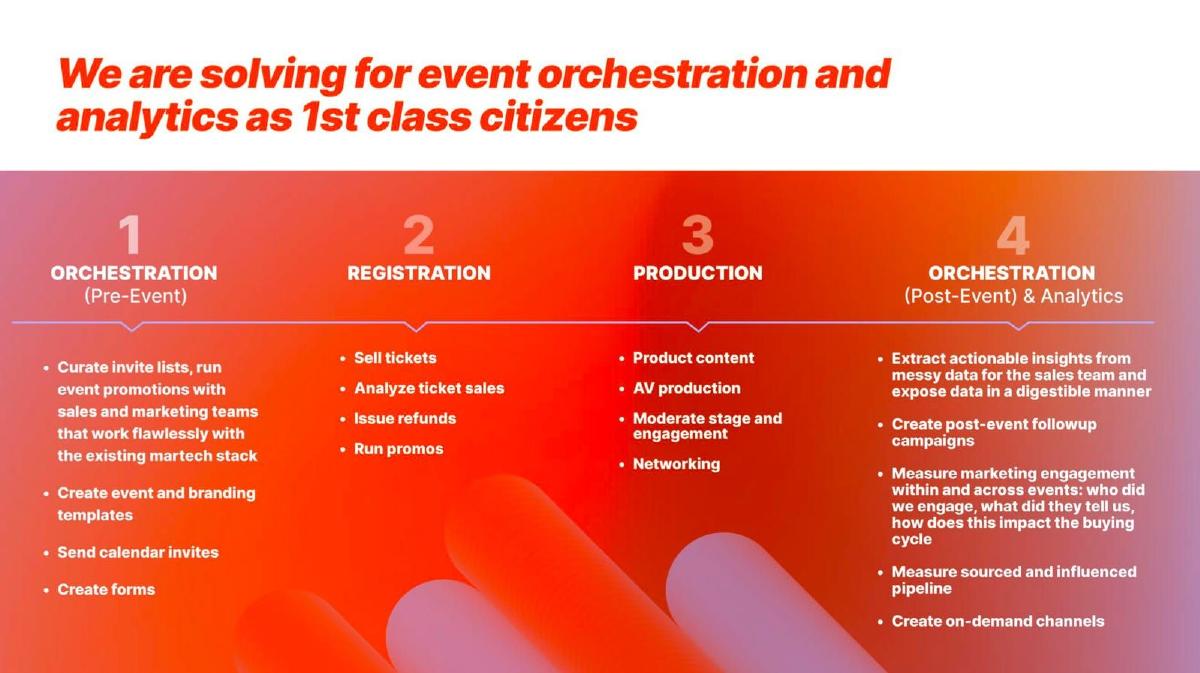
- A detailed four-stage orchestration framework on Slide 4 explains how the platform handles everything from pre-event invite lists to post-event analytics.
- The platform's primary value proposition is its 'System of Record' integration, syncing attendee engagement data with Salesforce, HubSpot, and Marketo (Slide 6).
- Slide 8 provides concrete ROI metrics, citing that Drift achieved 2x higher attendance and $35M in pipeline using the platform.
- Operational efficiency is highlighted by Alyce, which reduced post-event follow-up time from 3 days to 4 hours (Slide 8).
- The deck emphasizes high user satisfaction with a G2 'High Performer' badge and an NPS score of 60 (Slide 10).
The Narrative Shift: From Video Tool to Revenue Engine
Goldcast’s pitch deck for their $28M Series A is a study in enterprise B2B positioning. In a post-2020 world where 'Zoom fatigue' is a common complaint, Goldcast avoids the trap of selling features like 'high-quality video' or 'chat rooms.' Instead, they sell pipeline . The deck, as reported by Business Insider, was used to secure significant funding in 2024, a year where investors were highly selective about enterprise software. The core thesis of the deck is that events are not just one-off brand moments, but a continuous, data-rich marketing channel that should be treated with the same rigor as email marketing or paid search.
Slide 1: The Foundation and Traction
The deck opens with a 'Journey so far' slide that serves as a high-density credibility builder. It establishes the company was founded in May 2020, right at the onset of the virtual event boom. The team section highlights three founders—Kishore Kothandaraman (COO), Palash Soni (CEO), and Aashish Srinivas (CTO)—all sharing a Harvard Business School pedigree. Their previous experience at BCG, InMobi, and Jet.com suggests a blend of strategic consulting and high-scale engineering. Crucially, this slide discloses that they had raised $11.3M prior to this round and had $6M in the bank, signaling capital efficiency. The 'Key customers' section is a 'who's who' of modern B2B SaaS, featuring Drift, GitHub, Autodesk, and Toast. This immediately tells an investor that Goldcast has moved past the 'early adopter' phase and into the enterprise market.
Slide 2 & 3: Market Thesis and Positioning
Slide 2 uses a bold visual of the product interface with the headline: 'Events, in their virtualized and hybridized avatar, will be that next frontier of marketing.' This sets the stage for Slide 3, which contains the deck's most important strategic claim: 'Events are the new Email Nurture.' By quoting Sarah Reed, Senior Director at Zendesk, stating that virtual events account for 75% of their top-funnel pipeline, Goldcast validates their market category. They aren't competing for the 'event budget'; they are competing for the 'demand generation budget,' which is typically much larger and more resilient.
Slide 4: The Product Framework
Slide 4 breaks down the product into four distinct stages: Orchestration (Pre-Event), Registration, Production, and Orchestration (Post-Event) & Analytics. This is a critical slide because it moves the conversation away from the 'live stream' (Stage 3) and toward the 'data' (Stages 1 and 4). By listing tasks like 'curate invite lists,' 'analyze ticket sales,' and 'extract actionable insights for the sales team,' Goldcast positions itself as an end-to-end workflow tool rather than just a broadcast platform.
Slide 5 & 6: The Technical Moat - Systems of Record
Slide 5 and 6 focus on the 'how.' Slide 5 shows the hybrid experience, claiming to help marketers 'extend the reach and ROI of their in-person events.' Slide 6 is perhaps the most technically persuasive slide in the deck. It shows the Goldcast interface side-by-side with CRM records. The headline 'Goldcast recreates the entire attendee journey in the system of records' is supported by logos of Microsoft Dynamics, Eloqua, Marketo, Salesforce, and HubSpot. This slide addresses a major pain point for B2B marketers: the 'black hole' of event data. By showing that engagement scores and poll answers flow directly into a lead's profile, Goldcast proves its value to the Sales team, not just the Marketing team.
Slide 7: Automation and Workflow
Slide 7 provides a concrete example of the platform in action. It describes a Slack and Salesforce workflow that pings an Account Executive (AE) the moment a prospect from their target account registers for an event. The slide shows mockups of these notifications, including the prospect's name, email, and title. This is a 'lightbulb moment' for investors—it demonstrates how Goldcast shortens the feedback loop between a marketing activity and a sales follow-up.
Slide 8: The Proof Points (ROI)
Slide 8 is the 'money slide.' It features three case studies with specific, quantifiable outcomes:
Drift: 2x higher attendance and $35M in pipeline. · Alyce: Scaled events 10x (from 5 to 50 per year) and reduced follow-up time from 3 days to 4 hours. · Kong: 89% attendee satisfaction and a 2x increase in NPS.
These aren't just vanity metrics; they are the exact KPIs a CMO or VP of Sales cares about. The mention of $35M in pipeline for Drift is a particularly strong anchor for the company's valuation.
Slide 9 & 10: Social Proof and Sentiment
Slide 9 (as described in the text) emphasizes extending ROI, while Slide 10 doubles down on social proof. It features LinkedIn testimonials from CMOs and Event Managers at SalesLoft, ThoughtSpot, and Weave. It also showcases a G2 'High Performer' badge from Winter 2022 and an NPS score of 60. In a crowded software category, high user sentiment is a proxy for product-market fit and low churn risk.
What Goldcast Does Exceptionally Well
Goldcast excels at Category Re-positioning . Most event platforms focus on the 'experience'—the 3D booths, the avatars, the networking lounges. Goldcast focuses on the plumbing . By emphasizing how data moves from the event into the CRM, they align themselves with the 'RevOps' movement. This makes the software 'sticky.' It is much harder for a company to churn from a platform that is deeply integrated into their Salesforce workflows than from a platform that just hosts a video stream.
The deck also uses Social Proof as a Shield . By leading with logos like GitHub and Autodesk and following up with specific ROI numbers from Drift, they preemptively answer the question: 'Does anyone actually use this for serious business?' The inclusion of the founders' HBS background and previous roles at BCG and InMobi further reinforces the 'safe bet' narrative for institutional investors.
What Is Missing From The Goldcast Deck
Despite the successful $28M raise, the deck has several notable omissions that founders should be aware of: 1. Competitive Landscape: There is no mention of competitors. In 2024, the virtual event space was highly commoditized. Investors would certainly have asked how Goldcast wins against incumbents like On24 or newer rivals like Welcome. The deck relies on its 'system of record' argument to imply differentiation without naming names. 2. The 'Ask' and Use of Funds: The provided slides do not include a slide detailing how much they are raising (though we know it was $28M) or how they plan to spend it. A standard Series A deck usually allocates funds across R&D, Sales/Marketing, and International Expansion. 3. Financial Projections and Unit Economics: There are no charts showing Revenue Growth (ARR), Net Revenue Retention (NRR), or Customer Acquisition Cost (CAC). While the ROI for customers is clear, the ROI for investors (the company's own profitability path) is left to the verbal pitch. 4. Future Product Roadmap: The deck is very focused on what the product does now. It lacks a 'Vision' slide that explains where Goldcast goes next—perhaps into AI-driven content repurposing or deeper physical event tech integrations.
Lessons for Founders
Founders can learn two major lessons from the Goldcast deck. First, sell the outcome, not the feature . Goldcast doesn't talk about their video player's latency; they talk about reducing follow-up time from 3 days to 4 hours. Second, integrate to survive . In the modern enterprise, standalone tools are the first to be cut during budget reviews. Tools that are 'first-class citizens' in the existing martech stack (Slide 4) are viewed as infrastructure. If you are building B2B software, your 'Integrations' slide is often more important than your 'Features' slide. Finally, use specific customer quotes that mention pipeline. A quote saying 'the platform is easy to use' is good; a quote saying 'this channel accounts for 75% of our pipeline' is what gets a $28M check signed.
Frequently asked questions
- What is the core problem Goldcast is solving according to the deck?
- Goldcast is solving for 'event orchestration and analytics as 1st class citizens.' As shown on Slide 4, they address the fragmentation of the event lifecycle—from messy data extraction to the lack of actionable insights for sales teams. They position their solution as a way to turn 'messy data' into digestible, automated workflows that impact the buying cycle.
- How does Goldcast differentiate itself from generic video conferencing tools?
- The differentiation lies in CRM integration and sales enablement. Slide 6 and Slide 7 show how Goldcast recreates the attendee journey within a company's 'system of record.' Unlike Zoom, Goldcast pings Account Executives in Slack when a prospect registers and logs specific engagement scores (like questions asked or polls answered) directly into Salesforce.
- What specific ROI metrics are mentioned in the deck?
- Slide 8 lists several high-impact metrics: Drift saw 2x higher attendance and $35M in pipeline; Alyce scaled from 5 to 50 events per year while reducing follow-up time by 94%; and Kong achieved an 89% 5/5 rating for event experience along with a 2x increase in NPS.
- Who are the founders and what is their background?
- As detailed on Slide 1, the founding team consists of Kishore Kothandaraman (COO), Palash Soni (CEO), and Aashish Srinivas (CTO). All three are Harvard Business School alumni, with professional experience at top-tier firms including BCG, InMobi, and Jet.com.
- What is missing from this pitch deck?
- The deck is missing a competitive landscape slide, which is surprising given the crowded virtual event market (e.g., Hopin, 6Connex). It also lacks a clear 'Ask' slide detailing how the $28M will be spent, a detailed Go-To-Market strategy, and a slide for unit economics or long-term financial projections.