The 2006 Theranos pitch deck presents a vision for a closed-loop diagnostic system called the ABCS (Ambulatory BioInformatics Communications System). The presentation focuses heavily on the pharmaceutical application of its technology, specifically for real-time pharmacokinetic (PK) and pharmacodynamic (PD) monitoring during clinical trials. By promising to reduce pharmaceutical testing costs by 20-30% compared to traditional clinician offices while maintaining 70% margins, the deck positions Theranos as a high-efficiency data play rather than a simple hardware manufacturer. The management sl…
Key takeaways
- The company projected 70% margins on an 'Information fee' that bundled readers, cartridges, and data services (Slide 16).
- Theranos targeted the pharmaceutical industry by claiming their testing costs were 20-30% lower than traditional clinician office testing (Slide 16).
- The management team featured veterans from Intel, IBM, Panasonic, and Genentech, providing significant institutional weight (Slide 4).
- The core product was marketed as the ABCS: Ambulatory BioInformatics Communications System, connecting homes, pharmacies, and partners (Slide 7).
- Technical claims focused on 'on-chip chemiluminescence' providing greater sensitivity than clinical labs (Slide 22).
- The deck emphasizes real-time PK/PD monitoring to prevent drug toxicity during treatment courses (Slide 10 and 13).
- The Board of Directors included a 46-year venture capital veteran and the Stanford Senior Associate Dean of Engineering (Slide 4).
- The presentation lacks a specific 'Ask' slide or a detailed use-of-funds breakdown in the provided selection.
Introduction and Title
Slide 1: Title Slide
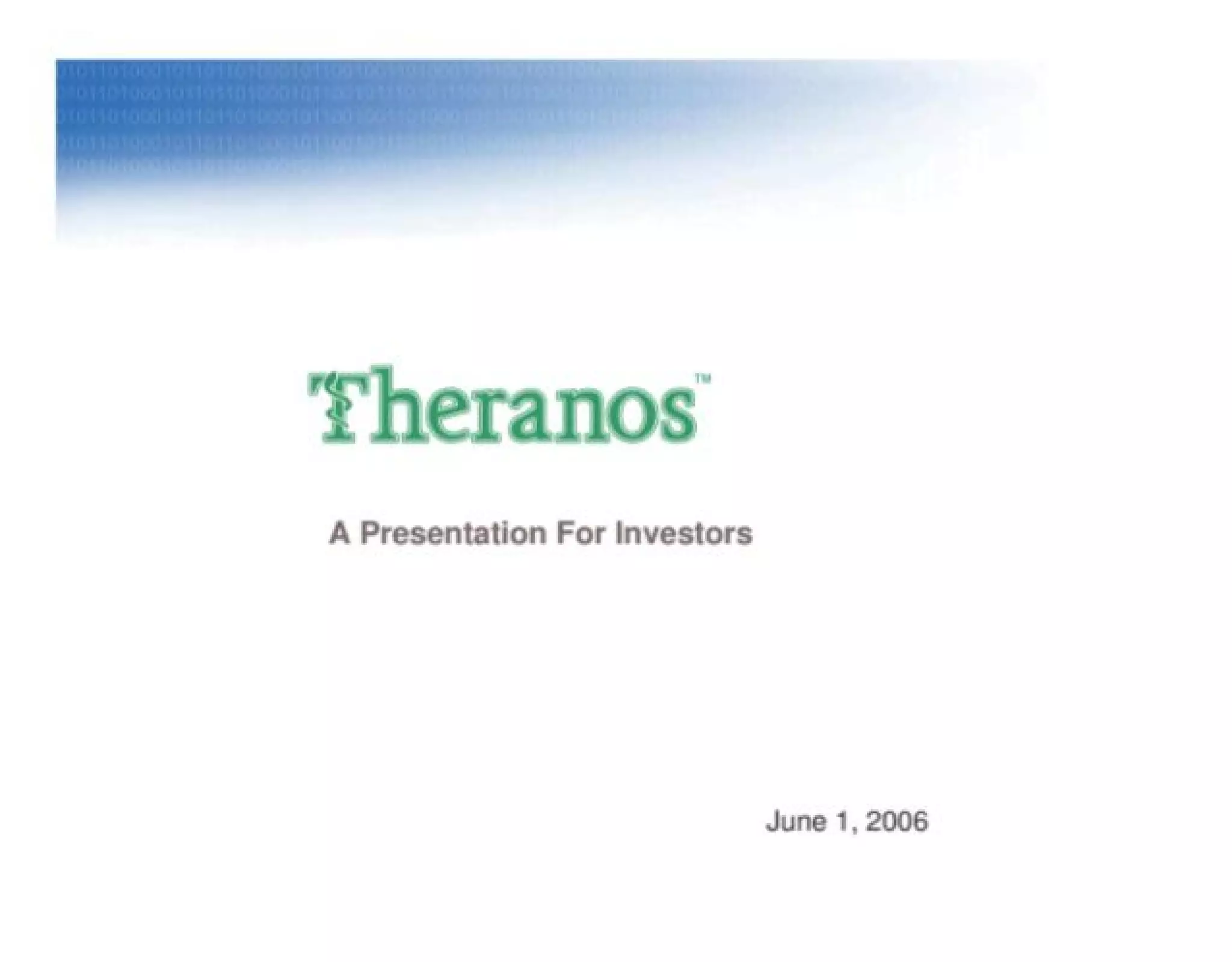
The deck opens with a minimalist title slide dated June 1, 2006. It features the original Theranos logo, which incorporates a caduceus-style 'T'. The subtitle is simply 'A Presentation For Investors.' The background uses a blue digital-style banner at the top and bottom, suggesting a focus on informatics and data technology rather than just biology.
The Team and Governance
Slide 4: Management and Board of Directors
This slide is arguably the most important in the early Theranos narrative. It lists a management team with deep roots in established Silicon Valley and pharmaceutical companies. Elizabeth Holmes is listed as President and CEO, noting she left Stanford Chemical and Electrical Engineering to found the company. The supporting cast is high-profile: Howard Bailey (CFO) is credited with taking QED and Photon Dynamics public and serving as a Controller at Intel. Diane Parks (CCO) came from Genentech and Aventis. John Howard (Senior VP, Products) is a former President of Panasonic Semiconductor and IBM Microelectronics. Dr. Ian Gibbons is noted as the Senior Director of Assay Development with experience at Syva and Biotrack. The Board of Directors includes Donald L. Lucas , a 46-year VC veteran, and Channing Robertson , the Stanford Senior Associate Dean of Engineering. This slide aims to provide massive institutional credibility to offset the founder's lack of a degree or prior executive experience.
The System Architecture
Slide 7: Theranos ABCS™
Slide 7 introduces the 'Ambulatory BioInformatics Communications System.' The diagram shows a closed-loop ecosystem. A 'Home' unit with telecommunications and videoconferencing capabilities connects to 'Theranos Informatics' (represented by a large server rack). This data is then shared with 'Partners,' 'HMOs,' and 'Pharmacies.' The stated goal is 'Effective narrow range therapy through post-prescription monitoring of the total available patient base.' This positioning frames Theranos not as a lab company, but as a distributed informatics company that uses hardware as a data collection point.
Clinical Application and Toxicity Monitoring
Slide 10: Infusion Chemotherapy Monitoring
This slide provides a specific clinical use case: chemotherapy. It shows a graph where the 'First course drug level' (pink line) rises significantly above the 'Drug level target' (red line) to a 'toxic level' because the patient is not eliminating the drug rapidly. The slide argues that standard dose rates are insufficient without the real-time monitoring Theranos provides.
Slide 13: Real-time PK/PD Monitoring
Building on the previous slide, slide 13 shows a 'Scenario' where toxicity is observed, and the dosage is subsequently reduced to an acceptable level. The graph tracks five parameters: Drug Dose, Drug Level, Effect Marker, Toxicity Marker, and Tox. Alert Level. The x-axis spans 50 days, implying that the Theranos system is intended for long-term, chronic, or multi-week monitoring in a home or ambulatory setting, rather than just a one-off diagnostic test.
Business Model and Value Proposition
Slide 16: Theranos Value Proposition
This slide outlines the financial logic of the business. The revenue is derived from an 'Information fee' that includes the use of readers, cartridges, and the ABCS informatics platform. Key claims include:
70% margins : A very high projection for a hardware-reliant business. · Requisite solution : Positioned as a way for pharma companies to improve drug labels or preempt liabilities. · 20-30% cost savings : Claiming to be significantly cheaper for pharmaceutical companies than testing through a traditional clinician's office.
Strategic Advantages
Slide 19: Drivers for Success
Theranos lists its competitive moats here. It claims a 'First mover advantage' and asserts that the 'Combination of several different technologies makes reproducing the solution difficult.' It also mentions an 'Innovation Pipeline,' a 'Strong Customer Base' (though no specific customers are named on this slide), 'Patents,' and 'Management and Culture.' This is a standard 'why we win' slide, emphasizing the difficulty of replication.
Technical Validation
Slide 22: Technology: Theranos System versus Today's Lab
The final slide in this selection attempts to provide scientific proof. It features five charts comparing Theranos assays to conventional assays. The headline claim is that 'On chip Chemiluminescence enables greater sensitivity than the clinical lab.' The graphs show high correlation (R² values are visible but small) between the Theranos system and standard laboratory equipment. This slide is intended to silence doubts about the miniaturization of the technology by showing it performs at or above the level of full-scale lab machines.
What Works and What is Missing
What Works: The deck is highly effective at leveraging 'social proof' through its management slide. By 2006, having executives from Intel, IBM, and Genentech on a single slide for a startup was a significant achievement. The focus on the pharmaceutical industry (PK/PD monitoring) is also a smart strategic choice, as pharma companies have higher budgets and a greater need for real-time data than general practitioners. The 'Information Fee' model is a classic 'razor and blade' strategy but rebranded as a modern SaaS-style recurring fee, which would appeal to VCs looking for high margins.
What is Missing: The provided slides lack a clear 'Ask' (how much money is being raised and at what valuation). There is no detailed breakdown of the 'Strong Customer Base' mentioned on slide 19; without names of pharma partners, this remains a vague claim. Furthermore, while the deck mentions 'Patents,' it does not list patent numbers or specific intellectual property filings. The financial projections are limited to a margin percentage (70%) without a multi-year P&L or a clear path to profitability. Finally, there is no mention of FDA regulatory hurdles, which are a primary risk factor for any medical diagnostic device.
Founder Takeaways
The Power of the Team Slide: If you are a young founder, your team slide is your most important asset. Theranos successfully used the resumes of its executives to mask the lack of a finished, proven product. Focus on a High-Value Niche: Instead of trying to replace all blood tests at once, the deck focuses on high-stakes pharmaceutical monitoring (chemotherapy, toxicity). This makes the 'value proposition' much easier to defend. Bundle Hardware into Service: By calling their revenue an 'Information Fee' rather than 'Hardware Sales,' they reframed the business as a high-margin data play. Founders should consider how they frame their revenue to align with the multiples investors give to different industries (e.g., SaaS vs. Manufacturing).
Frequently asked questions
- What was the primary revenue model proposed by Theranos in 2006?
- According to slide 16, Theranos planned to charge an 'Information fee.' This fee was not just for hardware but was a bundled service including the use of readers, disposable cartridges, and the ABCS informatics platform, which included a patient diary and data integration services. They explicitly projected 70% margins for this model.
- How did Theranos position its technology against existing laboratory standards?
- On slide 22, the company compared its 'Theranos System' against 'Today's Lab.' It claimed that its 'on-chip chemiluminescence' enabled greater sensitivity than traditional clinical labs. The slide includes five separate graphs intended to show high correlation between Theranos assays and conventional assays, as well as luminometer correlation.
- Who were the key members of the management team at this stage?
- Slide 4 lists Elizabeth Holmes as CEO, who left Stanford to found the company. The supporting team included CFO Howard Bailey (former Intel Controller), CCO Diane Parks (former SVP at Genentech), and John Howard (former President of Panasonic Semiconductor). This composition suggests a strategy of surrounding a young founder with seasoned corporate executives.
- What specific medical problem did the deck claim to solve?
- The deck focused on 'narrow range therapy' and preventing drug toxicity. Slides 10 and 13 illustrate scenarios where a patient's drug levels increase to toxic levels because they are not eliminating the drug rapidly enough. Theranos proposed real-time monitoring to allow for immediate dosage reduction to acceptable levels.
- What were the stated 'Drivers for Success' for the company?
- Slide 19 identifies several drivers: first-mover advantage, a combination of technologies that are difficult to reproduce, an innovation pipeline for next-generation systems, a strong customer base, speed to market, patents, and 'Management and Culture.'