The Smart Tire Company leverages a Space Act Agreement with NASA to commercialize airless tire technology originally designed for lunar and Martian rovers. Their core innovation centers on Shape Memory Alloys (NiTinol), which can recover their original shape after significant deformation. The deck outlines a strategic entry into the $19.4B two-wheel market (bicycles and scooters) before expanding into automotive and aerospace sectors. With a team boasting 30+ years of experience at Goodyear and NASA, the company presents a compelling case for disrupting a $250B global industry. However, the d…
Key takeaways
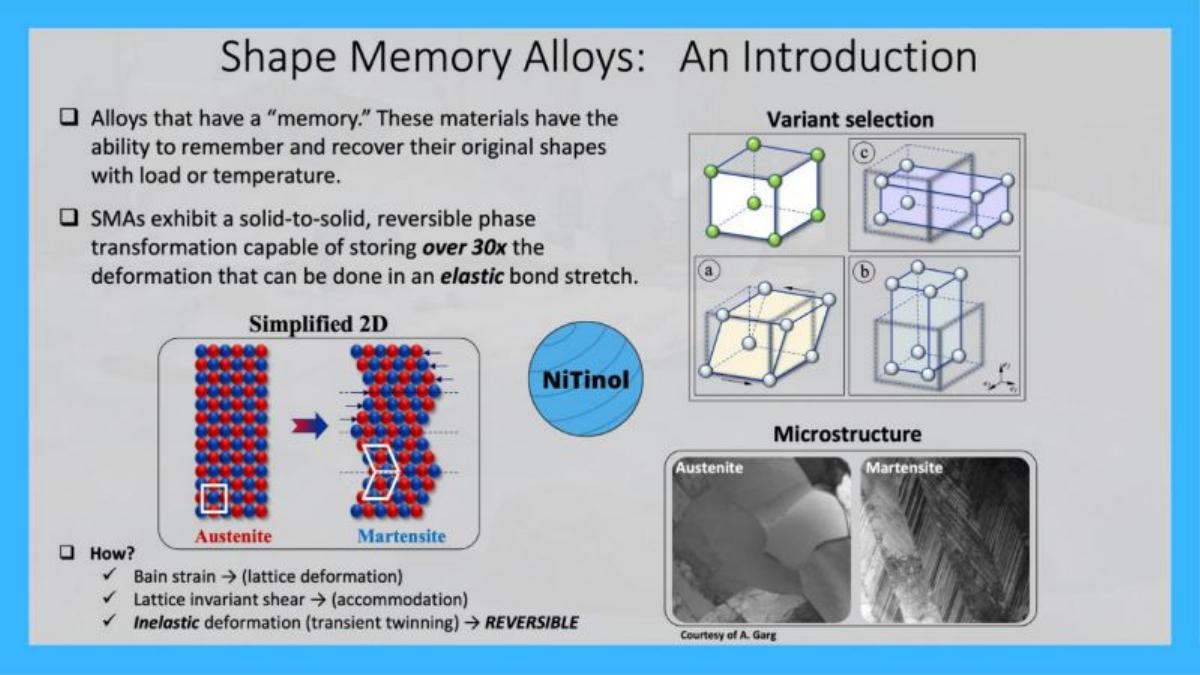
- The technology is based on NiTinol, a Shape Memory Alloy capable of storing over 30x the deformation of elastic bonds (Slide 3).
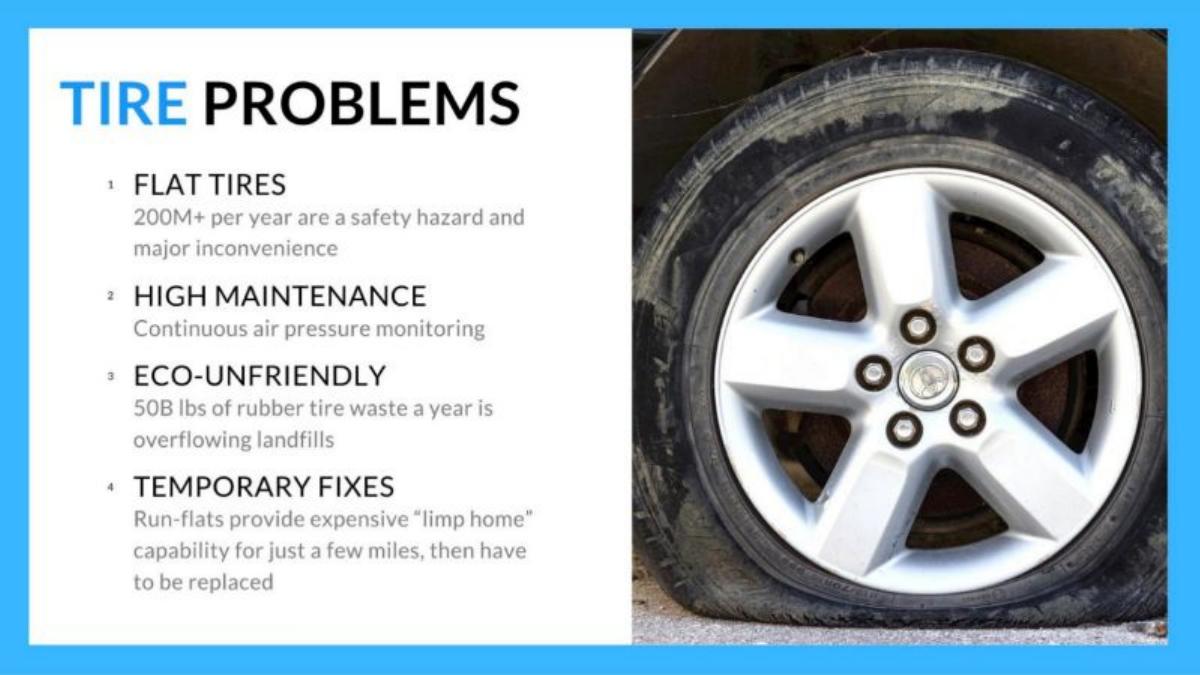
- The company identifies a massive environmental problem: 50 billion pounds of rubber tire waste are generated annually (Slide 4).
- Initial go-to-market focuses on the $19.4B two-wheel vehicle market, which includes bicycles and scooters (Slide 6).
- The product roadmap spans from a 2022 METL bike tire launch to road testing for aircraft and automotive by 2026 (Slide 9).
- The team includes a Principal Engineer with experience at both Goodyear and NASA (Slide 10).
- A waiting list of over 4,000 people exists for the METL bike tires (Slide 13).
- The funding request includes a $3M growth capital target to supplement $1.5M in SBIR grants (Slide 12).
- The company operates a 5,000 sq ft production facility in Akron, Ohio (Slide 13).
The Smart Tire Company: Reimagining the Wheel with NASA Tech
The Smart Tire Company represents a classic 'spin-out' play, taking advanced materials science developed for extreme environments (Mars) and applying it to a massive, stagnant terrestrial market. This teardown examines their 17-slide deck used during their 2022 venture round.
Slides 1-3: The Hook and the Science
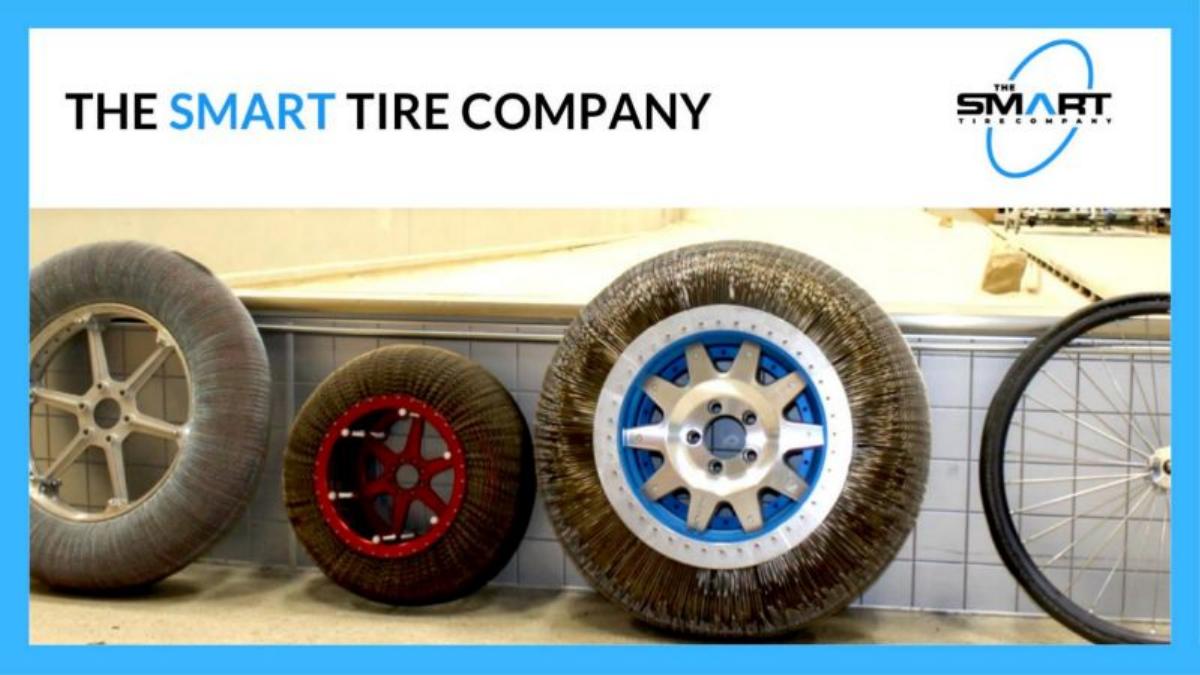
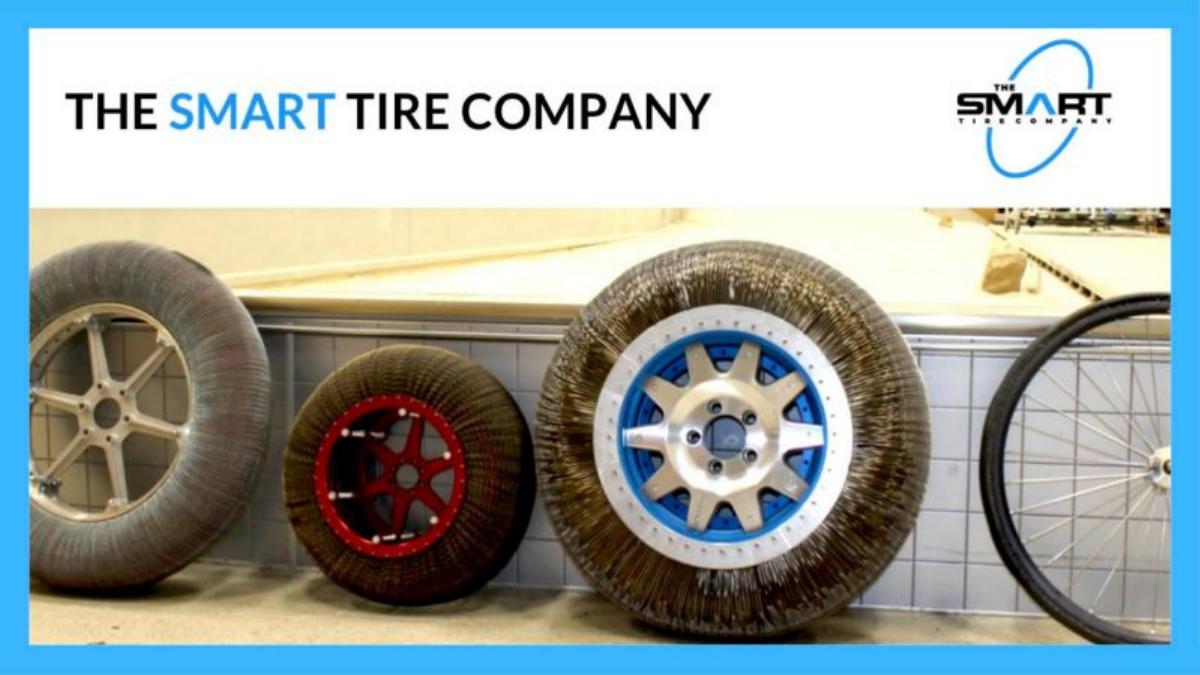
Slide 1 is a clean title slide featuring four distinct tire prototypes, ranging from bicycle wheels to heavy-duty automotive tires. This immediately establishes that the technology is versatile and physically manifested, not just a concept.
Slide 2 uses a classic 'Problem/Context' hook. By mentioning that there are 'no spares for 94 million miles' on Mars, they elevate the importance of their 'never flat' value proposition. It frames the technology as mission-critical rather than just a luxury convenience.
Slide 3 dives into the 'Shape Memory Alloys: An Introduction.' This is a technical slide, but it is necessary for a deep-tech hardware play. It explains NiTinol and the solid-to-solid reversible phase transformation. The key metric here is that these materials store 'over 30x the deformation' of an elastic bond. This slide justifies why this isn't just another 'airless tire'—it is a fundamental shift in material science.
Slides 4-5: Problem and Solution
Slide 4 categorizes 'Tire Problems' into four buckets: Flat Tires (200M+ per year), High Maintenance (air pressure monitoring), Eco-Unfriendly (50B lbs of waste), and Temporary Fixes (run-flats). This slide effectively builds the 'Total Addressable Pain' before introducing the solution.
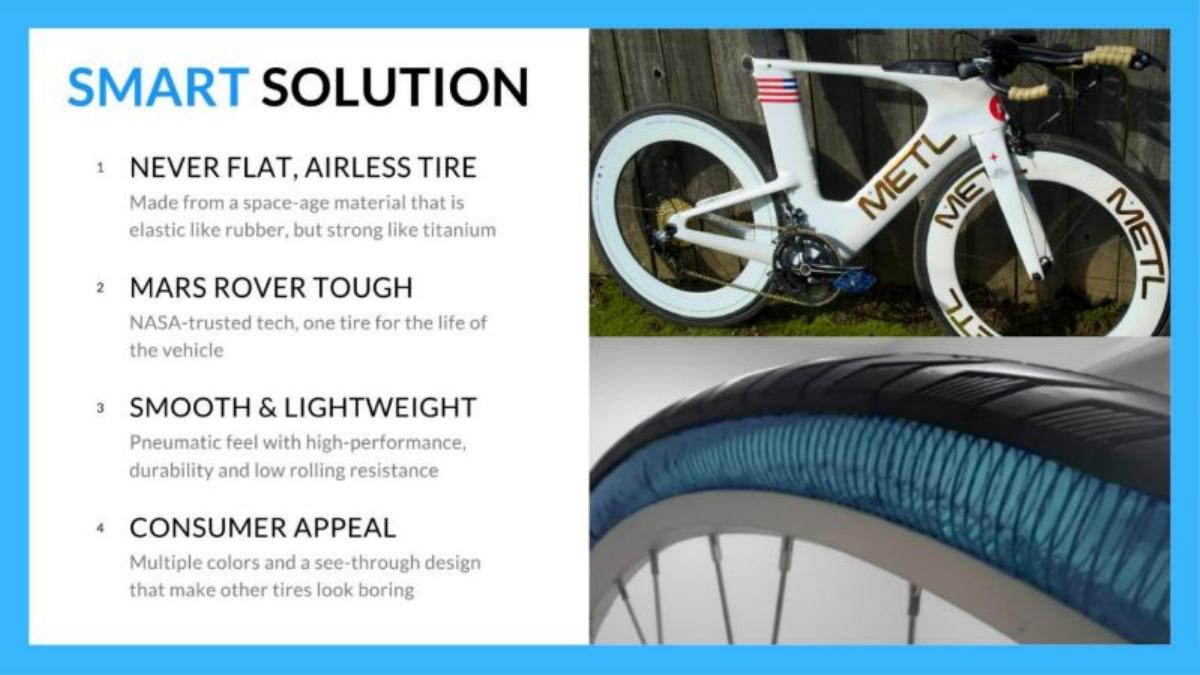
Slide 5 presents the 'Smart Solution.' They highlight the METL tire, which they claim is 'elastic like rubber, but strong like titanium.' They emphasize four pillars: Never Flat, Mars Rover Tough, Smooth & Lightweight, and Consumer Appeal. The inclusion of 'Multiple colors and a see-through design' on this slide suggests they are targeting the enthusiast/premium consumer market early on.
Slides 6-8: Market and Sustainability
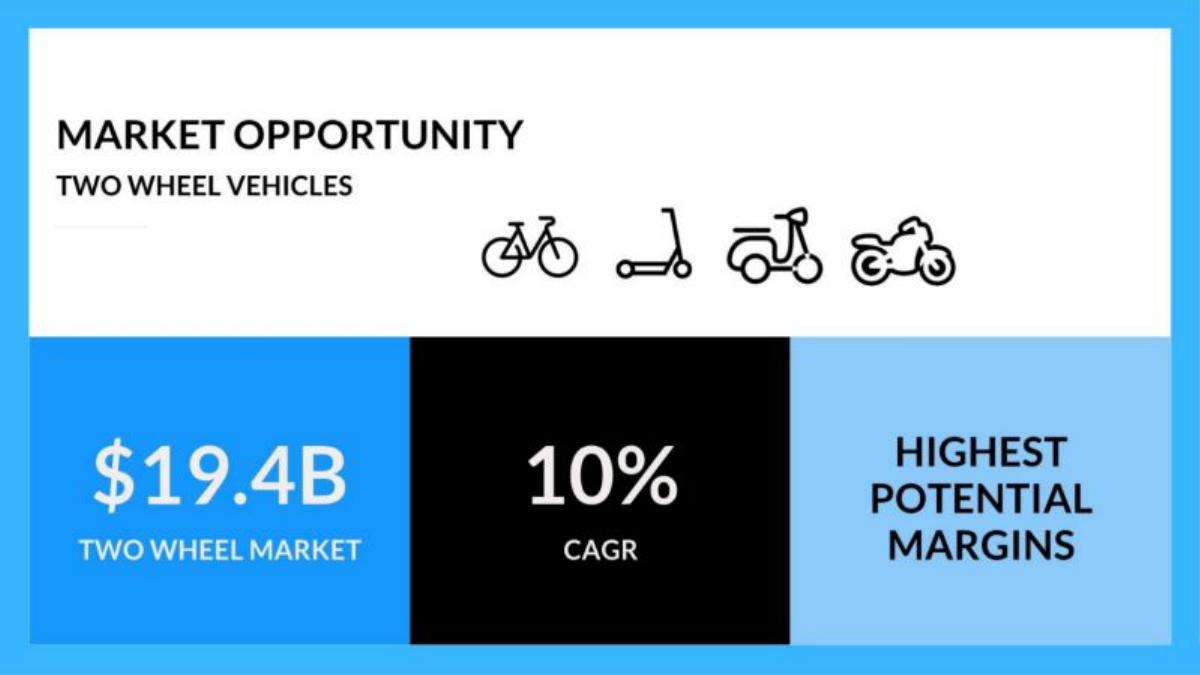
Slide 6 defines the 'Market Opportunity' specifically for two-wheel vehicles. They cite a $19.4B market with a 10% CAGR. This is a smart 'beachhead' strategy. Trying to disrupt the automotive tire market immediately is a capital-intensive regulatory nightmare; starting with bicycles allows for faster iteration and 'highest potential margins.'
Slide 7 showcases 'Smart Prototypes' across four categories: Automotive, Cycling, Integrated Rubber, and Aerospace. This proves the technology's scalability. The 'Integrated Rubber' photo is particularly important as it shows how the metal lattice can be encased in a traditional tread, making it look and feel like a standard tire to the end-user.
Slide 8 focuses on 'Clean Tire Tech.' In a world of ESG-focused investing, this is a vital slide. They reiterate the 50B lbs of waste and introduce the concept of 'retread-able' structural tires. They also make a claim about increasing MPG by eliminating low tire pressure issues, which is a major cost driver for trucking fleets.
Slides 9-11: Timeline, Team, and Traction
Slide 9 provides a 5-year timeline. Key milestones include the NASA Space Act Agreement in June 2021, a METL bike tire launch in late 2022, and road testing for aircraft by 2026. This is a realistic, albeit long, hardware roadmap.
Slide 10 introduces the 'Smart Team.' The pedigree is the highlight here: 30+ years of startup experience and 30+ years at Goodyear and NASA. They also list strategic partners: Felt Bicycles and Spin (Ford Mobility). Having a partner like Spin suggests a B2B fleet opportunity for scooters, which is a high-wear environment where airless tires provide immediate ROI.
Slide 11 is a visual 'Shark Tank' still. While it doesn't add data, it serves as social proof and 'fame' validation, which can be influential in certain investor circles.
Slides 12-13: Financials and Accomplishments
Slide 12 breaks down 'Funding Sources' and 'Use of Funds.' They show $1.5M in SBIR grants (Phase 1 and 2) and a target of $3M in Growth Capital. The use of funds is split evenly between R&D (34%) and Payroll (34%), with 17% going to manufacturing. This is a standard allocation for a pre-revenue hardware startup.
Slide 13 lists 'Key Accomplishments.' The most impressive metrics are the 4,000+ person waiting list for METL bike tires and the opening of a 5,000 sq ft production facility in Akron, Ohio. Akron is the historic 'Rubber Capital of the World,' so the location carries significant industry weight.
Slides 14-17: The Close
Slide 15 provides a powerful testimonial from a NASA Mars Rover Materials Scientist, stating the technology could 'revolutionize the entire terrestrial tire industry.' Third-party validation from a subject matter expert is the strongest possible endorsement for a deep-tech company.
Slide 16 is the final 'Join Us' slide, framing the opportunity as 'Disrupting the $250B Global Tire Market.' It features an astronaut on a scooter, a recurring visual theme that ties the high-tech origin to the everyday application.
Slide 17 is a placeholder for the pitch deck library and not part of the company's original presentation.
What Works in This Deck
The 'Why Now' is clear: By linking the technology to NASA's current lunar and Martian ambitions, they ride the wave of renewed interest in space tech. · Strong Beachhead Strategy: Focusing on the $19.4B two-wheel market is a pragmatic way to generate revenue while the longer-term automotive and aerospace R&D continues. · Credibility: The combination of SBIR grants, a NASA Space Act Agreement, and a Principal Engineer from Goodyear makes the technical claims hard to dismiss. · Visual Storytelling: The 'Astronaut on a bike/scooter' imagery is memorable and perfectly encapsulates the brand's 'Space-age tech for Earth' identity.
What is Missing
Unit Economics: There is no mention of the cost to produce a NiTinol tire versus a rubber tire. If the price point is 10x higher, the 'Consumer Appeal' might be limited to a very small niche. · Competitive Landscape: Major players like Michelin (Tweel) and Bridgestone have been working on airless tires for years. The deck doesn't explain why The Smart Tire Company's SMA approach is superior to these existing non-pneumatic solutions. · Revenue Projections: While there is a timeline for product launches, there are no financial forecasts or sales targets. · Regulatory Path: For the automotive and aerospace segments, the regulatory hurdles are massive. The deck glosses over the testing and certification requirements needed to get these tires on public roads or runways.
Founder's Playbook: What to Copy
The 'Problem/Solution' Framing: Slide 4 and 5 are textbook examples of how to present a complex hardware solution. They don't lead with the alloy; they lead with the fact that tires go flat and create waste. · Leveraging Non-Dilutive Funding: Highlighting the $1.5M in SBIR grants (Slide 12) shows that the government has already 'vetted' the tech, which reduces the perceived risk for private investors. · The Traction Slide: Using a 'Waiting List' (Slide 13) is an excellent way to prove demand for a product that isn't yet commercially available. It shows that 4,000 people are willing to sign up for a 'see-through' metal bike tire. · The Expert Quote: If you have a high-level endorsement from a respected figure in your field, give it its own slide (Slide 15). It carries more weight than a dozen bullet points of self-praise.
Frequently asked questions
- What is the core technology behind The Smart Tire Company?
- The company uses Shape Memory Alloys (SMA), specifically NiTinol. Unlike traditional rubber tires that rely on air pressure, these tires use a metal lattice that can deform and return to its original shape. According to slide 3, these materials can store over 30x the deformation of a standard elastic bond, providing a 'never flat' airless solution with the performance characteristics of pneumatic tires.
- How does the company plan to enter the market?
- The strategy is phased. They are starting with the 'Two Wheel Market' (bicycles and scooters), valued at $19.4B, because it offers the highest potential margins and lower regulatory hurdles. Slide 9 shows a product launch for METL bike and scooter tires in late 2022, followed by R&D for automotive, trucking, and aerospace through 2025.
- What is the environmental impact of this technology?
- Traditional tires contribute 50 billion pounds of waste annually. The Smart Tire Company's solution is 'retread-able' and uses significantly less rubber. Slide 8 notes that their structural tires can be reused and that maintaining optimal 'pressure' (via the alloy structure) increases fuel economy, reducing fossil fuel consumption in the automotive and trucking sectors.
- Who are the key people involved in the startup?
- The team is led by founders Earl Cole (CEO) and Brian Yennie (CTO). Crucially, the engineering side is bolstered by Jim Benzing, a Principal Engineer with a career spanning Goodyear and NASA. This combination of startup experience and deep industry technical expertise is a primary pillar of their credibility, as shown on slide 10.
- What are the primary risks or omissions in the pitch deck?
- While the technology and NASA pedigree are strong, the deck omits specific unit economics, such as the manufacturing cost of NiTinol tires compared to traditional rubber. It also lacks a detailed competitive analysis against other airless tire prototypes from incumbents like Michelin or Bridgestone. The 'Use of Funds' on slide 12 is high-level, providing percentages rather than line-item costs.