The Predictive Index (PI) deck is an anomaly in the world of Series A fundraising. Consisting of only four slides, it functions more as a brand brochure than a traditional investor presentation. The deck completely omits standard venture requirements such as a team slide, financial projections, market sizing (TAM), and a specific 'ask.' Instead, it leans heavily on the company's established methodology of 'Talent Optimization' and behavioral science. While the catalogue listing confirms a $50M raise, this specific deck likely served as a high-level leave-behind or a supplemental piece for a c…
Key takeaways
- The deck is exceptionally short, containing only 4 slides in total.
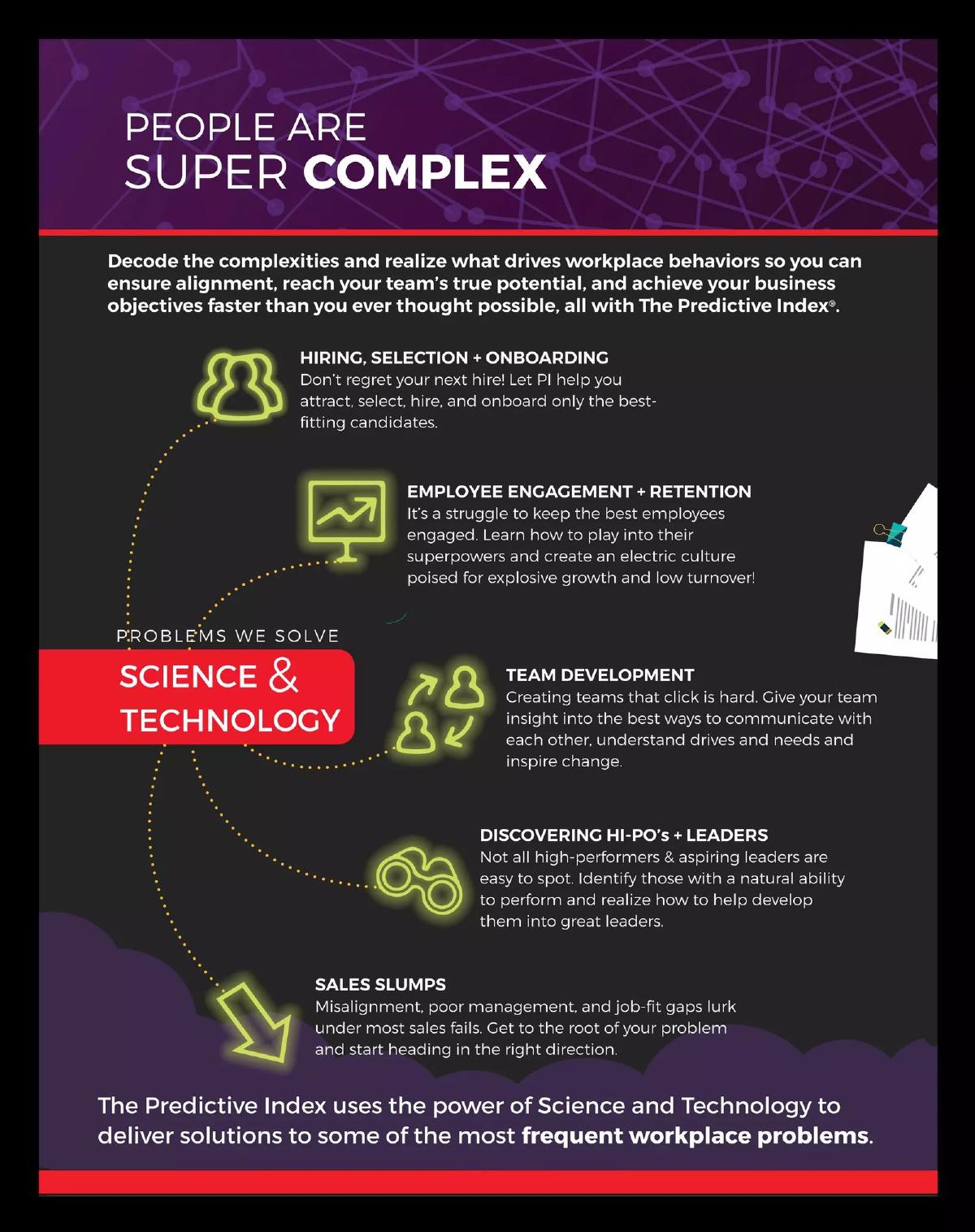
- Slide 2 identifies five core business problems solved: Hiring, Engagement, Team Development, Leadership Discovery, and Sales Slumps.
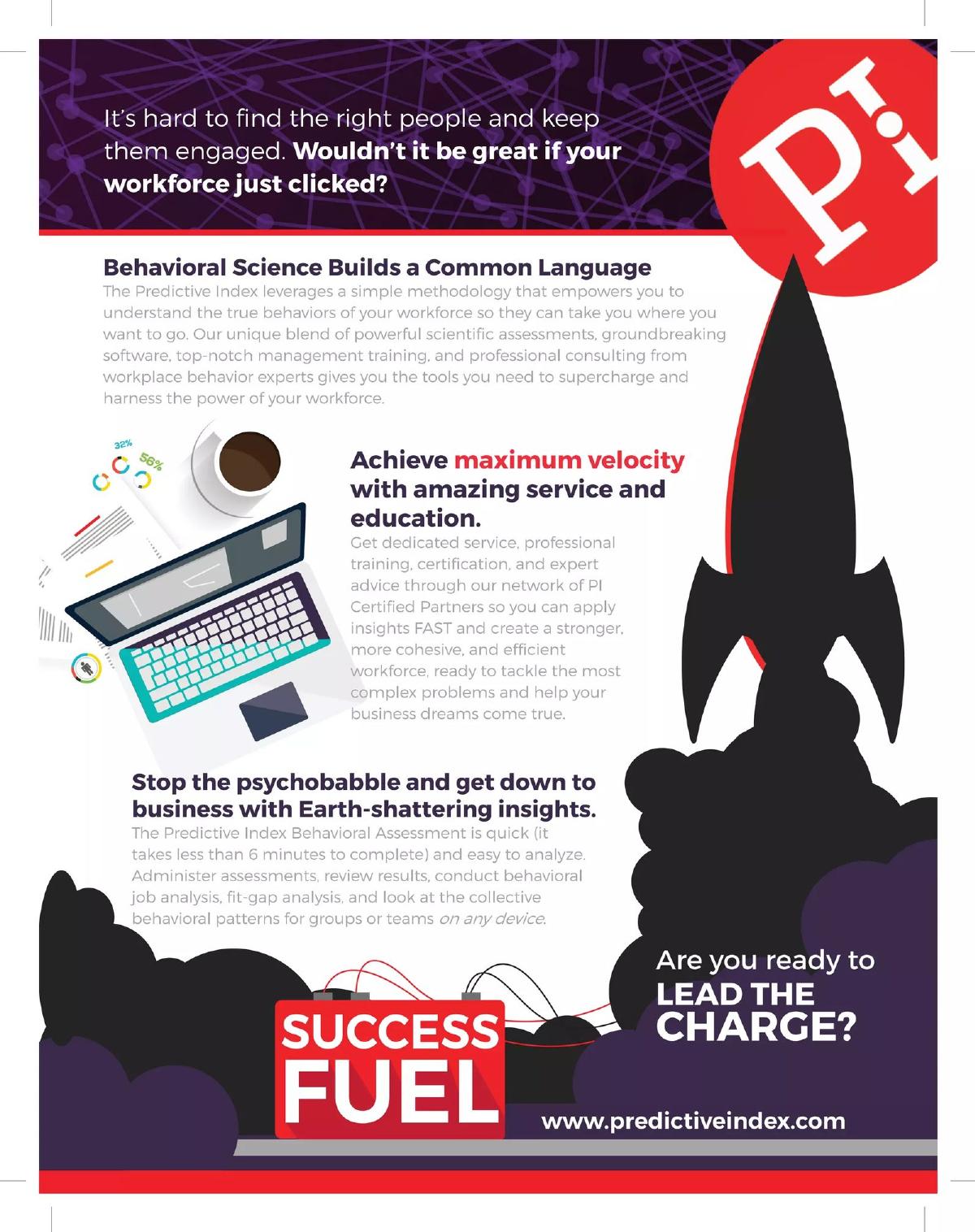
- The product's speed is a primary value prop, with Slide 3 stating the Behavioral Assessment takes less than 6 minutes to complete.
- The company utilizes a 'Certified Partner' model to scale service and education, as noted on Slide 3.
- Global reach is highlighted on Slide 4, mentioning assessments are available in over 70 languages, including English Braille.
- There is a total absence of financial data, traction metrics, or user growth numbers within these four slides.
- The deck relies on metaphorical imagery, such as rockets and 'Success Fuel,' rather than product screenshots or data visualizations.
- The copyright date on Slide 4 indicates this version of the collateral is from 2015.
The 4-Slide Series A: Brand Over Bullets
The Predictive Index (PI) occupies a unique space in the SaaS world. Unlike a pre-revenue startup trying to prove a concept, PI was an established entity with decades of history before raising its $50M Series A. This context is vital when reviewing their 4-slide deck. This is not a pitch for a product that might work; it is a brand statement for a product that already does. The deck is light on data and heavy on philosophy, focusing on the 'Science & Technology' of human behavior.
Slide 1: The Brand Identity
The cover slide is a minimalist branding exercise. It features the company name, 'The Predictive Index,' and the trademarked tagline: 'YOUR WORKFORCE SUPERCHARGED.' The use of the 'PI' logo inside a red circle establishes the visual shorthand the company uses throughout its marketing. There are no mentions of the investment round, the date, or the presenters. It is a clean, professional entry point that assumes the viewer already knows who is in the room.
Slide 2: The Problem and Solution Framework
Slide 2, titled 'PEOPLE ARE SUPER COMPLEX,' serves as both the problem statement and the solution overview. It uses a hub-and-spoke graphic to connect their 'Science & Technology' to five specific business outcomes. This is the most informative slide in the deck regarding the product's utility.
Hiring, Selection + Onboarding: Focuses on 'best-fitting candidates.' · Employee Engagement + Retention: Aims for 'low turnover' and 'electric culture.' · Team Development: Helping teams 'click' through communication insights. · Discovering Hi-Po’s + Leaders: Identifying natural ability in high-performers. · Sales Slumps: Attributing sales failure to 'job-fit gaps' and 'poor management.'
The slide concludes with a summary statement: 'The Predictive Index uses the power of Science and Technology to deliver solutions to some of the most frequent workplace problems.' This slide is effective because it maps a complex psychological product to tangible business ROI (sales, turnover, hiring).
Slide 3: The Methodology and Speed
Slide 3 moves into the 'how' of the platform. It introduces the concept of 'Behavioral Science Builds a Common Language.' The text describes a 'unique blend' of assessments, software, training, and consulting. A critical metric is buried in the third paragraph: 'The Predictive Index Behavioral Assessment is quick (it takes less than 6 minutes to complete).'
In the world of psychometric testing, where some assessments take 45–60 minutes, a 6-minute completion time is a massive competitive advantage for user adoption. The slide also mentions 'PI Certified Partners,' indicating a channel-sales or consultant-led growth strategy. The imagery shifts to a rocket ship fueled by 'SUCCESS FUEL,' a metaphor for the 'maximum velocity' the company promises to provide to its clients.
Slide 4: Global Scale and Contact Information
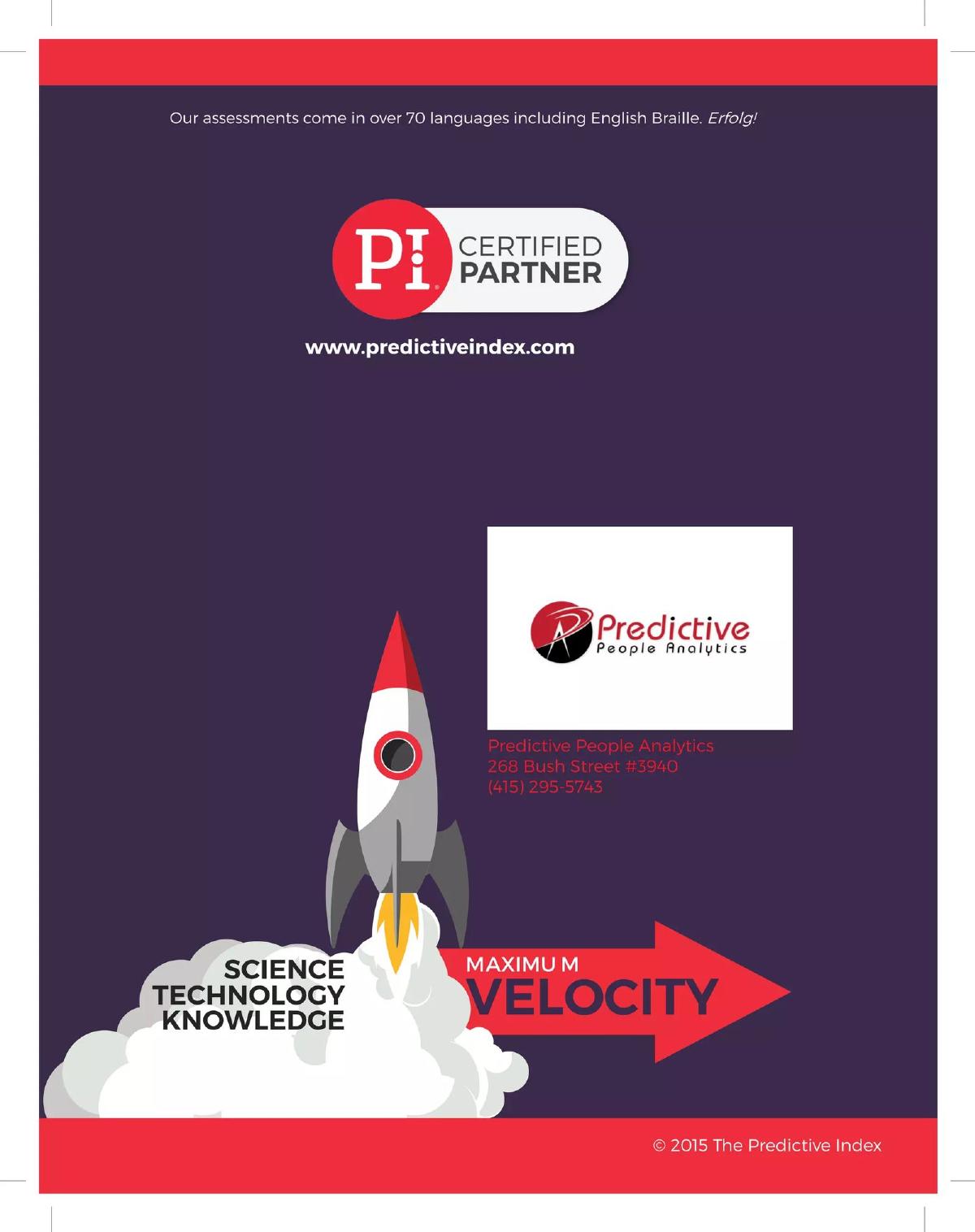
The final slide focuses on the company's reach and accessibility. A key fact is presented at the top: 'Our assessments come in over 70 languages including English Braille.' This is a powerful indicator of market maturity and global readiness—essential for a $50M Series A. The slide also features a specific 'PI Certified Partner' logo for 'Predictive People Analytics' based in San Francisco. This suggests that the deck may have been customized for a specific meeting or used by a partner to represent the parent brand. The footer contains a 2015 copyright, dating the materials to the era of their significant funding rounds.
What Works in This Deck
1. Extreme Clarity of Purpose: Within four slides, you know exactly what PI does: they use short behavioral assessments to solve five specific HR problems. There is no 'feature creep' in the messaging.
2. Outcome-Oriented Language: The deck avoids getting bogged down in the 'psychobabble' it explicitly promises to stop. Instead, it talks about 'Sales Slumps' and 'Low Turnover.' It speaks the language of the buyer.
3. Speed as a Moat: Highlighting the 6-minute assessment time is a brilliant move. It addresses the primary friction point of HR software—getting employees to actually use it.
4. Global Readiness: Mentioning 70+ languages and Braille immediately signals to an investor that the company can handle enterprise-level, multinational contracts.
What is Missing
From a traditional venture capital perspective, this deck is missing almost everything required for a standalone pitch:
Financials: There is no mention of Revenue, ARR, MRR, or growth rates. · Traction: No mention of the number of customers, total assessments taken, or logo slides of famous clients. · Market Size: No TAM/SAM/SOM analysis to justify a $50M check. · Team: No bios of the founders or executive leadership. · The Ask: No slide detailing how much they are raising or what the use of funds will be (though the catalogue confirms the $50M outcome). · Competition: No acknowledgment of the crowded HR tech or assessment space.
What a Founder Should Copy
1. The 'Problem-to-Outcome' Mapping: Slide 2 is a masterclass in showing how a technical product (science/tech) leads to specific business results. Founders should copy the way PI links their 'features' to 'problems solved.'
2. Professionalism and Branding: The deck is visually cohesive. It uses a consistent color palette and high-quality (if metaphorical) illustrations. It looks like a company that is already successful.
3. The 'Common Language' Pitch: Positioning a tool as a 'common language' for a workforce is a powerful psychological sell. It suggests that the tool isn't just a piece of software, but a foundational part of the company's culture.
Final Analysis
This 4-slide deck is likely a 'teaser' or a 'leave-behind' rather than the full presentation used in the boardroom for the $50M raise. However, it demonstrates a level of brand maturity that many startups lack. By focusing entirely on the value proposition and the ease of use (the 6-minute assessment), PI managed to communicate a compelling vision of 'Talent Optimization' that clearly resonated with institutional investors. For founders, the lesson here is not to make your deck 4 slides long, but to ensure that your core value proposition is so clear it could be explained in four slides.
Frequently asked questions
- How did The Predictive Index raise $50M with only 4 slides?
- It is highly probable that these 4 slides were part of a larger presentation or served as a high-level executive summary. The Predictive Index was an established company long before this 2015 Series A. Investors likely had access to a full data room containing the financials, churn rates, and growth metrics that are missing from this specific visual deck.
- What is the primary value proposition of the software?
- According to Slide 2, the value prop is 'Talent Optimization.' The software uses behavioral science to decode workplace behaviors, allowing companies to align their people with business objectives. It specifically targets the reduction of 'psychobabble' in favor of 'Earth-shattering insights' that can be gathered in under six minutes.
- Does the deck mention any competitors?
- No. The deck does not contain a competitive landscape slide or any mention of other behavioral assessment tools like Myers-Briggs or DiSC. It positions itself as a unique blend of science, technology, and professional consulting without referencing the broader market context.
- What is the 'Certified Partner' mentioned in the deck?
- Slide 3 and Slide 4 highlight a network of PI Certified Partners. This suggests a B2B2B or agency-led distribution model where third-party consultants use PI's tools to service their own clients. This is a key indicator of how the company scales its 'amazing service and education' without necessarily scaling its internal headcount linearly.
- Who is the target audience for this deck?
- While used for fundraising, the language is heavily geared toward HR leaders and C-suite executives. Phrases like 'Don’t regret your next hire' and 'Sales Slumps' (Slide 2) speak directly to operational pain points rather than investor-centric metrics like LTV/CAC or MoM growth.