The 2006 Theranos deck is a masterclass in institutional positioning, targeting the pharmaceutical industry rather than the general consumer market that later defined its public image. At this stage, the company sought $30M to scale its 'Ambulatory BioInformatics Communications System,' promising 70% margins by charging $7,500 per patient in clinical trials. The deck relies heavily on technical graphs and a high-profile board to establish credibility, while making bold claims about accuracy and sample sizes (5-10uL of blood). It successfully leverages existing investment from Silicon Valley h…
Key takeaways
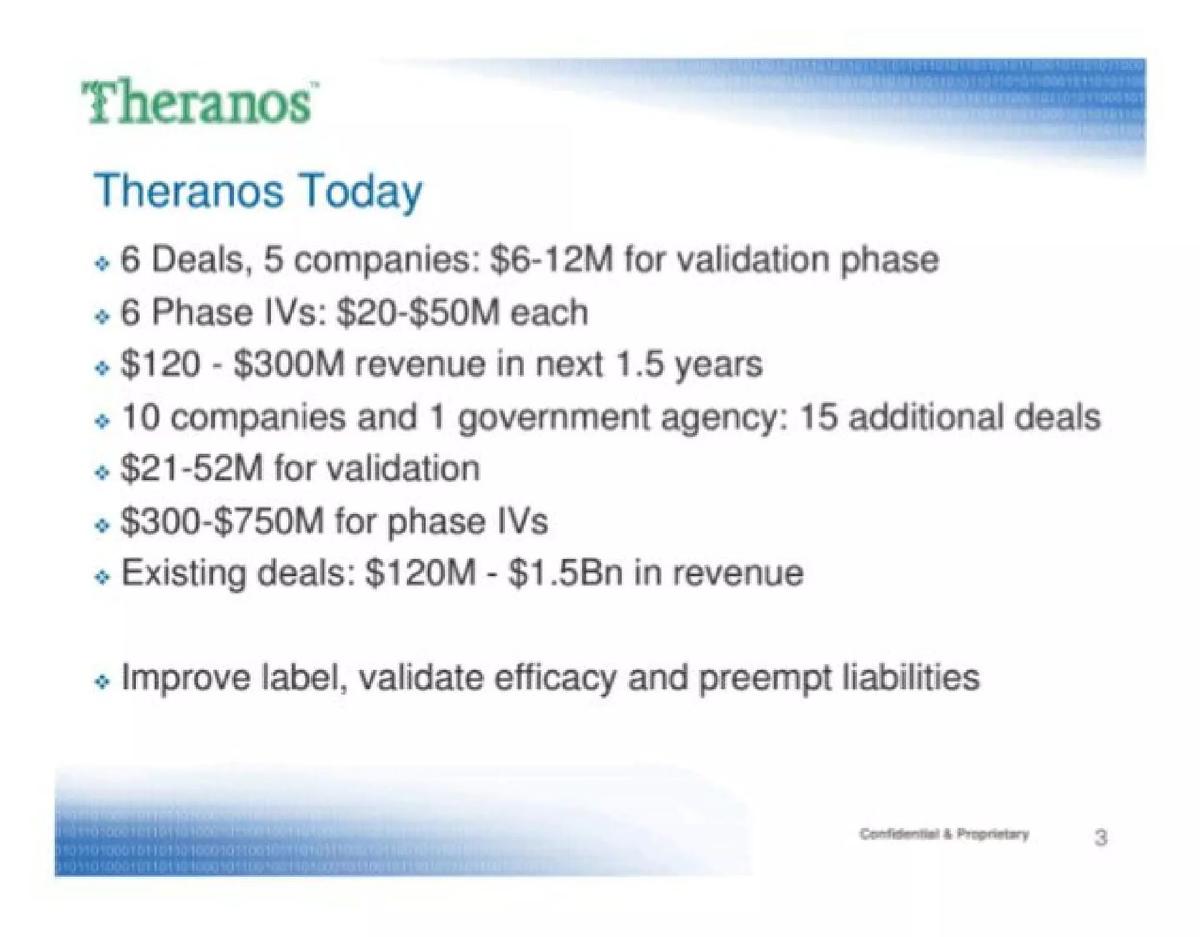
- The company targeted Phase IV clinical trials as its initial market, projecting $120M to $300M in revenue over 1.5 years (Slide 3).
- Theranos claimed its system could perform multiplex assays in less than 30 minutes using only 5-10uL of blood (Slide 8).
- The business model relied on a $7,500 'Information Fee' per patient every four months during clinical trials (Slide 14).
- Management claimed 70% margins and a cost to pharmaceutical companies that was 20-30% less than traditional clinical testing (Slide 16).
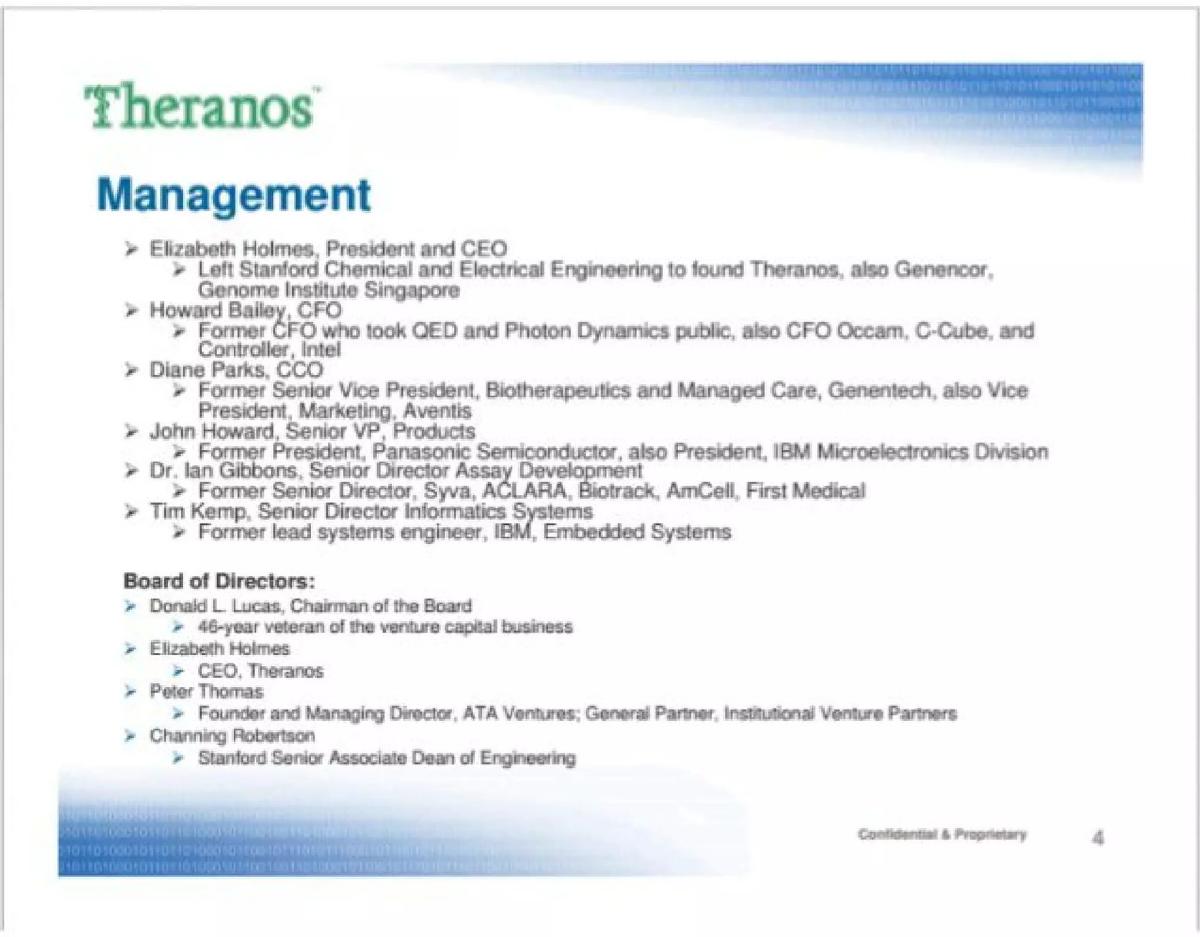
- The deck highlights a high-profile board including Donald L. Lucas and Channing Robertson to provide academic and VC credibility (Slide 4).
- Existing investors at the time included Larry Ellison (Tako Ventures) and Draper Fisher Jurvetson (Slide 21).
- The 'Offering' slide sought a $30M pre-IPO transaction, with $10-15M expected from new investors (Slide 20).
- Technical validation was presented through graphs comparing Theranos assays to conventional lab assays, claiming 'greater sensitivity' (Slide 22).
The 2006 Theranos Pitch Deck: A Study in Institutional Seduction
In 2006, Theranos was not yet the household name associated with one of the greatest frauds in corporate history. Instead, it was a promising Menlo Park startup with 50 employees and a vision to revolutionize how pharmaceutical companies monitor drug efficacy. This 24-slide deck, used to raise $9.1 million, provides a window into how Elizabeth Holmes successfully courted sophisticated investors by framing a hardware problem as a high-margin data solution.
The Executive Summary and Vision (Slides 1-3)
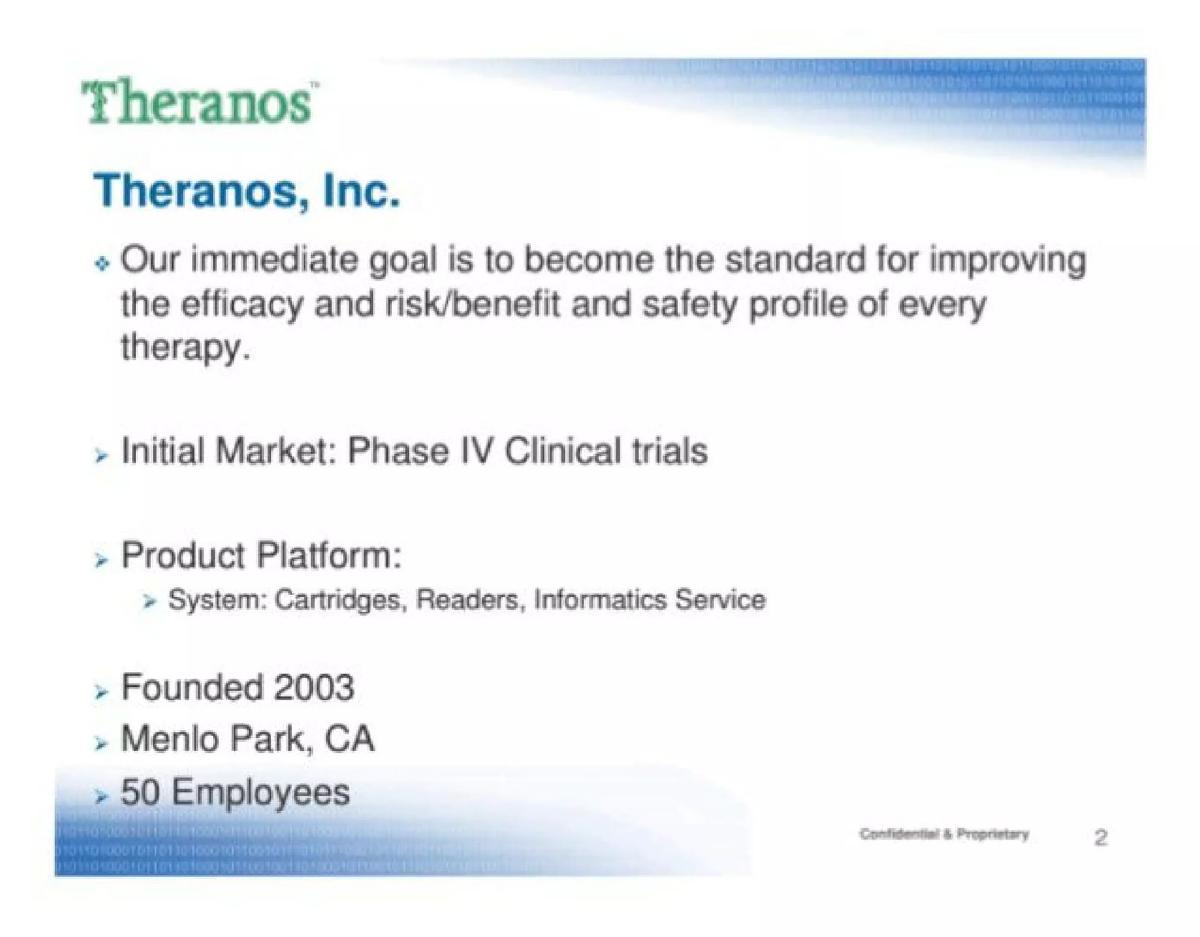
The deck opens with a standard title slide (Slide 1) dated June 1, 2006. Slide 2 immediately establishes the company's identity: founded in 2003, based in Menlo Park, and already employing 50 people. The 'immediate goal' is stated as becoming the 'standard for improving the efficacy and risk/benefit and safety profile of every therapy.' This is a crucial distinction from their later consumer-facing marketing; here, they are a B2B service for the pharmaceutical industry.
Slide 3, titled 'Theranos Today,' presents a picture of significant commercial traction. It lists '6 Deals, 5 companies' and '15 additional deals' in the pipeline with 10 companies and one government agency. The revenue projections are aggressive: $120M to $300M in the next 1.5 years, with the potential for existing deals to reach $1.5Bn. By leading with these figures, Holmes establishes a narrative of rapid scaling and market validation before even explaining the technology.
Management and Board Credibility (Slide 4)
Slide 4 is perhaps the most important slide in the deck for a pre-revenue or early-stage biotech company. It lists a management team with deep roots in established firms like Intel, Genentech, IBM, and Panasonic. However, the 'Board of Directors' section is the real anchor. By listing Donald L. Lucas (a legendary VC) and Channing Robertson (a Stanford Dean), Theranos effectively borrowed the institutional credibility of Silicon Valley and academia to shield its unproven technology from scrutiny.
The Technology and Product Ecosystem (Slides 5-8)
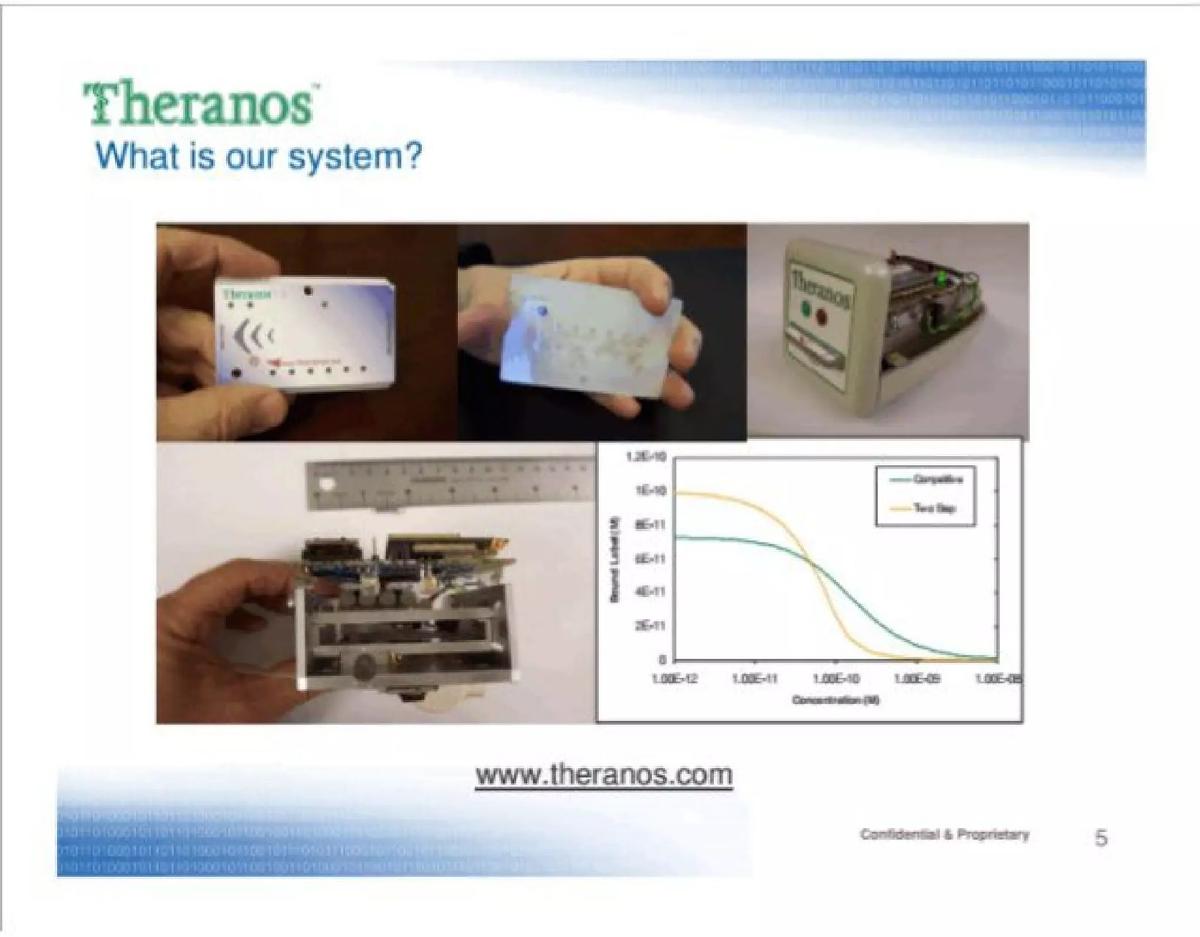
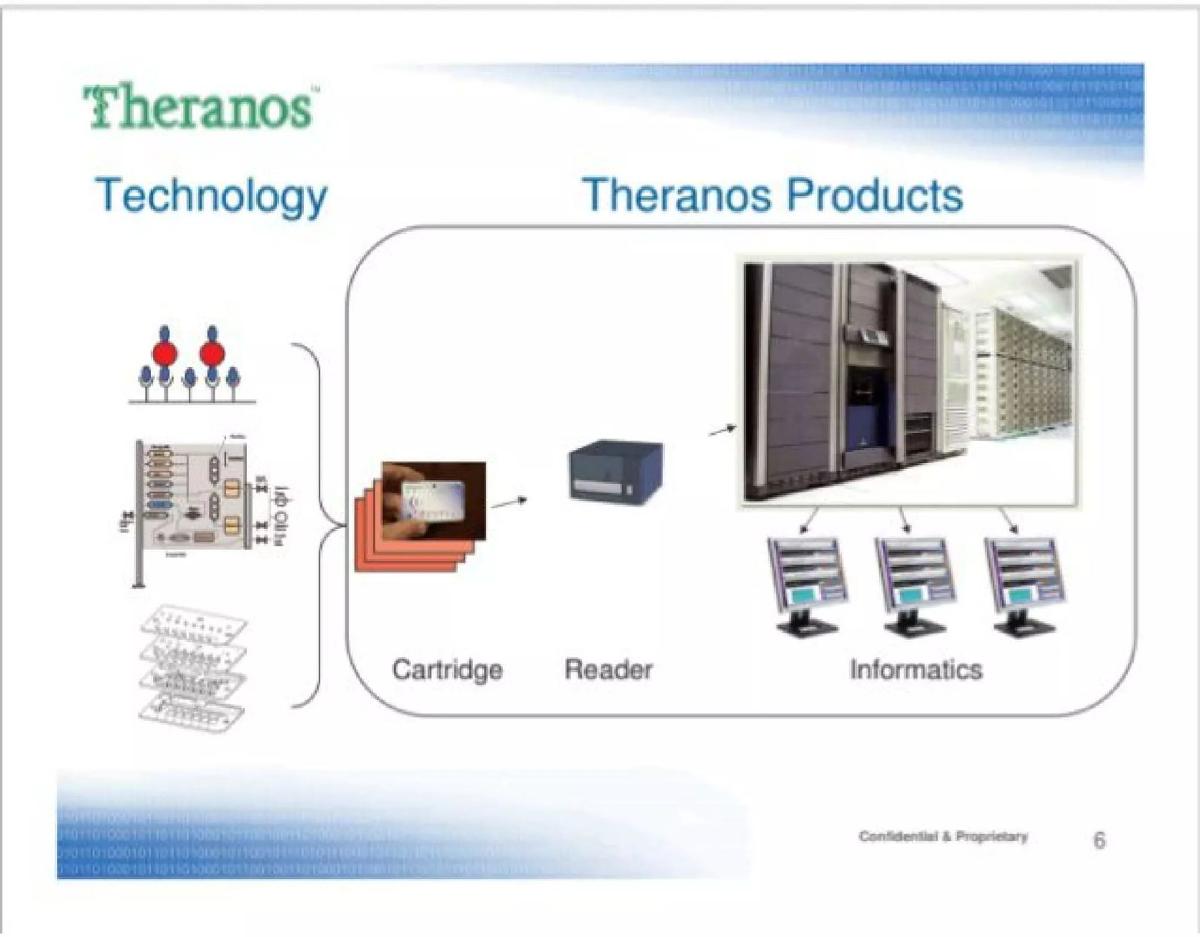
Slides 5 and 6 introduce the 'system.' Slide 5 shows photos of a handheld cartridge, a reader device, and internal components next to a ruler for scale. It also includes a technical graph comparing a 'Two Step' process to a 'Competitive' one, though the competitor is not named. Slide 6 illustrates the workflow: a cartridge goes into a reader, which then sends data to an 'Informatics' server farm.
Slide 7 introduces the 'Theranos ABCS™: Ambulatory BioInformatics Communications System.' This diagram shows a closed loop between the home, the pharmacy, the HMO, and the pharmaceutical partner, all mediated by Theranos Informatics. The value proposition is 'effective narrow range therapy through post-prescription monitoring.' Slide 8 lists specific 'Product Features,' including the infamous claim of using only '5-10uL of blood' and completing assays in ' This section of the deck (Slides 9 through 13) is a deep dive into the 'why' for drug companies. Slide 9 explicitly states the goal: 'Increase pharmaceutical sales by improving the label of a compound.' By monitoring patients in real-time, Theranos claimed it could 'remove black boxes' (FDA warnings) and 'preempt liabilities.'
Slides 10, 11, and 12 use chemotherapy as a case study. They show graphs where a patient's drug levels reach toxic heights under standard dosing, but are brought to 'target' levels using Theranos monitoring to adjust the dose. Slide 13 shows a 'Real-time PK/PD Monitoring' scenario over 50 days, suggesting a level of continuous, granular data that traditional lab testing could not provide. This was a compelling pitch to pharma companies looking to save failing drug trials.
Market Size and Business Model (Slides 14-16)
Theranos quantifies its opportunity in Slides 14 and 15. The 'Total Available Market' for Phase IV clinical trials is cited at $39 Billion per year, with an average Theranos revenue of $50M per trial. Slide 15 adds a $10 Billion preclinical market. The math is simple and enticing: $7,500 'Information Fee' per patient every four months (Slide 14).
Slide 16, 'Theranos Value Proposition,' is where the financial 'hook' is set. It claims 70% margins and states that the cost to pharmaceutical companies is 20-30% less than current testing methods. This slide frames Theranos not as a lab company, but as a high-margin software and data company that happens to use hardware to collect its inputs.
Market Pains and the Theranos Solution (Slides 17-19)
Slides 17 and 18 contrast the 'Pains' of the existing market (adverse drug reactions, no continuous monitoring, high costs) with the 'Theranos Solution.' The solution highlights that monitoring can take place 'anywhere and can be done by anyone.' Slide 19 lists 'Drivers for Success,' including 'First mover advantage,' 'Patents,' and 'Management and Culture.' Notably, it claims the 'combination of several different technologies makes reproducing the solution difficult,' a statement that discouraged deep technical due diligence by framing complexity as a competitive moat.
The Ask and Investor Pedigree (Slides 20-21)
Slide 20, 'Offering,' outlines the financial request: a $30M 'Pre-IPO transaction' to scale production and manufacturing. It notes that $15-20M is expected from existing investors, leaving $10-15M for new participants. Slide 21 lists those existing investors, a 'who's who' of the era: Larry Ellison, Draper Fisher Jurvetson, and the Palmieri Trust. For a new investor, the presence of these names suggested that the technical due diligence had already been performed by the best in the business.
Technical Appendix and Validation (Slides 22-23)
The deck concludes with two highly technical slides. Slide 22, 'Technology: Theranos System versus Today's Lab,' shows four correlation graphs, claiming that 'On chip Chemiluminescence enables greater sensitivity than the clinical lab.' Slide 23 explains the 'Computation of results,' noting that the signal is sent to a Theranos server where the concentration is derived based on factory calibration. This reinforces the 'black box' nature of the tech—the device doesn't give a result; the server does.
What Works in This Deck
1. Clear B2B Focus: By targeting the pharmaceutical industry's specific pain points (clinical trial dropouts and drug toxicity), Theranos presented a much more logical path to revenue than a general consumer play. The $7,500 per patient fee is a concrete, understandable unit of value.
2. Institutional Social Proof: The board and investor slides are exceptionally strong. In the absence of a peer-reviewed product, Holmes used the reputations of Larry Ellison and Donald Lucas to build a 'trust bridge' for new investors.
3. The 'Data Company' Pivot: Framing the business around 'Information Fees' and '70% margins' (Slide 16) allowed the company to be valued like a software startup rather than a low-margin medical diagnostics lab.
What Is Missing from This Deck
1. Hardware Unit Economics: While the deck mentions 70% margins on the 'Information Fee,' it provides no data on the cost to manufacture the readers or the cartridges. For a hardware-dependent business, this is a significant omission.
2. Peer-Reviewed Validation: All data presented is internal. There are no citations of third-party studies or independent lab comparisons, which is standard for a biotech company claiming to beat 'gold standards.'
3. Regulatory Roadmap: There is no mention of the FDA approval process for the hardware itself. The deck assumes a path to market through clinical trials but ignores the regulatory hurdles of becoming a 'standard' for medical therapy.
What a Founder Should Copy
1. Use Case Specificity: Instead of saying 'we do blood tests,' Theranos said 'we help pharma companies reduce toxicity in Phase IV trials.' Founders should copy this method of identifying a high-value, specific niche to enter a large market.
2. Visualizing the Ecosystem: Slide 7 is an excellent example of how to show a complex product's place in a larger value chain. It clearly identifies every stakeholder (HMO, Home, Pharmacy, Partner) and how they interact with the platform.
3. Leading with Traction: Even if the 'deals' were non-binding letters of intent (LOIs), placing them on Slide 3 creates immediate momentum. Founders should always lead with their strongest evidence of market pull.
Conclusion: The 2006 Theranos deck is a masterclass in narrative construction. It successfully shifted the investor's focus from the difficulty of the underlying science to the inevitability of the business model and the quality of the people involved. It serves as a reminder that in fundraising, the 'who' and the 'how much' often carry more weight than the 'how it works.'
Frequently asked questions
- What was the primary market focus of Theranos in 2006?
- Unlike its later focus on retail consumer testing, the 2006 deck focuses almost exclusively on the pharmaceutical industry. Specifically, it targets Phase IV clinical trials and the preclinical market. The goal was to help drug companies monitor patients in real-time to reduce adverse drug reactions and improve the safety profile of their therapies, thereby increasing sales.
- How did Theranos justify its high valuation and revenue projections?
- Theranos projected revenue between $120M and $1.5Bn based on existing and pending deals. They proposed an 'Information Fee' model, charging $7,500 per patient every four months. With trials involving 2,000 to 10,000 patients, a single trial could represent $50M in revenue. They claimed this model would yield 70% margins while still being 20-30% cheaper for pharma companies than traditional methods.
- What technical claims did the deck make about its blood testing capabilities?
- The deck claimed the system could perform 'simultaneous quantitative measurement of drugs and treatment-related biomarkers' using only 5-10 microliters of blood. It stated that multiplex assays could be completed in under 30 minutes with accuracy comparable to 'gold standards' and a coefficient of variation between 5-7%.
- Who were the key individuals and investors mentioned to build credibility?
- The deck leaned heavily on the reputation of its board and investors. The board included Donald L. Lucas (a 46-year VC veteran) and Channing Robertson (Stanford Associate Dean of Engineering). Investors listed included Larry Ellison of Oracle, Draper Fisher Jurvetson, and ATA Ventures. This 'social proof' was used to offset the lack of a finished, widely-deployed product.
- What was the 'ABCS' system described in the deck?
- The Ambulatory BioInformatics Communications System (ABCS) was the core product offering. It consisted of a cartridge, a reader, and an informatics service. The system was designed to be used in the home or at a pharmacy, with data uploaded to a secure server for real-time monitoring by doctors and pharmaceutical partners to adjust dosages and prevent toxicity.