The Plate’s pitch deck is a minimalist, 9-slide presentation that leans heavily on the 'Creator Economy' trend of 2023. Rather than focusing on complex market sizing or technical architecture, the deck prioritizes social proof and the user journey. By showcasing high-profile culinary figures like Michelin-starred chefs and Vogue editors, the founders established immediate credibility in a niche market. The deck successfully raised $1.3M in pre-seed funding from notable investors including Atlantic FoodLabs and Village Global. However, it is notable for what it lacks: there is no explicit slid…
Key takeaways
- The deck identifies the company as 'The Culinary Creator Platform' on slide 1.
- Social proof is established on slide 3 by listing creators with follower counts ranging from 4k to 33k.
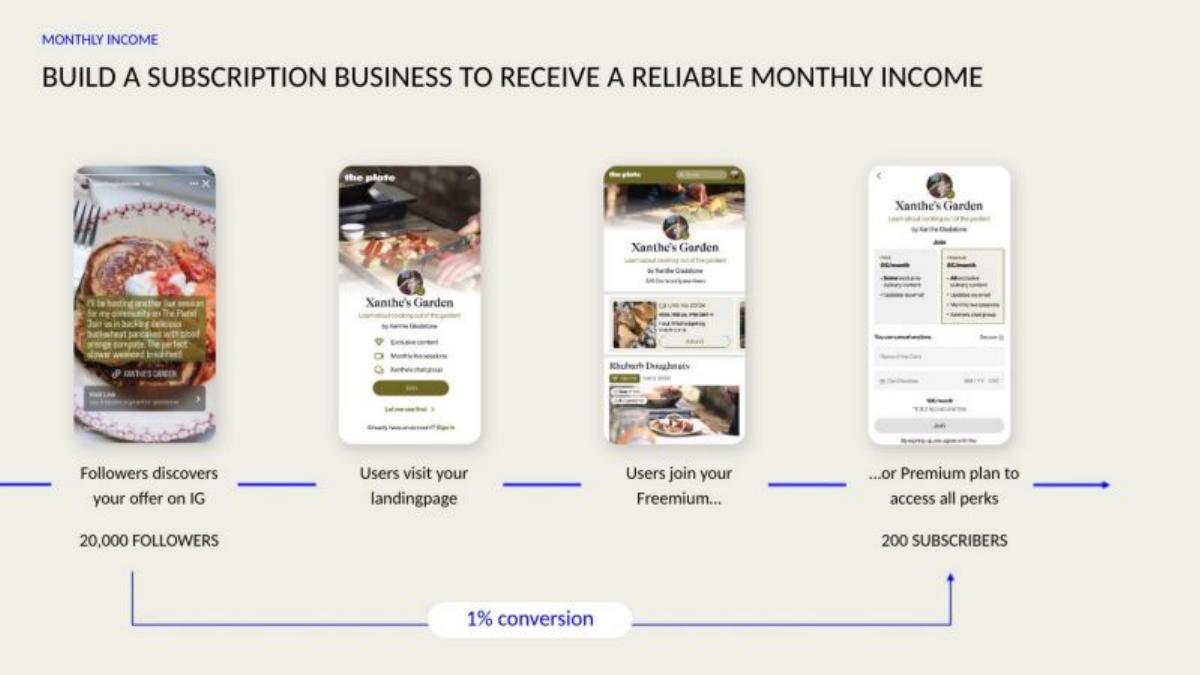
- The business model relies on a subscription funnel, projecting a 1% conversion rate from social followers to paid subscribers on slide 5.
- The platform features five core content types: Live Sessions, Group Chats, On-demand Video, Recipe Masks, and Posts, as shown on slide 7.
- The deck omits a traditional 'Ask' slide, failing to specify the $1.3M target mentioned in the catalogue facts.
- There is no competition slide or market valuation (TAM/SAM/SOM) included in the 9-slide sequence.
- The team slide (slide 8) features founders Isabell Weiser and Nadine Erk but lacks professional biographies or past company exits.
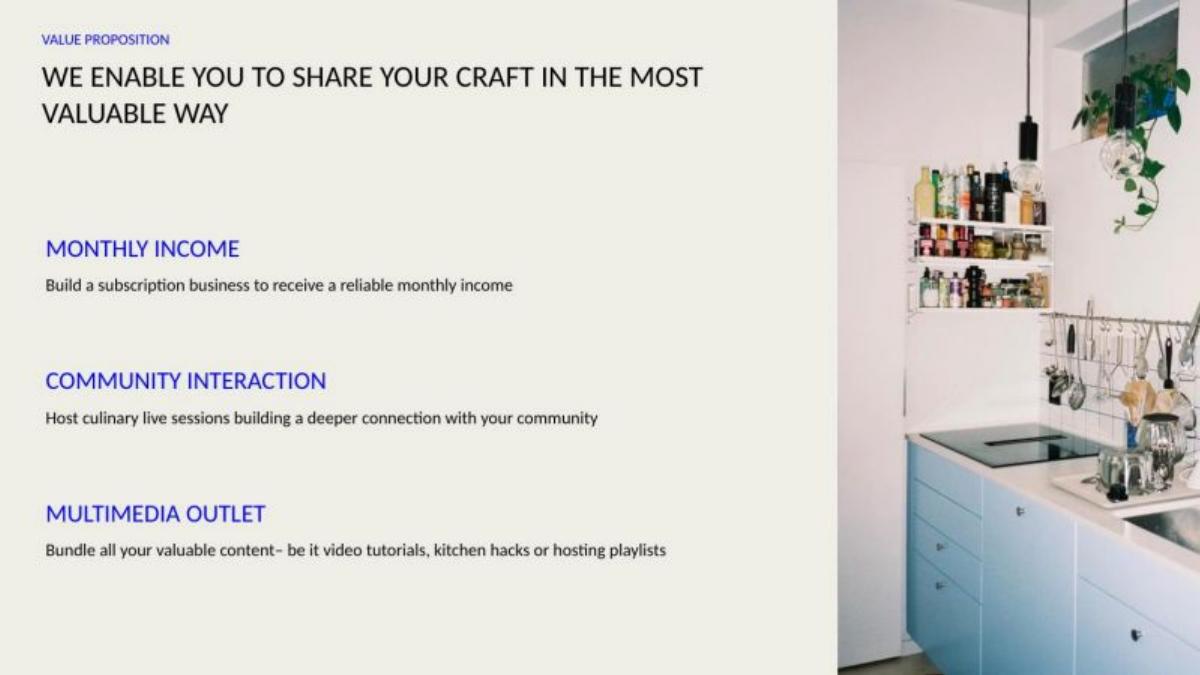
- The value proposition on slide 4 focuses on three pillars: Monthly Income, Community Interaction, and Multimedia Outlet.
The Plate: A Minimalist Approach to the Culinary Creator Economy
The Plate’s pitch deck is a masterclass in brevity, perhaps to a fault. At only 9 slides, it bypasses many of the traditional requirements of a venture capital pitch—such as market sizing, competitive landscapes, and financial projections—to focus entirely on the creators and the product experience. In the 2023 fundraising environment, where the 'Creator Economy' was a significant buzzword, this deck aimed to position culinary experts as the next frontier of monetizable talent.
Slide 1: Title and Positioning
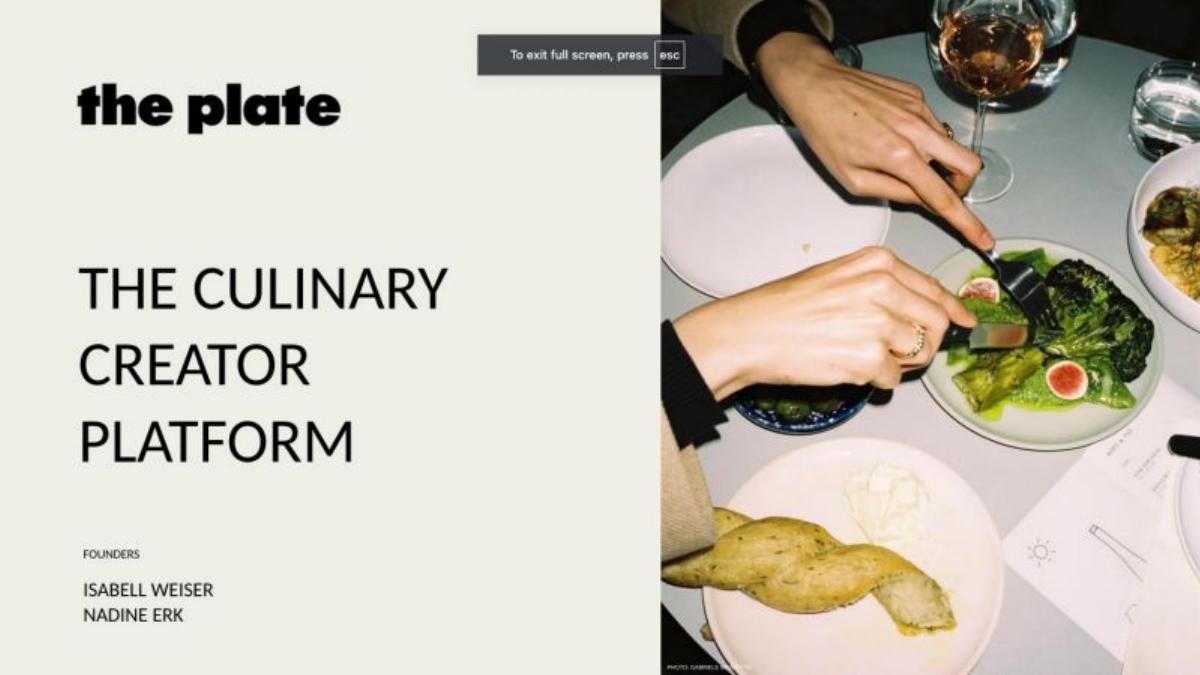
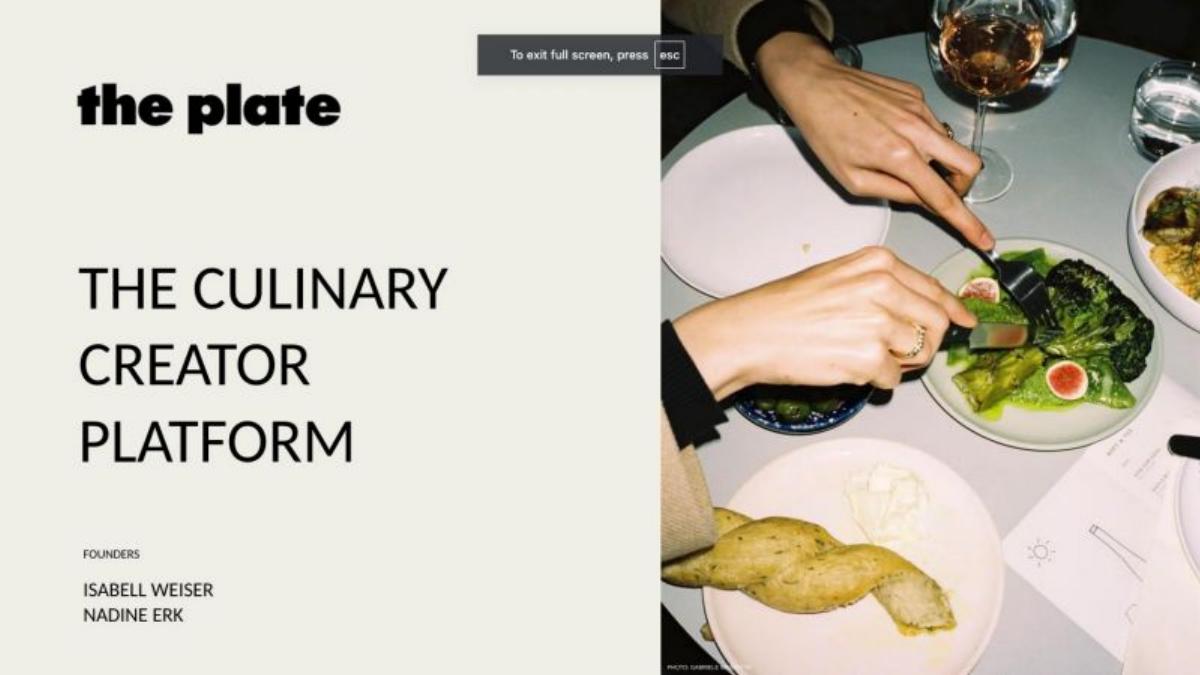
The opening slide is clean and high-contrast. It introduces the company name, the plate , and provides a clear four-word descriptor: THE CULINARY CREATOR PLATFORM . This is an effective 'high-concept pitch' that tells an investor exactly what the business is before they move to the next slide. It also lists the founders, Isabell Weiser and Nadine Erk, immediately establishing ownership. The imagery on the right—a high-quality, lifestyle-oriented photo of a meal—sets the aesthetic tone for the brand.
Slide 2: The Core Mission
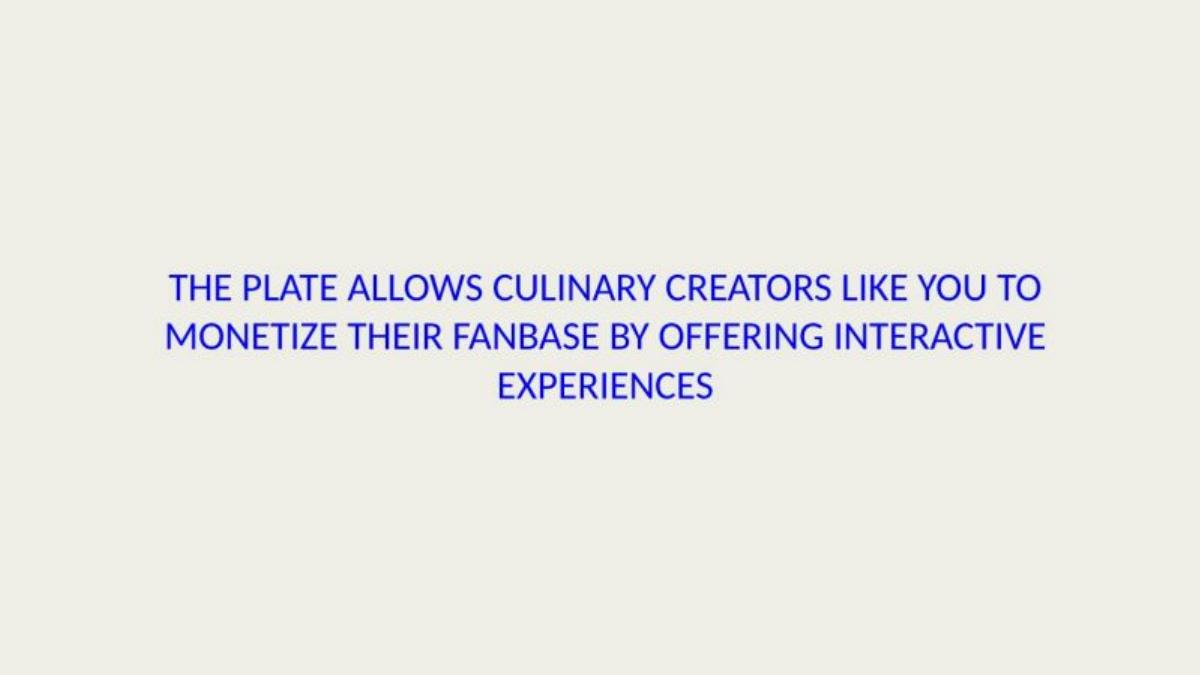
Slide 2 serves as the 'Problem/Solution' hybrid. It states: THE PLATE ALLOWS CULINARY CREATORS LIKE YOU TO MONETIZE THEIR FANBASE BY OFFERING INTERACTIVE EXPERIENCES . By using the phrase 'creators like you,' the deck suggests it may have been used as a dual-purpose document for both investors and creator recruitment. It identifies the primary pain point—monetization—and the primary solution—interactive experiences.
Slide 3: Social Proof and Creator Profiles
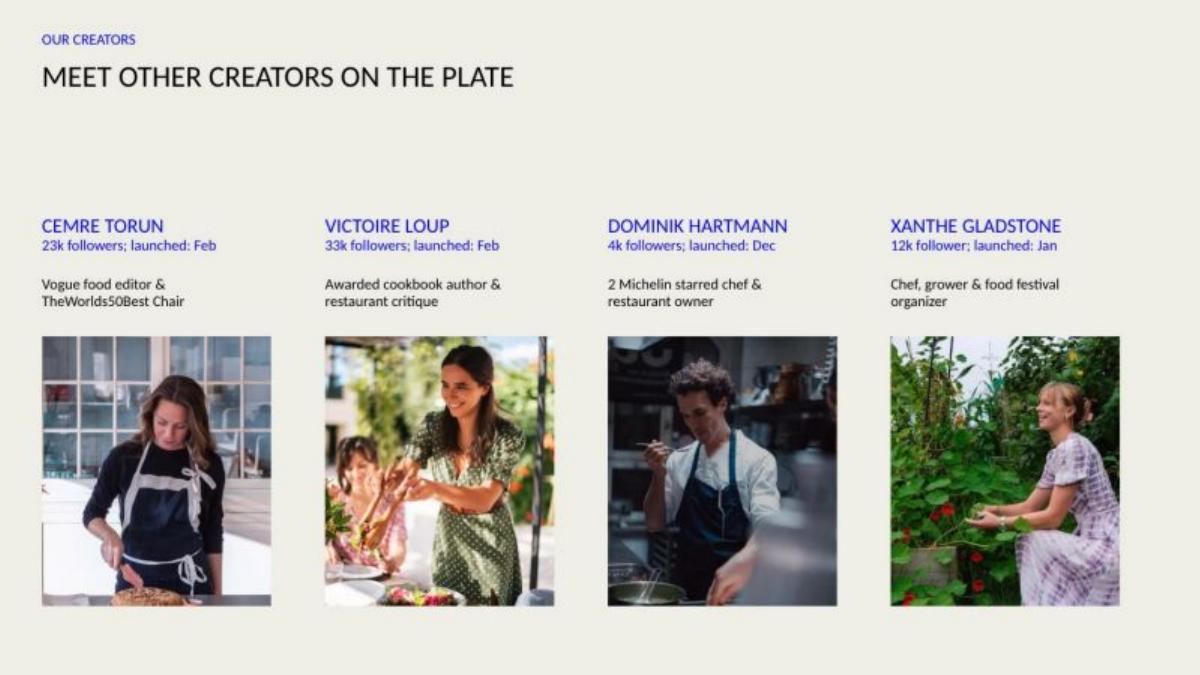
This is arguably the most important slide in the deck. It introduces four 'Creators on the Plate' to demonstrate early traction and the caliber of the platform’s users. The creators listed are:
Cemre Torun: Vogue food editor (23k followers). · Victoire Loup: Cookbook author and critic (33k followers). · Dominik Hartmann: 2 Michelin starred chef (4k followers). · Xanthe Gladstone: Chef and grower (12k followers).
This slide proves that the platform can attract high-status individuals (Michelin stars and Vogue editors) even if their follower counts aren't in the millions. It validates the 'culinary' niche effectively.
Slide 4: The Value Proposition
Slide 4 breaks down the 'Why' for the creators. It lists three pillars: Monthly Income (reliable subscription revenue), Community Interaction (live sessions), and Multimedia Outlet (bundling video, hacks, and playlists). This slide is designed to show how The Plate differentiates itself from a simple social media feed by offering a 'valuable way' to share craft.
Slide 5: The Funnel and Unit Economics
Slide 5 provides a visual walkthrough of the user journey. It starts with a follower discovering an offer on Instagram (IG) and moves through a landing page to a 'Freemium' or 'Premium' plan. Crucially, it includes a metric: 1% conversion . It uses a hypothetical example of 20,000 followers resulting in 200 subscribers. While this is a standard industry benchmark for creator conversions, seeing it mapped out helps investors understand the revenue engine of the marketplace.
Slide 6: Live Experiences
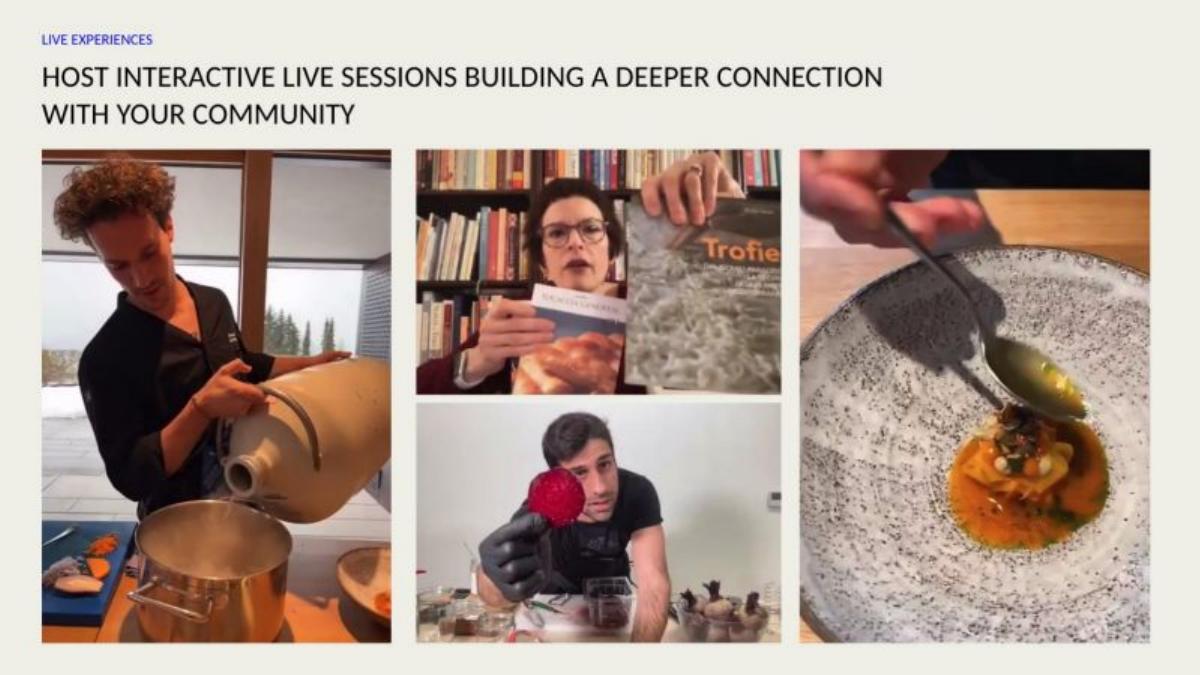
This slide is purely visual, showing four screenshots of creators in action—hosting live streams, showing cookbooks, and plating food. It reinforces the 'Interactive' element mentioned in slide 2. It demonstrates that the product is functional and being used for high-fidelity culinary content.
Slide 7: Product Features
Slide 7 uses iconography to list the technical capabilities of the platform. The five features are:
Live Sessions · Group Chats · On-demand Video · Recipe Masks · Posts
The mention of 'Recipe Masks' is the only hint at a unique technical feature specifically tailored to the culinary niche, though it is not explained in detail.
Slide 8: The Team
The team slide is surprisingly sparse. It features headshots of Isabell Weiser and Nadine Erk but provides no text regarding their backgrounds, previous roles, or education. In a pre-seed round, the team is usually the most scrutinized element. This deck relies on the 'Social Proof' of the creators on slide 3 to carry the credibility of the founders.
Slide 9: Call to Action
The final slide is a simple 'Get in Touch' with a link. Like many other slides in this deck, it omits details that are usually standard, such as a summary of the round terms or a 'Thank You' with contact emails visible on the slide itself.
What The Plate Pitch Deck Does Well
Niche Authority: By focusing exclusively on the 'Culinary' aspect of the creator economy, the deck avoids competing directly with broad platforms like Patreon or OnlyFans. The inclusion of a 2-Michelin starred chef (Slide 3) is a massive signal that the platform is respected by the industry's elite.
Visual Clarity: The deck is aesthetically pleasing and consistent with a high-end food brand. The use of whitespace and high-quality photography makes the platform feel 'premium,' which aligns with the goal of attracting cookbook authors and Vogue editors.
The Funnel Logic: Slide 5 is a very clear explanation of the business model. It doesn't hide behind complex jargon; it simply shows how an Instagram audience is converted into a paying subscriber base.
What Is Missing from The Plate Pitch Deck
Market Size (TAM): There is no mention of how large the culinary creator market is. Investors typically want to see that a company can become a 'billion-dollar business,' which usually requires a slide showing millions of potential creators or billions in spend.
Competitive Landscape: The deck does not address how it competes with Instagram Subscriptions, Patreon, or Masterclass. This is a significant omission for a marketplace business.
The 'Ask': The deck never mentions that they are raising $1.3M. Without an 'Ask' slide, the deck feels more like a sales brochure than a fundraising document.
Financial Projections: There are no charts showing projected growth, churn rates, or platform fees (take rates). Investors are left to guess how much the platform actually earns from those 200 subscribers mentioned on slide 5.
What Other Founders Can Copy
The 'Social Proof' Slide: If you are building a marketplace, your 'Supply Side' (the creators) is your best marketing. Copy The Plate’s method of listing specific, high-authority users with their follower counts and titles (Slide 3). It is much more convincing than a generic 'Our Users' slide.
The User Journey: Slide 5 is an excellent template for any B2B2C startup. Showing the transition from a third-party platform (IG) to your proprietary platform (The Plate) helps visualize the 'moat' you are building.
High-Concept Title: Use Slide 1 to define your category. 'The Culinary Creator Platform' is a perfect example of how to claim a niche immediately.
Frequently asked questions
- How much did The Plate raise with this deck?
- According to the catalogue facts, The Plate raised $1.3M in a pre-seed round in 2023. Interestingly, the 9-slide deck provided does not actually contain a slide stating the 'Ask' or the specific amount they were looking to raise, which suggests this version may have been a teaser or part of a larger presentation.
- Who are the lead investors in The Plate?
- The round was led by Atlantic FoodLabs. Other participants included Village Global, GE Ventures, and various angel investors. This represents a strong institutional backing for a pre-seed stage food-tech startup.
- What is the primary business model for The Plate?
- The Plate operates as a B2B2C marketplace. As shown on slide 5, the model is built on a subscription funnel where culinary creators convert their existing social media followers (specifically Instagram) into paid subscribers on The Plate to access 'Premium' perks.
- What features does the platform offer to creators?
- Slide 7 outlines five main features: Live Sessions, Group Chats, On-demand Video, Recipe Masks, and Posts. The goal is to provide a 'Multimedia Outlet' that bundles various types of content into a single subscription offering.
- Is there a market size analysis in the deck?
- No. The deck completely omits a market size slide. There is no mention of the Total Addressable Market (TAM) for the creator economy or the culinary industry. The founders chose to focus on the 'who' (the creators) rather than the 'how big' (the market).