Treatfuls is a B2C food and beverage startup focused on vegan, organic, and gluten-free snacks. Their 11-slide deck, used for a €15,000 crowdfunding raise in 2021, functions more as a brand lookbook than a traditional venture capital pitch. The deck excels at establishing a 'loud' and 'joyful' brand identity, utilizing high-quality product photography and bold messaging like 'sweeter than your ex.' However, it is critically thin on business fundamentals. There is no mention of market size, revenue, unit economics, distribution strategy, or a specific financial ask. For a small crowdfunding ro…
Key takeaways
- The deck prioritizes brand voice and aesthetic over traditional business metrics, reflecting its use in a small crowdfunding round (Slide 5).
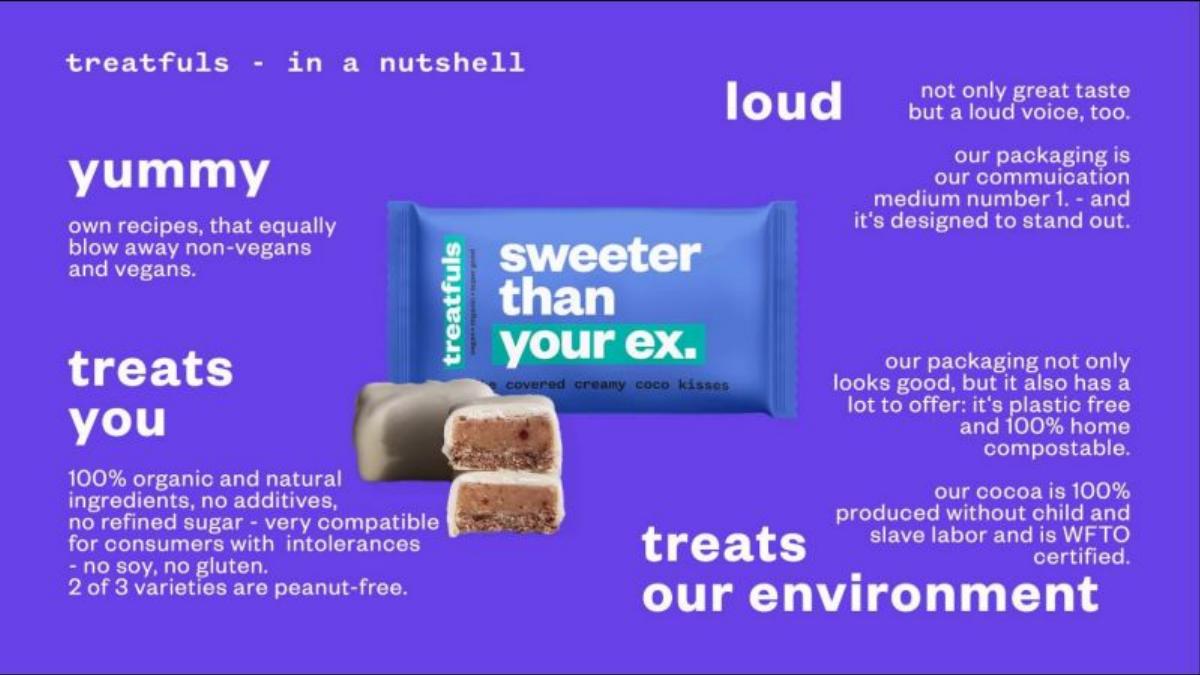
- Product differentiation is centered on being '100% organic and natural' with no refined sugar, soy, or gluten (Slide 5).
- Environmental sustainability is a core pillar, highlighting plastic-free and 100% home compostable packaging (Slide 5).
- The founders emphasize their personal passion and 'foodie' backgrounds rather than previous industry exits or corporate experience (Slide 3).
- The deck features three distinct product varieties with provocative naming conventions to stand out on shelves (Slide 7).
- Ethical sourcing is explicitly mentioned, noting that their cocoa is WFTO certified and produced without child or slave labor (Slide 5).
- There is a complete absence of a 'Market Slide,' meaning the total addressable market for vegan snacks is never quantified.
- The deck lacks a 'Financials' or 'Ask' slide, omitting how the €15,000 would be spent or what the growth projections look like.
The Brand-First Approach to Crowdfunding
Treatfuls entered the market in 2021 with a clear mission: to make healthy snacking 'loud' and 'joyful.' The pitch deck used for their €15,000 crowdfunding round is a masterclass in brand identity but a skeleton in terms of business operations. In the food and beverage (F&B) sector, especially at the pre-seed or crowdfunding stage, the 'vibe' of the brand often carries more weight with early backers than a complex spreadsheet. Treatfuls leans heavily into this, using all 11 slides to sell a lifestyle and a set of values.
Slide 1: Title Slide
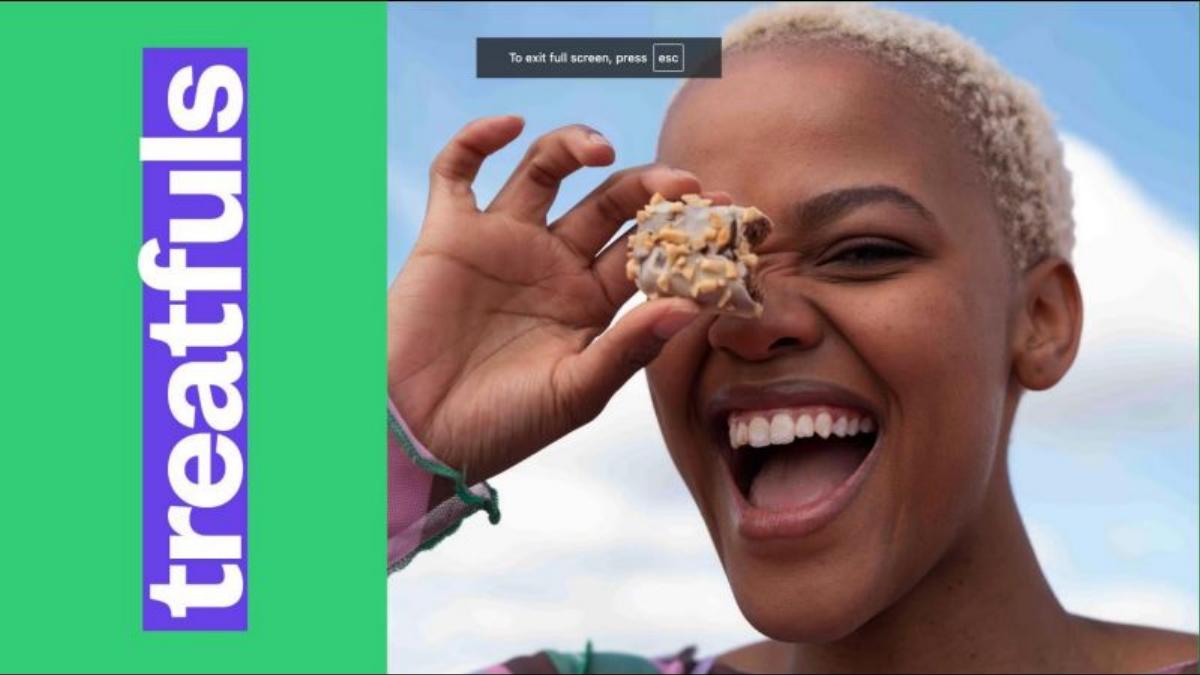
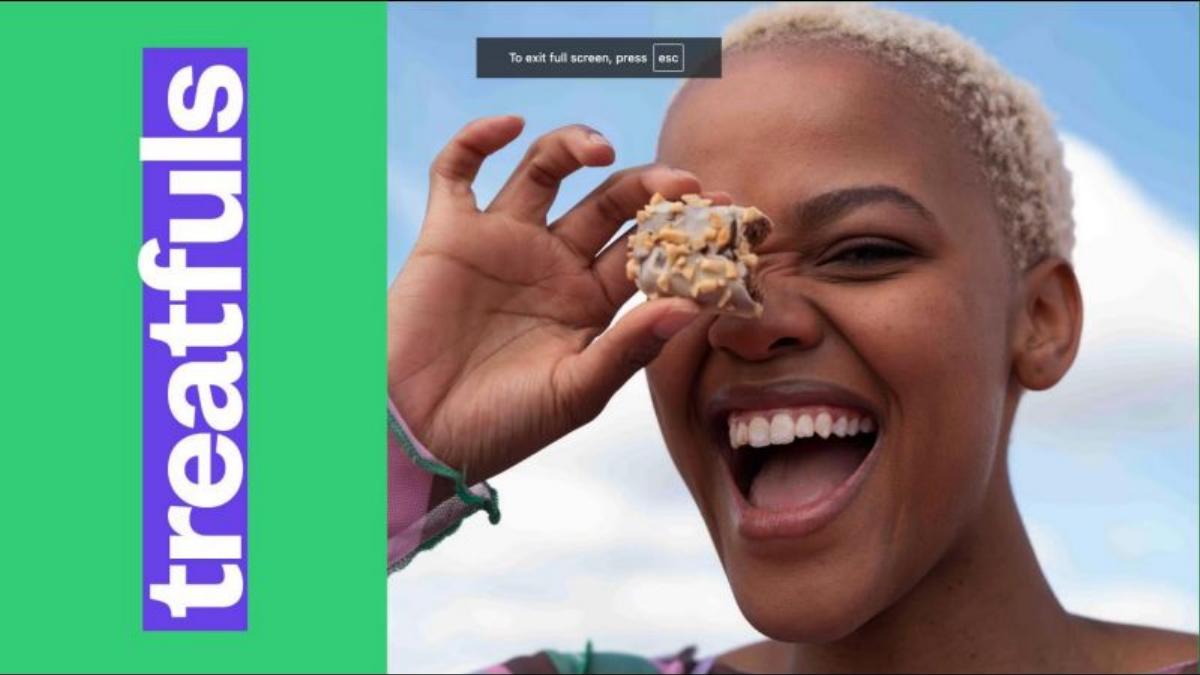
The opening slide is purely visual. It features the Treatfuls logo in white text against a purple block, set on a bright green background. The primary image is a high-quality lifestyle shot of a smiling woman holding a half-eaten snack bar. This immediately establishes the target demographic and the brand's energetic tone. There is no tagline or mission statement here; the image is intended to do the heavy lifting of communicating 'joyful snacking.'
Slide 2: The Hook
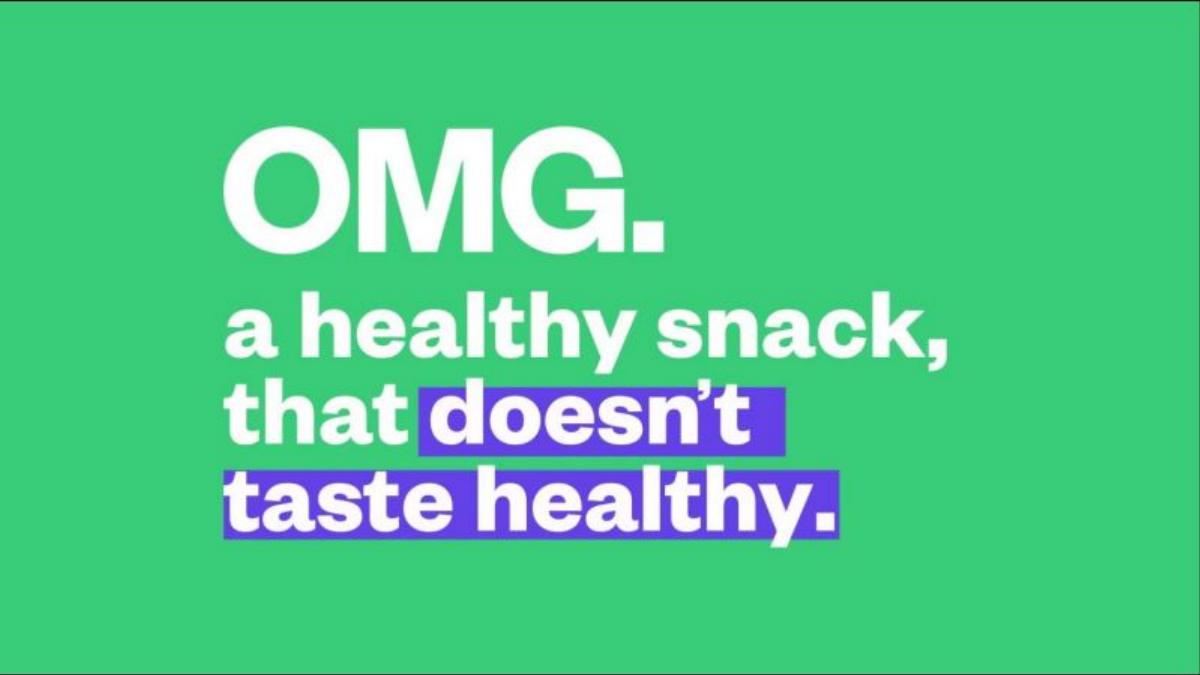
Slide 2 delivers the core value proposition: "OMG. a healthy snack, that doesn't taste healthy." By using the 'OMG' colloquialism and bold, sans-serif typography, Treatfuls signals that they are targeting a younger, social-media-savvy consumer. The purple highlights on the text emphasize the 'doesn't taste healthy' part, which addresses the primary pain point in the vegan and organic snack market: the perception of poor flavor.
Slide 3: About Us
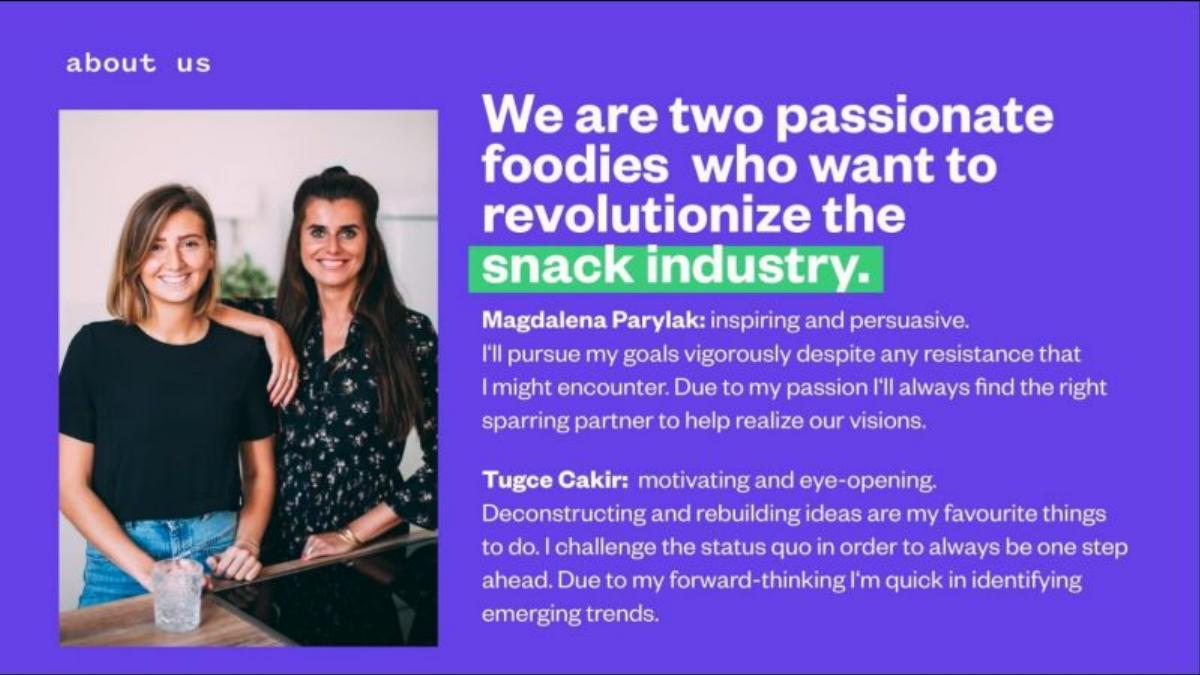
The team slide introduces Magdalena Parylak and Tugce Cakir. Rather than a traditional CV-style list of accomplishments, the text focuses on their internal drivers. Magdalena is described as 'inspiring and persuasive,' while Tugce is 'motivating and eye-opening.' They position themselves as 'two passionate foodies who want to revolutionize the snack industry.' While this builds a narrative of founder-market fit based on passion, it leaves a gap regarding their operational or manufacturing experience.
Slide 4: Our Vision
This slide expands on the hook from Slide 2. The vision is a world where 'healthy and delicious is the norm and not a niche.' The language 'craving for a world' and 'treatful moments' reinforces the emotional connection they want to build with the investor. It frames the company not just as a snack manufacturer, but as a facilitator of daily joy.
Slide 5: Treatfuls - In a Nutshell
This is the most information-dense slide in the deck. It breaks down the product into four quadrants: Yummy (own recipes), Loud (packaging as a communication medium), Treats You (100% organic, no additives, no refined sugar, no soy, no gluten), and Treats Our Environment (plastic-free, home compostable, WFTO certified cocoa). This slide serves as the 'Product' and 'ESG' (Environmental, Social, and Governance) slide combined. It effectively lists the technical specifications of the product without losing the brand voice.
Slide 6: Our Values
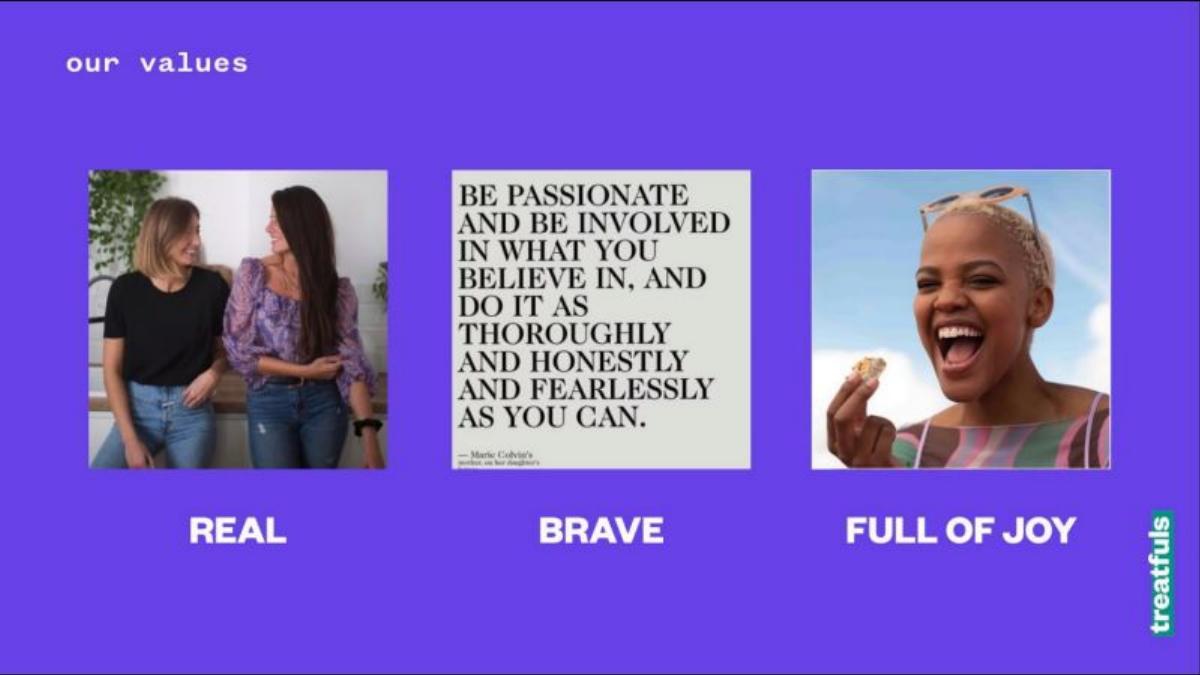
Slide 6 reinforces the brand pillars: Real, Brave, and Full of Joy. It includes a quote from Marie Colvin about being passionate and involved. While these values are important for brand building, this slide occupies space that could have been used for market data or traction. In a short 11-slide deck, dedicating an entire slide to abstract values is a choice that favors crowdfunding audiences over institutional ones.
Slide 7: Our Treats
This slide showcases the three product varieties. The packaging is the star here, featuring slogans like "sweeter than your ex" (white covered creamy coco kisses), "best date you'll ever have" (dark choc covered chewy peanut chunks), and "healthier than your last relationship" (white covered crunchy hazelnut treats). The slide also shows the back of the packaging, displaying the nutritional facts and the 'Bio' (organic) certification logo. This proves the product is retail-ready and compliant with EU labeling standards.
Slide 8: Product Features Summary
Slide 8 acts as a summary list of the product's 'free-from' attributes. It lists: vegan, certified organic, fair-trade cacao, without additives, without refined sugar, without gluten, without soy, and without plastic. The green highlighted footer 'taste without compromise' serves as the final punchline for the product section. The visual of the three-pack display boxes suggests the product is ready for wholesale and 'point of sale' retail environments.
Slide 9: Contact Slide
The deck concludes with a 'craving for more? let's talk!' call to action. It provides the phone numbers, email addresses, and LinkedIn URLs for both founders. Providing direct phone numbers is a common tactic in early-stage decks to signal accessibility and urgency.
Slide 10: Closing Statement
The final branded slide repeats the logo and the phrase "because life is too short for bad snacks." This brings the presentation full circle, ending on the same emotional note it started with.
What Treatfuls Does Well
The Treatfuls deck is visually cohesive and professionally designed. In the B2C food space, the packaging is the product, and this deck sells the packaging exceptionally well. By showing the display boxes and the back-of-pack nutritional labels, the founders prove they have moved past the 'kitchen concept' phase and into a production-ready state. The use of humor in the product names ('sweeter than your ex') is a strong differentiator that suggests the brand could achieve organic viral growth on platforms like Instagram or TikTok.
Furthermore, the deck hits every major trend in the 2021 food market: plant-based, clean label, sustainable packaging, and ethical sourcing. By checking all these boxes on Slide 5, they make it easy for a 'conscious consumer' investor to say yes to a small check.
What is Missing from the Treatfuls Deck
From a professional fundraising perspective, the omissions in this deck are significant. There is no Market Slide ; we don't know if the addressable market for these snacks is €100 million or €10 billion. There is no Competition Slide ; the deck ignores the fact that the 'healthy snack bar' category is one of the most crowded in the grocery store, with giants like Kind and RXBAR, as well as numerous organic incumbents.
Most importantly, there are no Financials . Investors have no insight into the Cost of Goods Sold (COGS), the wholesale vs. retail price points, or the current monthly burn rate. The Traction Slide is also absent—there is no mention of how many units have been sold to date, which retailers have expressed interest, or what the direct-to-consumer (DTC) conversion rates look like. Finally, the Ask is missing. While the catalogue data tells us they raised €15,000, the deck itself does not state how much money is being sought or how that capital will be allocated (e.g., inventory, marketing, or R&D).
Lessons for Founders
Founders can learn two distinct lessons from the Treatfuls deck. First, brand is a moat in F&B . If your product looks like it belongs on a shelf at Whole Foods or a high-end boutique, you can raise small amounts of capital based on aesthetic and 'vibe' alone. Treatfuls succeeded in raising €15,000 because they looked like a 'real' company, even if the deck lacked the data of one.
Second, know your audience . This deck was clearly designed for a crowdfunding platform where the 'investors' are often just enthusiastic customers. For that audience, a slide about 'Values' is more effective than a slide about 'EBITDA margins.' However, if these founders were to approach a venture capital firm for a Seed or Series A round, they would need to add at least five to seven data-heavy slides to address the business's scalability and defensibility. If you are building a deck, ensure you have a 'lite' version for brand-building and a 'data' version for professional due diligence.
Final Verdict: A high-quality brand teaser that effectively secured a small crowdfunding round but lacks the structural integrity required for institutional venture capital.
Frequently asked questions
- What was the primary goal of the Treatfuls pitch deck?
- Based on the catalogue data, the deck supported a crowdfunding round that raised €15,000. Its primary goal was to introduce the brand identity, product ingredients, and founder vision to individual angel investors and consumers, rather than providing the deep financial due diligence required for a large VC seed round.
- How does Treatfuls differentiate itself in the crowded snack market?
- Treatfuls differentiates through a combination of 'clean' ingredients (vegan, organic, gluten-free, no refined sugar) and 'loud' branding. Slide 5 and 7 show packaging with bold, humorous slogans like 'sweeter than your ex' and 'healthier than your last relationship,' aiming to move healthy snacking from a niche health food vibe to a mainstream, joyful experience.
- What environmental claims does the company make?
- On Slide 5, the company states that its packaging is plastic-free and 100% home compostable. Additionally, they claim their cocoa is 100% produced without child and slave labor and holds World Fair Trade Organization (WFTO) certification, positioning the brand as an ethical choice for conscious consumers.
- Who are the founders and what is their background?
- The founders are Magdalena Parylak and Tugce Cakir. According to Slide 3, they describe themselves as 'two passionate foodies.' The slide focuses on their personality traits—Magdalena as 'inspiring and persuasive' and Tugce as 'forward-thinking'—rather than listing specific past companies or degrees, which is common in early-stage consumer brand decks.
- What is missing from this deck that a professional investor would expect?
- The deck is missing several standard slides: Market Size (TAM/SAM/SOM), Competition, Business Model/Unit Economics, Traction (current sales or retail doors), and a Use of Funds slide. Without these, it is impossible for an investor to calculate the potential return on investment or understand the company's path to profitability.