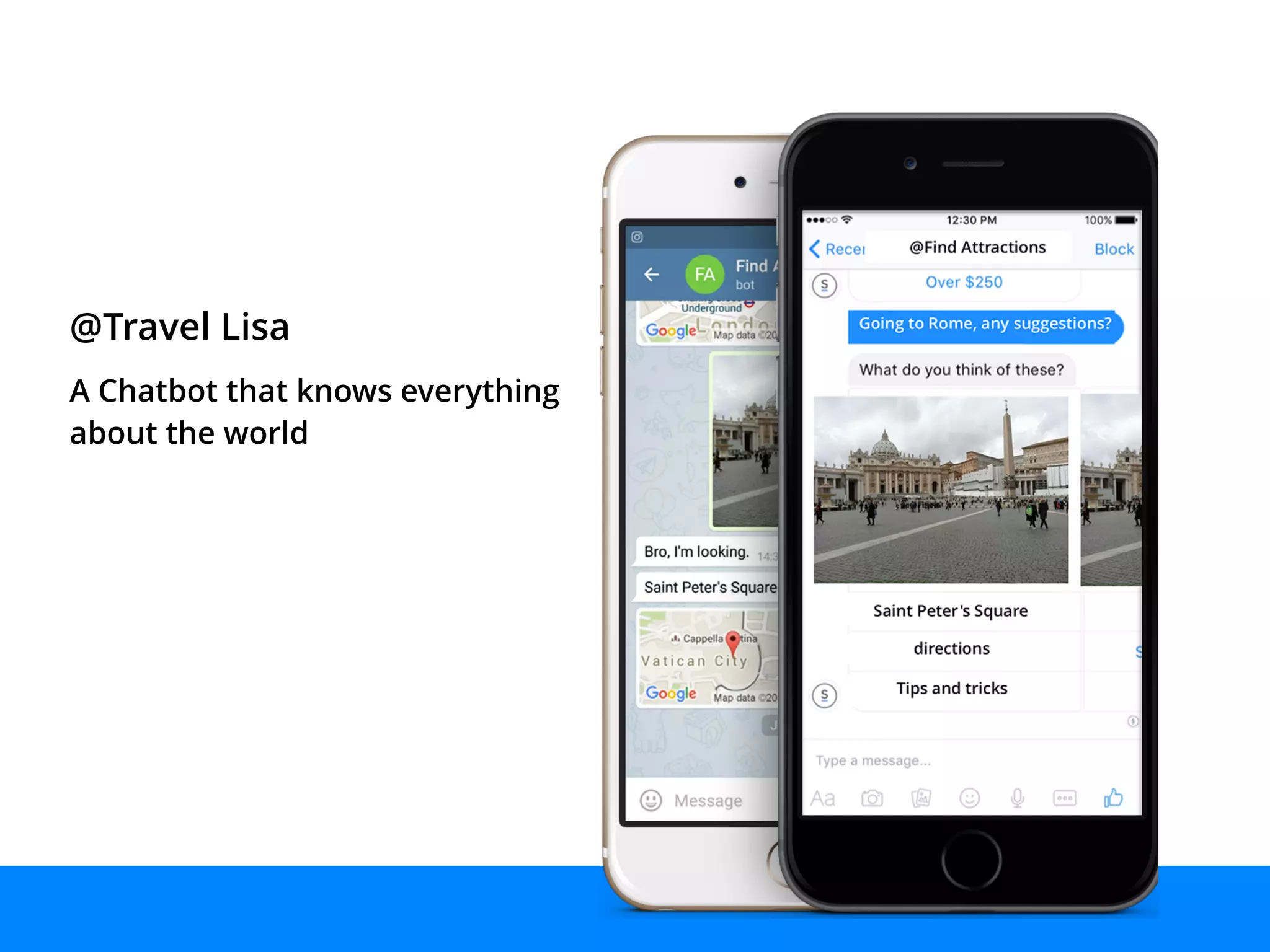
Travel Lisa is a specialized travel chatbot built for Facebook Messenger that uses proprietary image recognition to identify landmarks and provide travel recommendations. The deck is remarkably brief at only seven slides, omitting standard sections like a formal 'Ask,' competition analysis, or a detailed business model. However, it compensates with strong early traction metrics: the founders claim to have built an algorithm that outperforms Google Cloud Vision for landmark identification in just 1.5 months. More importantly, they report $10k in monthly revenue from API licensing with a low bu…
Key takeaways
- The company reports $10,000 in monthly revenue specifically from API licensing of their landmark recognition algorithm (Slide 4).
- The startup maintains a lean operation with a stated monthly burn rate of $4,000 (Slide 4).
- The product is positioned as a Facebook Messenger chatbot that recognizes photos of popular places and provides summaries (Slide 3).
- The founders claim their algorithm outperforms Google Cloud Vision APIs for real-footage landmark pictures (Slide 4).
- Traction includes a beta version with 200 users and a partnership with Travelask, a community of 500,000 subscribers (Slide 4).
- The team is composed of three technical members with backgrounds in Machine Learning (Yandex) and Quantitative Research (WorldQuant) (Slide 6).
- The deck completely omits a financial 'Ask' or a breakdown of how investment funds would be utilized.
- Market potential is illustrated using 2015 Statista data showing London as the top city for overnight visitors at 18.82 million (Slide 5).
Slide-by-Slide Teardown
Slide 1: Title Slide
The cover slide introduces the product as @Travel Lisa , described as "A Chatbot that knows everything about the world." The visual focus is on two smartphones displaying a chat interface. One screen shows a user asking for suggestions in Rome, and the bot responding with a photo of Saint Peter's Square along with buttons for "directions" and "Tips and tricks." The branding is minimal, using a blue and white color scheme.
Slide 2: The Problem
Slide 2 addresses the pain point of modern travel planning. The headline states: "Too much words and advertising when planning what to see in other country." The slide uses three screenshots of a mobile browser to illustrate the clutter of traditional search. The first shows a Google search for "places to visit," the second shows a mobile article dominated by a large "GUESS" advertisement, and the third shows a map interface crowded with pins for real estate and hostels rather than just landmarks. This slide effectively visualizes the "noise" the founders intend to filter out.
Slide 3: The Product
This slide defines the solution as a Facebook Messenger chatbot: @Travel Lisa . It lists four key features: photo recognition of popular places, providing summaries based on internet information, suggesting locations in unfamiliar cities, and a machine learning component where the bot "learns to give more personalized recommendations over time." The visuals show the bot in action, identifying the Sydney Opera House, St. Vitus Cathedral, and the Dancing House, providing "Get Direction" and "More Info" options for each.
Slide 4: Traction
Slide 4 is the most data-dense part of the deck. It lists several significant milestones:
Development of an algorithm in 1.5 months that claims to outperform google cloud vision apis for landmark pictures. · $10k monthly revenue from API licensing. · A $4k monthly burn rate . · A beta version with 200 people . · Speaking engagements at the Advanced Analytics conference in Moscow and the Deep Learning Summit Asia. · A partnership with Travelask (500k subscribers). · Winning Angelhack.com Moscow .
This slide attempts to prove technical superiority and financial viability simultaneously.
Slide 5: Potential Market
The market slide relies on 2015 Statista data. It features two bar charts. The left chart shows the "Number of international overnight visitors in the most popular city destinations worldwide in 2015," led by London (18.82 million) and Bangkok (18.24 million) . The right chart shows "Leading cities in international visitor spending," with London again at the top with $20.23 billion . While these figures show a large travel market, the slide fails to calculate a specific Total Addressable Market (TAM) for a chatbot or an API service.
Slide 6: Team
The team slide presents three members, all with strong technical or analytical backgrounds. Tom Semyanov (CEO) cites experience in big data and recruitment. Nikita Dmitriev (CTO) is highlighted as a Machine Learning expert from Yandex . Konstantin Semyanov (Data Scientist) comes from a quantitative research background at WorldQuant, LLC . The academic credentials listed include University College London and the London School of Economics. This is a "builder" team, though it lacks a member with specific travel industry or marketing leadership experience.
Slide 7: Conclusion
The final slide is a simple "Thanks!!" with the bot handle (@Travel Lisa) and a URL ( It features an isometric graphic of the bot interface on a tablet and two phones. Notably, there is no call to action or contact information for the founders beyond the website.
What Works
Efficiency of Capital: The most compelling part of this deck is the Traction slide. Reporting $10k in monthly revenue against a $4k burn is a rare feat for a pre-seed or seed-stage startup. It suggests a high level of capital efficiency and a product that has immediate B2B utility.
Technical Credibility: By calling out Google Cloud Vision and claiming superior performance, the founders are positioning themselves as a deep-tech play rather than just a wrapper for existing APIs. The team's background at Yandex and WorldQuant supports this claim.
Clear Problem/Solution Fit: The contrast between the cluttered mobile browser (Slide 2) and the clean, image-led chat interface (Slide 3) clearly communicates the value proposition: speed and simplicity.
What is Missing
The Ask: This is the most glaring omission. A pitch deck is a fundraising tool, yet this deck never mentions how much capital is being raised, the valuation, or what the milestones for the next round of funding would be.
Business Model Clarity: There is a disconnect between the consumer chatbot (the focus of Slides 1-3) and the API licensing revenue (Slide 4). The deck does not explain if the chatbot is intended to be a revenue generator or merely a showcase for the API.
Competition: The deck ignores other travel bots and platforms like TripAdvisor or Google Maps' own evolution. Claiming to beat Google's API is one thing; competing with their ecosystem is another, and the deck does not address this.
Roadmap: There is no indication of where the company is going. Investors need to see a 12-24 month plan, but this deck stops at the current beta and current revenue.
Founder Takeaways
Lead with Revenue: If you are making $10k a month with a $4k burn, that should be a central pillar of your pitch. Travel Lisa does this well on the traction slide, making the business seem "de-risked" from a survival standpoint.
Visual Problem Statements: Using actual screenshots of the "bad" user experience (Slide 2) is much more effective than bullet points. It allows the investor to feel the frustration of the current process.
Don't Forget the 'Why Now': The deck lacks a "Why Now" slide. In the chatbot space, timing is everything. Founders should explain why recent advances in ML or changes in user behavior (like the shift to messaging apps) make this the right moment for their specific solution.
Frequently asked questions
- What is the core technology behind Travel Lisa?
- Travel Lisa is built on a proprietary landmark recognition algorithm. According to Slide 4, the team developed this algorithm in 1.5 months and claims it outperforms Google Cloud Vision for real-world landmark photography. The technology is delivered via a Facebook Messenger chatbot that can identify locations from user-submitted photos and provide contextual information and travel stories.
- How does Travel Lisa generate revenue?
- While the product is a consumer chatbot, the primary revenue stream identified in the deck is B2B. Slide 4 states that the company earns $10,000 monthly through API licensing of their recognition algorithm. The deck does not detail any direct monetization from the 200 beta users of the chatbot itself, suggesting the bot may serve as a proof-of-concept for the underlying tech.
- What is the current scale of the user base?
- The consumer-facing side of the business is in its early stages. Slide 4 notes a beta version of the chatbot on Facebook Messenger with 200 people. To grow this, they have secured a cross-promotional partnership with Travelask, which reportedly has a 500,000-subscriber community across Facebook and Instagram.
- Who are the founders and what is their expertise?
- The team is highly technical and academic. CEO Tom Semyanov has a background in big data for real estate and was a calculus teacher for seven years. CTO Nikita Dmitriev is a former Machine Learning expert at Yandex. Data Scientist Konstantin Semyanov previously worked as a Quantitative Research Consultant at WorldQuant. Their education includes the London School of Economics and Moscow State University.
- What critical information is missing from this pitch deck?
- The deck is missing several standard components required for a professional fundraise. There is no 'Ask' slide (specifying how much money they want), no use of funds, no roadmap, and no competitor analysis. It also lacks a clear business model for the chatbot itself, focusing instead on the API revenue which seems disconnected from the 'Travel Lisa' consumer brand.