Travacco presents a vertical SaaS solution for travel agencies, a sector often overlooked by major ERP providers. The deck highlights a clear pain point: the inefficiency of using generic tools like Excel for complex travel bookings. With 87 paid subscribers and $18,500 in revenue generated between January and August 2025, the company demonstrates early product-market fit in regions like Azerbaijan and Uzbekistan. However, the deck lacks a formal team slide and a specific investment 'ask,' which are critical for a fundraising document. The financial projections are aggressive, aiming for a ju…
Key takeaways
- Travacco reports $18,500 in total revenue from January 2025 to August 2025 (Slide 5).
- The platform has secured 87 paid subscribers, including 11 on yearly plans, since its October 2024 test launch (Slide 5).
- The company targets a Serviceable Obtainable Market (SOM) of 5,000 agencies within 4 years, aiming for $3.3M+ ARR (Slide 4).
- Pricing is structured into three tiers: Basic ($18/mo), Admin ($39/mo), and Team ($69/mo) (Slide 7).
- The deck identifies a global market of 400,000+ travel agencies spending $3B+ annually on software (Slide 4).
- Competitive positioning focuses on being 'Travel-Specific' and 'Global' compared to CIS-only or Russia-only competitors like U-on.travel and Moidokumenti.ru (Slide 6).
- Expense allocation is planned with 40% dedicated to Development & R&D and 30% to Sales & Marketing (Slide 7).
- The deck omits a dedicated team slide, leaving the founders' backgrounds and technical expertise unknown to the reader.
Slide 1: Title and Product Overview
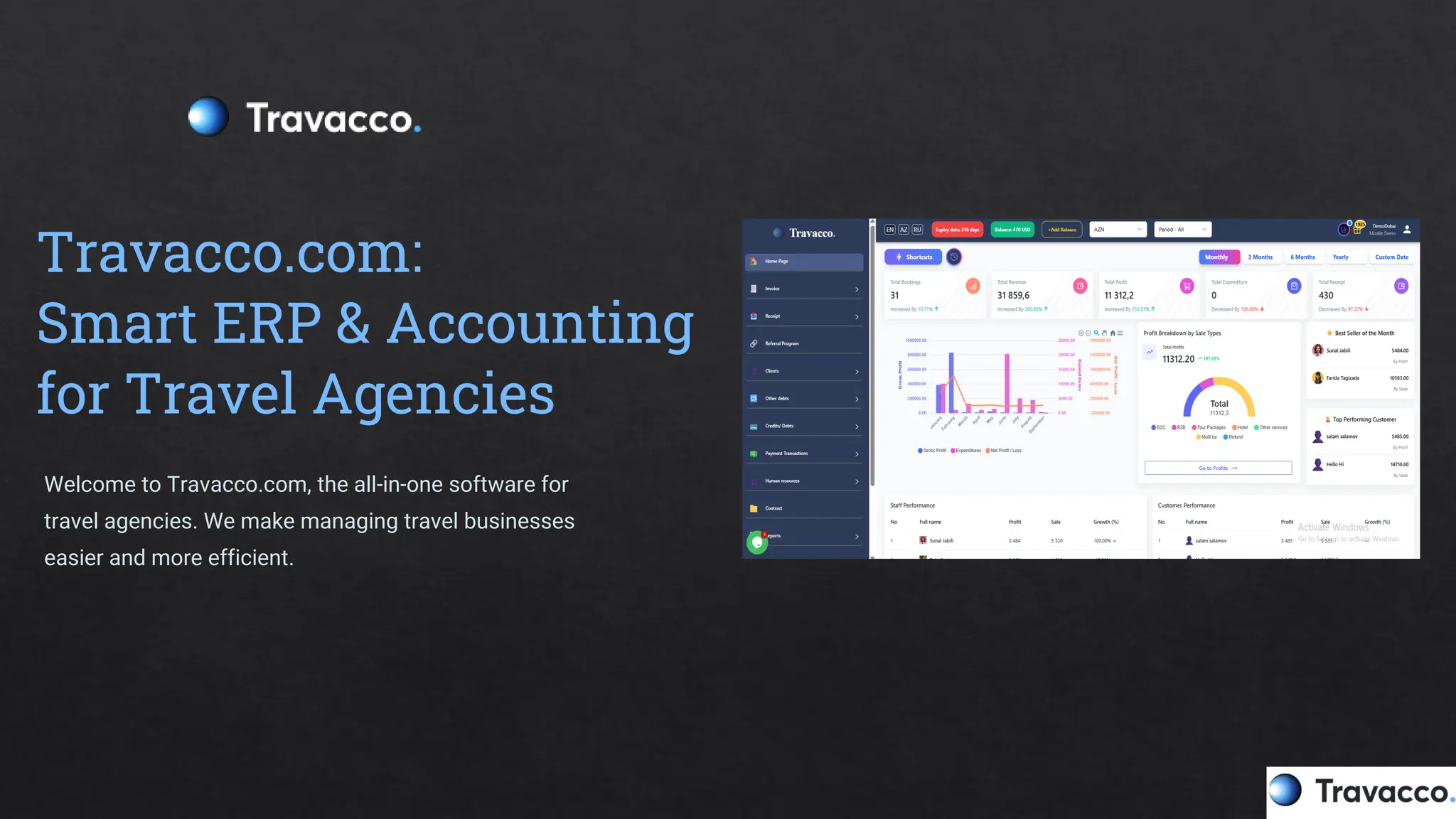
The opening slide introduces Travacco as a 'Smart ERP & Accounting for Travel Agencies.' It features a high-resolution screenshot of the software dashboard, which displays metrics like 'Total Bookings,' 'Total Revenue,' and 'Total Profit.' The visual evidence of a functional UI immediately establishes that this is a product-ready company rather than a conceptual one. The tagline 'all-in-one software for travel agencies' sets a broad but clear scope for the business utility.
Slide 2: The Problem - Impact of Inefficient Operations
Slide 2, titled 'The Impact: Lost Growth & Revenue,' breaks down the pain points of the target audience into six categories: Time Drain, Unmotivated Teams, Lost Clients, Missed Upsells, Low Satisfaction, and Growth Blocked. The slide argues that manual back-office operations 'drain time' and 'frustrate customers.' By framing the problem as a direct limitation on 'sales, retention, and growth,' Travacco positions its software as a revenue-generating investment rather than just a cost-saving tool.
Slide 3: The Solution - Features and Functionality
This slide details how Travacco addresses the previously mentioned problems. It highlights four key pillars: Automated Client Communication (reminders and campaigns), Reports via Email & Telegram (daily/weekly updates), Comprehensive Analytics (tracking profits and staff performance), and Audit & Logging (tracking internal operations). The inclusion of Telegram for reporting is a specific nod to the communication preferences in their target emerging markets, showing a localized product strategy.
Slide 4: Market Opportunity (TAM/SAM/SOM)
Travacco provides a structured market analysis on Slide 4. They estimate the Total Addressable Market (TAM) at 400,000+ agencies worldwide with a $3B+ annual software spend. The Serviceable Available Market (SAM) is narrowed down to small-to-mid agencies (50-500 bookings/month) in Africa, the Middle East, Eastern Europe, and Asia, valued at $500M. Their Serviceable Obtainable Market (SOM) target is 500 agencies in Year 1, scaling to 5,000+ in Year 4. They project $330K ARR in Year 1 based on a $55/month average price point.
Slide 5: Early Traction Metrics
Slide 5 presents the company's progress since its October 2024 test launch. Key figures include 87 Paid Subscribers (11 on yearly plans) and $18,500 in Total Revenue from January to August 2025. The slide also mentions 29 Active Monthly Users and a 7-Day Demo Trial period. The 'Global Reach' section lists specific countries where they have acquired customers, including Azerbaijan, Albania, Morocco, South Africa, Uzbekistan, and Tajikistan, proving the platform's cross-border viability.
Slide 6: Competitive Landscape
The competitive matrix on Slide 6 compares Travacco against Excel, QuickBooks, 1C Accounting, U-on.travel, and Moidokumenti.ru. The primary differentiators claimed are 'Travel-Specific' features and 'Global Scalability.' While regional competitors like U-on.travel are noted as travel-specific, they are marked as 'CIS-only,' whereas Travacco claims a 'Global' reach. The slide positions Travacco as the only affordable, all-in-one, global solution in the niche.
Slide 7: Financials and Pricing Model
This slide outlines the revenue growth projections and the business model. The revenue chart shows a steep climb from $30K in 2025 to $330K in 2026 and $820K in 2027 . The pricing is transparently listed: Basic Plan ($18/mo) , Admin Plan ($39/mo) , and Team Plan ($69/mo) . The slide also includes an 'Expenses Allocation' donut chart, showing that 40% of funds go to R&D and 30% to Sales & Marketing. A 70% retention rate is also cited as a key metric.
Slide 8: Future Vision and Contact
The final slide looks toward an 'Integrated Travel Ecosystem.' The roadmap includes Full CRM & AI Expansion , Global GDS Connectivity (Galileo, Sabre), Social Media Commerce APIs , and Mobile App Development . The slide concludes with contact information for Elmir Miriyev, including a phone number and links to the website and YouTube channel. Notably, the mission statement is 'Bringing efficiency, automation, and growth to every travel agency worldwide.'
What Travacco Does Well
The deck excels at identifying a highly specific niche. By focusing on travel agencies in emerging markets, Travacco avoids direct competition with massive horizontal ERPs that often ignore these regions or lack the specific integrations (like GDS or Telegram) required. The traction slide is particularly strong; showing revenue and paid users within the first year of a test launch provides tangible proof of concept. The pricing transparency is also a plus, as it allows investors to quickly model the unit economics of the SOM target.
What is Missing from the Deck
The most glaring omission is the Team Slide . In early-stage startup investing, the 'who' is often as important as the 'what.' Without knowing the backgrounds of the founders or the technical team, it is difficult to assess the execution risk. Additionally, there is no Investment Ask . The deck explains how they will spend money (Slide 7), but it never says how much they are raising or what milestones that capital will unlock. Finally, while the deck mentions 'Global GDS Connectivity' as a future vision, the current lack of these integrations might be a significant hurdle for larger agencies, which is not fully addressed in the risk or competition sections.
Founder Takeaways: What to Copy
Founders should look at Slide 4 (Market Opportunity) as a model for how to segment a market. Instead of just claiming a multi-billion dollar TAM, Travacco breaks it down into a realistic SOM with a specific agency count and price point. This makes the $3.3M ARR goal feel calculated rather than plucked from thin air. Furthermore, the use of a competitive matrix (Slide 6) that includes regional players rather than just global giants shows a deep understanding of the actual local competition. Finally, including a 'Global Reach' list of countries (Slide 5) is an excellent way to prove that a product has been localized effectively for different regulatory and linguistic environments.
Frequently asked questions
- What is Travacco's primary value proposition?
- Travacco provides an all-in-one ERP and accounting software specifically designed for travel agencies. According to Slide 3, it automates client communication (birthdays, reminders), provides daily reports via Telegram and Email, and offers comprehensive analytics to track receivables, payables, and staff performance. It aims to replace manual spreadsheets and generic accounting software that lack travel-specific features like flight and hotel check-in tracking.
- How does Travacco plan to spend its capital?
- Slide 7 outlines a clear expense allocation strategy. The largest portion, 40%, is earmarked for Development & R&D, followed by 30% for Sales & Marketing. Operations & Support accounts for 20%, while Miscellaneous expenses take up the final 10%. This suggests a heavy focus on product refinement and aggressive customer acquisition to meet their goal of 5,000 agencies in four years.
- What is the current traction of the company?
- As of Slide 5, Travacco has 87 paid subscribers and 29 active monthly users. They generated $18,500 in revenue between January and August 2025. The company also notes a global reach with customers already active in Azerbaijan, Albania, Morocco, South Africa, Uzbekistan, and Tajikistan, indicating successful initial penetration into emerging markets.
- Who are Travacco's main competitors?
- Slide 6 categorizes competitors into three groups: generic tools (Excel, QuickBooks), regional travel ERPs (U-on.travel, Moidokumenti.ru), and 1C Accounting. Travacco claims to differentiate itself by being the only 'Travel-Specific' and 'All-in-one' platform that offers 'Global Scalability' and 'Affordable Pricing,' whereas competitors are either not travel-focused or limited to the CIS/Russia regions.
- What is missing from this pitch deck?
- The most significant omissions are a Team slide and a Funding Ask. There is no information regarding the founders' experience or the size of the engineering team. Furthermore, while the deck shows financial projections and expense allocations, it never explicitly states how much money they are looking to raise or the valuation they are seeking. These are essential components for any serious investor presentation.