The 2010 Canlan Ice Sports investor presentation serves as a report on a mature, revenue-generating entity rather than a speculative startup. Represented by CEO Joey St-Aubin and CFO Mike Gellard, the company emphasizes its shift toward a multi-revenue model, moving beyond basic ice rentals to include proprietary leagues like the Adult Safe Hockey League (ASHL) and the Skating Academy. Financially, the deck shows a company with $67.2 million in 2009 revenue and a steady, albeit slightly fluctuating, EBITA of $10.9 million. The presentation focuses on stability, geographic expansion into the U…
Key takeaways
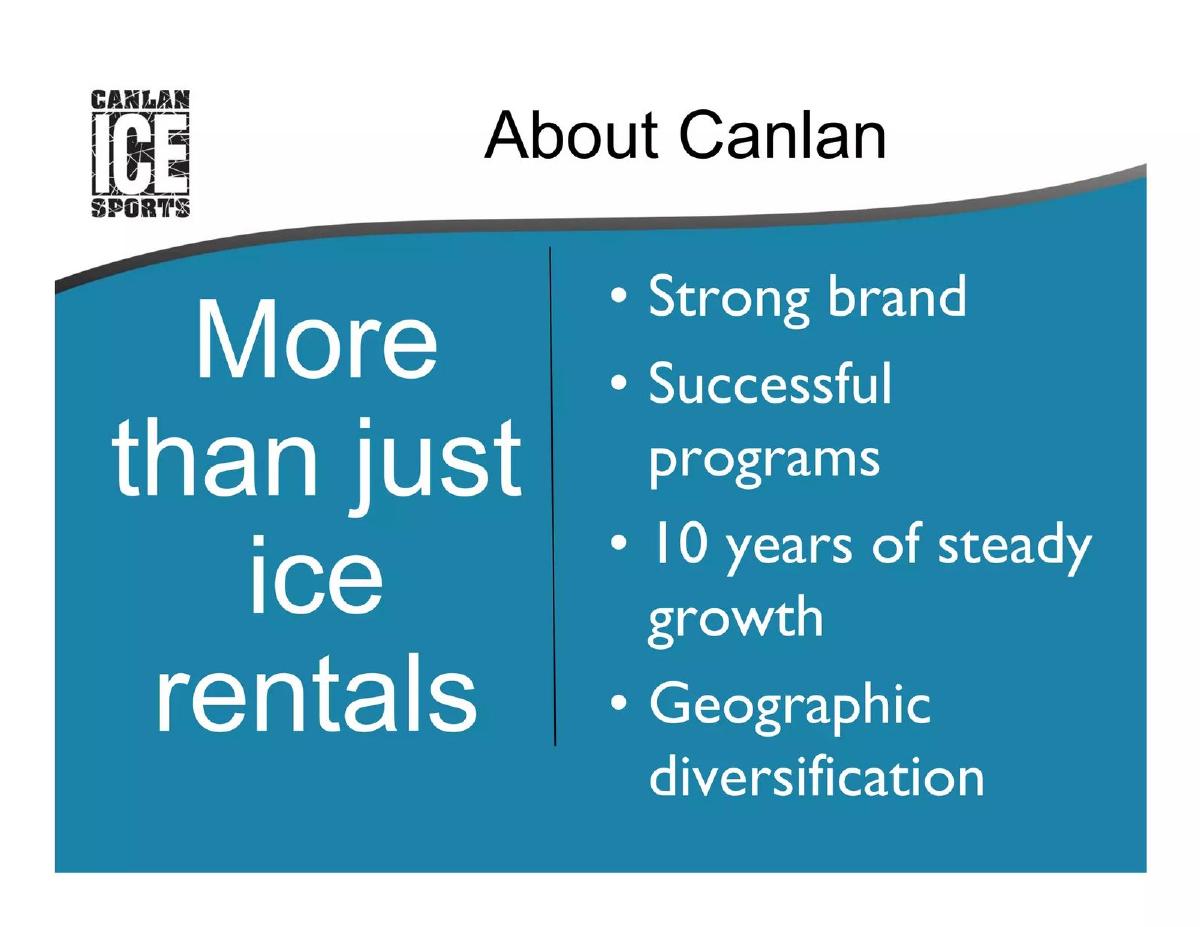
- The company positions itself as 'More than just ice rentals,' emphasizing diversified programming on Slide 2.
- Revenue grew from $62.5 million in 2007 to $67.2 million in 2009, as shown on Slide 4.
- The Adult Safe Hockey League (ASHL) is a major driver, generating $22.8 million in 2009, a 6% increase over the previous year (Slide 3).
- EBITA remained relatively flat over three years, moving from $10.2 million in 2007 to $10.9 million in 2009 (Slide 4).
- Digital engagement is cited as a metric of reach, with 17.4 million page views reported for the ASHN platform on Slide 3.
- Geographic expansion is a core strategy, with recent developments including new sites in Vineland, New Jersey, and Fort Wayne, Indiana (Slide 6).
- Strategic partnerships are highlighted through a marketing agreement with Molson Coors Canada on Slide 6.
- Q1 2010 results showed a slight dip in earnings before taxes to $2.8 million compared to $3.0 million in Q1 2009 (Slide 5).
Executive Summary: The Transition to a Sports Ecosystem
The Canlan Ice Sports investor presentation from May 2010 is a classic example of a 'steady state' corporate deck. Unlike early-stage venture decks that sell a vision of the future, Canlan sells a history of performance. The core narrative, established on Slide 2, is the evolution from a facility provider to a program-driven sports brand. By 2010, the company was managing significant revenue and a massive participant base, positioning itself as a leader in the niche market of recreational ice sports management.
Slide 1: Title and Leadership
The cover slide identifies the company as Canlan Ice Sports and introduces the key presenters: Joey St-Aubin (President & CEO) and Mike Gellard (CFO). The date, May 2010, places this presentation in the post-2008 recovery period, where investors were particularly focused on balance sheet strength and proven revenue models.
Slide 2: The Value Proposition
Slide 2, titled 'About Canlan,' sets the strategic tone. The left side of the slide features the bold claim: 'More than just ice rentals.' This is the most important psychological hook in the deck. It tells investors that the company is not just a real estate play subject to utility costs and maintenance, but a branded service business. The bullet points highlight a 'Strong brand,' 'Successful programs,' '10 years of steady growth,' and 'Geographic diversification.' This slide attempts to de-risk the investment by emphasizing longevity and brand equity.
Slide 3: 2009 Operational Metrics
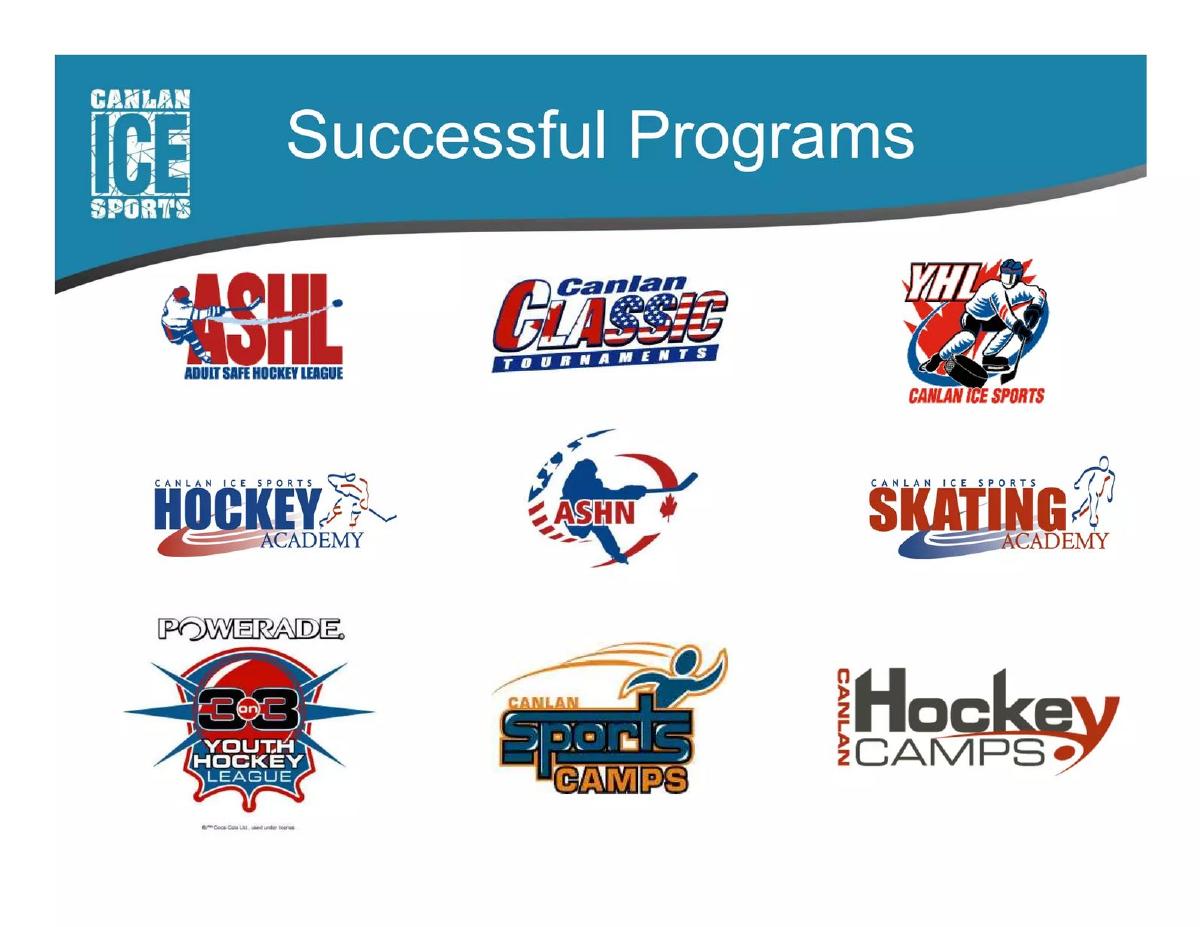
Slide 3 provides the evidence for the 'more than just rentals' claim. It breaks down the business into four sub-brands: ASHL (Adult Safe Hockey League), Canlan Ice Sports Skating Academy, Canlan Classic Tournaments, and ASHN (Adult Safe Hockey Network). The metrics are impressive for the sector:
ASHL: Generated $22.8 million, representing a 6% increase over 2008. · Participation: More than 18,200 participants. · Events: 47 events hosted with 1,638 teams. · Digital: 17.4 million page views.
The inclusion of page views is a notable attempt to modernize the business model in the eyes of 2010 investors, suggesting a digital community that could be monetized through sponsorships.
Slide 4: Historical Financial Performance
Slide 4, titled 'Steady Performance,' uses bar charts to show Revenue and EBITA from 2007 to 2009. Revenue shows a clear upward trend: $62.5 million in 2007, $64.7 million in 2008, and $67.2 million in 2009. However, the EBITA (Earnings Before Interest, Taxes, and Amortization) chart shows more volatility, peaking at $11.2 million in 2008 before settling at $10.9 million in 2009. This suggests that while the company was successful at growing the top line, operational costs or expansion expenses were keeping pace, preventing significant margin expansion.
Slide 5: Quarterly Results
Slide 5 focuses on 'Q1 Results,' comparing the first quarter of 2009 to 2010. Earnings before taxes dropped slightly from $3.0 million to $2.8 million, while Net Earnings remained flat at $2.0 million. For a seasonal business like ice sports, Q1 is typically a strong period, so the flat net earnings would have been a point of discussion for investors regarding cost management and the impact of the new expansions mentioned later in the deck.
Slide 6: Recent Developments and Growth Strategy
This slide outlines the company's forward-looking activities. It lists two major U.S. expansions in Vineland, New Jersey, and Fort Wayne, Indiana. It also mentions a 'Strengthened balance sheet,' which is a common phrase used to signal debt reduction or improved liquidity. Two strategic wins are highlighted: a marketing agreement with Molson Coors Canada (a major sponsor in the hockey world) and the Richmond Olympic Oval Satellite League, which shows the company's ability to win management contracts for high-profile facilities.
Slide 7: Closing and Contact
The final slide is a standard 'Questions' slide, providing the direct contact information for CFO Michael Gellard. In a public company or institutional context, the CFO is often the primary point of contact for the investment community, and the inclusion of a direct phone number and email address signals transparency.
What Works in This Deck
The deck is highly effective at proving the existence of a 'moat.' By showing that they own the leagues (ASHL) that play in their rinks, Canlan demonstrates that they control their own demand. This is a much stronger position than a rink owner who relies on external local hockey associations to rent ice time. The use of sub-branding for tournaments and academies also shows a sophisticated approach to market segmentation.
The financial transparency is also a strength. By showing three years of data, the founders avoid the 'hockey stick' projection trap that many startups fall into. They are presenting a real, albeit slower-growing, business that generates millions in net earnings.
What Is Missing
The 'Ask': There is no slide explaining why they are presenting to investors at this specific moment. Are they looking to raise capital for more U.S. acquisitions? Are they looking for a buyout? Without a clear 'Ask,' the deck feels more like an annual general meeting (AGM) update than a fundraising pitch.
Unit Economics: While we see total revenue, we don't see the profitability of a single facility. Investors would want to know the 'payback period' for building or acquiring a new rink in a market like New Jersey versus the existing Canadian portfolio.
Competitive Analysis: The deck operates as if Canlan has no competitors. In the recreational space, they compete not only with other rinks but with other forms of leisure spend. A slide addressing their market share or competitive advantages over municipal rinks would have been valuable.
Lessons for Founders
Founders in traditional industries should take note of how Canlan 'tech-ifies' a physical business. By highlighting their digital page views and branded programs, they move the conversation away from 'real estate' and toward 'platform.' If you are building a brick-and-mortar business, you must show investors how you are capturing the community and the data, not just the foot traffic.
Additionally, the 'Steady Performance' slide is a masterclass in managing expectations. By showing that EBITA stayed relatively flat despite revenue growth, they are being honest about the costs of expansion. This builds trust with sophisticated investors who know that growth is rarely free.
Frequently asked questions
- What is Canlan's primary value proposition according to the deck?
- Canlan moves beyond the commodity business of ice rink rentals by creating a vertically integrated sports ecosystem. By owning the leagues (ASHL), the training programs (Skating Academy), and the tournaments, they capture a higher percentage of participant spend and build brand loyalty that simple facility providers lack.
- How does the company demonstrate its growth potential?
- Growth is demonstrated through two primary channels: geographic expansion and program scaling. Slide 6 explicitly lists new expansions in the United States (New Jersey and Indiana) and a satellite league at the Richmond Olympic Oval, suggesting a model that can be exported to new territories.
- What do the financial metrics reveal about the company's health in 2010?
- The financials on Slide 4 and 5 suggest a stable, mature company. While revenue increased by nearly $5 million between 2007 and 2009, EBITA and Net Earnings remained largely flat. This indicates a business with high fixed costs or significant reinvestment into expansion that hasn't yet yielded higher margins.
- Why does the deck include page views as a metric for a physical facility business?
- Slide 3 lists 17.4 million page views for the ASHN. This is likely included to demonstrate the 'stickiness' of their community and the potential for digital sponsorship or advertising revenue, further supporting their claim of being more than just a physical rental business.
- What is missing from this presentation that a modern investor would expect?
- The deck lacks a detailed breakdown of unit economics (revenue per rink), a clear 'Ask' regarding how much capital they are seeking, and a competitive landscape analysis. It also omits a detailed team slide beyond the names of the CEO and CFO on the title page.