Cannassure Therapeutics Ltd's February 2019 investor deck outlines a strategy to dominate the medical cannabis sector through total vertical integration. Positioned as a publicly traded entity on the Tel Aviv Stock Exchange (TASE: CSURE), the company leverages a highly pedigreed leadership team, including a former Israel Air Force commander, to build credibility in a nascent industry. The deck highlights a 4,000 sqm indoor growing facility and a distribution agreement with Hadassah Medical. While it successfully communicates regulatory progress and infrastructure milestones, it lacks specific…
Key takeaways
- The company is publicly traded on the Tel Aviv Stock Exchange under the ticker CSURE (Slide 1).
- Cannassure aims for a holistic integrated production system including breeding, cultivation, extraction, and R&D (Slide 3).
- The management team features high-level military and pharmaceutical experience, including a former commander of the Israel Air Force (Slide 7).
- The deck cites a MarketWatch forecast of a $28B global cannabis market by 2024 (Slide 9).
- Infrastructure includes a 4,000 sqm indoor growing facility built to IMC-GAP standards (Slide 11).
- A strategic distribution agreement is in place with Hadassah Medical for pharmacy and licensed customer reach (Slide 11).
- The company received financial support and innovation recognition from the Israel Innovation Authority (Slide 13).
- A proprietary patent application was filed by an expert formerly with Teva Pharmaceuticals (Slide 15).
Executive Summary and Vision
Slide 1: Title Slide
The deck opens with a clean, professional aesthetic using a purple color palette. It clearly identifies the company as Cannassure Therapeutics Ltd and highlights its public status on the Tel Aviv Stock Exchange with the ticker TASE: CSURE . The date is noted as February 2019. The background imagery of test tubes and lab equipment immediately signals a focus on science and medical standards rather than recreational lifestyle branding.
Slide 3: Our Vision and Mission
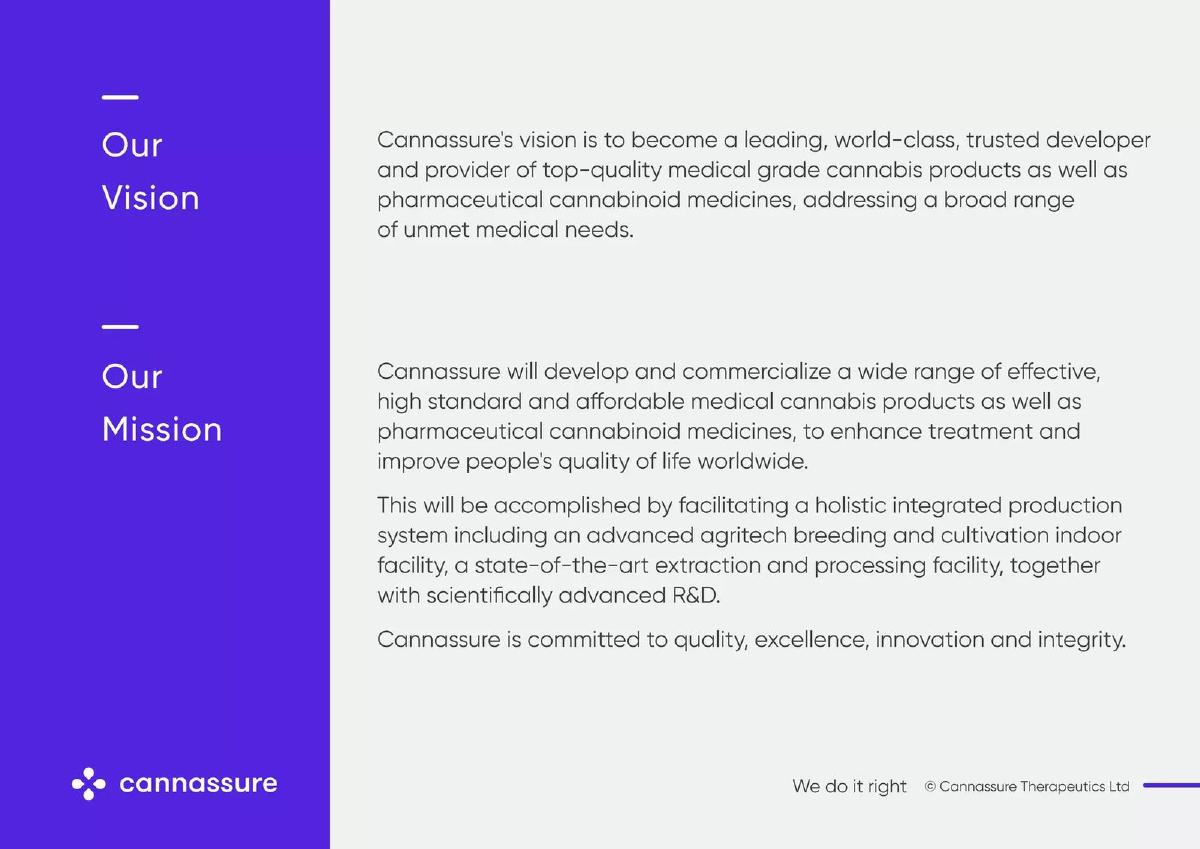
This slide establishes the company's high-level goals. The vision is to be a "world-class, trusted developer and provider of top-quality medical grade cannabis products." The mission statement emphasizes a "holistic integrated production system," which is a key theme throughout the deck. It mentions specific infrastructure components: an advanced agritech breeding and cultivation facility, a state-of-the-art extraction facility, and scientifically advanced R&D. The focus is squarely on addressing "unmet medical needs."
Traction and Leadership
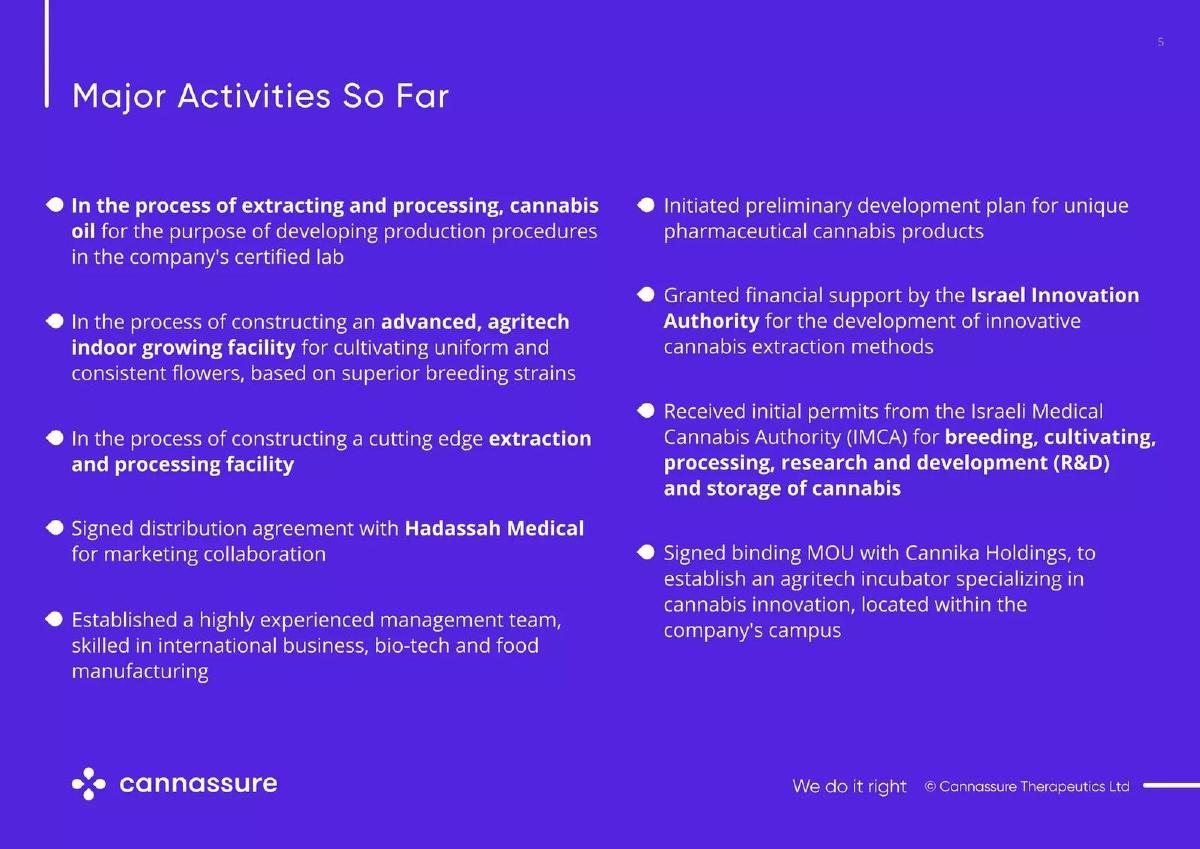
Slide 5: Major Activities So Far
This is a high-density traction slide. Key achievements listed include:
In the process of constructing an advanced agritech indoor growing facility and a cutting-edge extraction facility. · Signed distribution agreement with Hadassah Medical . · Granted financial support by the Israel Innovation Authority for innovative extraction methods. · Received initial permits from the Israeli Medical Cannabis Authority (IMCA) for the full lifecycle of cannabis production. · Signed a binding MOU with Cannika Holdings to establish an agritech incubator on the company's campus.
This slide serves to de-risk the investment by showing that the company has already secured the necessary regulatory permissions and strategic partnerships to operate.
Slide 7: Executive Team
Cannassure presents a heavy-hitting leadership team, which is common for Israeli startups looking to project stability and institutional quality. Major General Ido Nehushtan , Chairman of the Board, is a former commander of the Israel Air Force, bringing significant operational and strategic weight. Ran Amir (CEO) brings 15 years of international experience, including a stint as CEO of Solbar. Nir Peles (Founder/VP Biz Dev) has experience with NASDAQ-listed companies like Bluephoenix Solutions and Alcobra Pharma. Dr. Hadile Ounallah-Saad (VP R&D) holds a Ph.D. in Medical Science and has a background in neurodegenerative disorders. The team composition suggests a blend of military-grade operations, public market experience, and deep medical research.
Market Opportunity and Value Chain
Slide 9: Medical Cannabis Opportunity and Global Market Trends
The deck uses a macro-market approach to justify the opportunity. It cites a MarketWatch forecast from September 2018, projecting a $28B global cannabis market by 2024 . The right side of the slide lists trends: increased demand for medical treatments, rising R&D investment, and regulatory reforms. Crucially, it notes that "price reductions of raw cannabis yields" highlight the opportunity for "top-quality extraction," signaling that Cannassure intends to move up the value chain into high-margin processed products rather than just selling raw flower.
Slide 11: Comprehensive Value Chain
This slide illustrates the company's vertical integration strategy across five pillars:
Breeding: Developing unique strains using advanced technology. · Cultivation: A 4,000 sqm facility built to IMC-GAP standards for consistent yields. · Processing: Large-scale production of oils and APIs, aiming for EU-GMP accreditation . · Distribution: Leveraging the Hadassah Medical agreement to reach pharmacies and licensed customers. · R&D: Developing patent-protected, molecular-based products and hosting a technological incubator with Cannika Holdings.
The emphasis here is on control and quality assurance at every stage, which is a significant competitive moat in a regulated medical market.
Technical Capabilities and R&D
Slide 13: Medical Cannabis Extraction and Processing
This slide dives deeper into the technical side of the business. It reiterates the construction of an IMC-GMP approved facility and mentions the "accumulated expertise, know-how and experience of Solbar Group ." The right side of the slide lists lab activities: stability testing, identification of single APIs, and product development led by a scientific team and regulatory advisors. The presence of the Israel Innovation Authority logo reinforces the government-backed nature of their innovation.
Slide 15: Innovative Medical Cannabis Products Development
Cannassure outlines its future product pipeline here. They intend to develop pharma-grade products for oncological gynecology using active plant-sourced cannabinoids. A key piece of intellectual property is mentioned: a proprietary patent application filed by an expert who previously served as the Intellectual Property Team Manager at Teva Pharmaceuticals . This connection to Teva—a global pharmaceutical giant—is a subtle but powerful credibility marker.
Roadmap and Conclusion
Slide 17: Next Steps, Key Milestones 2019
8.2018 and onwards: Extracting cannabis in the analytical lab. · 6.2019: Completion of the extraction and processing facility (IMC-GMP). · 7.2019: Completion of the indoor grow facility (IMC-GAP). · H2/2019: Ready for production and sale of approved medical cannabis oil and APIs.
This timeline gives investors a clear window for when the company expects to transition from a pre-revenue infrastructure project to a commercial entity.
Slide 19: Thank You
The final slide provides contact information for CEO Ran Amir and lists the logos of key partners and stakeholders: Solbar, Israel Innovation Authority, Hadassah Medical, and the Tel Aviv Stock Exchange. It maintains the professional, corporate tone established at the beginning.
What Works in This Deck
The deck is exceptionally strong at projecting institutional credibility . In a sector often plagued by 'green rush' hype, Cannassure uses its public listing status, high-ranking military leadership, and pharmaceutical pedigree to stand out. The focus on vertical integration is a sound strategy for the 2019 era, as it addresses the supply chain volatility and quality control issues that were prevalent in the medical cannabis market at the time. The specific mention of a 4,000 sqm facility and the Hadassah Medical partnership provides tangible evidence of scale and market access.
What Is Missing from This Deck
The most glaring omission is financial data . While the company is public, an investor deck should still provide a snapshot of the current balance sheet, projected revenue for the H2/2019 launch, and the cost structure of their production. There is no mention of the cost per gram of cultivation, which is a standard metric for cannabis companies. Additionally, the competitive landscape is ignored. In 2019, Israel had several major players (like Tikun Olam) and international competitors were eyeing the market. Failing to address how Cannassure wins against these incumbents is a missed opportunity. Finally, there is no specific "Ask" slide in this version of the deck, likely because the company was already public and might have been using this for general investor relations rather than a specific private placement round.
What a Founder Should Copy
Founders in highly regulated industries should emulate Cannassure's regulatory and partnership focus . By highlighting permits from the IMCA and support from the Israel Innovation Authority, they prove they can navigate the bureaucracy that kills many startups. The team slide is also a masterclass in building authority; even if you don't have a Major General, highlighting specific, relevant corporate experience (like the Teva and Solbar connections) is vital. Lastly, the roadmap (Slide 17) is excellent because it ties specific facility completions to regulatory standards (GMP/GAP), showing that the founders understand the technical requirements of their industry.
Frequently asked questions
- What is Cannassure's primary business model?
- Cannassure operates as a vertically integrated medical cannabis company. According to slide 11, they control the entire value chain: breeding unique strains, indoor cultivation in a 4,000 sqm facility, extraction and processing of oils/APIs, distribution through partners like Hadassah Medical, and ongoing R&D for molecular-based medical products.
- How does Cannassure differentiate itself from other cannabis startups?
- The company differentiates through its 'pharma-grade' approach and high-level leadership. Slide 7 shows a board led by a Major General and an R&D head with neurobiology expertise from Hadassah Medical School. Slide 13 emphasizes their adherence to strict IMC-GMP and EU-GMP standards, positioning them as a pharmaceutical company rather than a simple agricultural producer.
- What major milestones had the company achieved by early 2019?
- As of slide 5, Cannassure had secured permits from the Israeli Medical Cannabis Authority (IMCA) for breeding and cultivation, signed a distribution agreement with Hadassah Medical, and received financial support from the Israel Innovation Authority. They were also in the process of constructing their advanced indoor growing and extraction facilities.
- What is the company's geographic focus and market outlook?
- While based in Israel and listed on the TASE, Cannassure has global ambitions. Slide 9 highlights a $28B global market opportunity by 2024. Slide 11 mentions exploring international affiliations and preparing for EU-GMP accreditation, which is essential for exporting medical cannabis products to European markets.
- What information is missing from this investor deck?
- The deck lacks detailed financial data, such as revenue targets, burn rate, or specific funding requirements. It also omits a competitive landscape slide, failing to show how Cannassure compares to other Israeli or international cannabis giants. There is no mention of unit economics (cost per gram) or specific patient acquisition strategies.