The Cannabis Energy Oil pitch deck is a brief, high-level presentation focusing on the intersection of alternative energy and non-food feedstock extraction. Spanning only six slides, the deck identifies a $270 billion market opportunity in alternative energy, projected to reach $1 trillion by 2030. The core value proposition is a 'high efficiency extraction process' designed to compete with petroleum, which the founder claims is becoming less accessible. Led by Jason Baudendistel, a self-described self-taught scientist, the company seeks $1,000,000 in seed capital in exchange for 20% equity.…
Key takeaways
- The deck identifies the alternative energy market as a $270 billion opportunity, growing to $1 trillion by 2030 (Slide 2).
- The stated problem is that current alternative energy solutions are inefficient and non-competitive with petroleum (Slide 3).
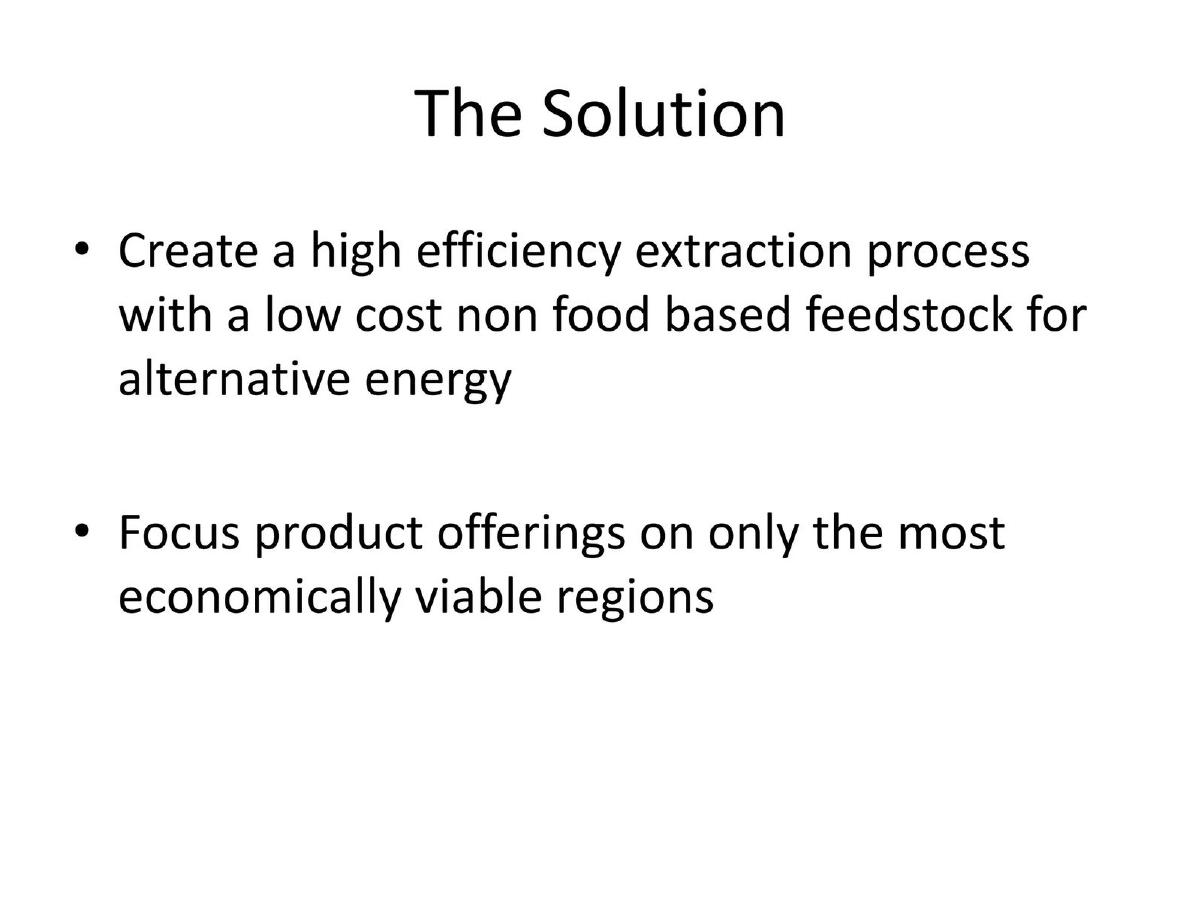
- The proposed solution involves a high-efficiency extraction process using low-cost, non-food based feedstock (Slide 4).
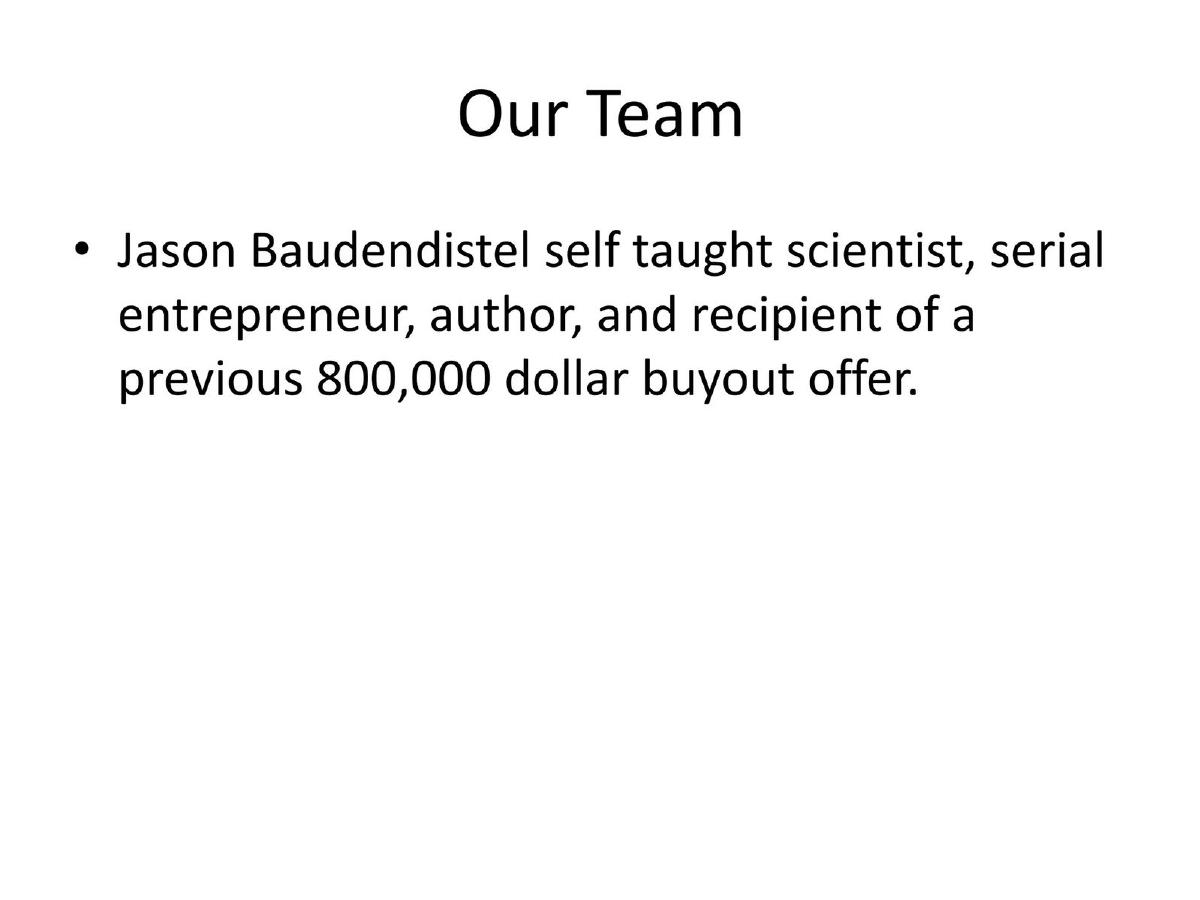
- The team consists of a single individual, Jason Baudendistel, described as a self-taught scientist and serial entrepreneur (Slide 5).
- The founder claims to have previously received an $800,000 buyout offer, though the company or context is not specified (Slide 5).
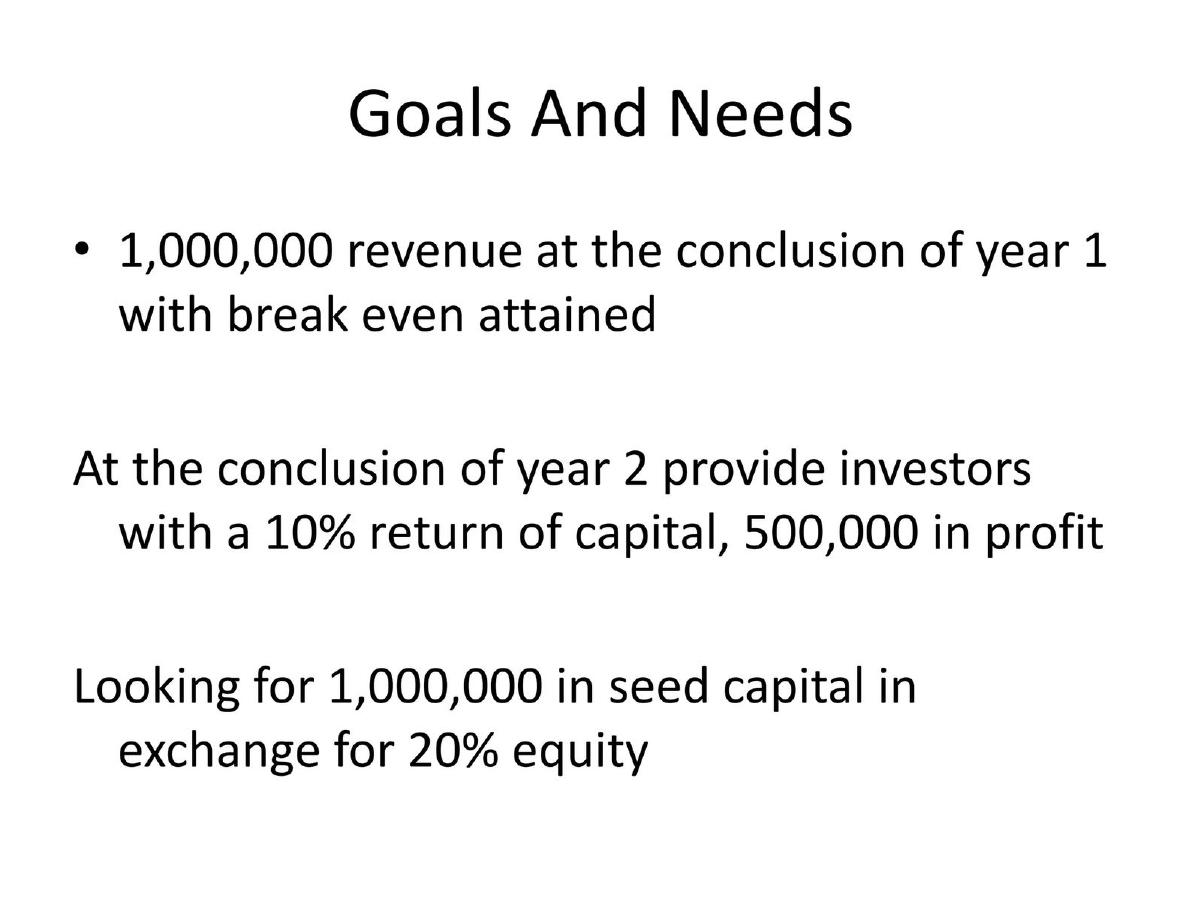
- Financial goals include reaching $1,000,000 in revenue and breaking even by the end of Year 1 (Slide 6).
- The company projects $500,000 in profit by the end of Year 2 (Slide 6).
- The funding ask is $1,000,000 in seed capital for a 20% equity stake, implying a $5 million post-money valuation (Slide 6).
Executive Summary: A Sparse Vision for Biofuel
The Cannabis Energy Oil pitch deck is a six-slide presentation that attempts to bridge the gap between the cannabis industry and the alternative energy sector. The deck is characterized by its extreme brevity and lack of visual or technical detail. It frames the opportunity as a response to the inefficiency of current alternative energy and the declining accessibility of petroleum. However, the presentation functions more as a statement of intent than a comprehensive business plan, omitting standard components such as a competitive landscape, product diagrams, or a marketing strategy.
Slide 1: Title and Contact
The cover slide is minimalist, featuring the title "Cannabis Energy Oil" and the tagline "Puff On The Future Of Energy." It lists Jason Baudendistel as the point of contact, providing a phone number and an email address associated with "wibbets.com." The inclusion of the word "ICO" next to the founder's name is notable, though the deck later asks for traditional equity investment rather than a token sale. The slide establishes the core theme but provides no branding or visual identity for the company.
Slide 2: The Current Market Opportunity
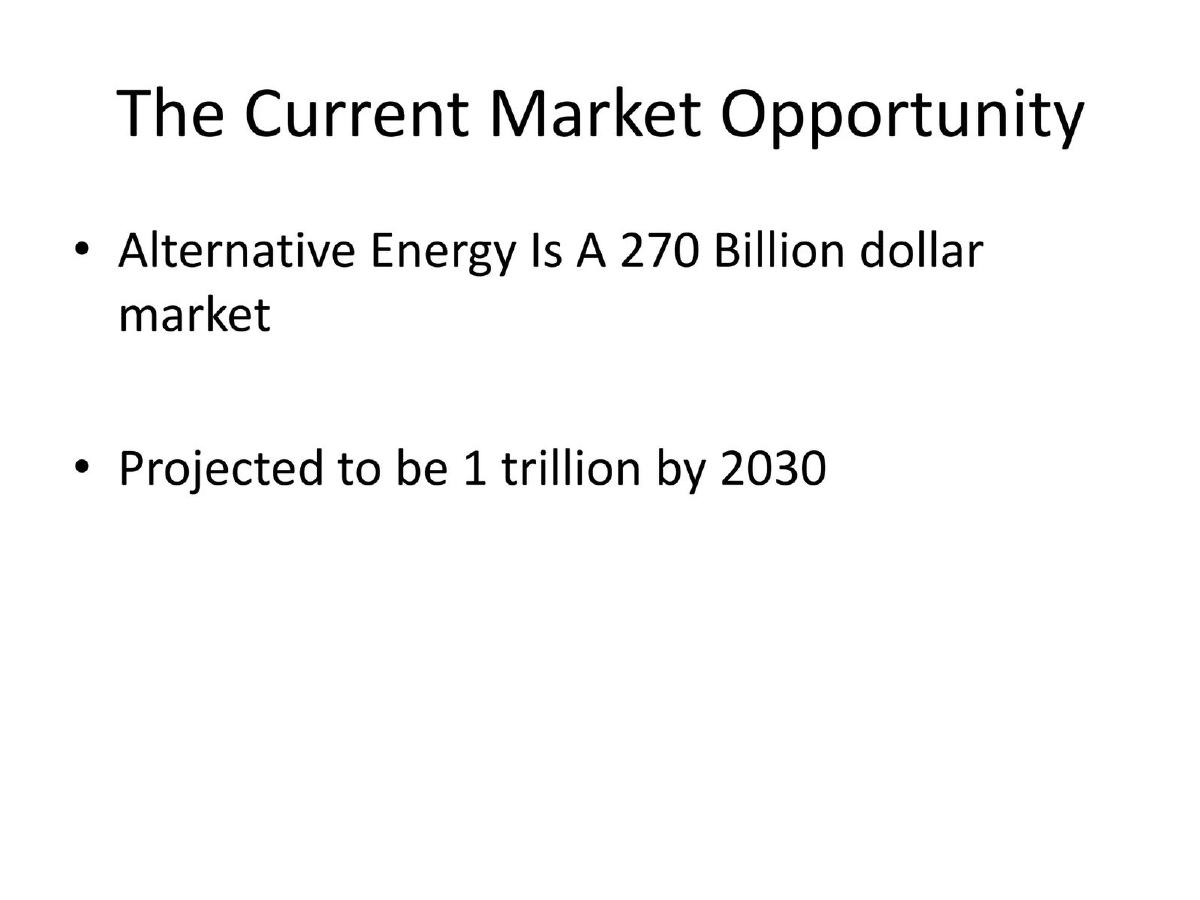
This slide focuses on the macro-economic environment for alternative energy. It states that the market is currently worth $270 billion and is projected to reach $1 trillion by 2030. These are large, top-down figures that lack specific attribution. While they demonstrate a growing sector, the slide does not explain what portion of this market "Cannabis Energy Oil" intends to capture or how the specific niche of cannabis-based fuel fits into these broader energy projections.
Slide 3: The Problem
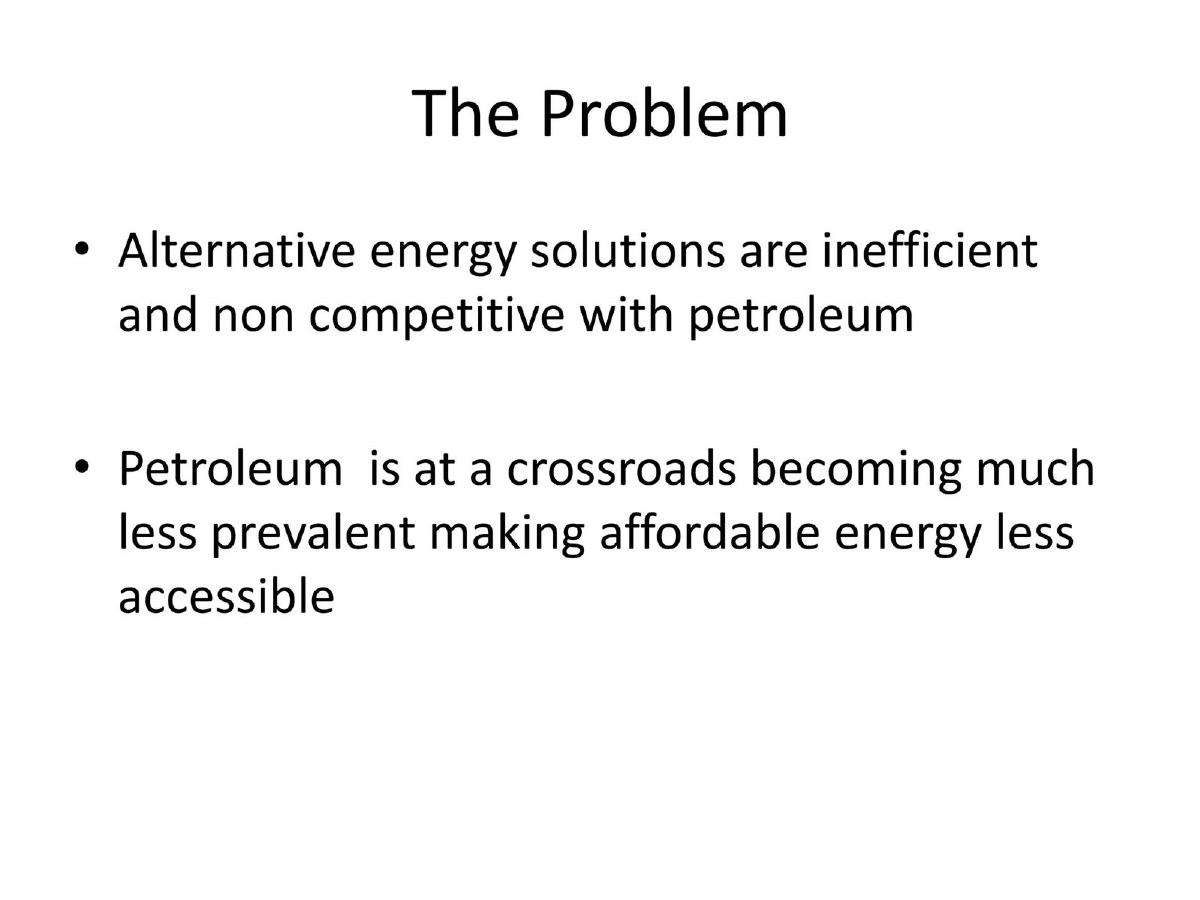
The problem is defined in two bullet points. First, it claims that alternative energy solutions are currently inefficient and cannot compete with petroleum on price or performance. Second, it suggests that petroleum is at a "crossroads," becoming less prevalent and making affordable energy less accessible. This slide sets up a classic "gap in the market" narrative, but it does not provide data to support the claim that petroleum is becoming less accessible or define the specific "inefficiencies" the company aims to solve.
Slide 4: The Solution
The solution slide introduces the company's core value proposition: a "high efficiency extraction process" using "low cost non food based feedstock." The use of non-food feedstock is a common goal in the biofuel industry to avoid competing with food supplies. The slide also mentions a strategy to focus on "only the most economically viable regions." However, the slide is entirely text-based; there are no diagrams of the extraction machinery, no chemical formulas, and no explanation of why this process is more efficient than existing methods.
Slide 5: Our Team
The team slide is dedicated to a single individual, Jason Baudendistel. He is described as a "self taught scientist, serial entrepreneur, author, and recipient of a previous 800,000 dollar buyout offer." In the context of a highly technical field like energy extraction, the term "self taught scientist" may be a red flag for institutional investors who typically look for PhDs or industry veterans. The mention of an $800,000 buyout offer is intended to show past success, but without naming the company or the industry, it provides little verifiable evidence of his ability to scale an energy startup.
Slide 6: Goals And Needs
The final slide outlines the financial ask and short-term projections. The company is seeking $1,000,000 in seed capital for 20% equity. The stated goals are ambitious: $1,000,000 in revenue and break-even status by the end of Year 1, followed by $500,000 in profit and a 10% return of capital to investors by the end of Year 2. These figures are presented as round numbers without any underlying financial modeling, unit economics, or expense breakdowns to show how the $1 million investment will be utilized to reach these milestones.
What This Deck is Missing
The most striking aspect of this deck is what it leaves out. For a company claiming a breakthrough in extraction technology, the absence of a Technical Validation slide is a major oversight. Investors in the energy space require data on energy density, cost per gallon (or equivalent unit), and proof of concept. There are no photos of a prototype, no lab results, and no mention of intellectual property or patents.
Furthermore, the deck lacks a Competitive Analysis . The biofuel and cannabis extraction markets are crowded. Failing to mention how this process differs from standard CO2 or ethanol extraction, or how it competes with other biofuels like algae or switchgrass, makes the pitch feel incomplete. The Go-To-Market Strategy is also absent; stating that the company will focus on "economically viable regions" is not a substitute for a detailed plan on how to acquire customers, navigate energy regulations, or secure feedstock supply chains.
What a Founder Should Copy
While the deck is critically underspecified, there are two elements that founders can learn from. First, the clarity of the ask on Slide 6 is commendable. Many founders hide their valuation and ask behind vague language; here, the terms ($1M for 20%) are explicit. Second, the problem/solution framing on Slides 3 and 4 follows a standard, logical flow that is easy to digest, even if the content lacks depth. The focus on "non-food based feedstock" is a strong narrative hook in the green energy sector that aligns with ESG (Environmental, Social, and Governance) goals.
Final Analysis
The Cannabis Energy Oil pitch deck is a high-level conceptual pitch that lacks the rigor required for a $1,000,000 seed round. The reliance on a single "self-taught" founder and the absence of technical data or market specifics make it a difficult sell for professional investors. To move forward, the company would need to produce a significantly more detailed document including a cap table, a detailed use-of-funds breakdown, and third-party verification of their extraction efficiency claims.
Frequently asked questions
- What is the specific product being offered?
- The deck is vague regarding the specific product. While the title mentions 'Cannabis Energy Oil,' the solution slide (Slide 4) refers more broadly to a 'high efficiency extraction process' for 'non food based feedstock.' It does not clarify if the end product is a biofuel, a lubricant, or a combustible oil, nor does it detail the chemical composition of the output.
- How does the company plan to achieve $1 million in revenue in year one?
- The deck does not provide a roadmap for this milestone. Slide 6 states the goal of $1,000,000 in revenue and break-even status by the end of Year 1, but there is no mention of sales channels, specific customers, manufacturing capacity, or the price per unit required to reach that figure.
- What is the technical background of the team?
- The team slide (Slide 5) lists only Jason Baudendistel. He is described as a 'self taught scientist.' There are no mentions of academic credentials, patents, or technical advisors to validate the 'high efficiency extraction process' claimed in the solution slide. This represents a significant gap for a deep-tech or energy-sector startup.
- What is the valuation implied by the seed ask?
- On Slide 6, the company asks for $1,000,000 in exchange for 20% equity. This calculation results in a $4,000,000 pre-money valuation and a $5,000,000 post-money valuation. The deck attempts to justify this by promising a 10% return of capital to investors by the end of Year 2.
- Are there any competitors mentioned in the deck?
- No. The deck mentions 'petroleum' as a general competitor in the energy market (Slide 3) but does not list any specific companies in the biofuel or cannabis extraction space. It also fails to address how this extraction process differs from existing industrial hemp or cannabis oil extraction methods already on the market.