CanniMed Therapeutics’ February 2017 deck serves as a post-IPO roadmap for a company transitioning from a government supplier to a global biopharmaceutical player. With a fresh $69 million in gross proceeds, the company focuses heavily on its 15-year history and its unique status as a former sole supplier to Health Canada. The deck is notable for its lack of traditional 'startup' metrics, instead focusing on regulatory compliance (GMP), clinical trial progress, and infrastructure scale—including a massive 35-square-mile underground facility in Michigan. By targeting the 'baby boomer' demograp…
Key takeaways
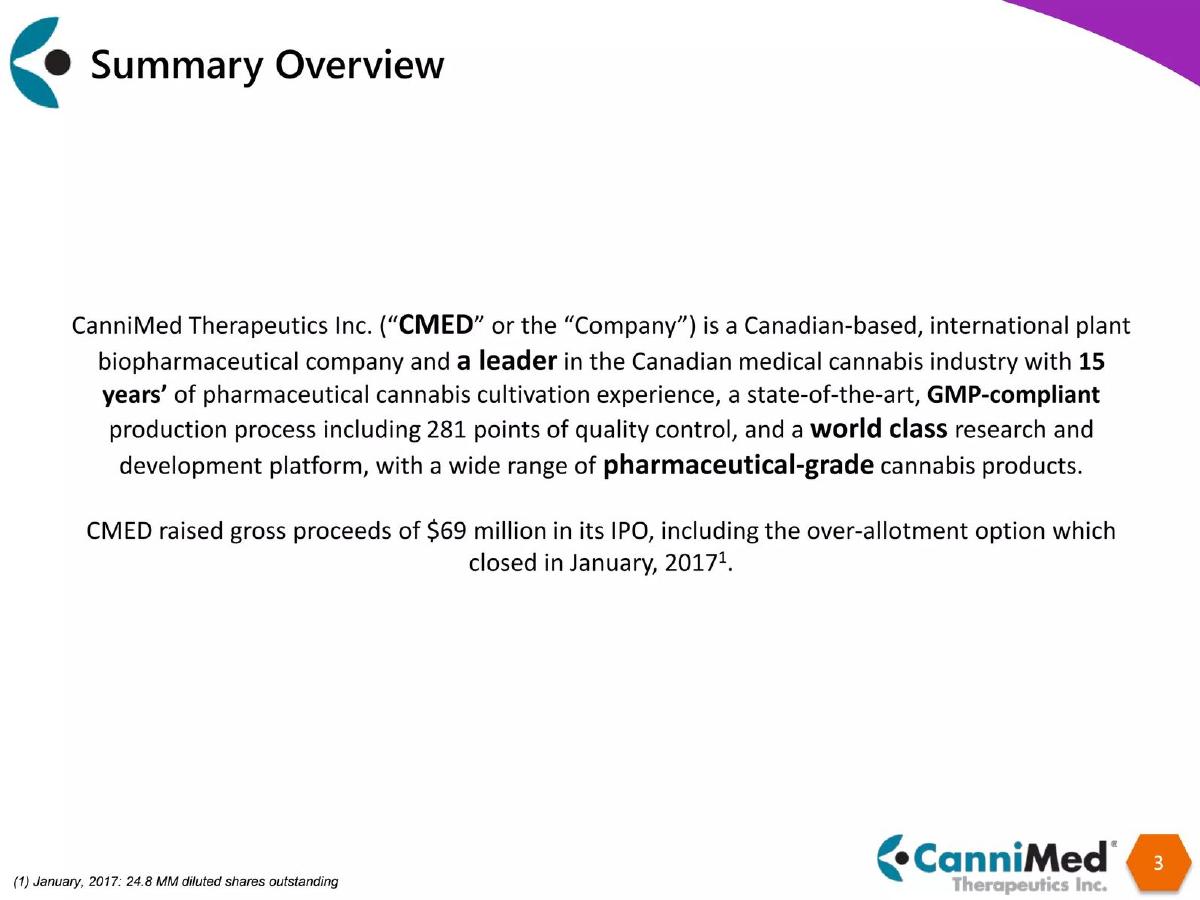
- The company raised $69 million in its IPO, which closed in January 2017, just prior to this deck's release (Slide 3).
- CanniMed emphasizes a 15-year history in the industry, including a period as the sole supplier to Health Canada (Slide 13).
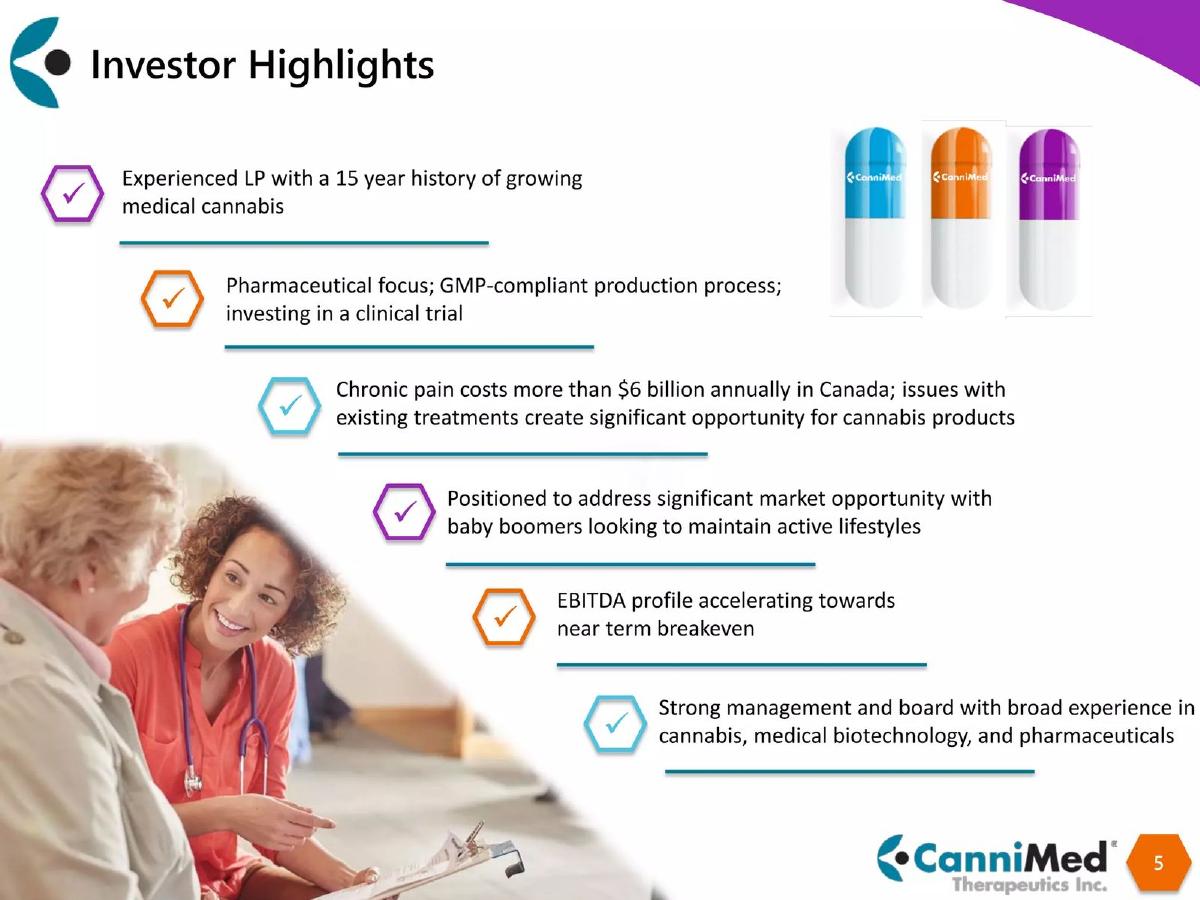
- The strategy focuses on chronic pain, which the deck claims costs more than $6 billion annually in Canada (Slide 5).
- Physician sentiment is a key metric, with the deck noting that 78% of doctors were approached by patients about cannabis in 2016, up from 48% in 2014 (Slide 7).
- Infrastructure is a primary competitive advantage, featuring a 97,000 sq. ft. facility in Saskatoon and a 35-square-mile underground footprint in Michigan (Slide 15).
- The product roadmap prioritizes high-margin 'value-added' products like oils and gelcaps to avoid the stigma of smoking (Slide 17).
- The management team is heavily weighted toward regulatory and scientific backgrounds, including a VP who was a former Senior Program Manager at Health Canada (Slide 19).
CanniMed Therapeutics: The Biopharmaceutical Pivot
The February 2017 CanniMed Therapeutics deck is a study in institutional positioning. Coming off a successful $69 million IPO, the company needed to prove it wasn't just another 'pot stock' but a sophisticated biopharmaceutical entity. The deck leans heavily on regulatory milestones, infrastructure scale, and medical legitimacy to justify its valuation to public market investors.
Slide 1: Title and Positioning
The cover slide establishes the core thesis: CanniMed is an "International Biopharmaceutical Company and Leader in Canadian Medical Cannabis." The imagery is telling—hexagonal frames show laboratory settings, doctors, elderly people exercising, and pharmaceutical packaging. There are no images of recreational use; the focus is entirely on health and science.
Slide 3: Summary Overview
This slide serves as the 'traction' proof for a public company. It highlights the January 2017 IPO which raised $69 million in gross proceeds. Crucially, it mentions 15 years of cultivation experience and "281 points of quality control." By leading with these numbers, CanniMed establishes itself as an incumbent with deep operational history rather than a new market entrant.
Slide 5: Investor Highlights
CanniMed uses this slide to outline its value proposition. The key takeaways are the $6 billion annual cost of chronic pain in Canada and the company's acceleration toward "near term breakeven" EBITDA. The inclusion of "Strong management and board" with experience in medical biotechnology signals to investors that the leadership understands the pharmaceutical regulatory landscape, not just agriculture.
Slide 7: Physician Attitudes Shifting
This is one of the most data-dense slides in the deck. It tracks physician sentiment from 2014 to 2016. The most significant metric is that doctors being approached by patients rose from 48% to 78%. Interestingly, the percentage of doctors who "will not prescribe under any circumstances" dropped from 36% to 27%. This data validates the market demand and the medical community's softening stance, which is critical for a prescription-based business model.
Slide 9: Broad Potential Benefits
CanniMed lists 19 medical conditions, from Alzheimer’s to PTSD, alongside observed medical impacts. The right side of the slide shows that 79% of prescribed uses are for chronic and neuropathic pain. This justifies the company's "early focus on chronic pain," showing that they are following the data to the largest current market opportunity.
Slide 11: The Baby Boomer Opportunity
This slide identifies the primary customer persona. It notes that those 55 and over represent over 9.3 million people in Canada. The deck makes a direct connection between aging, chronic pain, and the high rate of opioid use (16% of seniors). CanniMed positions its products as a way to "maintain an active lifestyle" and "avoid stigmas associated with smoking," which explains the push toward oils and gelcaps.
Slide 13: Pharmaceutical Focus
CanniMed doubles down on its history as the "sole supplier to Health Canada." This is a powerful moat. The slide also mentions the "First Health Canada approved Phase IIA clinical trial" and the development of cannabis oil gelcaps. The goal here is to convince investors that CanniMed is following a traditional drug development path, which typically commands higher multiples than pure agricultural plays.
Slide 15: Production Facilities
The scale of infrastructure is presented as a competitive barrier. The Saskatoon facility is 97,000 sq. ft. with a 7,000 kg annual capacity. However, the White Pine, Michigan facility is the standout, mentioning a "35 square mile underground footprint" with the potential for 50,000 kg of capacity. The pyramid graphic at the bottom illustrates the regulatory ladder, placing CanniMed at the top with "GMP Standards" required for pharmaceutical production, above the standard "Good Production Practices" required by law.
Slide 17: Product Offering - Oils and Gelcaps
This slide focuses on margins. It explicitly labels oils and gelcaps as "higher margin, value-added products." It provides a detailed breakdown of THC and CBD content for three specific product lines (Purple, Orange, and Blue). By showing the pharmaceutical-style packaging and precise dosing, CanniMed reinforces the message that they are selling medicine, not a commodity crop.
Slide 19: Management and Board
The team slide is heavy on credentials. CEO Brent Zettl is noted as a co-founder with tenure since 1991. The presence of John Knowles (CFO) with 30 years of executive experience and Larry Holbrook (CRO) with 20 years in genetic research provides the "adult supervision" that public market investors look for. The board includes members with backgrounds in venture capital, pharmacy, and FDA/USDA regulatory processes.
What CanniMed Does Well
The deck is exceptionally strong at market education . Instead of assuming investors understand why medical cannabis is a good business, it provides third-party data on physician attitudes and demographic shifts. It also does an excellent job of de-risking the regulatory aspect . By highlighting their 15-year history with Health Canada and their GMP-compliant facilities, they position themselves as the safest bet in a volatile industry. The focus on "value-added" products like gelcaps is a smart strategic move to signal higher future margins and a move away from the price compression seen in raw herbal markets.
What is Missing from the Deck
Despite being a post-IPO deck, there is a noticeable lack of granular financial performance in the provided slides. While they mention "accelerating towards breakeven," there are no charts showing revenue growth, cost per gram, or average selling price trends over the previous quarters. Additionally, the competitive landscape is entirely absent. In 2017, the Canadian medical cannabis market was becoming crowded with players like Canopy Growth and Aurora; CanniMed does not explicitly state how its production costs or patient acquisition costs compare to these peers. Finally, there is no clear 'Ask' or use of proceeds detailed for the $69 million raised, other than general infrastructure expansion.
Lessons for Founders
Lead with your Moat: CanniMed didn't just say they were good at growing; they highlighted their 15-year history as a government supplier. If you have a unique regulatory advantage or a long-standing relationship with a gatekeeper, make it the centerpiece of your deck. · Use Data to Validate the Market: The physician sentiment slide (Slide 7) is a masterclass in using trend data to prove a market is reaching a tipping point. Don't just say the market is growing; show how the behavior of the decision-makers (in this case, doctors) is changing. · Target a Specific Persona: CanniMed didn't target "everyone." They targeted baby boomers with chronic pain. This allowed them to tailor their product development (gelcaps) and their messaging (active lifestyle) to a specific, high-value segment. · Infrastructure as a Barrier: If your business requires physical scale, show the 'before and after' of your capacity. The mention of the 35-square-mile Michigan footprint serves as a massive signal of intent and future dominance. · Professionalize the Aesthetic: For industries with a 'stigma' (like cannabis, gaming, or crypto), your deck should look as corporate and 'boring' as possible. CanniMed’s use of clean lines, medical imagery, and pharmaceutical branding helps neutralize the perceived risk of the sector.
Frequently asked questions
- What was the primary purpose of this deck?
- This is an investor deck created shortly after CanniMed's IPO in January 2017. It was designed to communicate the company's long-term biopharmaceutical strategy to public market investors, focusing on their transition from herbal cannabis to pharmaceutical-grade products like oils and gelcaps, and their expansion into the U.S. market via their Michigan facilities.
- How does CanniMed differentiate itself from other cannabis companies?
- CanniMed differentiates itself through its 'pharmaceutical focus.' Unlike recreational-leaning competitors, CanniMed highlights its 281 points of quality control, GMP-compliant production, and its history as a government supplier. They specifically target the medical community, citing clinical trials and physician prescription trends rather than retail consumer metrics.
- What is the significance of the Michigan facility mentioned in the deck?
- The White Pine, Michigan facility represents a massive scale play. Slide 15 notes an 'additional 35 square mile underground footprint' with the potential to support more than 50,000 kg of herbal capacity per annum. This indicates CanniMed's intent to become a dominant producer in the North American market by leveraging unique, large-scale infrastructure.
- Who is the primary target patient demographic for CanniMed?
- The deck explicitly identifies 'Baby Boomers' as the key target market. Slide 11 notes that this group makes up 29% of the population and has the highest rate of opioid use. CanniMed positions its oils and gelcaps as safer, non-smoked alternatives that align with the lifestyle and medical needs of an aging population.
- What financial information is provided in the deck?
- As a post-IPO deck, it is light on early-stage venture metrics. It mentions the $69 million raised in the IPO and states that the EBITDA profile is 'accelerating towards near term breakeven' (Slide 5). However, it lacks specific revenue figures or detailed quarterly projections in the provided slides, focusing instead on market size and production capacity.