Canndescent's 2019 Series C deck is a sophisticated example of how to present a cannabis company as a high-end Consumer Packaged Goods (CPG) powerhouse. The deck successfully distances the brand from 'counterculture' tropes, instead leaning into CPG best practices, vertical integration, and rigorous market data. With a 700% CAGR through 2018 and a revenue run rate of $37.1M, the company demonstrates significant traction in the competitive California market. The presentation excels at showing how their 'effect-based' naming convention (Calm, Cruise, Create, Connect, Charge) simplifies the cons…
Key takeaways
- The company achieved a 700% revenue CAGR through 2018, reaching a $37.1M run rate (Slide 3).
- Canndescent commands a 2.4x market price premium compared to the average California spot price (Slide 12).
- The brand simplifies cannabis by replacing 6,000 confusing strain names with five desired outcomes: Calm, Cruise, Create, Connect, and Charge (Slide 7).
- Vertical integration is a core pillar, with 75,000 sq ft of cultivation and processing space and 14 California licenses (Slide 5).
- The deck highlights a 'Starbucks' consumer target, moving away from 'counterculture' branding toward aspirational messaging (Slide 7).
- Market validation is shown through scatter plots where Canndescent is the outlier, marrying high volume with the highest retail price per gram (Slide 11).
- The management team is presented as 'institutional quality,' featuring a CEO with five exits and executives from Mattel, P&G, and Snapple (Slide 18).
- Future growth is predicated on a 'house of brands' strategy, expanding into value, women-focused, and athletic segments (Slide 14).
Executive Summary: The CPG-ification of Cannabis
Canndescent’s Series C pitch deck is a masterclass in rebranding a commodity. In an industry often characterized by fragmented branding and 'stoner' stereotypes, Canndescent presents itself as a sophisticated, vertically integrated Consumer Packaged Goods (CPG) company. The deck, used to raise $27.5 million in 2019, focuses heavily on the 'Starbucks' consumer—those seeking consistency, luxury, and simplified choices. By replacing strain names with 'effects,' Canndescent successfully argued for a 2.4x price premium, a metric that serves as the backbone of their investment thesis.
Slides 1-5: The Hook and the Snapshot
Slide 1: Title Slide. The deck opens with a minimalist, high-contrast orange background featuring the Canndescent logo. The footer introduces the five core brand pillars: Calm, Cruise, Create, Connect, and Charge. This immediately establishes the brand's visual identity.
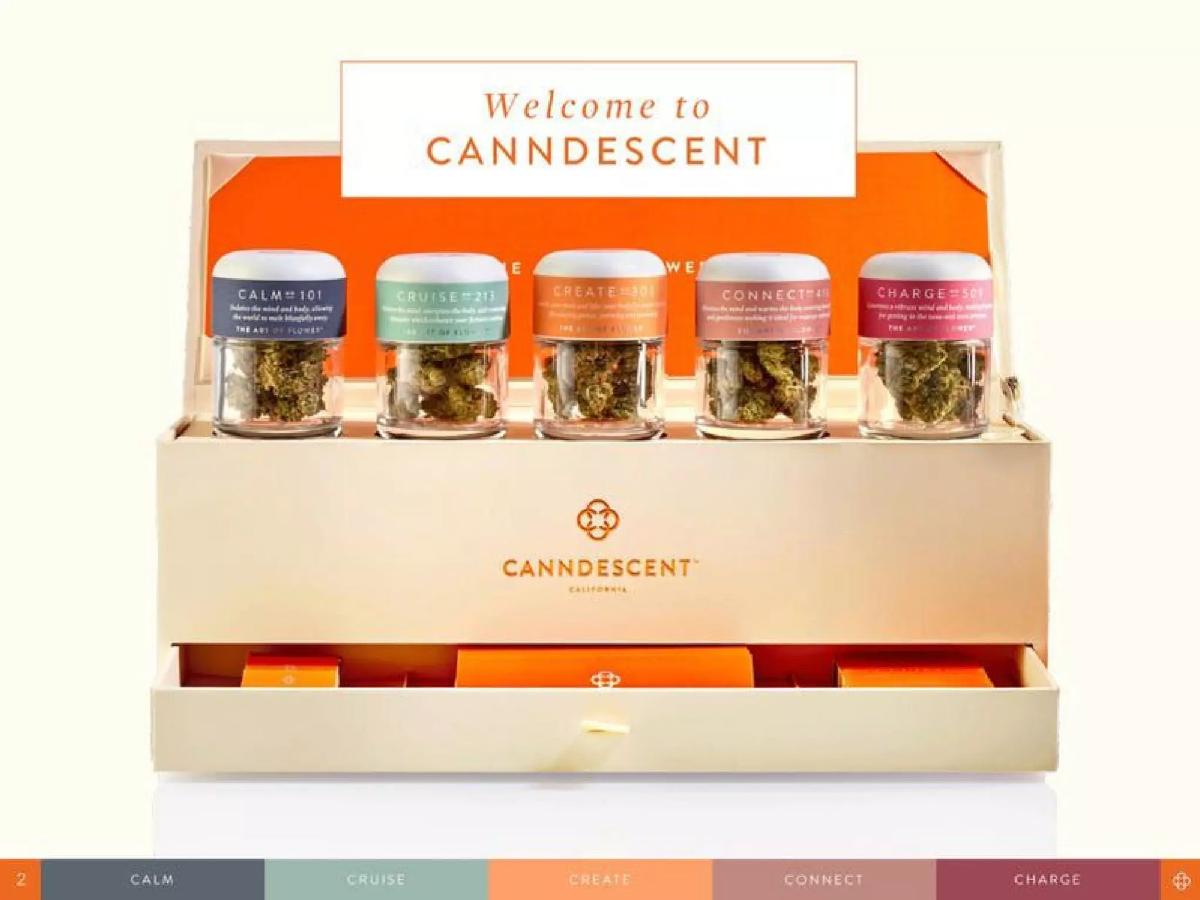
Slide 2: Product Photography. A high-resolution image of a luxury gift box containing the five signature jars. This slide sells the 'Art of Flower' concept without using words, emphasizing the premium packaging that justifies their price point.
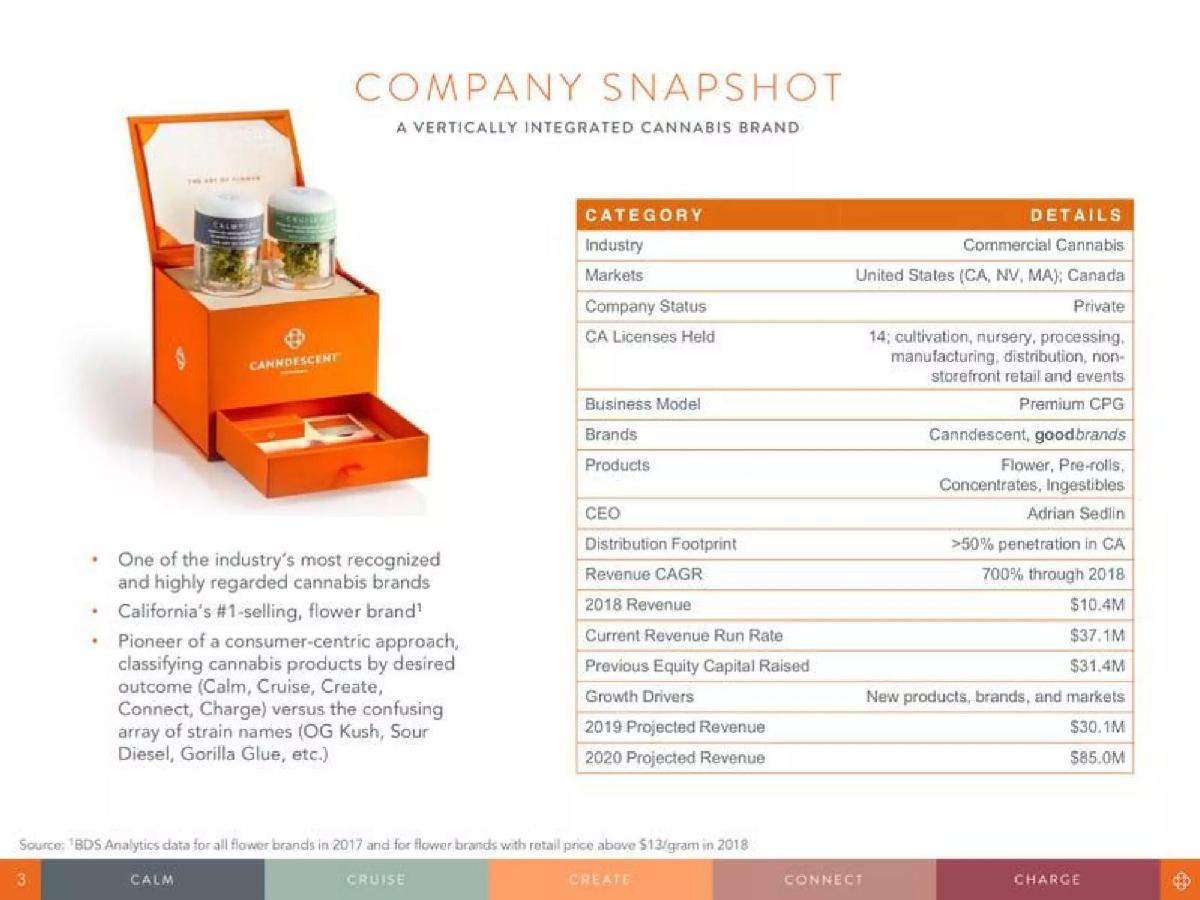
Slide 3: Company Snapshot. This is a data-heavy slide that acts as an executive summary. Key figures include a 700% Revenue CAGR through 2018, a $37.1M current revenue run rate, and a 2020 projected revenue of $85.0M. It also notes they hold 14 California licenses covering cultivation, nursery, processing, manufacturing, distribution, and retail. This slide establishes the scale and legitimacy of the business immediately.
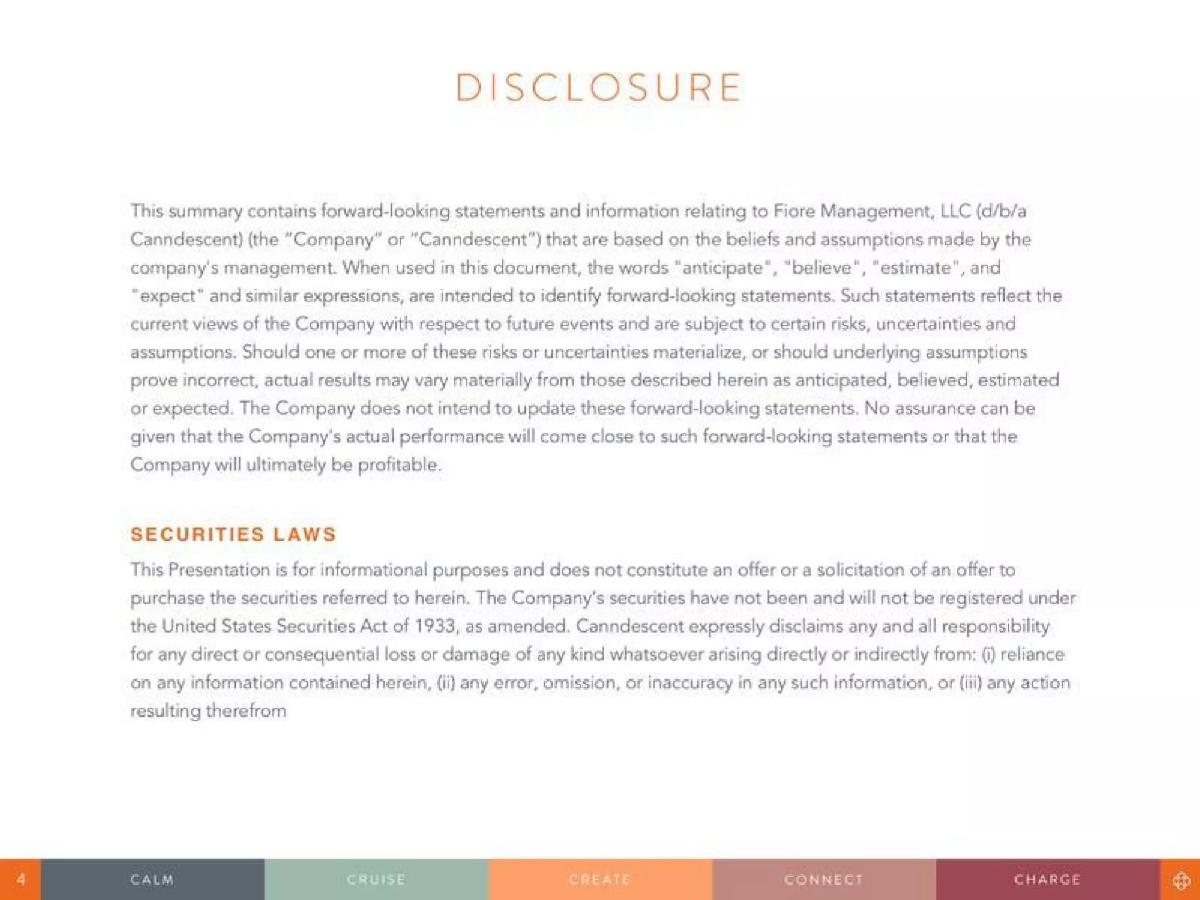
Slide 4: Disclosure. A standard legal disclaimer regarding forward-looking statements and securities laws. While necessary, it is a standard 'wall of text' slide.
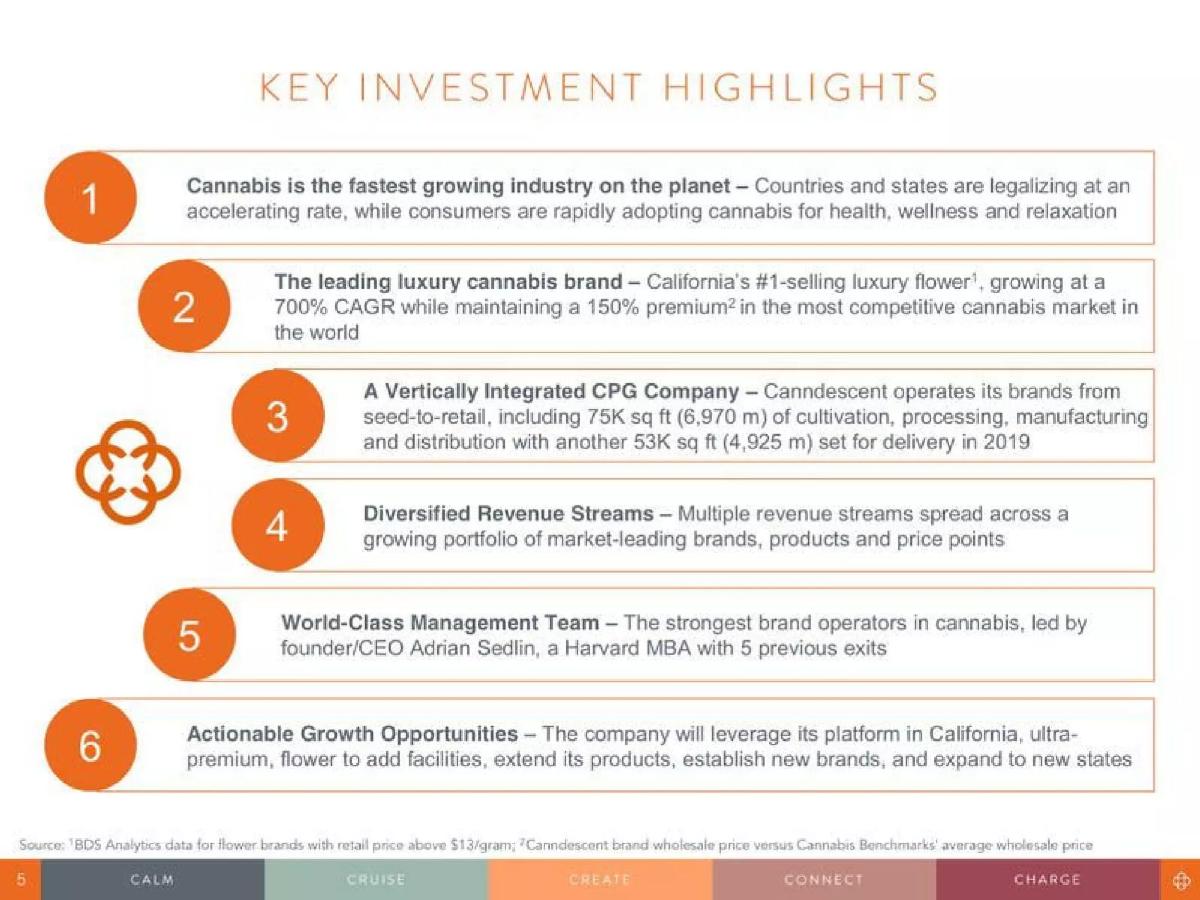
Slide 5: Key Investment Highlights. This slide distills the pitch into six points. Most notable is point 5, which highlights CEO Adrian Sedlin’s credentials: a Harvard MBA with five previous exits. Point 3 mentions their 75,000 sq ft of operational space, with another 53,000 sq ft set for delivery in 2019. This emphasizes that they have the physical infrastructure to back up their growth projections.
Slides 6-9: The Strategic Beachhead and Problem/Solution
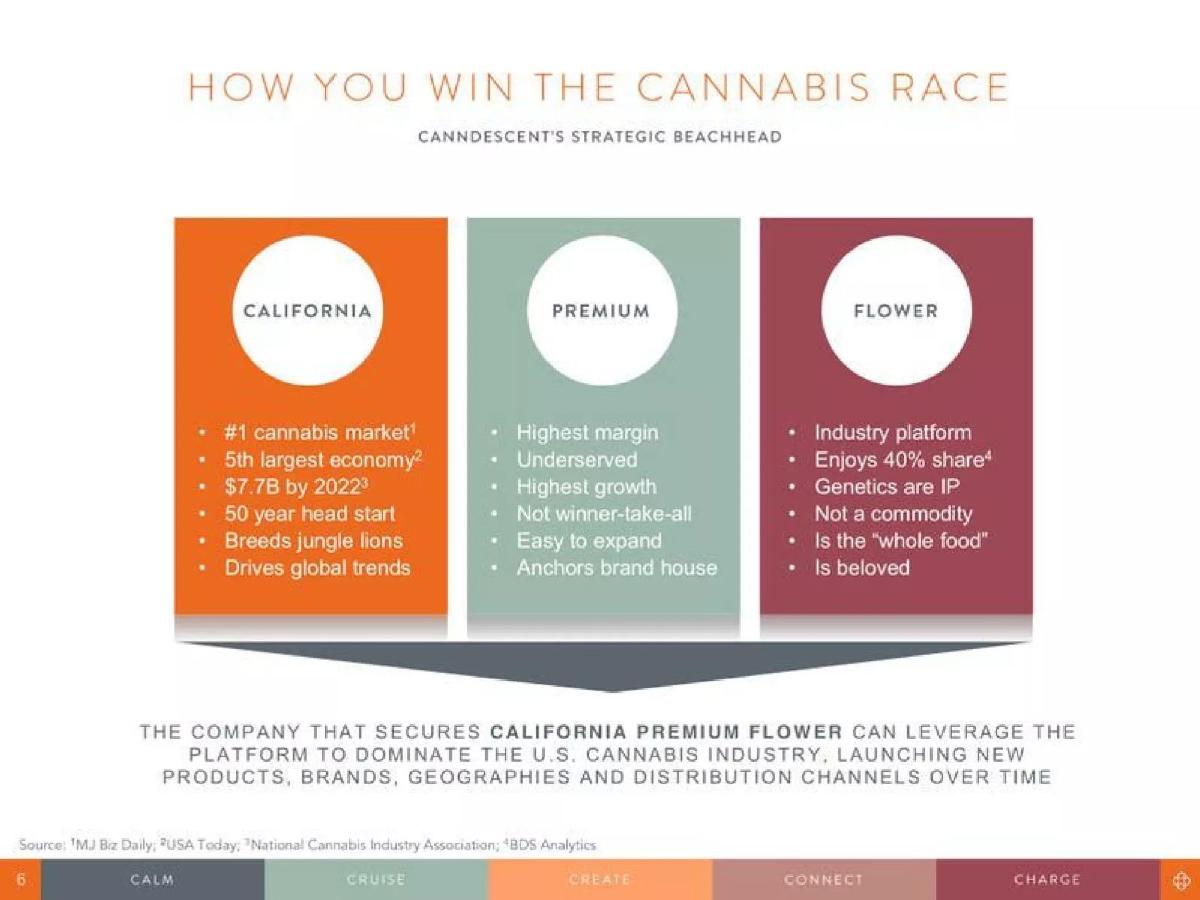
Slide 6: How You Win The Cannabis Race. The company identifies its 'Strategic Beachhead' as California, Premium, and Flower. They claim California is the #1 cannabis market and the 5th largest economy globally. By dominating the 'Premium Flower' segment (which they call the 'Whole Foods' of the industry), they argue they can leverage that platform to dominate the U.S. industry.
Slide 7: Where We Started (Consumer Pain Points). This is a critical 'Problem' slide. It contrasts 'What the Market Delivers' (mediocre products, inconsistent experiences, confusion from 6,000 strain names) with 'What Consumers Want' (exceptional products, repeatable outcomes, simplification). The most striking phrase is the 'Counterculture Paradox,' where they describe current marketing as the 'misogynistic offspring of Cypress Hill x Duck Dynasty,' positioning Canndescent as the mature alternative.
Slide 8: What We Built. A breakdown of their vertical integration. It lists 16,000 lbs/year capacity in cultivation, cold CO2 extraction in manufacturing, and a distribution arm with 12 trucks making 500 deliveries a month. This slide proves they aren't just a brand, but a full-scale industrial operator.
Slide 9: How We Built It. This slide bridges the gap between strategy and outcome. It lists tactics like 'Stats & Data' and 'Scalable' processes. The visual focuses on the 'Art of Flower' box, reinforcing the luxury aesthetic.
Slides 10-12: Market Validation and Hard Metrics
Slide 10: 2017 Market Validation. A scatter plot showing California flower retail sales vs. average selling price. Canndescent is shown as the leader in branded flower sales while maintaining a premium price, significantly higher than competitors like Flow Kana or Marley Natural.
Slide 11: 2019 Leadership Maintenance. A follow-up scatter plot showing that even as market prices fell, Canndescent increased sales while maintaining its price point. They describe themselves as the 'only brand to marry price & volume.'
Slide 12: What The Numbers Say. Three growth charts: Accounts Signed (5 to 398), Grams Sold (82k to 1.6M), and Revenue ($0.5M to $6.3M quarterly). The footer notes that August 2019 closed at $3.1 million in sales, providing very recent proof of momentum.
Slides 13-17: The Roadmap and Brand Extensions
Slide 13: Where We’re Going. A roadmap from 2018 to 2020. It details the move into new states, new channels (e-commerce), and new product categories like vapes, ingestibles, and beauty products.
Slide 14: How It Will Look. A visual representation of a retail shelf. It shows how Canndescent plans to occupy 33% of the 'Super Premium' shelf, while their 'goodbrands' line targets the 32% 'Premium' segment and a new 'GO' brand targets the 35% 'Value' segment. This 'House of Brands' strategy is a classic CPG move to capture the entire Total Addressable Market (TAM).
Slide 15: New Brand Gallery. Visuals for 'good flower,' showing a more accessible, colorful packaging style compared to the flagship Canndescent line.
Slide 16: Welcome to Stylus. Introduction of their hardware play: a rechargeable 4-setting oil vaporizer. This shows they are moving into the high-margin hardware and oil cartridge business.
Slide 17: Ready-to-Use Vape Pens. Further product expansion into disposable pens, maintaining the 'Calm, Cruise, Create' naming convention to ensure brand continuity across different form factors.
Slides 18-20: The Team and The Close
Slide 18: Who’s Accountable. The team slide. It is heavy on corporate pedigree. Executives have backgrounds from Mattel, P&G, Snapple, MedMen, ConAgra, and Citi. This is designed to reassure institutional investors that the 'adults are in the room.'
Slide 19: Why Invest (Recap). A bulleted summary of the pitch: market leadership, proven pricing power, diversified products, and a world-class team. It frames the investment as an 'opportunity to invest in a privately-held market leader' at a phase of 'explosive growth.'
Slide 20: Closing Slide. A simple return to the logo and brand colors with the website and social media handles.
What Works in This Deck
The 'Effect' Framework: The most powerful part of the deck is the rejection of traditional cannabis nomenclature. By focusing on 'Calm, Cruise, Create, Connect, Charge,' they solve a genuine consumer friction point (confusion) and create a proprietary language for their brand. This is a classic 'Blue Ocean' strategy.
Data Visualization: The scatter plots on Slides 10 and 11 are excellent. They don't just show that the company is growing; they show that the company is an outlier. Being the only brand in the top-right quadrant (high price AND high volume) is the strongest possible argument for brand equity.
Pedigree: The 'Who's Accountable' slide is exceptionally strong for the cannabis space. Highlighting a Harvard MBA CEO with five exits and a CFO from P&G/Mattel directly addresses the 'execution risk' that often plagues the industry.
What is Missing
The Ask: Surprisingly, for a Series C deck, there is no slide detailing how much capital is being raised or how it will be specifically allocated. While the 'Roadmap' hints at expansion, a dedicated 'Use of Funds' slide is a standard omission here.
Unit Economics: While the deck mentions a '2.4x market price,' it doesn't provide a breakdown of Gross Margins or Customer Acquisition Cost (CAC). For a later-stage round, investors would typically want to see the path to profitability at the unit level, especially given the high costs of vertical integration.
Competitive Landscape: Aside from the scatter plots, there is no direct comparison of features or market share against other major multi-state operators (MSOs). The deck assumes a 'winner-take-all' or 'winner-take-most' scenario for the premium segment without detailing the defensive moats against well-funded competitors.
What a Founder Should Copy
The 'House of Brands' Slide (Slide 14): Every CPG founder should study this slide. It visually demonstrates how a company can expand its TAM by creating sub-brands for different price points (Luxury, Premium, Value) without diluting the flagship brand. It makes a complex retail strategy immediately understandable.
The Problem/Solution Contrast (Slide 7): Instead of just listing features, Canndescent lists 'Market Delivers' vs. 'Consumers Want.' This framing makes their solution feel like an inevitable evolution of the market rather than just another product.
Vertical Integration Breakdown (Slide 8): If you are an operations-heavy business, use this format. Breaking the business down into Cultivation, Processing, Manufacturing, and Distribution with specific square footage and capacity metrics proves operational maturity.
Frequently asked questions
- What is Canndescent's core value proposition?
- Canndescent positions itself as a luxury CPG brand that simplifies the cannabis buying process. Instead of using traditional strain names like 'OG Kush,' which they claim confuse consumers, they categorize products by five desired effects: Calm, Cruise, Create, Connect, and Charge. This consumer-centric approach allows them to target the 'Starbucks' consumer and maintain a significant price premium over competitors.
- How does the deck demonstrate market traction?
- The deck uses three primary metrics: revenue growth, account penetration, and pricing power. Slide 12 shows a jump from 5 accounts in Q4 2016 to 398 in Q2 2019, alongside a revenue increase from $0.5M to $6.3M in the same period. Crucially, they use scatter plots on Slides 10 and 11 to show they are the only brand successfully combining high sales volume with a premium price point.
- What is the company's operational strategy?
- Canndescent follows a vertically integrated model. According to Slide 8, they manage everything from cultivation (67,000 sq ft) and processing to manufacturing (Cold CO2 extraction) and distribution (12 trucks, 500 deliveries per month). This control over the supply chain is presented as a way to ensure product consistency and 'pure and natural' quality standards.
- Who is the target audience for this pitch deck?
- This is a Series C deck intended for institutional investors. The language is professional and focuses on CPG terminology like 'CAGR,' 'SKUs,' 'Account Penetration,' and 'Strategic Beachhead.' The 'Who's Accountable' slide (Slide 18) emphasizes 'Institutional Quality' by highlighting executives with backgrounds at blue-chip companies like P&G, Citi, and ConAgra.
- What are the primary growth drivers mentioned?
- Growth is driven by three factors: product expansion, brand diversification, and geographic scaling. Slide 13 outlines a roadmap to move beyond flower into vapes, concentrates, ingestibles, and beauty products. Slide 14 illustrates a 'shelf' strategy where they plan to launch new brands (like 'goodbrands' and 'Volcannics') to capture 3x more shelf space across luxury, premium, and value segments.