Cafetino's 2020 deck is a 12-slide PowerPoint for a Romanian coffee pre-ordering app with a working iOS and Android MVP. Its strengths are restraint, a disclosed 2 lei per-order fee with gross margin acknowledged, a bottom-up market model sanity-checked against a real Bucharest franchise, and a dated roadmap with a named beachhead city. Its defining flaw is that there is no ask anywhere in the file: no amount, no runway, no use of funds. The team slide lists four co-founders with titles but no employers, and the only traction claim is the unquantified phrase "positive feedback".
Key takeaways
- Cafetino's deck is 12 slides built in PowerPoint in July 2020 for a Romanian app that lets customers order and pay for coffee before arriving at the shop.
- There is no ask slide anywhere in the file — no amount, no instrument, no runway, no use of funds, no valuation.
- The business model slide discloses a flat 2 lei (~$0.45) fee per order and admits roughly half of it goes to processing, infrastructure and marketing — unusually honest for pre-seed.
- The market slide is built bottom-up from the company's own unit economics and sanity-checked against one major franchise's ~1.8 million annual Bucharest coffee sales.
- The roadmap is dated and countable: ~5 shops in 2020, ~30 by 2021, ~100 by 2023, European expansion from 2024, with Bucharest named as the beachhead.
- The team slide names four co-founders with titles only — no employers, no photos, no links — despite an earlier slide claiming IT experience at top global companies.
- The only traction claim in the deck is positive feedback from possible coffee shop partners, with no counts, letters of intent or pilots named.
- The progress slide proves a shipped MVP on iOS and Android with payments live, but never states whether anyone has placed an order.
What this deck actually is
This is a 12-slide PowerPoint deck built in July 2020 by Cafetino, a Romanian startup building a mobile app for ordering and paying for coffee before you arrive at the shop. Every page is stamped “CAFETINO PITCH DECK - 2020”, and the last slide ends with an email address and a website rather than an ask.
That detail tells you what kind of document this is. It is a pre-seed, pre-revenue deck from a four-person founding team with a working MVP, written in the middle of the first pandemic year, aimed at whoever would take a meeting — angels, a local accelerator, possibly a coffee franchise partner. It is not a Series A deck and it should not be read as one.
It is worth studying precisely because of that. Most teardown material online uses decks from companies that already won, where survivorship makes every choice look deliberate. This is what the honest majority of first decks look like: a clear idea, a real product, a decent market frame, and three or four structural gaps that will cost the founders their meeting. The walkthrough below covers all 12 pages in order.
Slide-by-slide walkthrough
Slide 1 — Title: “A much faster way to order coffee”
Company name plus an eight-word positioning line. No jargon, no mission statement, no “reimagining the coffee experience.” A reader who sees only this slide knows the category (coffee), the product (ordering), and the claimed benefit (speed).
The one weakness is that “faster” is the weaker of the two benefits the deck goes on to argue. By slide 3 the stronger claim appears: in mid-2020, queueing was not just annoying, it was something people actively avoided. A title line like “Order and pay for your coffee before you arrive” would have described the product more concretely, and the pandemic argument could have carried the urgency.
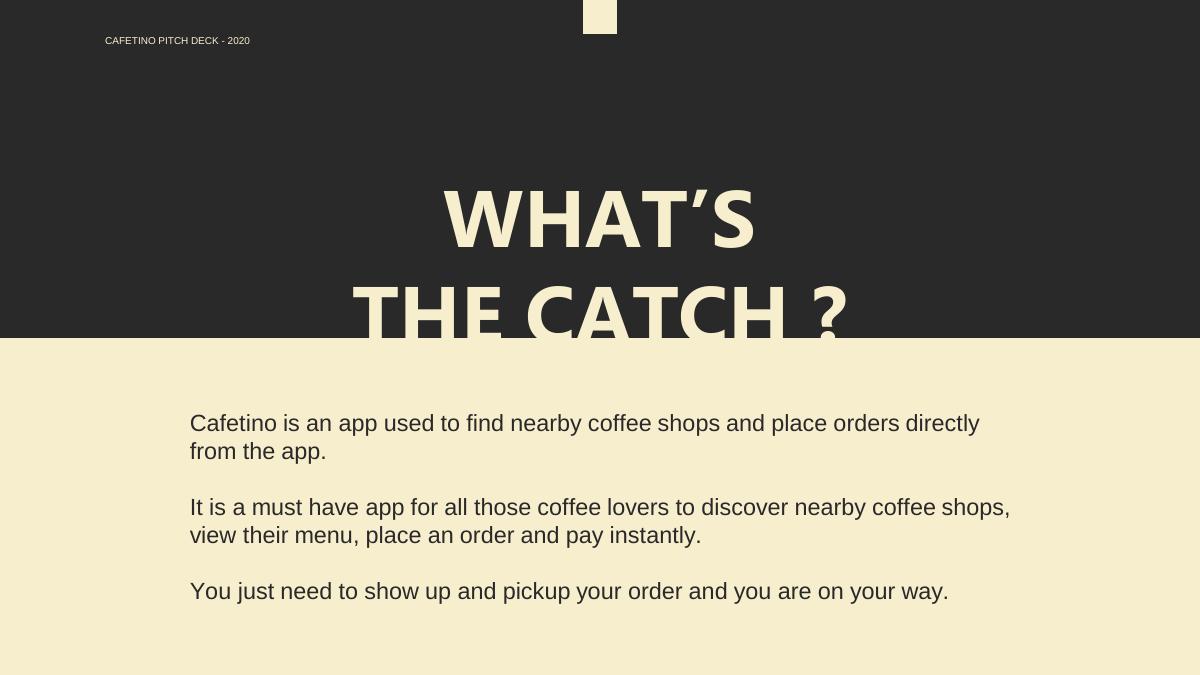
Slide 2 — “What’s the catch?”
Three sentences explaining that Cafetino finds nearby coffee shops, shows their menus, and takes orders and payment in-app, so the customer just shows up and collects.
The content is right — an early explainer slide that removes ambiguity is a good instinct, and the closing line (“You just need to show up and pickup your order”) is the clearest sentence in the deck. The headline is the problem. “What’s the catch?” primes the reader to look for a trick. On a slide whose job is to make the product feel obvious and frictionless, the header is working against the body copy. “How it works” would have done the job without inviting suspicion.
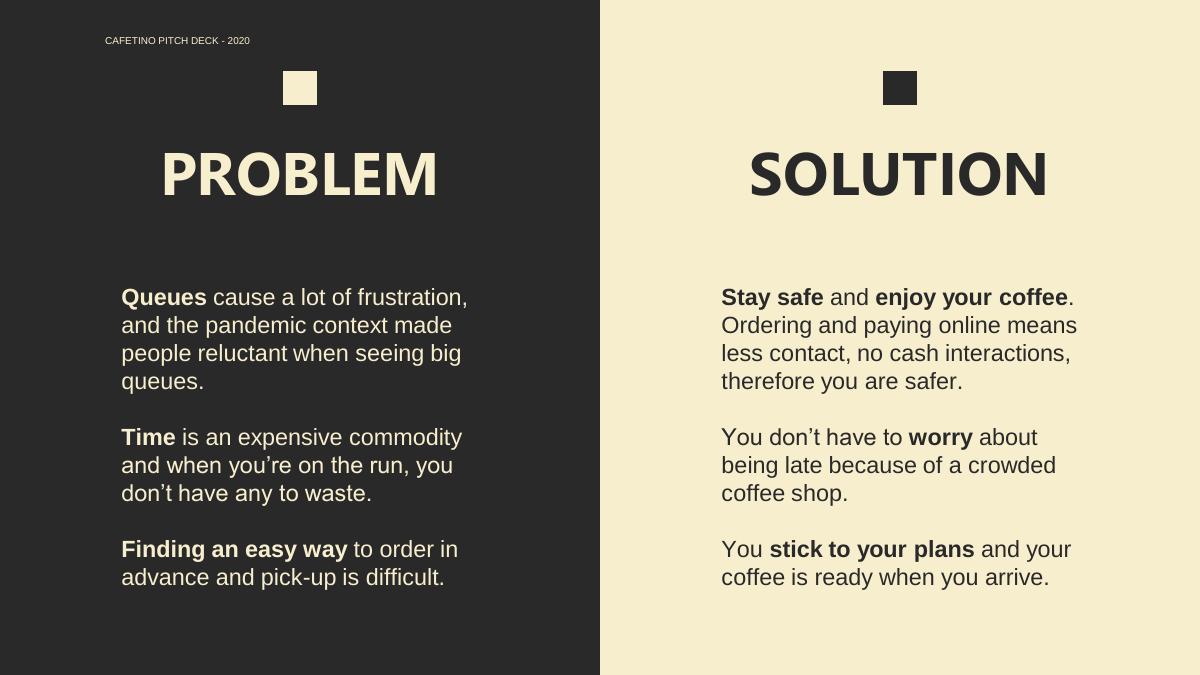
Slide 3 — Problem and solution, side by side
Three problem statements in the left column, three matching solutions on the right: queues cause frustration and the pandemic made people wary of them; time is expensive when you are on the run; ordering ahead and picking up is hard today.
Pairing problem and solution on one page is a defensible choice at pre-seed, and the mapping here is disciplined — each solution sits directly opposite the problem it answers, so the reader never has to hold a problem in memory across pages.
What is missing is scale. Every one of these statements is qualitative. Not one carries a number: no average wait time, no share of customers who abandon a queue, no survey of the founders’ own target shops. In mid-2020 this data was gettable cheaply — stand outside three Bucharest coffee shops for a morning with a stopwatch. A single line such as “we counted an average 6-minute wait at 3 central Bucharest cafes across 4 mornings” would convert this from an assertion everyone already agrees with into first-party evidence that this specific team does field work.
Slide 4 — Core advantages
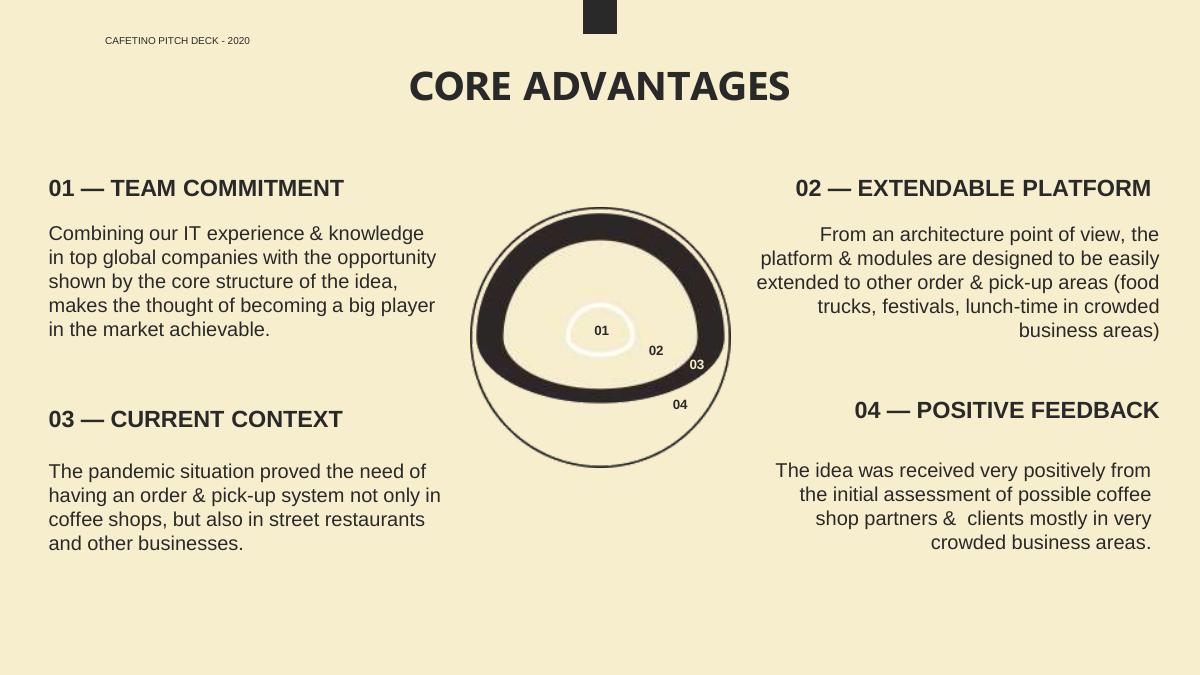
Four numbered blocks: team commitment (IT experience at “top global companies”), an extendable platform (food trucks, festivals, business districts), the current pandemic context, and positive feedback from early conversations with coffee shops and customers.
This slide is the deck’s most consequential miss, because it contains three genuinely valuable claims and lets all three evaporate into abstraction.
“Top global companies” names nobody and nothing. If four founders have engineering experience at recognisable employers, the employers belong on the page. This is the single highest-value edit available in the whole file. · “Positive feedback” from “possible coffee shop partners” is the deck’s only traction claim, and it is unquantified. How many shops? Did any sign a letter of intent? A line like “7 of 9 independent cafes we approached in Bucharest agreed to a pilot” converts a soft adjective into a hard commercial signal. · The extendability argument is real and correctly placed as an advantage, but at pre-seed it is also a risk: an investor reads “food trucks, festivals, lunch-time” and hears a team that has not yet committed to a beachhead.
Slide 5 — The journey
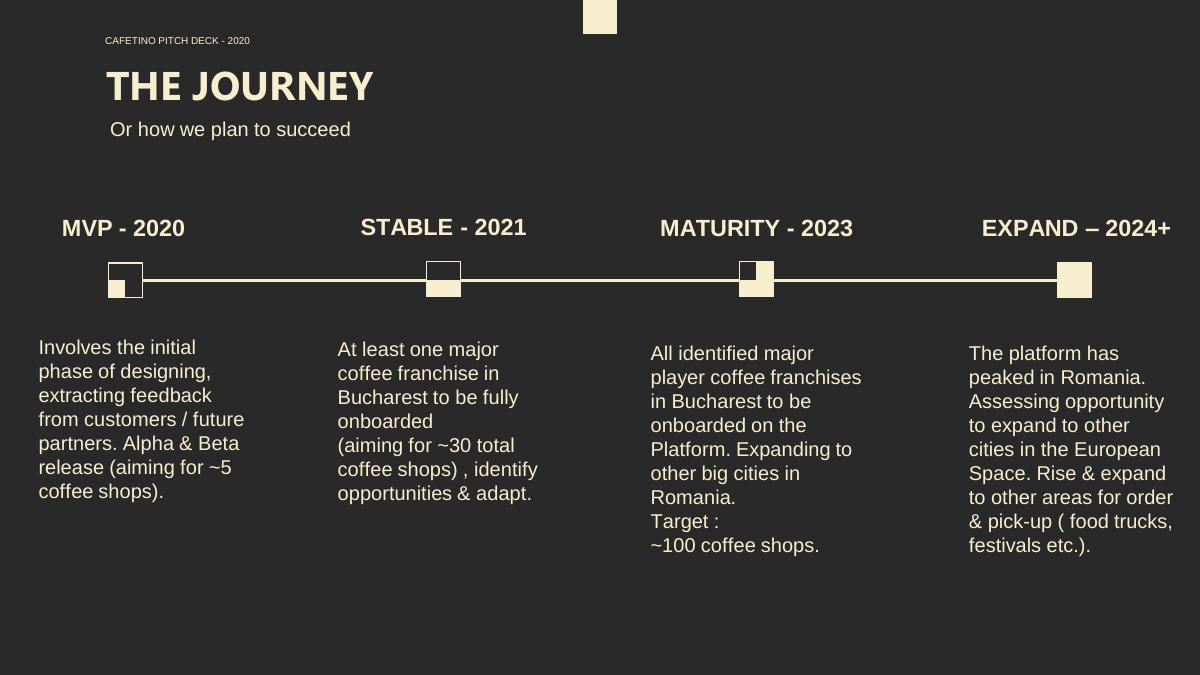
A four-stage roadmap: MVP in 2020 with roughly 5 pilot shops, a stable release in 2021 with a major Bucharest franchise and around 30 shops, maturity in 2023 with roughly 100 shops and expansion to other Romanian cities, and European expansion from 2024.
This is the best-constructed slide in the deck. Each phase carries a date and a countable target, which is far more than most pre-seed roadmaps offer, and the shop counts are modest enough to read as considered rather than fantasised. Naming Bucharest as the beachhead is exactly right.
Two upgrades would make it investor-grade. First, tie the phases to money: what does the round being raised actually buy, and which milestone does it fund the team to? Second, attach a revenue implication to the shop counts — at the fee disclosed on the next slide, 100 shops means a specific monthly number, and stating it turns the roadmap into a financial argument rather than an operational one.
Slide 6 — Business model
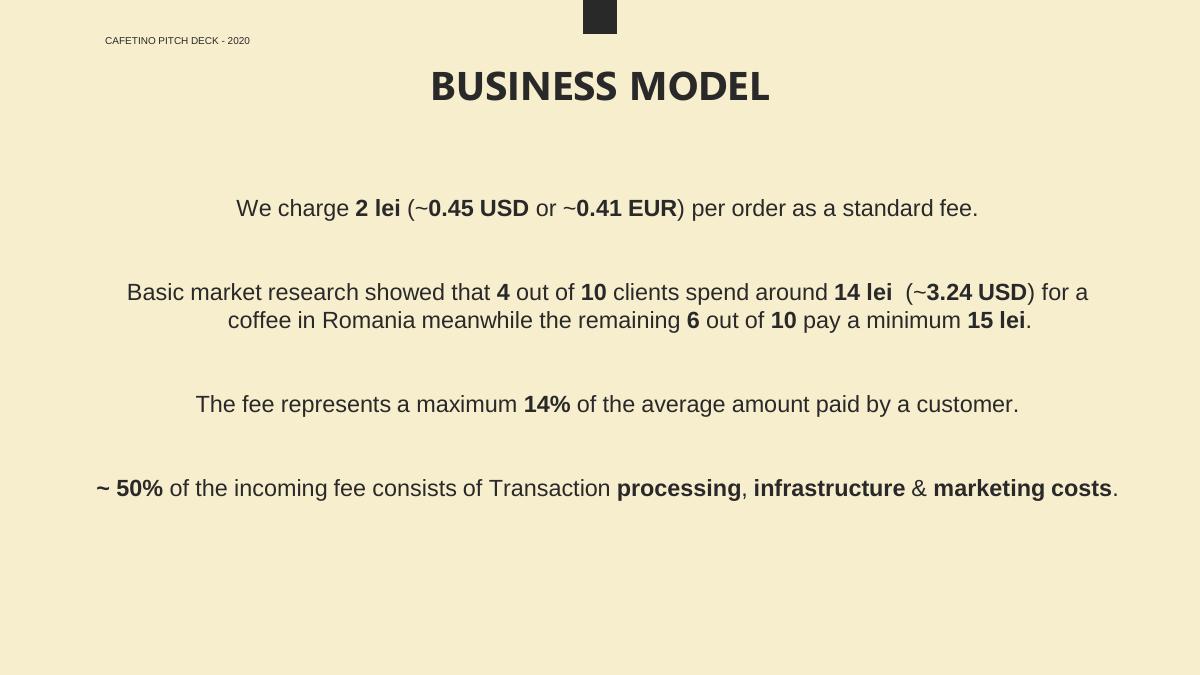
A flat 2 lei fee per order (about $0.45 or €0.41), framed against research showing that 4 in 10 Romanian customers spend around 14 lei on coffee and the other 6 spend at least 15 lei, making the fee a maximum of about 14% of the ticket. The slide closes by noting that roughly half the fee is consumed by transaction processing, infrastructure and marketing.
Disclosing the gross-margin assumption unprompted is unusually honest for a pre-seed deck, and it is the single most credibility-building line in the file. A flat per-order fee is also the right model for this business: it is legible to a cafe owner in one sentence, which matters when the sales motion is a founder walking into an independent coffee shop.
The gap is the arithmetic that follows from it. At roughly 1 leu of contribution per order, the reader can compute what the 2021 and 2023 targets are worth — and the founders should have done that computation on the slide rather than leaving it to a stranger. There is also no mention of who pays the fee. If it is added to the customer’s bill, that is a conversion question; if the cafe absorbs it, that is a merchant objection. The deck does not say, and an investor will ask within the first two minutes.
Slide 7 — Potential market value
A bottom-up calculation: 15,000 daily customers over a year, or roughly 2 million orders at 2 coffees each, equals 5.4 million coffees and about 3.9 million RON (roughly €800,000) annually. A footnote anchors it: one major franchise sells around 1.8 million coffees a year in Bucharest.
Building the market from the company’s own unit economics rather than quoting a global industry number is the correct approach, and the franchise comparison is a smart sanity check — it tells the reader that the modelled volume is roughly three times one large chain’s Bucharest sales.
The problem is that the comparison quietly undermines the model. If a major franchise sells 1.8 million coffees a year, then 5.4 million coffees ordered through a two-year-old app implies a share of the city’s coffee market that requires its own defence. The number that is missing is the one an investor actually wants: the realistic year-two figure. Ten shops, 40 orders a day each, is roughly 150,000 RON of fee revenue in a year. That is a smaller number, and it is far more persuasive because it is checkable.
Slide 8 — Market statistics
Three large figures: 300,000+ coffee shops in the EU, 33% of global coffee consumption in the EU, and $8.97bn spent on coffee in the UK in 2018.
This slide should be cut or rebuilt. None of the three numbers is sourced, the UK figure is for a market Cafetino has no plan to enter, and all three describe coffee consumption rather than demand for pre-ordering. A slide of unsourced global statistics immediately after a specific, self-built market model weakens the credibility the previous page earned.
The replacement is obvious and available: Bucharest. Number of coffee shops in the city, share that are independent versus franchise, and how many already offer any form of digital ordering. That is a market slide only this team would build, and it is the one a local investor can verify.
Slide 9 — Progress
A three-stage bar — MVP, Stable, Extend — with a “we are here now” marker on MVP, listing shipped core functionality (account creation, location list and map, coffee selection and customisation, ordering, payment) and planned features (rewards, partner onboarding, ratings, promotions, redeemable gifts).
Marking current position on a roadmap is a good device, and the shipped list is specific enough to be verified in a demo. The fact that payments are already working on Android and iOS is a real de-risking signal for a four-month-old build.
What the slide cannot answer is whether anyone uses it. There is no download count, no number of test orders placed, no pilot shop live in production. At pre-seed a founder is not expected to have revenue, but any evidence of a real transaction — even “120 test orders placed by 30 beta users across 2 partner cafes” — changes the conversation from “can they build” to “does anyone want it.”
Slide 10 — Android and iOS prototype
Product screenshots with three short captions about ease of use, registration, and the e-loyalty rewards section.
Including real screens is correct — it proves the product exists and is further along than a mockup. The captions are the weak part: “client friendly” and “easy-to-use interface” are claims the screenshot itself either supports or does not, and a caption that repeats what the image shows wastes the only annotation space the deck has.
The stronger version annotates the flow: how many taps from opening the app to a paid order, how long a returning order takes, where the loyalty card creates the repeat visit. Product slides earn their place by showing a mechanic that a competitor would have to copy, not by asserting that the UI is friendly.
Slide 11 — The team
Four names with titles: CEO, Technology Director, Brand Director, Operations Director — all four labelled co-founder. No photographs, no employers, no years of experience, no links.
For a pre-seed deck this is the most costly page in the file, because at this stage the team is the investment. Slide 4 already claimed IT experience at top global companies; this slide is where that claim gets substantiated, and it does not. Four co-founders with a shipped iOS and Android app in four months is a genuinely strong data point, and none of it is visible here.
The fix costs a paragraph: one line per founder naming a recognisable employer and the thing they built or ran, plus who is full-time and who is not. Four co-founders also raises an ownership question that a cap-table line would pre-empt.
Slide 12 — Thank you
This is where the deck’s central omission becomes undeniable: there is no ask . Twelve slides, and at no point does the deck state how much money the team wants, at what valuation or instrument, for how many months of runway, or what the money buys. There is no use-of-funds breakdown, no hiring plan, no burn figure, no target for the next milestone.
A pitch deck without an ask forces the investor to do the founders’ work, and most will simply not bother. The final slide should carry the number, the runway it buys, the milestone it reaches, and the two or three things the money is spent on.
What Cafetino got right
A product that exists. A working MVP on both platforms, with payments live, four months after starting — shown with real screenshots rather than promised. · A disclosed business model. A flat 2 lei fee, benchmarked against the average ticket, with the cost base acknowledged at roughly half. Very few pre-seed decks state gross margin at all. · A bottom-up market model. The market slide is built from the company’s own unit economics and sanity-checked against a real franchise’s Bucharest volume, instead of a downloaded industry figure. · A dated, countable roadmap. Four phases, each with a year and a shop target, and a named beachhead city. · Problem-solution symmetry. Three problems, three answers, laid out so the reader never has to hold anything in memory. · Restraint. Twelve slides, one idea per page, no filler. The pacing is genuinely good.
What we would change
Add an ask slide. Amount, instrument, runway in months, the milestone it funds, and a three-line use of funds. This is the single highest-impact change in the file. · Name the employers on the team slide. Four co-founders with a shipped cross-platform app is a strong signal that is currently invisible. One line each: name, role, prior employer, what they built. · Quantify the “positive feedback.” Replace the adjective with counts: shops approached, shops interested, letters of intent or pilot agreements signed. · Put one usage number on the progress slide. Test orders placed, beta users, orders completed end-to-end. Any real number beats a feature list. · Replace the EU and UK statistics with Bucharest data. Coffee shop count in the city, independent versus franchise split, current digital ordering penetration. · Do the fee arithmetic on the roadmap. Translate 30 shops and 100 shops into monthly order volume and monthly fee revenue at 2 lei, so the roadmap reads as a financial plan. · Say who pays the fee. Customer surcharge or merchant commission — the answer determines both the conversion risk and the sales objection, and every investor will ask. · Add a competition slide. In 2020 the honest answer includes cafe-owned apps, delivery platforms adding pickup, and the status quo of walking in. Naming them and explaining why a dedicated pre-order app wins is stronger than silence. · Fix the slide 2 headline. “What’s the catch?” invites scepticism on the page designed to make the product feel effortless. · Lead with the pandemic argument. In July 2020 “people avoid queues right now” was a why-now argument with a clock on it. It sits in the third column of slide 3 instead of driving the narrative.
The transferable lesson
Cafetino’s deck fails in the way most competent first decks fail: it describes the product thoroughly and the deal not at all. Twelve slides explain what the app does, how it makes money, where it will roll out and what has shipped — and never state what the founders are asking for, who they are, or what anyone has done with the product yet.
The pattern is easy to spot from outside and nearly impossible to see from inside, because founders spend months on the product and minutes on the ask. An investor reads in the opposite order: who is this team, what are they asking for, is anyone using it, and only then how the thing works.
Before you send your next deck, find out which of those four questions a first read actually answers — and which ones a partner would have to email you about, if they bothered.
Frequently asked questions
- Is the Cafetino deck a real pitch deck?
- Yes. It is a 12-slide PowerPoint file created in July 2020 and titled Cafetino Pitch Deck - 2020 on every page. It is a pre-seed, pre-revenue deck from a four-person founding team with a working MVP, not a post-hoc recreation.
- What is Cafetino?
- Cafetino is a Romanian mobile app for finding nearby coffee shops, viewing their menus, ordering and paying in-app, then collecting the order without queueing. It launched an iOS and Android MVP in 2020 and charged a flat 2 lei (~$0.45) fee per order, with Bucharest as its beachhead market.
- How many slides is the Cafetino pitch deck?
- Twelve. Title, what it does, problem and solution, core advantages, roadmap, business model, market value, market statistics, progress, product prototype, team, and a thank-you slide with contact details.
- Which Cafetino slides should founders copy?
- Three. The business model slide states an exact per-order fee, benchmarks it against the average coffee ticket, and admits roughly half is consumed by costs. The roadmap gives each of four phases a year and a countable shop target with a named beachhead city. The market slide builds the number bottom-up from the company's own unit economics rather than quoting a global industry figure.
- What is the biggest weakness in the Cafetino pitch deck?
- There is no ask. Across 12 slides the deck never states how much is being raised, at what valuation or on what instrument, how many months of runway it buys, or what the money is spent on. The unnamed team slide and the unquantified positive feedback traction claim come next.
- Does a pre-seed deck need an ask slide?
- Yes. At pre-seed the ask is the point of the meeting: amount, instrument, runway in months, the milestone the money funds, and a short use-of-funds split. Without it an investor has to reconstruct the deal themselves, and most will not bother.