The Bytez pitch deck is a masterclass in brevity, using just nine slides to articulate a clear problem-solution fit within the rapidly expanding machine learning sector. Founded in 2018, the company identifies a critical bottleneck: the sheer volume of new ML research makes it impossible for practitioners to effectively benchmark and implement new architectures. The deck relies heavily on macro-trend data—specifically the exponential growth of data, data scientists, and research papers—to justify its existence. While it lacks traditional financial projections or a specific 'ask' slide, it com…
Key takeaways
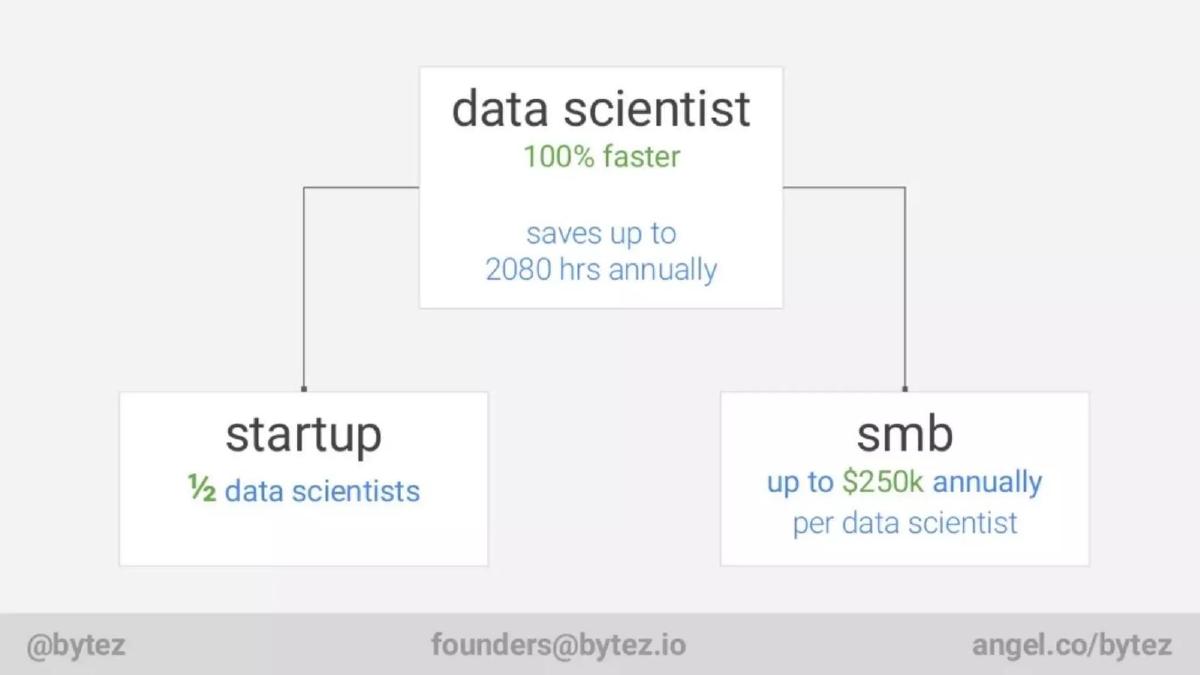
- The deck identifies a massive efficiency gap, claiming data scientists can work 100% faster and save up to 2080 hours annually (Slide 2).
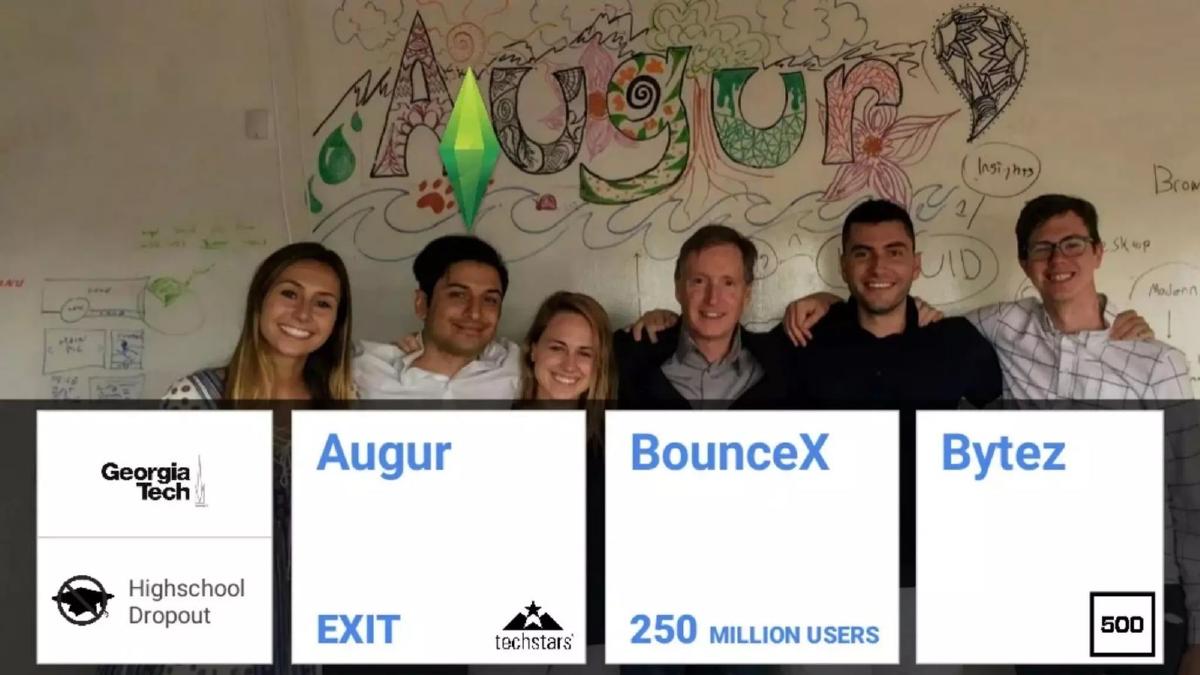
- The team slide leverages social proof by highlighting a previous exit (Augur), a high-user-count project (BounceX), and affiliation with 500 Startups (Slide 3).
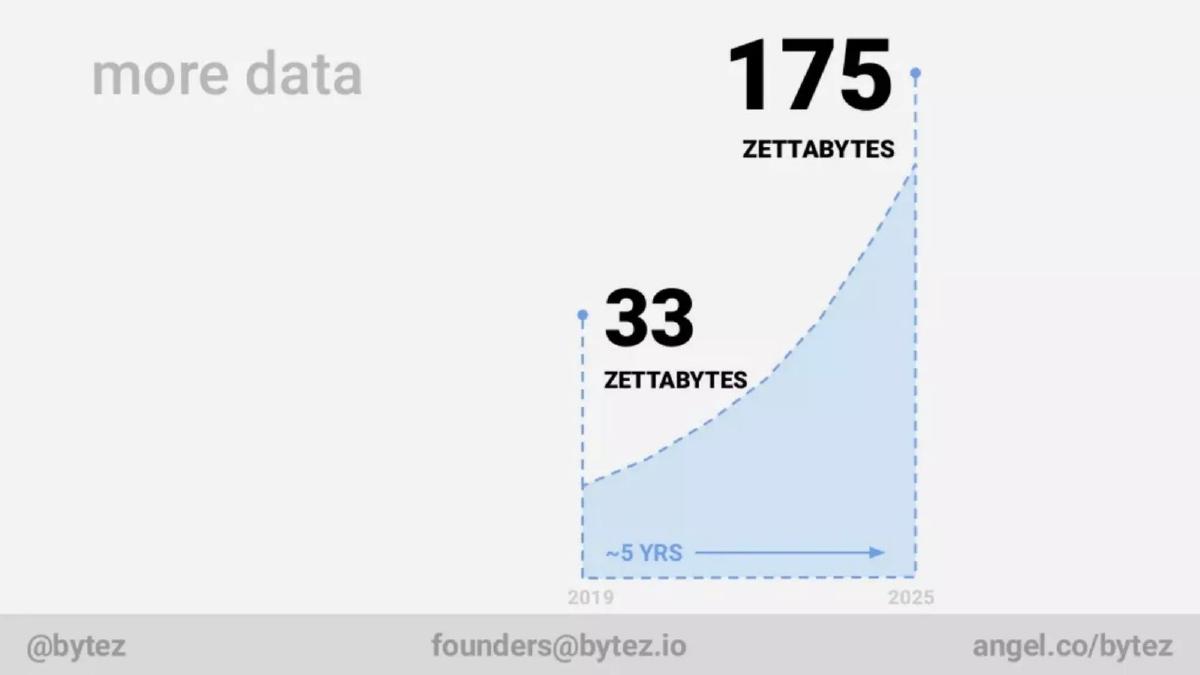
- Market growth is visualized through a projected increase in global data from 33 to 175 zettabytes between 2019 and 2025 (Slide 4).
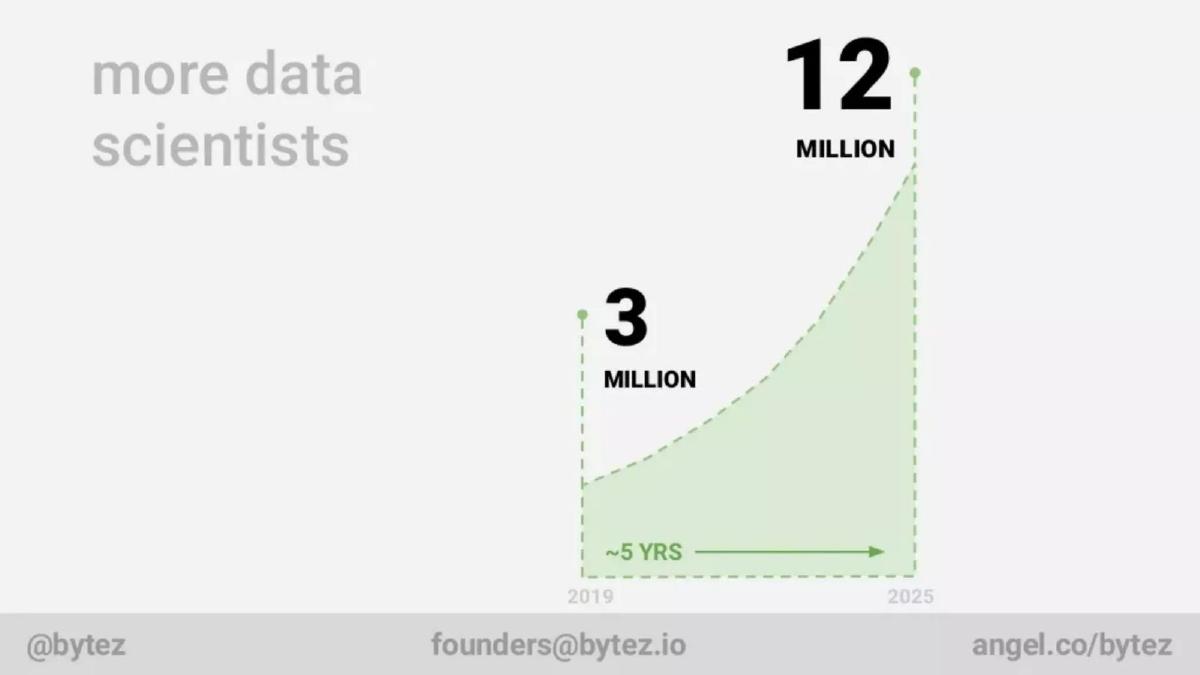
- The talent gap is emphasized with a forecast of data scientists growing from 3 million to 12 million over a five-year period (Slide 5).
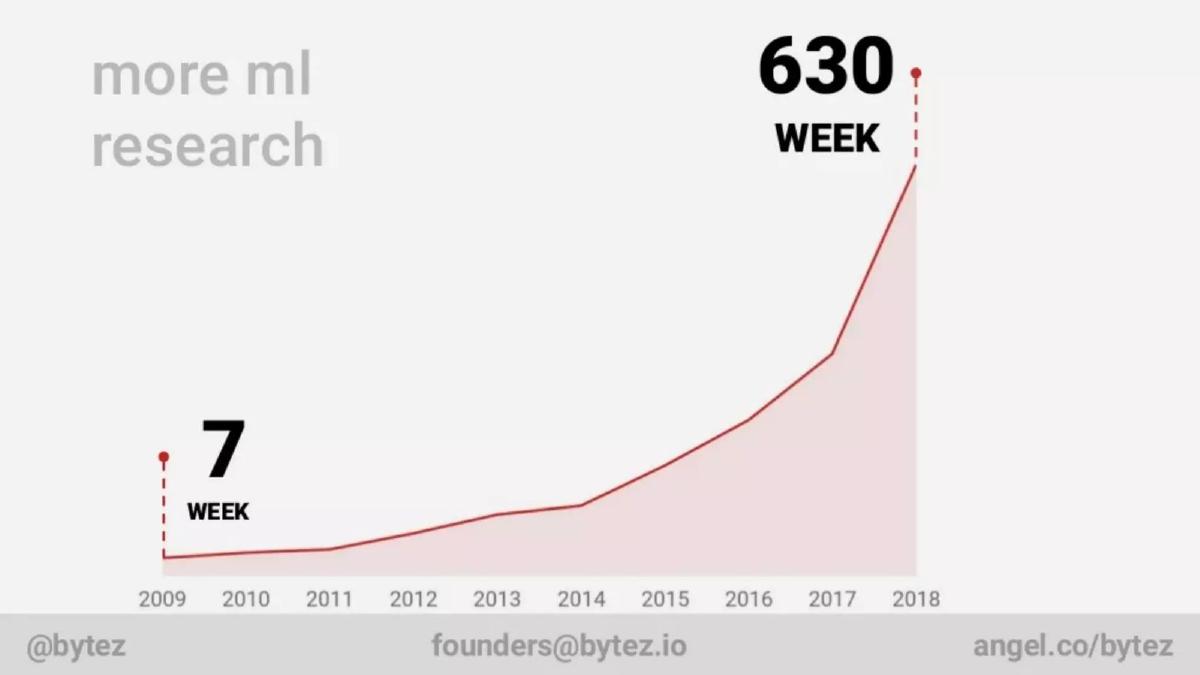
- Research volume is shown to have exploded from 7 papers per week in 2009 to over 1,000 per week by 2020 (Slides 6 and 7).
- The product is positioned as a 'Leaderboard' that tracks 'Practitioner Metrics' like training cost, inference speed, and inference cost (Slide 8).
- The value proposition is distilled into three pillars: Ready to use models, Ranked models, and models of 'All shapes & sizes' (Slide 9).
- The deck omits a formal 'Ask' slide, business model details, and a competitive landscape analysis.
Introduction: The Power of the Nine-Slide Deck
The Bytez pitch deck is a lean, 9-slide presentation that focuses on a single, powerful narrative: the machine learning world is drowning in its own success. By 2018, the explosion of deep learning research had created a paradox of choice for developers. There was too much data, too many papers, and not enough time to benchmark them all. This teardown examines how Bytez used minimalist design and macro-trend data to secure its initial $150,000 in funding.
The Hook and the Value Proposition (Slides 1-2)
Slide 1: Title The deck opens with a stark black background and a clear mission statement: "Industry Benchmark for Deep Learning." It includes contact information and a social handle, establishing a professional, developer-centric brand from the first second.
Slide 2: The Efficiency Argument Bytez immediately moves to the 'Why.' Instead of explaining the technology, they explain the savings. They claim a data scientist becomes "100% faster" and saves "up to 2080 hrs annually." They break this down by customer type: startups can function with "1/2 data scientists," and SMBs can save "up to $250k annually per data scientist." This is a bold slide that quantifies the pain point in dollars and hours rather than abstract technical terms.
The Team and the Market Context (Slides 3-5)
Slide 3: The Team The team slide is unconventional, featuring a group photo with a "Sims" crystal edited over one founder's head. However, the substance is in the logos and text below. It highlights a Georgia Tech pedigree, a Highschool Dropout (often a badge of honor in tech), and three specific track records: Augur (marked as an EXIT with Techstars), BounceX (highlighting 250 million users), and Bytez (associated with the 500 Startups logo). This provides immediate credibility to a pre-seed investor.
Slide 4: More Data This slide establishes the macro environment. It shows a growth curve of global data from 33 Zettabytes in 2019 to 175 Zettabytes by 2025 . The message is clear: the raw material for machine learning is growing exponentially.
Slide 5: More Data Scientists To process that data, the world needs more people. This slide projects the number of data scientists growing from 3 million to 12 million over a five-year period. Bytez is positioning itself to serve a market that is quadrupling in size.
The Research Explosion (Slides 6-7)
Slide 6: More ML Research (2009-2018) This is the core of the Bytez problem statement. In 2009, there were only 7 research papers per week . By 2018, that number hit 630 per week . The chart shows a hockey-stick growth curve that makes manual tracking look impossible.
Slide 7: More ML Research (2020 Projection) The deck doubles down on the previous slide, projecting that by 2020, there will be 1,000's every week . This creates a sense of urgency. If a company doesn't have a tool like Bytez, they are guaranteed to fall behind the state-of-the-art research.
The Product and Vision (Slides 8-9)
Slide 8: Leaderboard for the Deep Learning Race This slide shows the actual product interface. It is a table comparing different models (e.g., Google's XLNet vs. Fast.ai's ULMFiT). Crucially, it highlights "Practitioner Metrics"—things a developer actually cares about: Training cost ($245,000 vs $7), Inference speed (100 ms vs 300 ms), and Inference cost . It also shows icons for Python code, Docker containers, and model weights, signaling that this is a "ready-to-use" platform.
Slide 9: Conclusion The final slide summarizes the offering: Ready to use , Ranked models , and All shapes & sizes . The tagline "Valuable today, Invaluable tomorrow" reinforces the growth trends mentioned earlier in the deck. It ends with the same contact info as the first slide.
What Works in the Bytez Deck
The most successful element of this deck is its clarity of purpose . Bytez doesn't try to explain how their ranking algorithm works or the specifics of their infrastructure. Instead, they focus on the "Information Overload" problem. Every data scientist knows the frustration of trying to keep up with ArXiv papers; Bytez promises to solve that frustration.
The use of external data (Zettabytes of data, millions of data scientists) anchors the startup in a massive, undeniable trend. It makes the success of the company feel like an inevitability of the market's growth rather than a gamble on a specific feature. Additionally, the Practitioner Metrics on Slide 8 are highly specific. Mentioning the $245,000 training cost for a Google model versus the $7 cost for a Fast.ai model immediately demonstrates the value of a comparison tool.
What Is Missing from the Bytez Deck
Despite its effectiveness in raising a pre-seed round, the deck has several glaring omissions that would likely be required for a Seed or Series A round:
Business Model: There is no mention of how Bytez makes money. Is it a subscription? Do they take a cut of compute costs? Is it an enterprise license? · The Ask: The deck does not state how much money they are looking for or what the milestones for that funding will be. · Competition: The deck ignores other model hubs or benchmarking sites (like Papers with Code, which was gaining traction around the same time). · Traction: Aside from the team's past successes, there are no metrics regarding current Bytez users, waitlist numbers, or pilot programs. · Unit Economics: There is no discussion of the cost to acquire a user or the lifetime value, which is expected as the company matures.
What a Founder Should Copy
Founders in highly technical spaces should copy the "Problem Quantification" found on Slide 2. Don't just say your tool is "faster"; say it saves 2080 hours a year. This gives investors a concrete number to use when calculating the potential ROI of the software.
Another takeaway is the visual storytelling of market trends . Slides 4 through 7 use very little text but tell a compelling story of a world that is becoming increasingly complex and data-heavy. Using simple, color-coded charts to show that "the old way" (7 papers a week) is dead and "the new way" (1,000 papers a week) requires new tools is a highly effective way to build a narrative.
Finally, the Team Slide (Slide 3) is a great example of how to use "Social Proof" effectively. Even if you don't have a massive exit yet, highlighting your university, your participation in top-tier accelerators (500 Startups), and the scale of your previous projects (250 million users) builds a wall of credibility that makes the rest of the pitch easier to swallow.
Conclusion
The Bytez deck is a product of its time—the early days of the AI boom—but its lessons remain relevant. It prioritizes the "Why Now?" and the "Who?" over the "How?" For a pre-seed company, showing that you understand the market's direction and have the pedigree to build for it is often more important than a 50-page financial model. Bytez kept it simple, kept it visual, and kept it focused on the practitioner's pain.
Frequently asked questions
- How much did Bytez raise with this deck?
- According to the catalogue facts, Bytez raised $150,000 in 2018 during a pre-seed round. The deck itself does not state the amount being raised or the valuation, which is common for early-stage decks used in demo days or as introductory teasers.
- What is the core problem Bytez is solving?
- The problem is the 'Deep Learning Race' inefficiency. As shown on slides 6 and 7, the volume of machine learning research has grown from 7 papers a week to over 1,000. This makes it impossible for developers to know which models are actually cost-effective or performant for their specific needs.
- Who is the target audience for the Bytez platform?
- The deck specifically targets three segments on slide 2: individual data scientists, startups (who can supposedly operate with half the data scientists), and SMBs (who could save up to $250k annually per data scientist).
- What metrics does the Bytez 'Leaderboard' track?
- As illustrated on slide 8, the platform focuses on 'Practitioner Metrics.' These include the error rate, training time to 95% accuracy, training cost (ranging from $7 to $245,000 in their examples), inference speed, and inference cost.
- Is there a business model included in the deck?
- No. The 9-slide deck focuses entirely on the problem, the market trends, the team, and the product interface. It does not explain how the company intends to generate revenue, whether through a SaaS subscription, API usage fees, or a marketplace model.