Airbnb's deck succeeded through extreme simplicity. It framed the problem around price, cultural disconnection, and access, then presented a web platform as the cure. The deck validated the market using proxies like Craigslist, proposed a clean '10% commission' business model, and tied its $500K ask directly to achieving 80,000 transactions. It is a benchmark for clear, concise storytelling.
Key takeaways
- Define the problem in human terms. 'Price,' 'disconnected from culture,' and 'no easy way to book' are universal pain points, not niche tech issues.
- Validate your market with proxies if you lack direct competitors. Citing Craigslist's 50,000 listings and Couchsurfing's 660,000 users was a brilliant way to prove demand existed.
- A simple business model wins. 'We take a 10% commission' is impossible to misunderstand and shows a clear, scalable path to revenue.
- Use a competitive matrix to create your own category. Their 2x2 matrix (Affordable/Expensive vs. Online/Offline) positioned them alone in the 'Affordable' and 'Online' quadrant, defining the space.
- Tie your fundraising ask to a single, tangible milestone. They asked for $500K to facilitate 80,000 transactions, making the use of capital concrete and measurable.
- Your team slide must answer 'Why you?' Airbnb covered the three pillars: design (Gebbia), business (Chesky), and engineering (Blecharczyk). This is the minimum viable team.
- Early traction can be press and testimonials. Before metrics, social proof from publications like Mashable and quotes from real users demonstrated validation.
The Moment That Almost Wasn't
Before Airbnb was an $85 billion public company, it was AirBed & Breakfast, an idea born out of necessity when its founders, Joe Gebbia and Brian Chesky, couldn't afford their San Francisco rent. This was 2008. The financial world was imploding. The idea of sleeping in a stranger’s home was fringe, associated more with free couch-surfing than a legitimate business. To fund their company, they were designing and selling novelty political breakfast cereals—Obama O's and Cap'n McCain's. This pitch deck was their shot at escaping the cereal business and getting real capital.
They were looking for $500,000. For this, they offered a piece of a company with minimal traction, built on a concept investors had repeatedly rejected as niche, unsafe, and unscalable. Yet, in March 2009, after a formative stint at Y Combinator, they closed a $600,000 seed round led by Sequoia Capital and Y Ventures. This deck was a core part of that journey. It is a masterclass in narrative simplicity. It doesn’t have the sophisticated metrics or design of a modern deck, and that is precisely why we must study it. It shows how to convey a massive vision with almost nothing but the idea itself. It succeeded not because of its polish, but because of its unassailable logic and clarity in a world that was not yet ready to believe.
The Problem
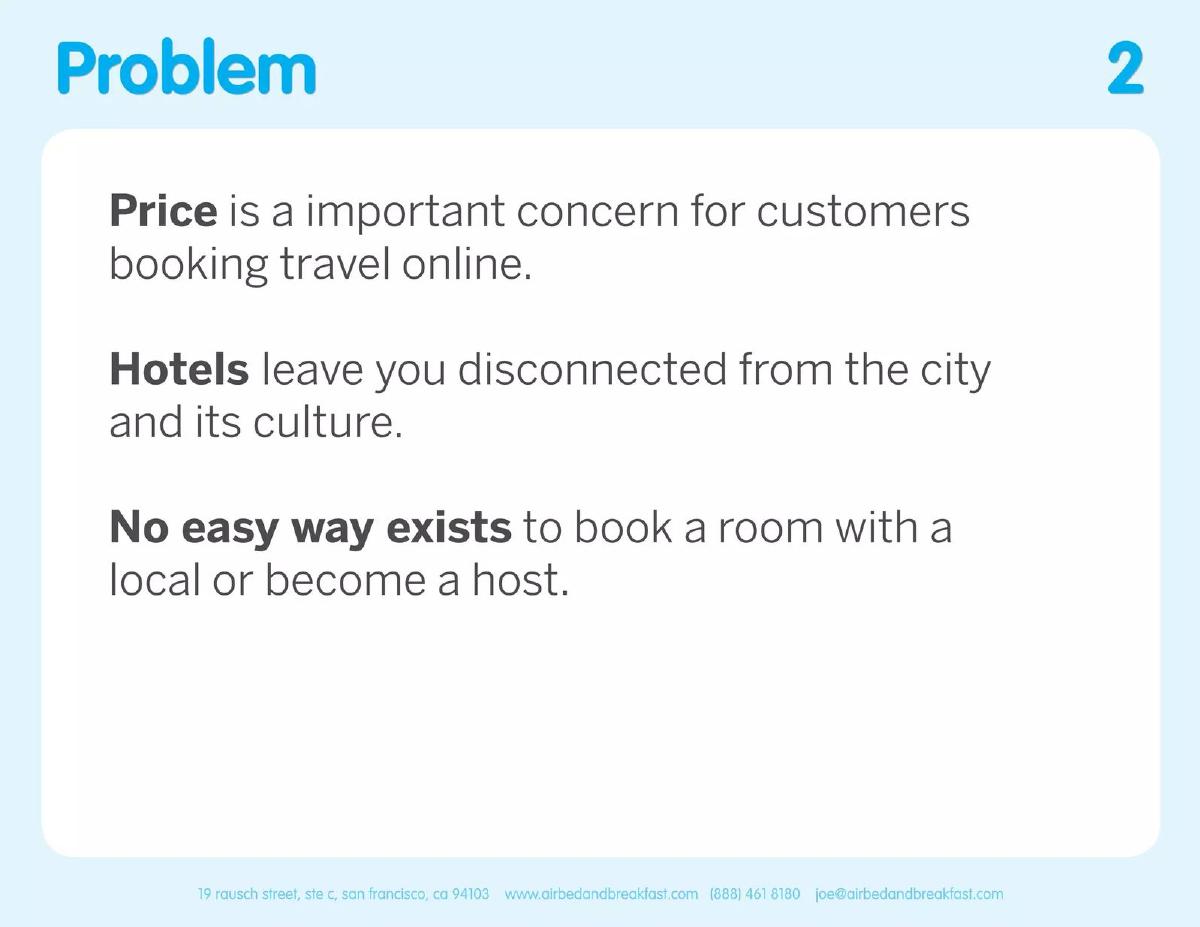
The deck opens with a three-pronged problem statement. This is a classic structure I advise founders to use. It’s digestible and easy to recall. First, they target price. Hotels are expensive. This is a universal, easily understood pain point for a massive segment of travelers. It immediately grounds the pitch in a relatable financial reality. It’s not a theoretical problem; it’s a budget problem.
Second, they address a cultural disconnect. Hotels, they argue, isolate you from the city and its people. This was the unique insight. While others were focused purely on the transaction of booking a room, the Airbnb founders identified a deeper, more emotional pain point. Travelers want authenticity, not just a bed. This elevated the pitch from a simple cost-saving tool to a cultural movement. It gave the business a soul and a mission beyond just being a cheaper alternative.
Finally, they state a clear logistical problem: there is no easy way to book a room with a local. They mention existing platforms like Craigslist are clunky, anonymous, and lack a proper transaction layer. This third point establishes the market gap. They've identified a financial pain (price), an emotional pain (culture), and a functional pain (usability). By framing the problem this way, they created a perfect setup for their solution to address each point directly. It’s a textbook example of defining the "why" before the "what."
The Solution
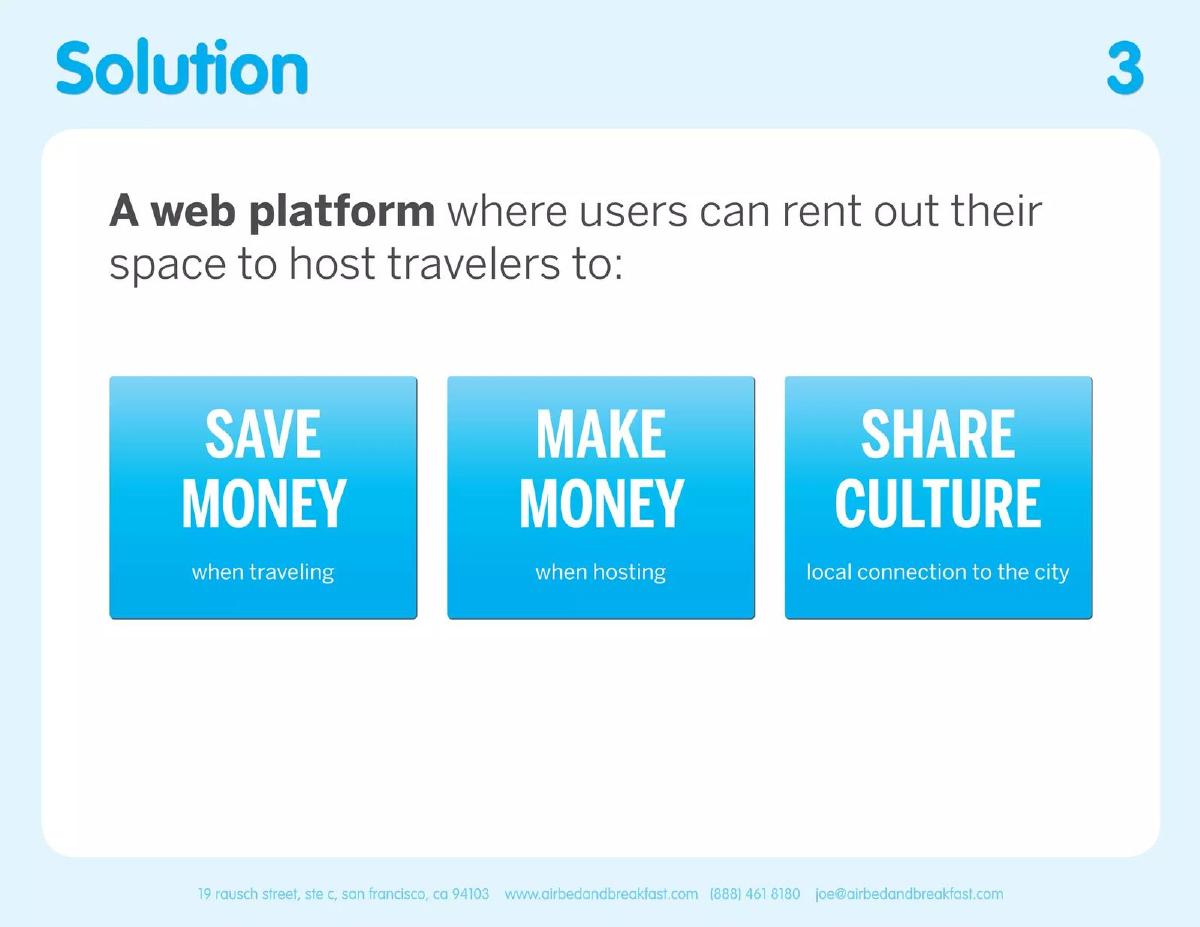
The solution slide is a direct mirror to the problem slide. It’s structured to answer each of the three problems in the same order, creating a satisfying and logical narrative loop for the investor. The core of the solution is presented as "A web platform where users can rent out their space to host travelers." This is the functional "what." It’s simple, direct, and leaves no room for confusion.
To address the price problem, the solution offers a simple benefit: "Save money when traveling." For the cultural problem, the benefit is to "Share culture" and have a local connection. And for the logistical problem of hosting, the platform provides a way to "Make money when hosting." Notice the symmetry. They are not just solving problems for travelers; they are creating value for hosts. This is the critical insight of a two-sided marketplace. You must articulate the value proposition for both supply (hosts) and demand (travelers) on the same slide. Many founders forget this, focusing only on the customer.
This slide is effective because it avoids feature-listing. It focuses entirely on benefits. It doesn’t talk about the technology stack or specific search filters. It talks about saving money, making money, and connecting with a local culture. These are outcomes, not features. Investors, especially at the seed stage, invest in outcomes. The simplicity here is its greatest strength.
Market Validation
This is where the deck shows its resourcefulness. With little to no traction of their own, the founders needed to prove that the behavior of staying in a stranger's home was already happening at scale. They used proxy data to validate the market. This is a critical lesson for founders who are pre-revenue or pre-product. You must find evidence of the behavior you intend to monetize.
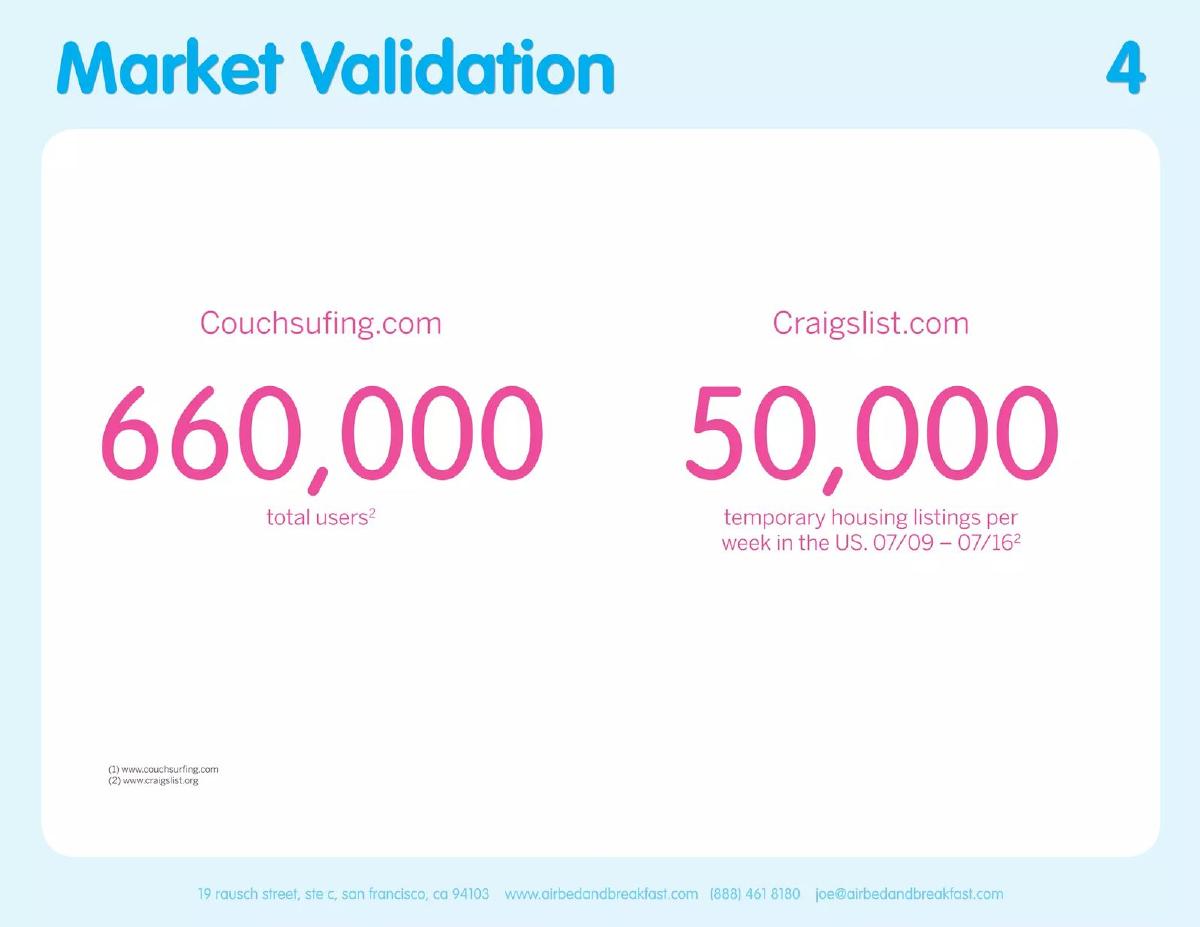
They used two primary data points. First, they pointed to a competitor that proved the behavior, even without a business model.
This was a brilliant move. Couchsurfing proved that hundreds of thousands of people were willing to sleep in a stranger's home for free. The implicit argument is powerful: if this many people will do it for an authentic experience with no money involved, imagine how many would do it if there were a financial incentive for the host and a more reliable system for the guest.
Second, they pointed to a large, clunky incumbent to quantify the transactional market.
Craigslist.org 50,000 temporary housing listings per week in the US
This data point proved that there was existing, high-intent commercial activity in the temporary housing market. However, anyone who had used Craigslist knew the experience was terrible. By citing Craigslist, Airbnb was implicitly saying, "There is a massive, underserved market here, and we can win it with a better product." They found the demand and used it to justify building a superior supply platform.
Market Size
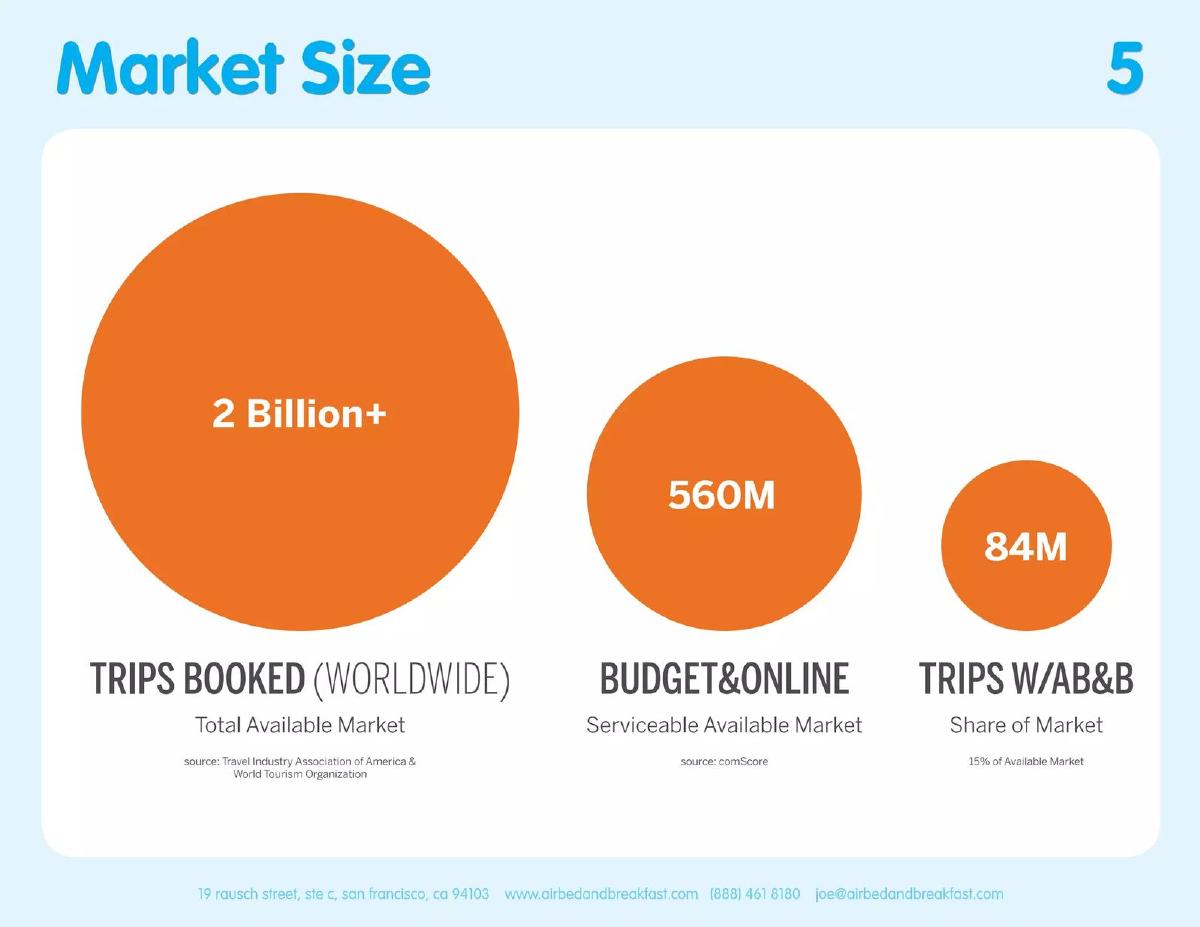
The market size slide employs a classic top-down TAM, SAM, SOM model. It's ambitious and, by today's standards, lacks the bottoms-up validation investors prefer. However, it served its purpose: to show the venture-scale potential of the idea.
TAM: 2 Billion+ trips booked worldwide · SAM: 560M budget & online · SOM: 84M trips w/AB&B target
The Total Addressable Market (TAM) of "2 billion+ trips" is a huge, impressive number meant to anchor the conversation in a massive global industry. It tells the investor that they are not playing in a small pond. The Serviceable Addressable Market (SAM) then narrows the focus to "560M budget & online" trips. This segmentation shows the founders have thought about their specific target segment—travelers who are both price-sensitive and digitally native.
The most important—and audacious—number is the Serviceable Obtainable Market (SOM), where they project capturing 84 million trips, or 15% of the SAM. Claiming you can capture 15% of a market is a bold move. In 2024, a founder presenting this without deep, bottoms-up analysis would be grilled relentlessly. A bottoms-up forecast would look something like: (Number of target cities) x (Avg. number of potential hosts per city) x (Avg. rooms per host) x (Avg. occupancy rate) x (Avg. nights per booking) = Total Bookable Nights. This demonstrates a granular understanding of the business levers.
While the top-down approach in this deck is simplistic, it succeeded in 2008 because it communicated one thing clearly: the opportunity was astronomical. For a seed-stage investor in a high-risk, unproven concept, the potential upside has to be enormous to justify the risk. This slide did that job.
Product
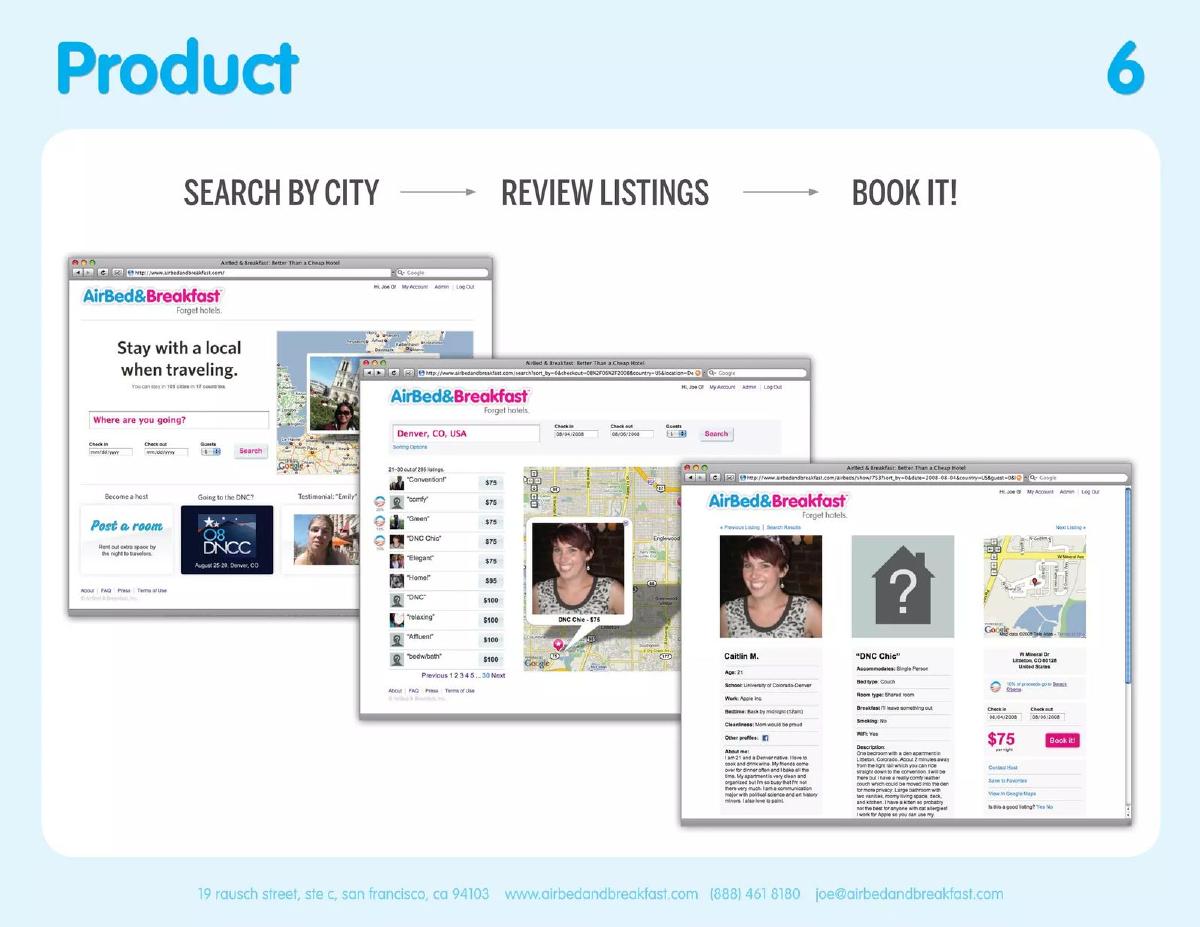
The product slide is almost comically simple. It presents the user experience in three steps: "Search by city," "Review listings," and "Book it." It is accompanied by clean, unadorned screenshots of the website. There is no jargon, no talk of architecture, no complex user flows. This is a lesson in radical clarity.
The power of this slide is that it proved the product existed and worked. It was not just an idea on a napkin. It showed a functional, user-friendly interface that was already a significant improvement over the chaos of Craigslist. The design, clean and simple even in this early form, reflected the RISD background of two of its founders. It implicitly communicated a commitment to user experience, which would become one of Airbnb's most powerful competitive moats.
In a modern pitch, a product slide would likely include a link to a live demo or a short video walkthrough. It might also show key product metrics like user engagement or conversion rates. But in 2008, for a company with almost no users, showing a polished, working MVP was enough. It de-risked the technical execution and allowed investors to imagine themselves using the product. The simplicity made the entire concept feel less daunting and more inevitable.
Business Model
This is one of the most effective and clear slides in the entire deck. It answers the fundamental investor question—"How do you make money?"—in a single line: "We take a 10% commission on each transaction." It is unambiguous and easy to model. There are no complex tiers, ad revenues, or enterprise licenses. Just a simple, scalable, transaction-based fee.
The slide then connects this model back to their market size projection to calculate a potential revenue figure. 84M trips × $25 avg fee = $2.1B projected revenue
This projection, showing a path to billions in revenue by 2011, is pure early-stage fantasy. No one in the room believed they would hit $2.1 billion in three years. But that's not the point. The point is to demonstrate the mechanics of how this could become a billion-dollar company. The formula is sound: (volume of transactions) x (average commission) = revenue. By showing this simple math, they allowed investors to plug in their own, more conservative assumptions and still arrive at a venture-scale outcome.
This is a critical takeaway for founders. Your business model slide should not be a spreadsheet. It should be a simple equation that explains how your company's core activity generates revenue. The simpler the model, the easier it is for an investor to believe it can scale.
Adoption Strategy
Often called the Go-To-Market slide, this is where a company proves it has a credible plan to acquire customers. Airbnb's strategy was a mix of clever, unscalable guerilla tactics and more traditional partnerships. This combination showed both scrappiness and strategic thinking. Their first tactic was targeting events. They recognized that large events create moments of peak demand for accommodation where hotels are sold out or overpriced. This was a brilliant "point-of-need" strategy.
Their second strategy was partnerships. They mention targeting alternative travel sites like Kayak and GoLoco. This showed an understanding of the ecosystem and a plan to tap into existing pools of their target demographic. But the most legendary part of their strategy was what they called the "dual-posting feature" for Craigslist. They planned to build a tool that would allow a host to easily post their Airbnb listing to Craigslist as well. This was a growth hack of the highest order. They were planning to leech growth from the very incumbent they sought to disrupt. It was a clear, actionable, and asymmetric bet that showed a deep understanding of user behavior and a willingness to do what it takes to win.
Today, a GTM slide would need more detail on customer acquisition cost (CAC), lifetime value (LTV), and channel-specific metrics. But in 2008, this slide demonstrated a founder's most valuable asset: creative hustle. It proved they wouldn't just sit back and wait for users to arrive.
Competition
The competition slide uses a 2x2 matrix, a tool that is now a cliché in pitch decks, often executed poorly. Here, however, it is used to devastating effect. The founders chose their axes carefully: "Affordable vs. Expensive" on the Y-axis and "Offline vs. Online transaction" on the X-axis. This was not an accident. These axes perfectly framed the market to create an open quadrant for Airbnb to occupy.
They placed hotel booking sites and vacation rental platforms like VRBO in the "Expensive / Online" box. They put offline classifieds and temporary housing brokers in the "Affordable / Offline" box. This left a glaringly empty space in the "Affordable / Online" quadrant, which they populated with only two names: Couchsurfing and themselves. By positioning Couchsurfing—a non-commercial platform—as their closest competitor in the quadrant, they implicitly highlighted their own unique value proposition: they were the only ones facilitating an affordable, online transaction. It’s a brilliant piece of visual rhetoric. It dismisses the hotel industry as too expensive and Craigslist as too clunky, and defines a new category where they are the sole commercial player.
Founders today often create self-serving matrices with meaningless axes like "Hard to Use vs. Easy to Use." The Airbnb deck is a reminder of how it should be done. The axes must represent the two most critical dimensions of customer value, and they must carve out a distinct and defensible position for your company.
Competitive Advantages
Following the competition slide, this slide answers the inevitable question: "Why will you win?" It’s a bulleted list that directly builds on the narrative already established. They claim several advantages, but a few stand out as critical. First, they claim to be the "1st to market" for transaction-based temporary housing online. While not entirely true (VRBO existed), they framed it in the context of the "affordable," peer-to-peer space they defined, making the claim feel credible.
The most important point is "Host Incentive." This is their core differentiator against their closest conceptual competitor, Couchsurfing. By allowing hosts to make money, they created a powerful engine for supply growth that Couchsurfing, by its very ethos, could never replicate. This is a true, sustainable competitive advantage. Then they list product-based advantages like "List once" (vs. Craigslist's daily reposting), better search, user profiles, and superior design. These points reinforce the message that they are not just a better idea, but a better product.
This slide works because it’s a mix of market positioning ("first to market"), business model ("host incentive"), and product ("ease of use"). It presents a multi-layered defense against competitors. The lesson is that your "moat" isn't a single thing. It's a combination of factors that, together, make your business hard to replicate.
The Team
For any pre-traction company, the team is the product. Investors are betting on the people. This team slide, while simple, is exceptionally strong. It presents three co-founders with perfectly complementary skill sets, a classic triad that I have seen succeed time and again at my firm, Panthera Advisors. Joe Gebbia is listed with a background in design from RISD. Brian Chesky has a similar background, focused on business and brand. Nathan Blecharczyk is the technical anchor, with a computer science degree from Harvard.
This is the "Hustler, Hipster, and Hacker" combination before the terms were popularized. You have the design and user experience focus (the "Hipster"), the business and vision lead (the "Hustler"), and the engineering talent to build it (the "Hacker"). An investor looking at this slide sees a self-sufficient unit. They don't have to worry about a key non-technical founder needing to hire an expensive CTO. The core competencies are all in the room. The inclusion of Michael Seibel, then CEO of Justin.tv (and now a Managing Director at Y Combinator), as an advisor adds another layer of critical validation. It showed they were resourceful enough to attract guidance from an experienced operator in the tech world.
The Ask
The final crucial slide is the financial ask. This is where many founders falter, but Airbnb nailed it. They state a clear ask with a clear purpose.
Raising $500K angel round for 12 months to reach 80,000 transactions.
This is a textbook example of a milestone-based ask. They are not asking for money to "cover salaries" or "fund marketing." They are asking for a specific amount of capital to achieve a specific, measurable business outcome. This is exactly what investors want to see. It shows that the founders are disciplined and goal-oriented. It turns the investment from a speculative bet into a purchase of a specific set of milestones.
Furthermore, they connect this milestone directly back to revenue: "80K trips × $25 avg fee = $2M revenue." This ties the entire narrative together. The investment of $500,000 will unlock a run-rate of $2 million in revenue within 12 months. This presents a compelling ROI to an investor. Whether the numbers were achievable is secondary. The structure of the ask—linking capital to a key performance indicator that drives revenue—is what created confidence. It’s a formula I coach founders on relentlessly in "The Art of Startup Fundraising."
What Worked
Narrative Simplicity: The deck follows a clean, 10-slide arc from Problem to Solution to Ask. It is easy to follow and tells a single, coherent story. · Problem/Solution Mirroring: The Solution slide directly answers each of the three problems laid out in the Problem slide, creating a logical and satisfying argument. · Proxy Validation: Lacking their own traction, they brilliantly used data from Couchsurfing and Craigslist to prove that the core user behavior already existed at scale. · Visual Framing of Competition: The 2x2 matrix was a masterstroke in communication, defining a new market category ("Affordable / Online") that Airbnb could uniquely own. · The Milestone-Based Ask: Connecting the $500K ask to a specific business outcome (80,000 transactions and $2M revenue) de-risked the investment and showed operational discipline. · The Complementary Team: The "Hacker, Hustler, Hipster" trio of founders with engineering, business, and design skills presented a complete, self-sufficient team capable of executing.
What Would Fail in 2026
Lack of Proprietary Traction: A 2026 seed round deck could not rely solely on proxy data. Investors would expect to see initial MRR ($5k-$25k), user growth charts, and cohort retention data, no matter how early. · Top-Down Market Sizing: The TAM/SAM/SOM approach without a rigorous, bottoms-up analysis of the serviceable market would be picked apart. Investors today demand a granular understanding of unit economics and realistic market penetration. · The $600K "Seed" Round Size: In 2008, $600K was a sizable seed. In 2026, this is a pre-seed round. A modern seed round for a company with this ambition would be in the $2M to $4M range, with expectations for traction to match. · Simplistic GTM Strategy: While the Craigslist hack was clever, a modern GTM slide would need to show early data on acquisition channels, CAC, and a more detailed plan for scaling beyond guerilla tactics. · Basic Product Screenshots: While effective then, today's investors would expect a link to a polished live demo, a video walkthrough, or data on user engagement and conversion funnels within the product. · Vague Financial Projections: The simple "84M trips x $25 fee" is a vision statement. A 2026 seed deck would need a basic 3-year financial model showing key assumptions around growth, hiring, and unit economics.
Lessons for Founders Raising in 2026
Master the Simple Narrative: Complexity is your enemy. Can you tell your story in 10-12 slides, following a clear problem-to-solution arc? Cut everything that doesn't serve this central narrative. · Connect Your Ask to a Milestone: Do not ask for money to "survive." Ask for a specific amount of capital to achieve a specific, revenue-driving goal (e.g., "$2M to reach $1M ARR and 50 enterprise customers"). · Show, Don't Just Tell: Airbnb showed screenshots to prove the product existed. You must show early traction, a working demo, or at the very least, data from user interviews and smoke tests. Prove you have moved beyond the idea stage. · Frame the Market to Your Advantage: Don't just list competitors. Use a 2x2 matrix or a similar framework to define the market in a way that highlights your unique value proposition. Show where you live and why no one else can touch you there. · Build a Complete Founding Team: Investors are betting on you. Your team slide must show that you have the core competencies—typically product, technology, and go-to-market—covered by the founders. Gaps in the founding team are red flags. · Find Evidence of the Problem: If you don't have revenue, find proxy data. Point to existing behaviors, competitors' user counts, or search volume data. Prove that the pain you are solving is real and people are already trying to solve it, even with inadequate tools.
The Airbnb 2008 pitch deck is a historical artifact, a snapshot of a different era in fundraising. To copy it verbatim today would be a mistake. The bar for traction, market analysis, and financial detail has been raised significantly. However, the principles embedded within this deck are timeless. It is a powerful reminder that fundraising is not about having the most data or the fanciest design. It is about communicating a clear, compelling, and logical story. It teaches us that a deep understanding of a human problem, a simple solution, and a clear path to making money can be more powerful than any spreadsheet. For founders today, the lesson is not to replicate the slides, but to replicate the clarity.
Frequently asked questions
- Did the Airbnb pitch deck have any weaknesses?
- Yes, the financial projections were extremely aggressive. Projecting $2.1 billion in revenue within three years was a fantasy. However, the near-term ask was grounded: $500K to generate $2 million in revenue from 80,000 transactions. Investors likely focused on the credible next step, not the grand vision.
- How would this pitch deck perform in 2024?
- The core story is timeless and would still capture attention. However, investors today would demand more traction data beyond a few testimonials. The $600K they raised would be considered a pre-seed or angel round now; a modern seed round for a company with this potential would be in the $2M to $4M range and require early product-market fit signals.
- What was the single most effective slide in the deck?
- The Market Validation slide. Before they had meaningful traction, they used data from Craigslist and Couchsurfing to prove a market of people seeking and offering alternative accommodations already existed. It de-risked the central idea without them having to spend a dollar.
- Why was the 10-slide structure so effective?
- The deck follows a classic narrative: problem, solution, market size, product, business model, competition, team. It is a logical flow that answers an investor's questions in the order they think of them. There is no wasted space, forcing a level of clarity that is hard to achieve with more slides.
- What is the main lesson for founders from Airbnb's Go-to-Market slide?
- Go where your users are and be scrappy. Instead of expensive marketing, they planned to target large events where accommodation was scarce and partner with existing travel sites. The plan to build a dual-posting feature for Craigslist showed a deep understanding of user behavior and a willingness to build tools for growth.