Supernormal’s 18-slide deck is a masterclass in product-led growth (PLG) storytelling. The company positions itself not just as a tool, but as a 'System of Record for digitized meetings' (Slide 2). By showcasing a transition from a manual 1.0 version with 60,000 hours of data (Slide 5) to an automated 2.0 AI version (Slide 6), they demonstrate a clear technical moat. The deck is particularly strong in its use of specific traction metrics, such as a 72% DAU/MAU ratio and 3.8 average recordings per day per user (Slide 10). Furthermore, the inclusion of a detailed cost-efficiency chart (Slide 14…
Key takeaways
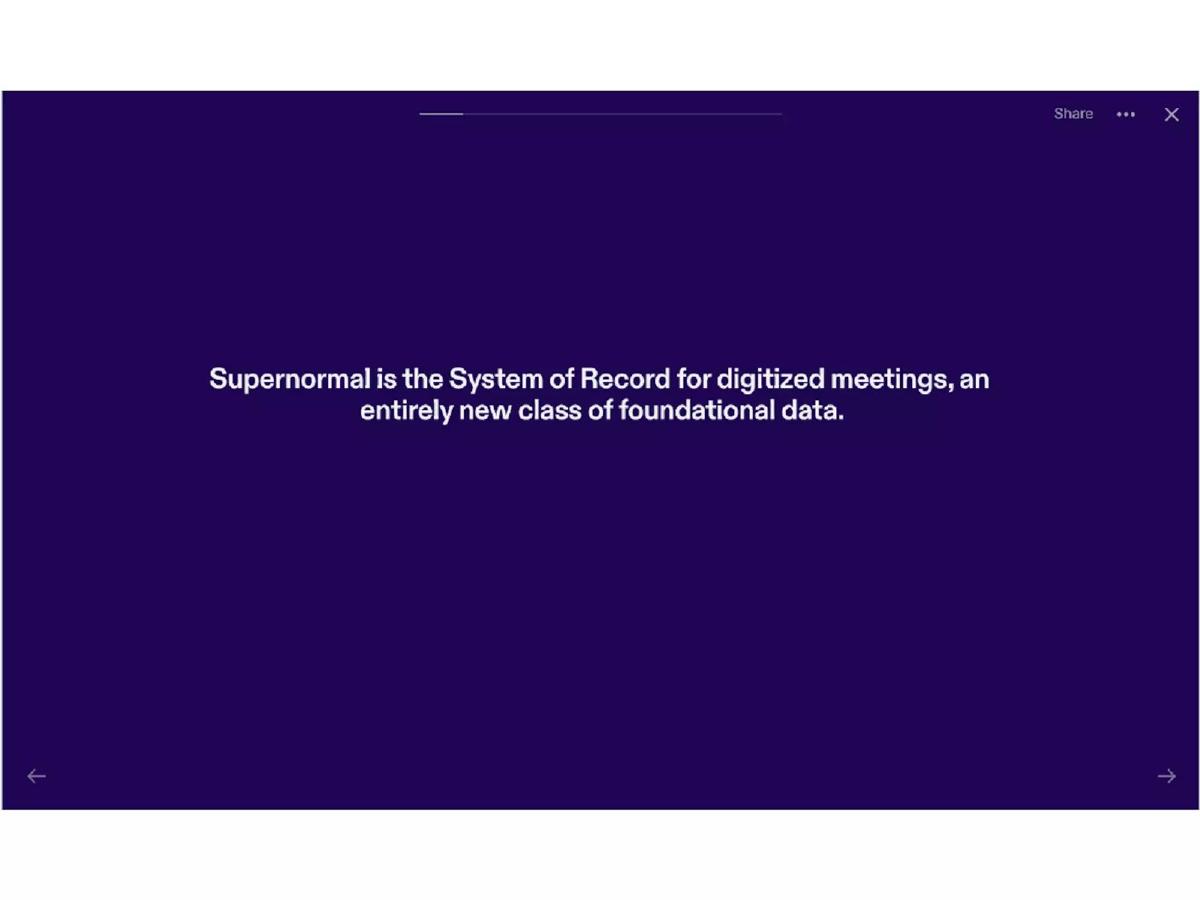
- The deck defines a new category, calling digitized meetings a 'new class of foundational data' (Slide 2).
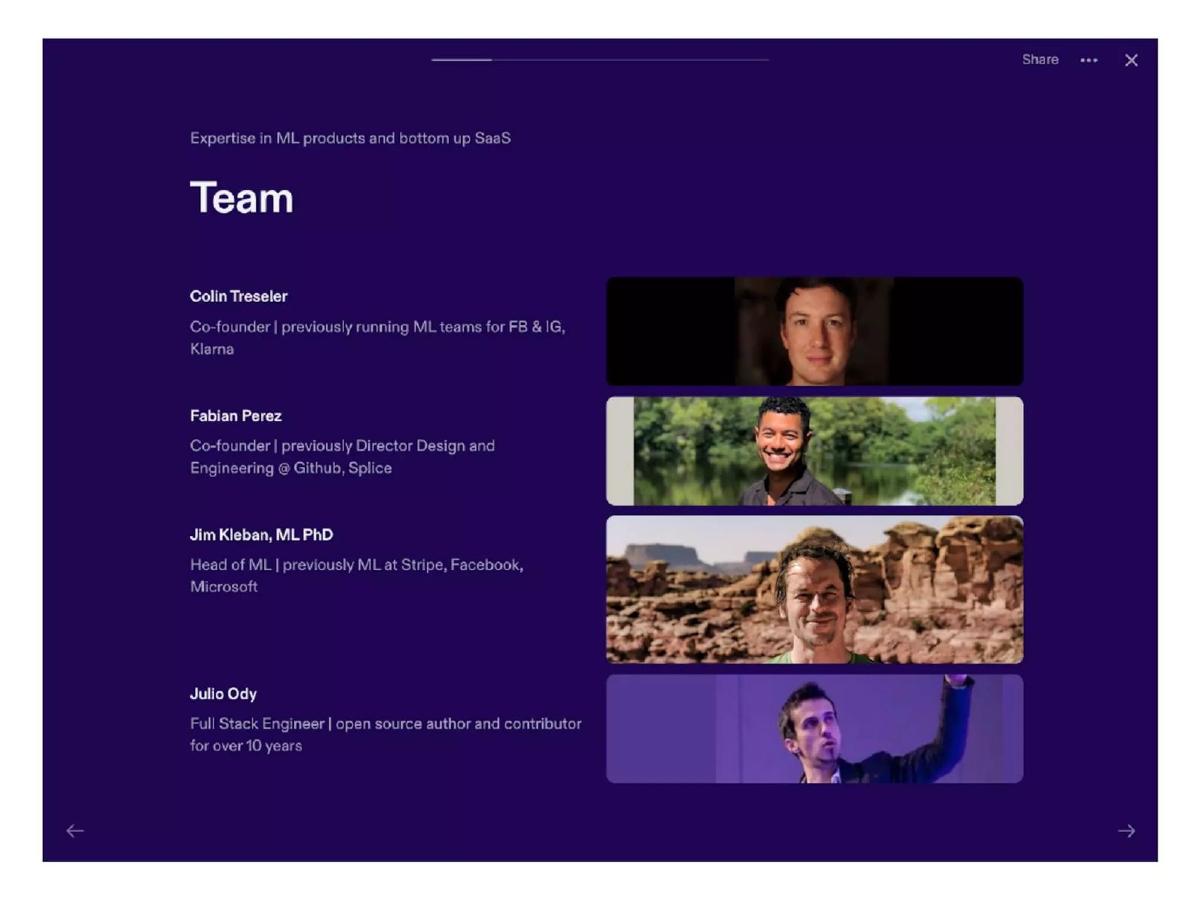
- The team slide highlights deep experience in ML and design from Facebook, Instagram, Stripe, and GitHub (Slide 3).
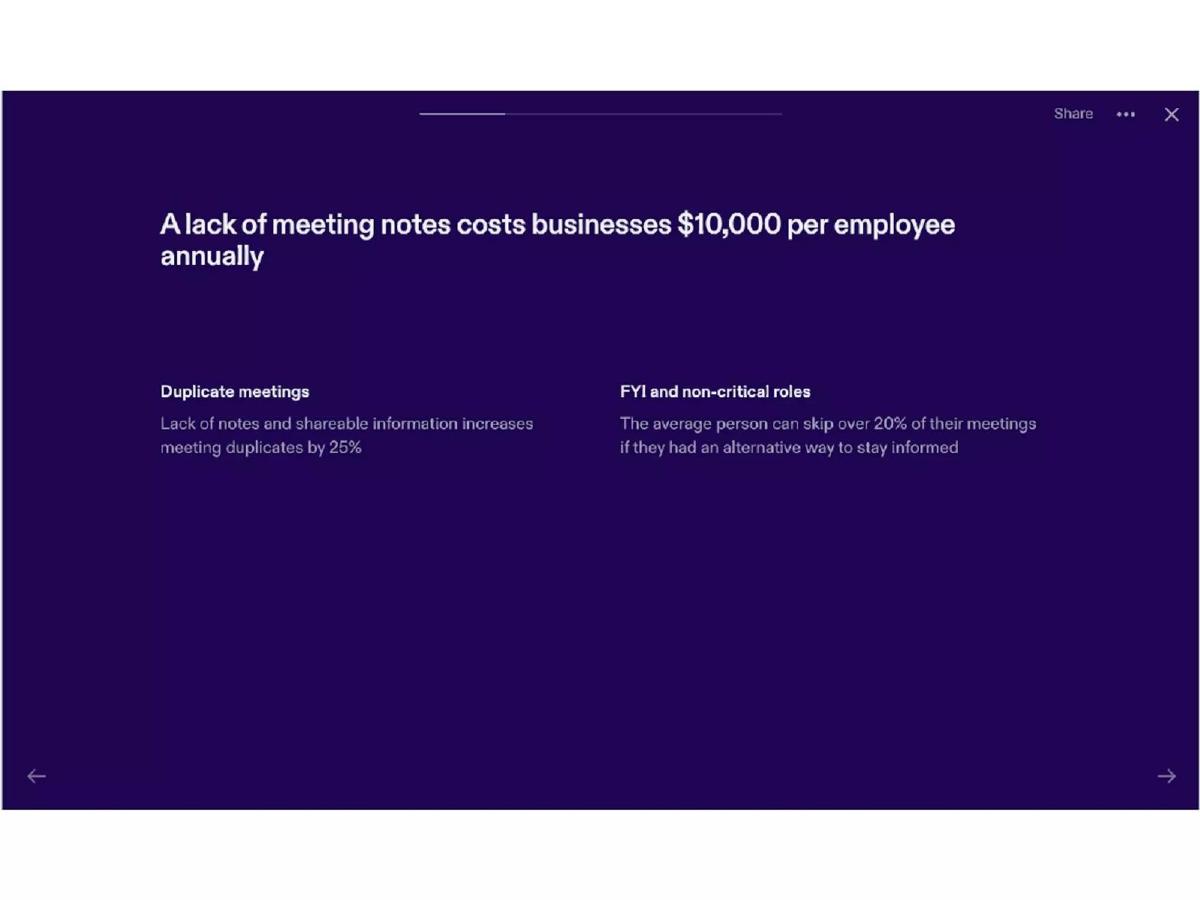
- A lack of meeting notes is quantified as a $10,000 annual cost per employee due to duplicate meetings and inefficiency (Slide 4).
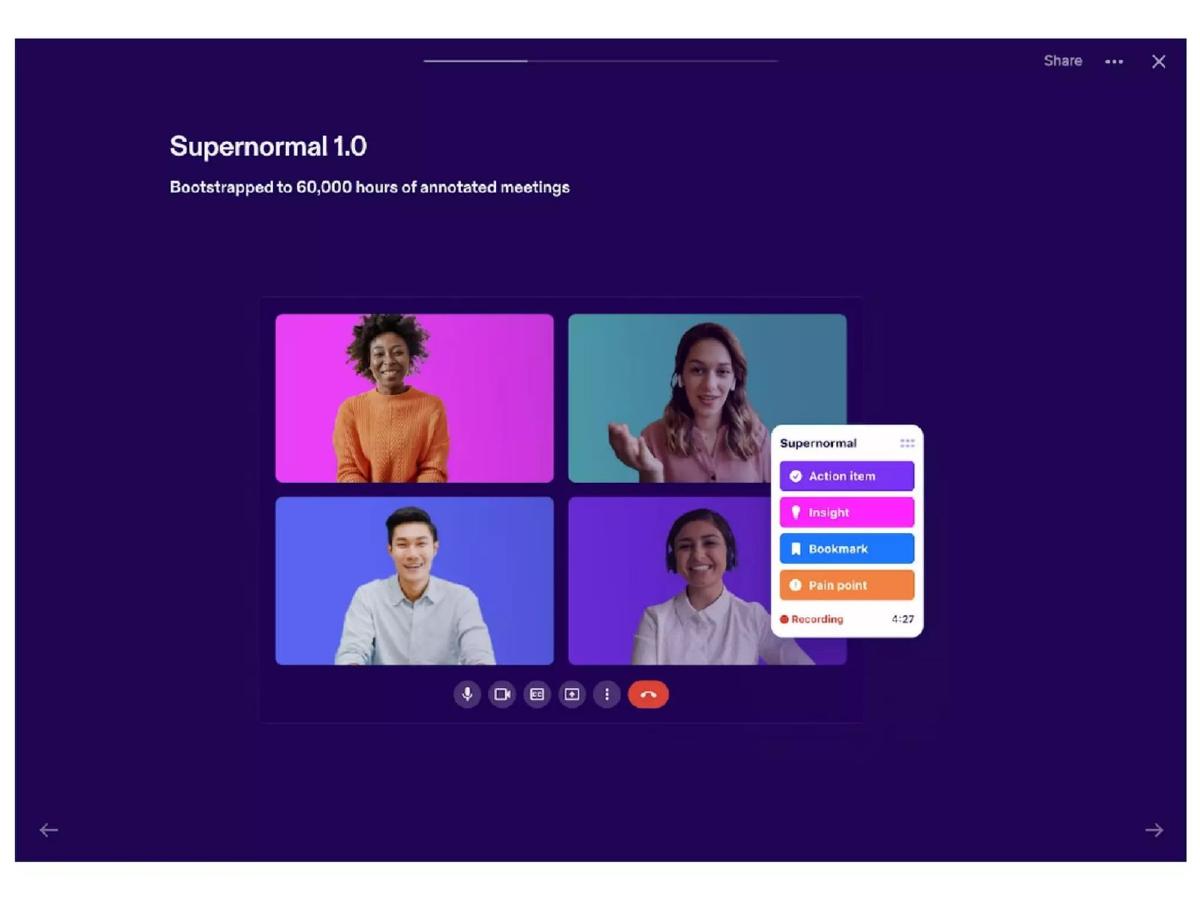
- Supernormal 1.0 provided a data moat of 60,000 hours of annotated meetings to train their automated 2.0 version (Slide 5).
- Product stickiness is exceptionally high, reported at 72% DAU/MAU (Slide 10).
- The Go-to-Market strategy relies on a 'Strong K Factor' where meeting notes are inherently viral when shared (Slide 17).
- Technical defensibility is shown through a cost-per-hour chart, projecting costs dropping toward $0.00 with on-device models (Slide 14).
- The deck lists a specific fundraising timeline, accepting term sheets from Nov 4 and finalizing by Nov 15 (Slide 13).
Executive Summary: The System of Record for Meetings
Supernormal’s pitch deck for their $10M seed round is a clinical example of how to pitch a product in a crowded space by focusing on technical moats and viral growth loops. The deck moves quickly from the problem (inefficient meetings) to a sophisticated solution that leverages a massive proprietary dataset. By the time the investor reaches the 'Ask' slide, the founders have already demonstrated high user retention, a clear path to profitability through declining AI costs, and a 'who's who' list of committed angel investors.
Slides 1-2: The Vision and Category Definition
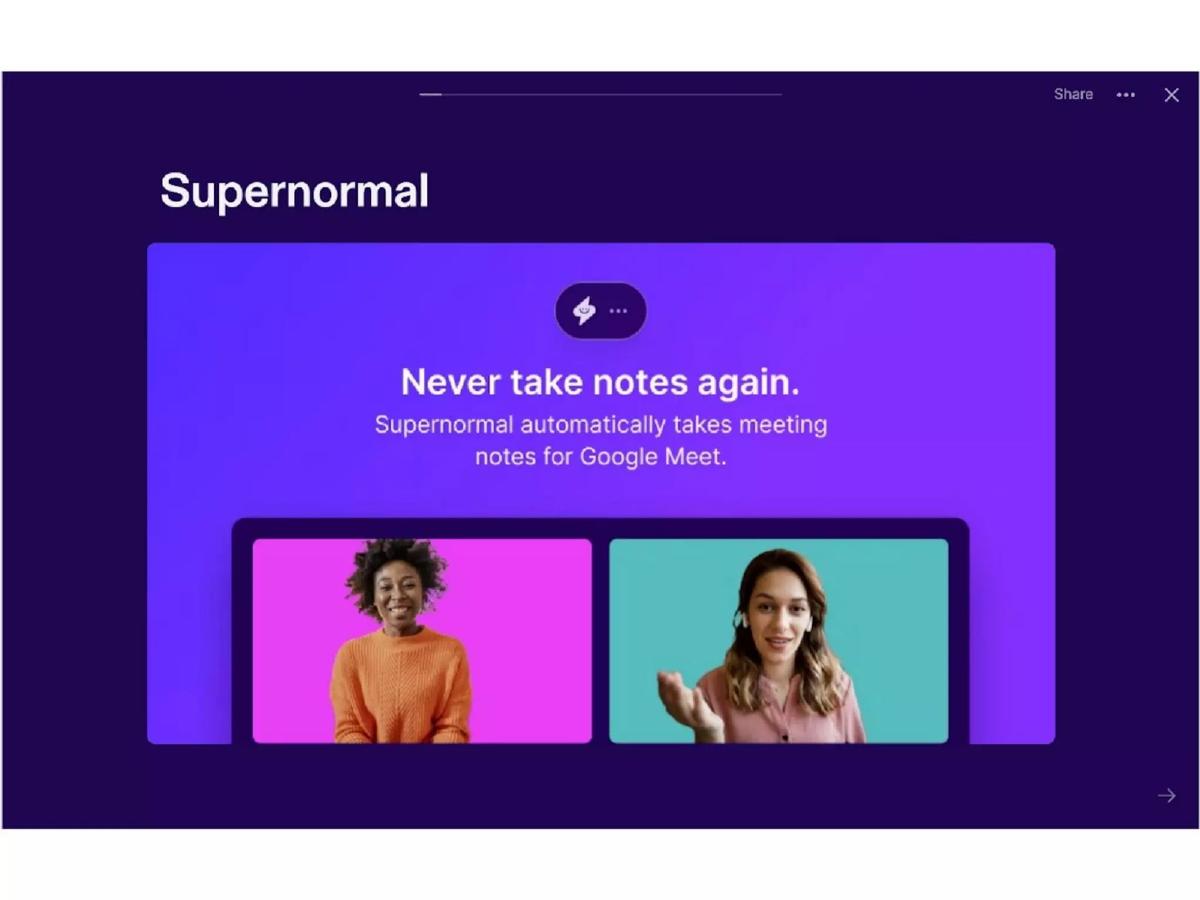
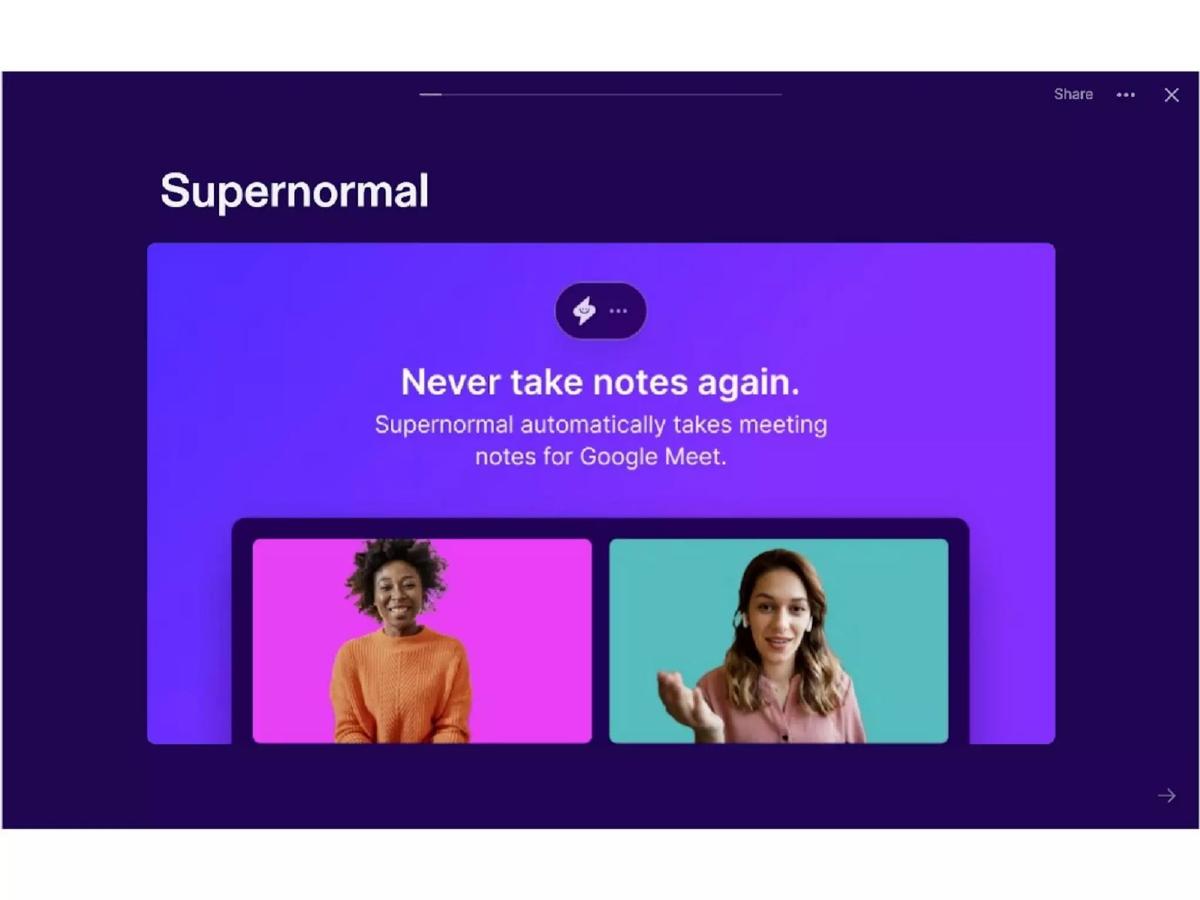
The deck opens with a simple, bold promise: "Never take notes again." Slide 1 establishes the immediate utility—automatic meeting notes for Google Meet. However, Slide 2 immediately elevates the ambition. Supernormal isn't just a utility; it is the "System of Record for digitized meetings." This is a crucial distinction for VCs. Utilities are features; systems of record are platforms. By framing meeting data as a "new class of foundational data," they suggest that the value of the company lies in the data captured, not just the transcription service.
Slide 3: The Pedigree of the Team
The team slide is positioned early, which is common when the founders have significant 'Big Tech' experience. Colin Treseler (formerly ML at FB, IG, and Klarna) and Fabian Perez (formerly Design/Engineering at GitHub and Splice) represent a balanced duo of technical and product leadership. The inclusion of Jim Kleban , an ML PhD with a background at Stripe and Microsoft, reinforces the message that this is a deep-tech AI company, not just a wrapper around a third-party API.
Slide 4: Quantifying the Pain Point
Supernormal quantifies the cost of the status quo: "$10,000 per employee annually." They break this down into two specific buckets: Duplicate meetings (increased by 25% due to lack of notes) and Non-critical roles (claiming 20% of meetings could be skipped if an alternative way to stay informed existed). This gives the sales team a concrete ROI to pitch to enterprise buyers.
Slides 5-8: The Product Evolution and Moat
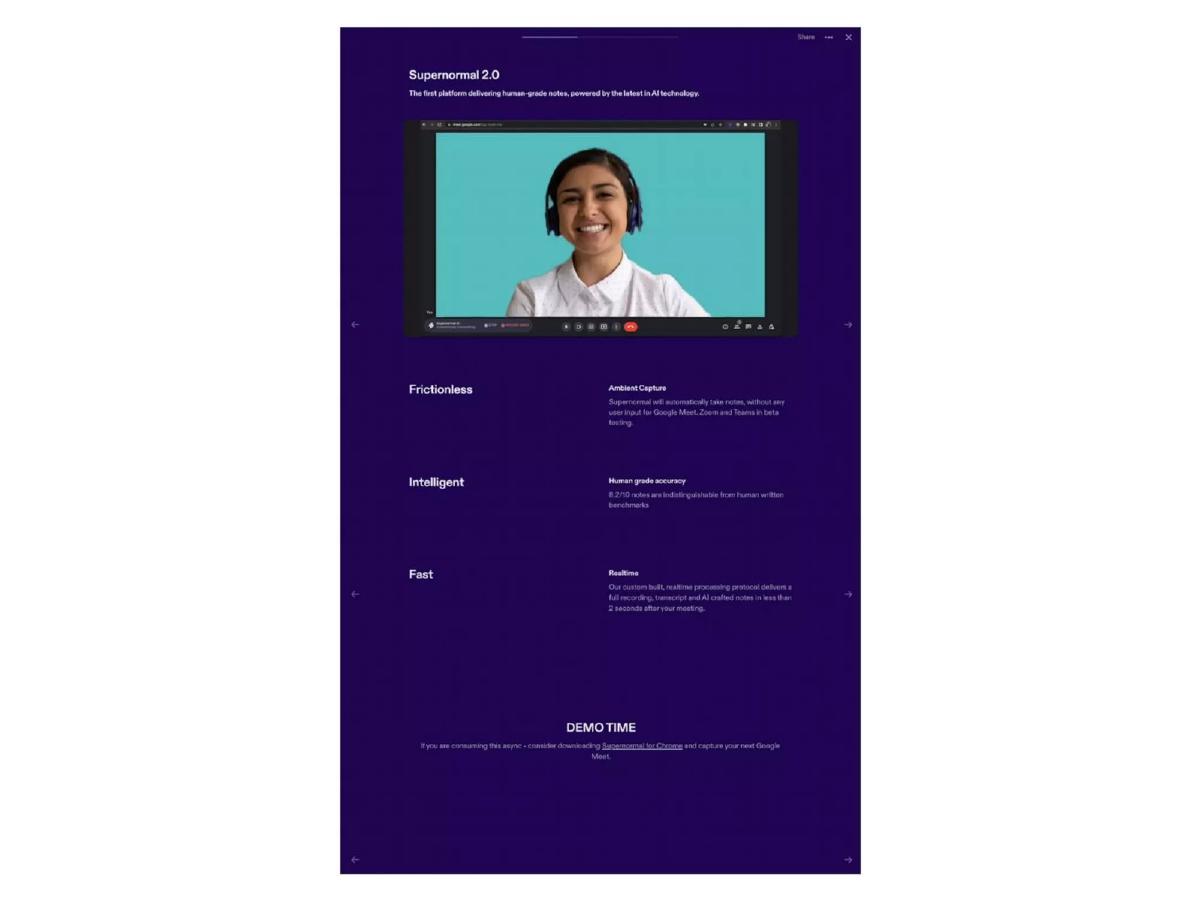
Slides 5 and 6 are the most important for technical defensibility. Supernormal 1.0 was bootstrapped to 60,000 hours of annotated meetings. This is their 'data moat.' They used this human-annotated data to train Supernormal 2.0 , which they claim delivers "human grade accuracy" (8.2/10 on their internal benchmark) and processes notes in less than 2 seconds.
Slide 7 shows the workflow: an action item is generated, and with one click, it is shared via email or Slack. Slide 8 explains the "Highly extensible" nature of the notes, divided into Summary, Decisions, and Action Items. They mention that each section is a "prompt that we run through a fine-tuned version of our base model," signaling to investors that they are not just using generic out-of-the-box LLMs.
Slides 9-11: Traction and Social Proof
Slide 9 illustrates the growth trajectory: Personal Use -> Team -> Organization. They note that a paying organization typically starts with 5 seats and doubles every 10 days. Slide 10 provides the 'hard' metrics: 72% DAU/MAU is an elite retention figure for SaaS. The 3.8 average recordings per day suggests the tool has become a daily habit for its users. Slide 11 displays a logo wall including Netflix, Salesforce, Wayfair, and Clover , proving they can penetrate top-tier enterprise accounts.
Slides 12-14: The Market Opportunity and The Raise
Slide 12 (Why Now) cites the "Macro AI environment" and the lack of automatic solutions as the primary catalysts. Slide 13 details the raise, targeting $4M ARR with 200K+ DAU. Interestingly, they include a "Process" section, creating urgency by stating they are accepting term sheets from Nov 4 and finalizing by Nov 15. This is a tactical move to drive competition among VCs.
Slide 14 is a rare and impressive unit economics chart. It compares the cost per recorded hour across different models. While GPT-4 starts at over $11.00, Supernormal shows their proprietary models (V1, V2, V3) driving costs down significantly, with a goal of "On Device" processing bringing the cost to near $0.00. This addresses the biggest concern in AI startups: the high cost of inference.
Slides 15-18: Feedback and GTM Strategy
Slide 15 uses customer testimonials to highlight the 'magic' of the product. Slide 17 provides a "Quick tour of our GTM," defining a $22B TAM and a $250M early target market specifically for Google Meet users. They define their Ideal Customer Profile (ICP) as a team lead at a Google Workspace company who manages 3-5 meetings per day. The deck concludes with a simple logo slide and a call to action.
What Supernormal Does Well
Data Moat: They clearly explain how their 1.0 version (manual) created the training data for their 2.0 version (automated). · Engagement Metrics: 72% DAU/MAU is a powerful signal of product-market fit that few seed-stage companies can boast. · Cost Transparency: Showing a roadmap for declining AI costs proves they have a sustainable business model, not just a high-burn research project. · Urgency: The fundraising timeline on Slide 13 is a bold way to manage investor expectations and close the round quickly.
What is Missing
Competitive Landscape: The deck mentions that "no one on the market has a completely automatic solution," but it does not name or analyze competitors like Otter.ai, Fireflies, or Gong. · Detailed Financials: While they mention a $4M ARR target, there is no breakdown of current revenue or burn rate. · Churn Data: While DAU/MAU is high, they do not explicitly state their monthly or annual churn rates for paying teams.
Founder Takeaways: What to Copy
Quantify the Problem: Don't just say meetings are bad; say they cost $10,000 per employee. · Show the 'Aha' Moment: Slide 7 shows exactly how the product delivers value in one click. · Address the 'AI Wrapper' Concern: By showing their own fine-tuned models and cost-reduction chart (Slide 14), Supernormal proves they are building proprietary technology, not just reselling OpenAI. · Leverage Social Proof: If you have high-profile angels, list them. It creates a 'fear of missing out' (FOMO) for institutional investors.
Frequently asked questions
- What is Supernormal's core value proposition?
- Supernormal positions itself as an automated 'System of Record' for meetings. Unlike manual note-taking, it uses AI to capture 'human-grade' notes (8.2/10 accuracy) within two seconds of a meeting ending. The goal is to eliminate the $10,000 per employee annual cost associated with meeting inefficiency and information silos.
- How does the company plan to grow its user base?
- The company utilizes a bottom-up, product-led growth (PLG) strategy. It relies on a 'Strong K Factor,' meaning the product is inherently viral. When a user shares AI-generated notes with colleagues, those colleagues are introduced to the platform, leading to a transition from personal use to team and then organizational adoption.
- What technical advantages does Supernormal claim over competitors?
- Supernormal emphasizes its proprietary processing protocol and data moat. They bootstrapped 60,000 hours of annotated meetings to train their models. Additionally, they show a clear roadmap for reducing LLM costs, moving from expensive GPT-4 models to highly efficient, proprietary 'Supernormal V3' and eventually 'On Device' models to reach near-zero marginal costs.
- Who participated in Supernormal's $10M seed round?
- The round was led by EQT Ventures, who had previously invested in the pre-seed round. It also featured a significant list of angel investors, including executives from Toast, Facebook, Airbnb, Twitter, and Unity, as well as specialists in ML from Apple.
- What specific traction metrics did the deck highlight?
- The deck shows impressive engagement: 72% DAU/MAU, 3.8 recordings per day per user, and 125 paying teams in a single month. They also claim a 48% conversion rate from sign-up to the 'aha moment' and delivered $600,000 in productivity gains over a three-month period.