The AI-Driven Large Space Security pitch deck presents a high-level overview of an Intelligent Video Analytics (IVA) solution aimed at crowd safety. The deck relies heavily on third-party market research from IHS Markit to establish a 16% CAGR in the security camera market, yet it fails to provide any company-specific metrics, revenue figures, or a defined business model. The product strategy emphasizes 'Edge AI' and compatibility with third-party Video Management Systems (VMS), but the competitive advantage slide uses generic terms like 'Brand Awareness' without supporting evidence. Cruciall…
Key takeaways
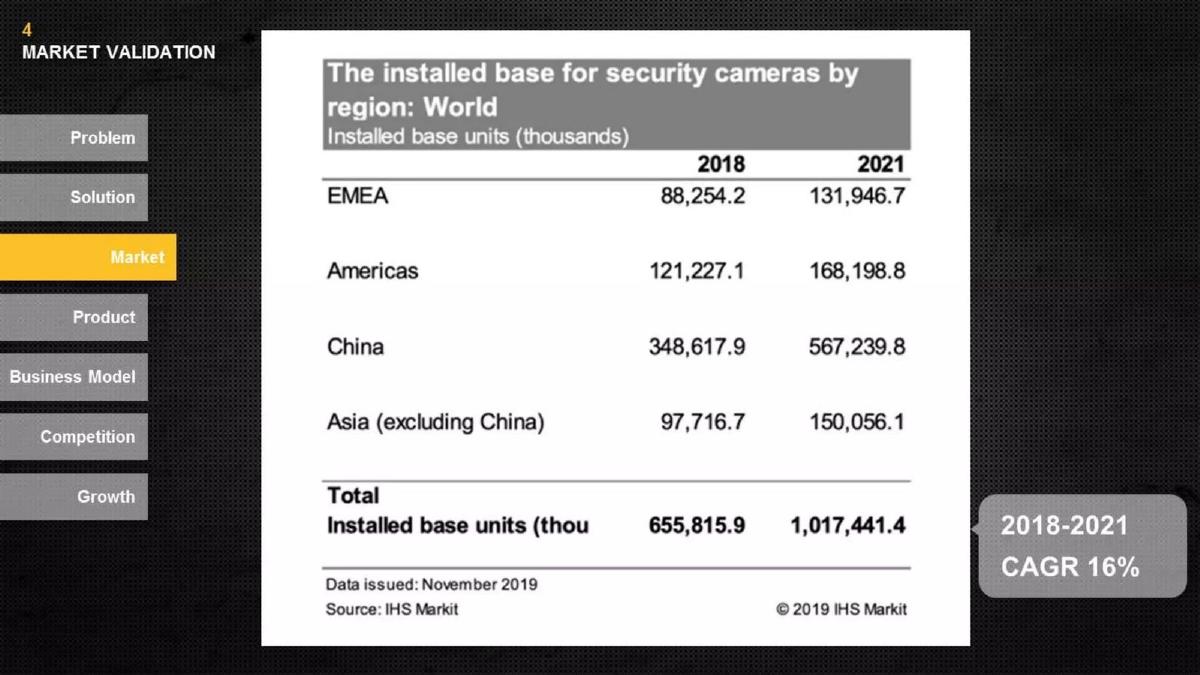
- The deck identifies a global installed base of over 1 billion security cameras by 2021, citing a 16% CAGR from 2018 (Slide 4).
- The solution is defined as Intelligent Video Analytics (IVA) that monitors crowd behavior in real-time to reduce manpower and increase safety (Slide 2).
- Product features are categorized into Point, Line, and Surface levels, ranging from Face Recognition to Crowd Behavior (Slide 6).
- The technical strategy focuses on Edge AI, supporting third-party cameras and Video Management Systems (VMS) to integrate with mobile devices (Slide 8).
- Market validation is the strongest section, utilizing IHS Markit data to show China as the largest market with 567 million units by 2021 (Slide 4).
- Competitive advantages are listed as Brand Awareness, System Integration, and R&D Capability, though no specific competitors are named (Slide 10).
- The growth strategy includes future support for security drones and robots, alongside a customer advisory board (Slide 12).
- The deck completely omits a team slide, financial projections, unit economics, and a specific funding ask (Slides 1-14).
Executive Summary: A Product-First Presentation Lacking Financial Rigor
The pitch deck for AI-Driven Large Space Security, presented by Jonathan Chen, focuses heavily on the technical capabilities of Edge AI and the massive growth of the global surveillance market. While the deck successfully identifies a large and growing Total Addressable Market (TAM) using reputable third-party data, it fails to transition from a product showcase to a business investment opportunity. The absence of a team, financial history, and a clear funding request makes it difficult for potential investors to assess the company's viability.
Slide 1: Title and Contact
The cover slide introduces the company's focus: "AI-Driven Large Space Security." The subtitle, "Ensure crowd health and safety in large event and place," sets a broad mission statement. Contact information for Jonathan Chen is provided, including a Gmail address and a phone number. The design is minimalist, using a dark textured background with yellow and white text. Notably, there is no company logo, which may indicate an early-stage or pre-incorporation status.
Slide 2: The Solution Overview
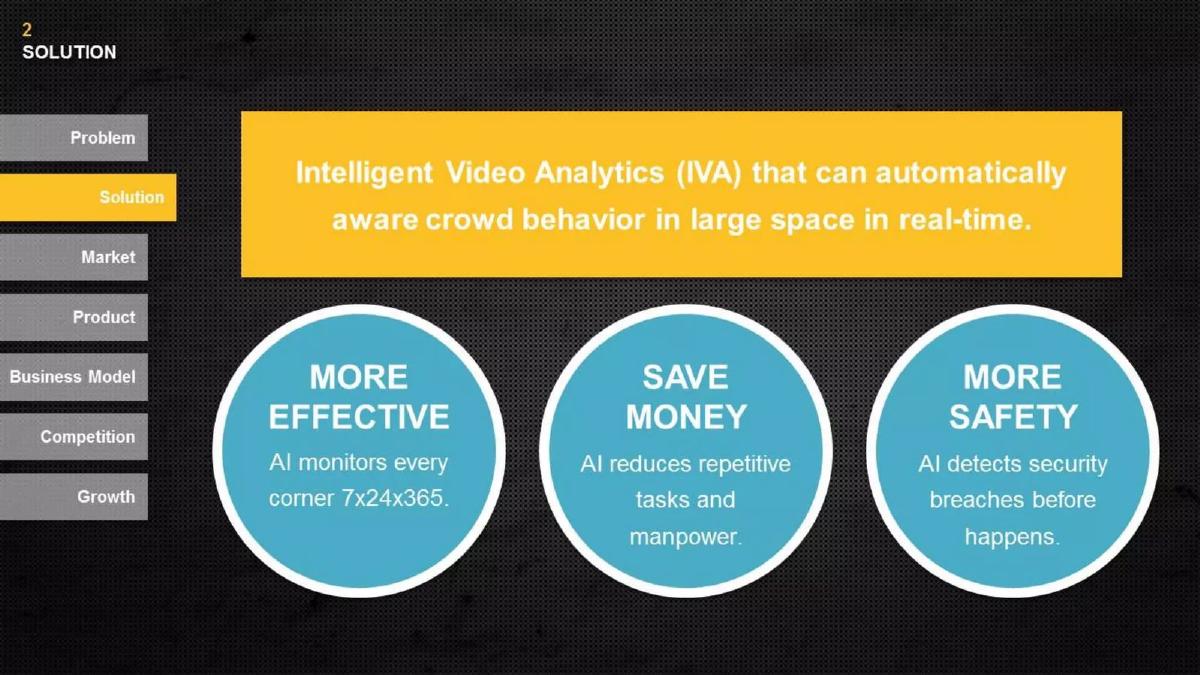
Slide 2 defines the core offering as "Intelligent Video Analytics (IVA) that can automatically aware crowd behavior in large space in real-time." The value proposition is broken down into three pillars: More Effective (7x24x365 monitoring), Save Money (reducing manpower), and More Safety (detecting breaches before they happen). While these are standard benefits for AI security, the slide lacks specific metrics or case studies to prove these claims.
Slide 4: Market Validation and Global Trends
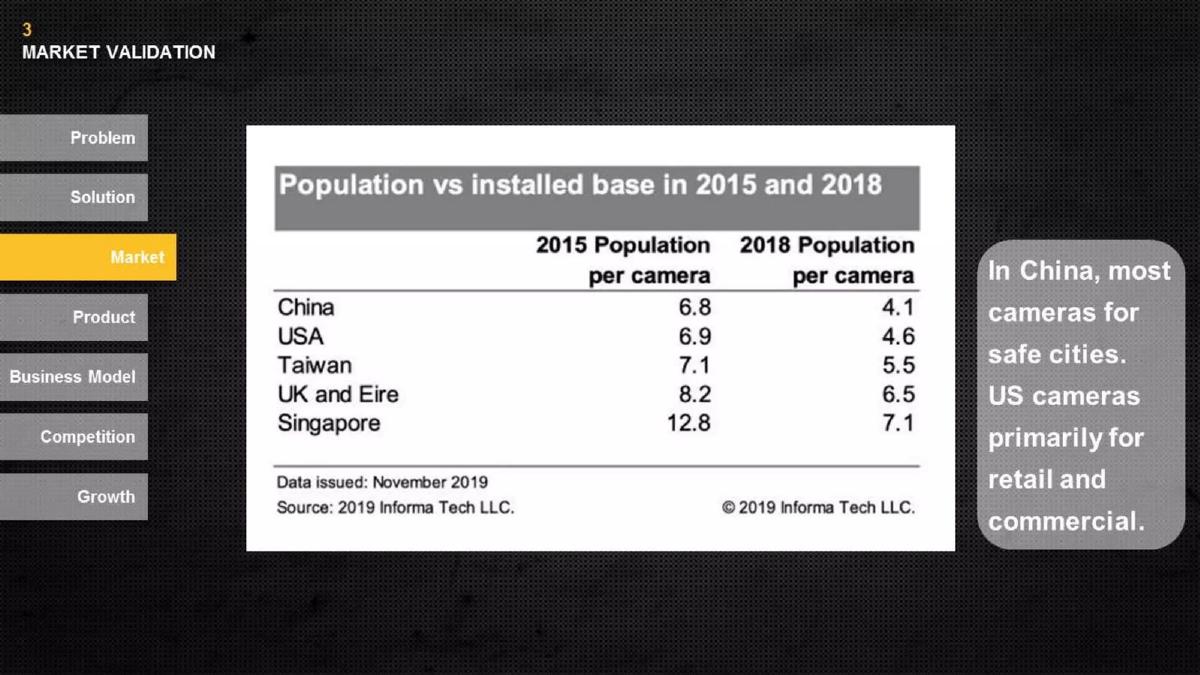
This is the most data-dense slide in the deck. It utilizes a table from IHS Markit (issued November 2019) to show the "installed base for security cameras by region." The data points are specific: the global market was expected to grow from 655,815.9 thousand units in 2018 to 1,017,441.4 thousand units in 2021. This represents a 16% CAGR. The slide highlights China as the dominant market, growing from 348 million to 567 million units in the same period. This slide effectively validates that the underlying hardware infrastructure for the company's software is expanding rapidly.
Slide 6: Video Analytics Product Features
Slide 6 provides a functional hierarchy of the software. It categorizes features into three levels: Point (Face Recognition, Object Detection), Line (Object Tracking, Intrusion Detection, Perimeter Security), and Surface (Crowd Counting, Crowd Density, Crowd Movement, Crowd Behavior). All of these are powered by "Edge AI." This slide is useful for understanding the technical scope of the product, moving from simple identification to complex behavioral analysis.
Slide 8: Product Strategy and Integration
This slide illustrates the workflow of the technology. It shows images of crowds and events feeding into a central box labeled "Edge AI Video Analytics." The output is then sent to "3rd Party VMS" (Video Management Systems) and "Mobile Devices." The stated strategy is to "Start from edge" and "Support 3rd-party camera and VMS." This indicates a software-only or software-plus-gateway model that avoids the need for proprietary camera hardware, which is a scalable approach.
Slide 10: Competitive Advantage
Slide 10 lists three competitive advantages: Brand Awareness , System Integration Capability , and Research & Development Capability . On the right side, there are small, blurred images of what appear to be awards, a brand map, and a command center. However, the claims are generic. Claiming "Brand Awareness" as a competitive advantage without showing market share or recognizable logos is a weak point in the deck. There is no direct comparison to competitors like Hikvision, Avigilon, or newer AI startups.
Slide 12: Growth and Future Roadmap
The final analyzed slide outlines the growth plan. Customer Development focuses on learning from potential customers. Customer Service promises dedicated reps for each account. Product Development mentions staying competitive through a customer advisory board and expanding to support "security drones or robots." While these are logical steps, they lack a timeline or specific milestones (e.g., "Reach 100 enterprise customers by Q4").
What Works in This Deck
Market Data: The use of IHS Markit data provides a credible foundation for the pitch. It shows the founder understands the scale of the industry and where the hardware is being deployed. · Technical Clarity: The breakdown of Point, Line, and Surface features (Slide 6) clearly communicates what the AI actually does without getting bogged down in incomprehensible jargon. · Integration Strategy: The decision to support third-party hardware and VMS (Slide 8) is a smart business move that lowers the barrier to entry for customers who have already invested in camera infrastructure.
What is Missing
The Team: There is no mention of who is building this. Investors invest in people, especially in AI where specialized talent is a major differentiator. The absence of a team slide is a significant red flag. · The Business Model: How does the company make money? Is it a per-camera monthly fee? A one-time license? The deck is silent on unit economics and pricing. · Traction: There are no mentions of current pilots, revenue, or partnerships. The images used appear to be stock photos or generic event photos rather than screenshots of the actual software in use at a specific venue. · The Ask: The deck does not state how much money is being raised, the valuation, or what the funds will be used for. · Financial Projections: There are no forward-looking statements regarding revenue growth or profitability.
Founder Recommendations
If you are modeling your deck after this one, you should focus on filling the massive gaps in business logic. While the market data is strong, a pitch deck must prove that this specific company can capture that market. You must include a team slide highlighting technical and commercial expertise. Furthermore, replace generic advantages like "Brand Awareness" with specific moats, such as proprietary datasets, patents, or exclusive distribution partnerships. Finally, always include a clear financial slide that shows your path to revenue and exactly what you need from an investor to get there.
Frequently asked questions
- What is the primary problem this company is trying to solve?
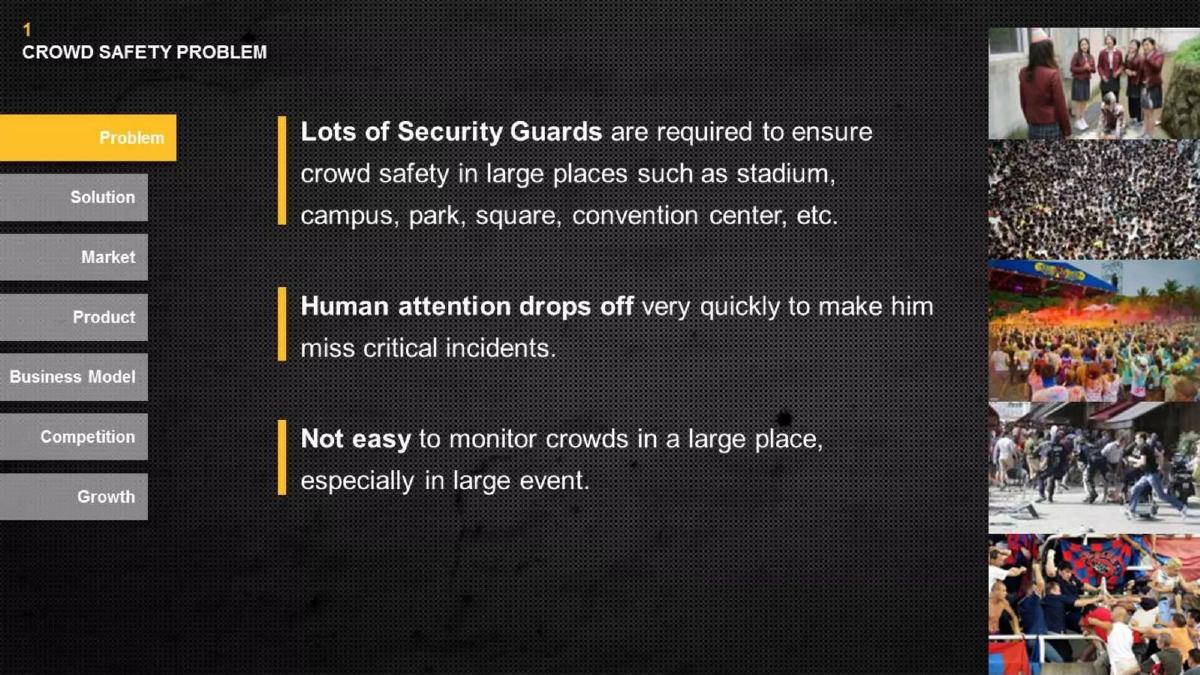
- Based on Slide 2, the company aims to address the limitations of manual security monitoring in large spaces. It proposes using AI to monitor 'every corner 7x24x365,' reducing the need for repetitive human tasks and detecting security breaches before they occur. However, the deck lacks a dedicated 'Problem' slide to quantify the cost or frequency of these security failures.
- How does the product actually work technically?
- The deck specifies an 'Edge AI' approach on Slide 8. This means the video analytics are processed locally rather than solely in the cloud. The system is designed to be hardware-agnostic, supporting third-party cameras and integrating with existing Video Management Systems (VMS) and mobile devices. Slide 6 breaks down the capabilities into specific AI tasks like object tracking and intrusion detection.
- What market data does the company use to justify its existence?
- On Slide 4, the company cites data from IHS Markit issued in November 2019. It highlights that the global installed base for security cameras was projected to grow from 655.8 million units in 2018 to over 1 billion units in 2021. This represents a 16% CAGR, with China accounting for more than half of the global market.
- What is missing from the business model and growth sections?
- The deck is missing almost all standard financial metrics. There is no mention of pricing strategy (SaaS vs. licensing), customer acquisition costs, or current revenue. While Slide 12 mentions 'Customer Development' and 'Customer Service,' it does not list any current pilot programs, signed contracts, or specific target industries beyond the general 'large event and place' mentioned on the cover.
- Is this a complete pitch deck for a seed round?
- No. This deck functions more as a product overview or a sales presentation. It lacks the essential components of a fundraising deck, most notably a Team slide, a Financials slide, and an 'Ask' slide detailing how much capital is being raised and how it will be deployed. Without these, an investor cannot evaluate the execution risk or the potential return.