A.ID’s pitch deck is less of a traditional startup presentation and more of a manifesto on the future of global finance and identity. Spanning 37 slides, the deck identifies the failure of traditional credit bureaus, noting that 38% of the world's population remains unbanked and 25 million Americans are 'credit invisible.' The solution proposed is a 'Unified Digital ID' that leverages big data—from mobile calling patterns to social media—to create a reputation-based economy. While the deck is visually striking and intellectually dense, it suffers from a lack of concrete business metrics, a mi…
Key takeaways
- The deck identifies a massive market gap, stating that 38% of the global population is unbanked and 25 million Americans are credit invisible (Slide 13).
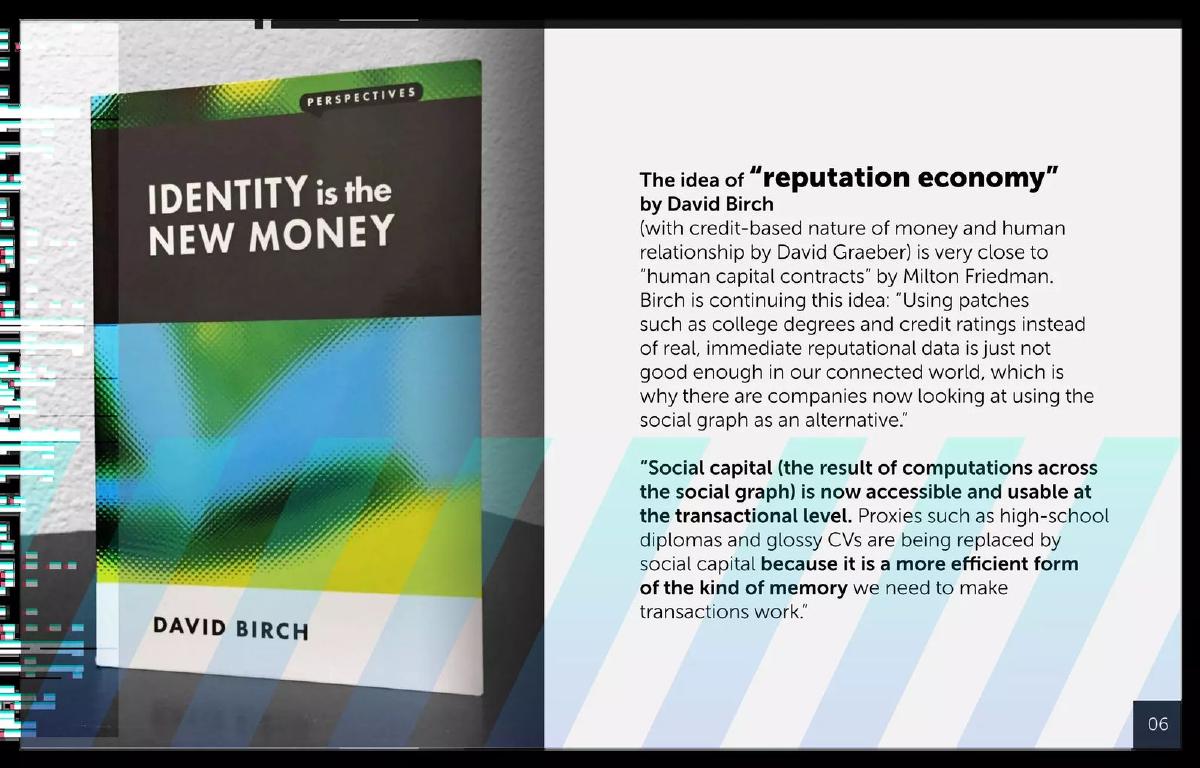
- A.ID proposes moving away from traditional credit scores toward 'human capital contracts' and a reputation-based economy (Slide 09).
- The solution centers on a 'Unified Digital ID' to eliminate middle-men 'parasites' like passport office workers (Slide 17).
- The company highlights Estonia's digital residency program as a successful model for 'Country-as-a-Service' (Slide 21).
- A.ID views big data as a 'blood system' that can analyze unstructured data points like messaging and browsing activity to generate social scores (Slide 09).
- The vision extends beyond fintech into healthcare, suggesting Al algorithms can use digital identities to predict health conditions (Slide 29).
- The deck includes external validation through a 2018 Transferwise news clipping to illustrate the demand for borderless banking (Slide 33).
- There is a total absence of unit economics, revenue models, or a specific funding ask in the reviewed slides.
The Philosophical Pitch: A.ID Teardown
The A.ID pitch deck is a 37-slide journey into the future of digital sovereignty. It positions itself at the intersection of fintech, blockchain, and social theory. Rather than starting with a product, it starts with a worldview: that the current systems of identity and credit are broken, and that data is the only logical replacement for traditional collateral.
Slide 1: The Cover and Branding
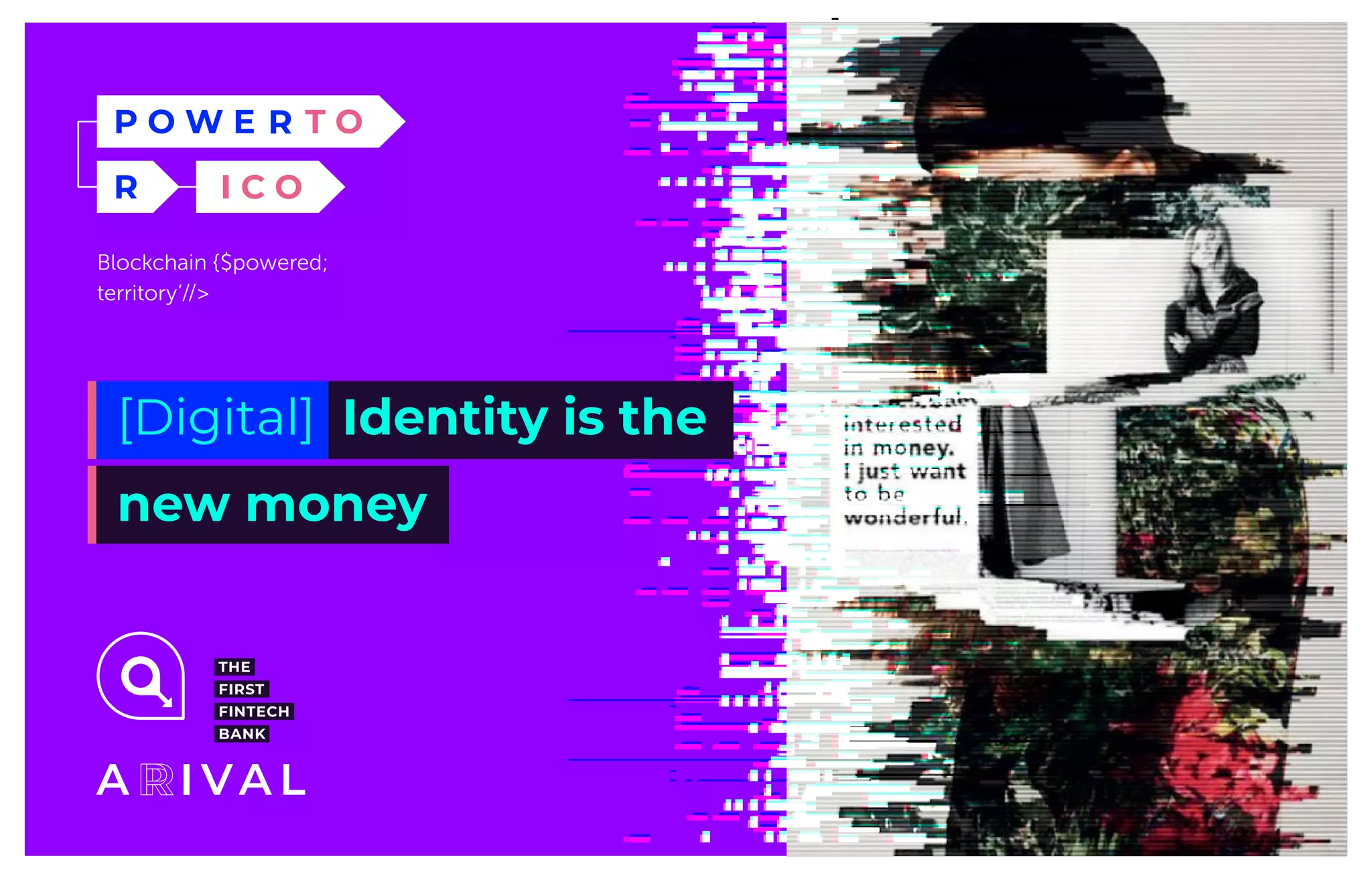
The cover slide introduces the company under two names: Arival ('The First Fintech Bank') and A.ID. The aesthetic is 'glitch-art' meets cyber-punk, featuring a purple color palette and the tagline '[Digital] Identity is the new money.' It explicitly mentions 'ICO' and 'Blockchain powered,' signaling that this deck was likely produced during the height of the Initial Coin Offering boom. The imagery of a pixelated, fragmented face reinforces the theme of digital identity.
Slide 5: The Economic Foundation
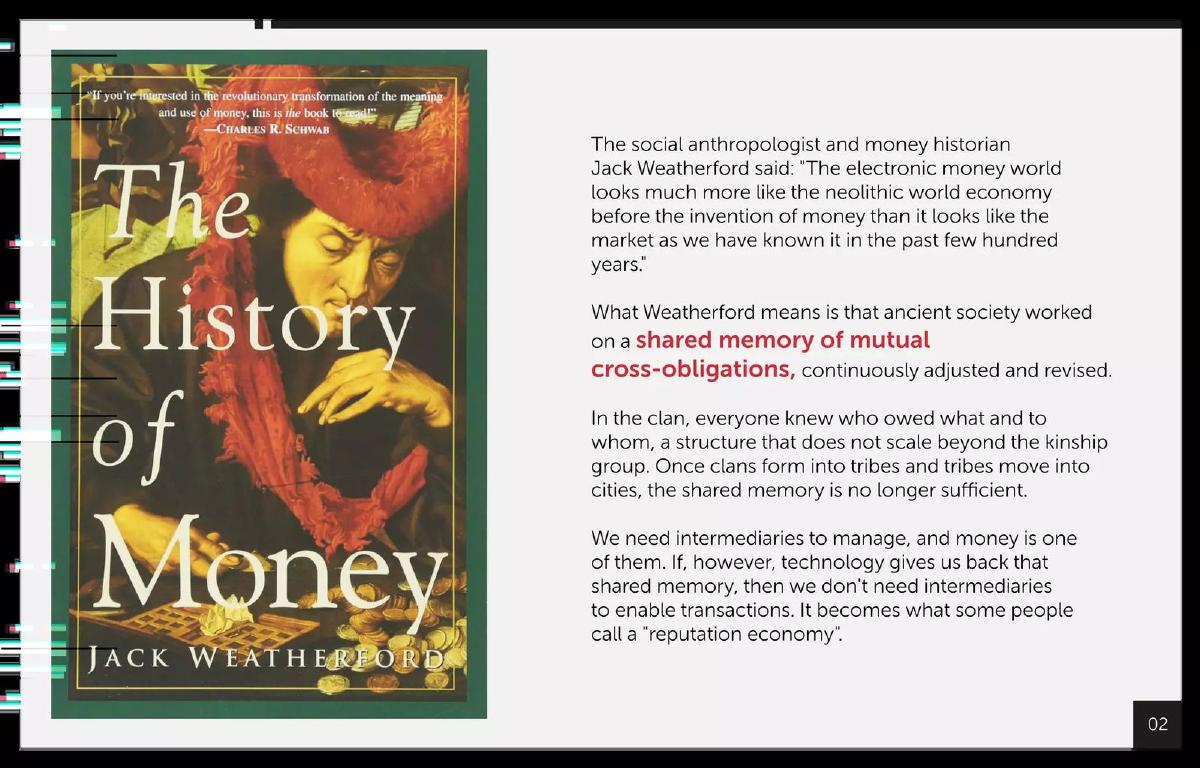
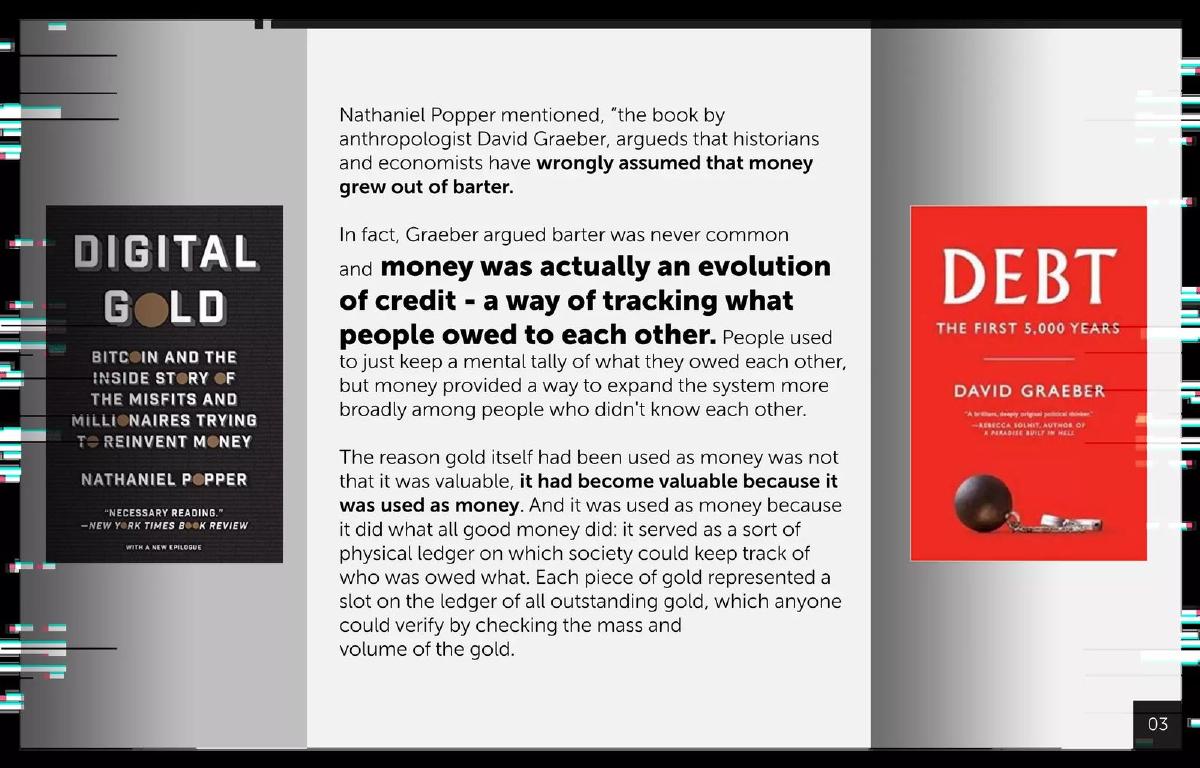
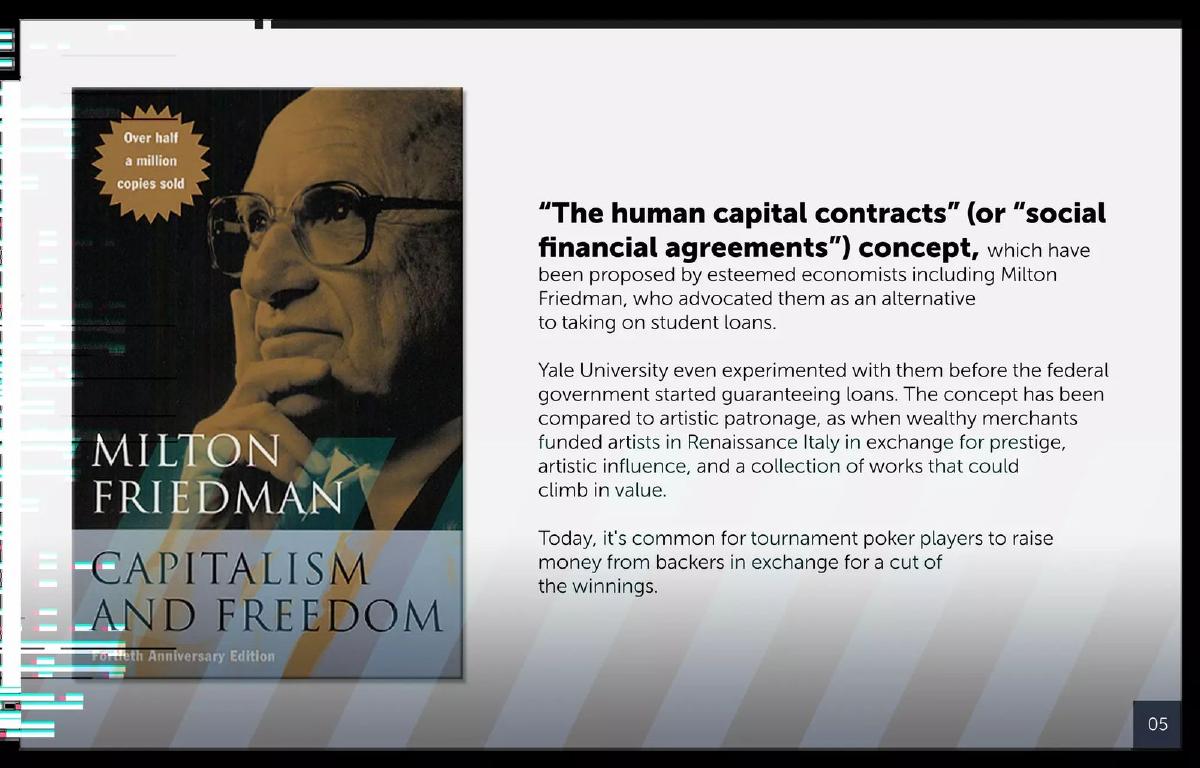
Slide 5 grounds the company’s vision in established economic theory. It cites Milton Friedman’s 'Capitalism and Freedom' and the concept of 'human capital contracts.' By referencing Friedman and Yale University’s experiments with social financial agreements, the founders are attempting to lend academic weight to what might otherwise be seen as a radical crypto-proposal. They compare their vision to Renaissance-era artistic patronage and modern-day poker staking, framing the investment in human reputation as a historical norm rather than a new invention.
Slide 9: Big Data as a 'Blood System'
This slide explains the mechanics of their proposed ecosystem. A.ID describes big data as a 'connector between all fintech verticals.' The slide lists specific data points they intend to analyze: bill payments, mobile calling patterns, locations, insurance premiums, social media profiles, and even 'messaging and browsing activity.' The goal is to provide 'meaningful social scores' for retail customers and SMEs. This is a bold, if controversial, proposition that essentially describes a decentralized social credit system.
Slide 13: The Problem Statement
A.ID identifies four key failures in the current financial landscape: the monopoly of credit bureaus, the 'invisible' status of 25 million Americans, the 38% of the global population that is unbanked, and the siloed nature of markets. The slide notes that 91% of residents in developing nations face difficulty receiving debt financing. This is the strongest slide in the deck, providing clear, quantifiable pain points that justify the need for a global, non-traditional scoring system.
Slide 17: The Solution - Unified Digital ID
The solution is presented as a 'Unified Digital ID' that encompasses passports, visas, and other documents. The deck claims this will eliminate the need for forms, wait times, and bribes. Notably, the slide uses aggressive language, stating the solution will lead to a 'significant decrease in "parasites": useless middlemen like officials, passport office and Pension Fund workers.' While this appeals to a libertarian or decentralization-focused audience, it is unusually combative for a standard venture capital pitch.
Slide 21: Country-as-a-Service (CaaS)
A.ID uses Estonia’s e-Residency program as a proof of concept for their vision. The slide features a photo of a digital identity card and quotes venture capitalist Tim Draper on 'competitive governance.' The argument is that governments are now in competition for 'digital residents,' and A.ID aims to be the infrastructure that facilitates this virtual residency. This slide successfully moves the conversation from abstract theory to a real-world, functioning example.
Slide 25: The APEC Business Travel Card
To further illustrate the utility of a unified ID, slide 25 details the APEC Business Travel Card. It explains how this card allows business travelers from 21 participating economies to bypass traditional visa requirements through pre-clearance. This serves as a 'low-tech' analog for what A.ID wants to achieve digitally: a pre-vetted, globally recognized status that grants the holder access to services (or in this case, borders) without friction.
Slide 29: Expansion into Healthcare
Slide 29 demonstrates the 'scope creep' common in visionary decks. It argues that digital identities and big data apply to 'just about every industry,' with healthcare being the largest potential market. It suggests using AI algorithms to make preliminary diagnoses and creating a 'toolbox' for researchers to purchase data from users. While this shows the scale of the ambition, it also risks making the company seem unfocused, as banking and healthcare are two of the most heavily regulated and distinct industries globally.
Slide 33: External Validation
The deck includes a screenshot of a 2018 article from 'This Is Money' regarding Transferwise’s (now Wise) borderless debit card. This is used to show that the 'borderless' trend is already being validated by major market players. It positions A.ID as the logical next step in an evolution that has already begun with companies like Transferwise.
Slide 37: The Closing
The final slide is a simple 'Thank You' featuring the Arival and A.ID logos. It repeats the 'Power to Rico' branding seen on the cover, suggesting a specific geographic focus or headquarters in Puerto Rico, a common hub for blockchain projects due to tax incentives. However, there is no 'Ask' slide in this selection—no mention of how much money is being raised, the valuation, or the intended use of funds.
What Works in the A.ID Deck
1. Strong Problem Identification: The deck does an excellent job of quantifying the 'unbanked' and 'credit invisible' problem. By citing specific figures (38% global unbanked, 25 million invisible Americans), they create a sense of urgency and scale.
2. Use of Analogies: Comparing their product to Estonia’s e-Residency and the APEC card makes a complex, futuristic concept feel grounded and achievable. It shows that the 'behavior' they are betting on already exists in other forms.
3. Visual Consistency: The deck has a very strong, distinct brand identity. The use of purple, glitch aesthetics, and modern typography makes it stand out from the typical 'corporate blue' fintech decks.
What is Missing from the A.ID Deck
1. The Team: In the 10 slides provided, there is no mention of the founders, their backgrounds, or why they are qualified to build a bank and a global ID system. For a project this ambitious, the 'Why Us' is as important as the 'What.'
2. Unit Economics and Revenue Model: The deck explains how the world will change, but not how the company will make money. There is no mention of transaction fees, subscription models, or data licensing costs.
3. Regulatory Roadmap: Building a 'Fintech Bank' and a global ID system requires navigating a minefield of international regulations (KYC, AML, GDPR). The deck brushes past this by suggesting 'reputation rather than regulation' will animate trust, which is a significant red flag for institutional investors.
4. Product Demo: We see a lot of theory and a few photos of other people's ID cards, but we don't see the A.ID interface or how a user actually interacts with the 'social score' system.
Founder's Guide: What to Copy and What to Avoid
Copy the 'Problem-First' Approach: Slide 13 is a masterclass in defining a market gap. If you are building in a crowded space like fintech, you must show the specific segments that the 'giants' are failing to serve.
Copy the Case Studies: Using Estonia as a case study (Slide 21) is a brilliant way to prove that your 'radical' idea is already being implemented by a sovereign nation. It de-risks the concept significantly.
Avoid the 'Manifesto' Trap: While the philosophical depth of Slide 5 and 9 is interesting, a pitch deck is a sales document, not a white paper. Too much time spent on Milton Friedman is time not spent on your traction, your team, and your path to profitability.
Avoid Combative Language: Calling government workers 'parasites' (Slide 17) is a high-risk move. Even if your target investors are libertarians, this language can suggest a lack of professional maturity or a disregard for the very regulatory bodies you will eventually need to work with to get a banking license.
Final Thoughts: A.ID presents a compelling vision for a post-national financial system. However, the deck functions more as a 'top-of-funnel' brand awareness piece than a 'bottom-of-funnel' investment vehicle. To close a round, a founder would need to follow this up with a much leaner, data-driven deck focused on the 'how' rather than the 'why.'
Frequently asked questions
- What is the core problem A.ID is trying to solve?
- A.ID targets the inefficiency and exclusivity of traditional credit scoring. According to slide 13, credit scoring is a 'monopoly of few organizations' that leaves 3 billion people globally unable to obtain credit cards. The deck argues that traditional bureaus require debt to prove creditworthiness, creating a catch-22 that keeps poor people poor and leaves millions of 'potentially creditworthy individuals unscorable.'
- How does A.ID define 'Identity as the new money'?
- This concept, introduced on slide 09, suggests that a person's digital footprint and social graph should serve as the nexus of commerce. By analyzing unstructured data—such as bill payments, location data, and social media profiles—A.ID believes it can create a 'reputation economy' where trust is animated by data rather than rigid, siloed government regulations.
- What role does blockchain play in this deck?
- While the cover slide (Slide 01) mentions 'Blockchain {$powered; territory' and references an 'ICO' (Initial Coin Offering), the technical implementation is not detailed in the provided slides. The deck uses blockchain terminology more as a branding signal for decentralization and 'Country-as-a-Service' rather than providing a technical architecture or tokenomics breakdown.
- What is 'Country-as-a-Service' in the context of this pitch?
- As shown on slide 21, it refers to governments becoming 'virtual.' A.ID uses Estonia’s e-Residency program as a case study, where foreigners can access banking and services without living in the country. The deck suggests that in the future, people will choose to 'reside' in the digital infrastructure of the best-performing governments, regardless of physical location.
- Is there a clear product-market fit demonstrated in the deck?
- The deck excels at demonstrating 'problem-market fit' by highlighting the massive unbanked population. However, it lacks a specific product demo or user traction metrics. It relies on analogies (like the APEC Business Travel Card on slide 25) and news articles about competitors like Transferwise (slide 33) to prove that a market for borderless identity and finance exists.