The December 2020 Celsius investor presentation serves as a masterclass in demonstrating market outperformance through distribution and clinical differentiation. At the time of this deck, Celsius was already a public entity (Nasdaq: CELH), using these slides to communicate its rapid 44% year-over-year growth and its position as a top 11 brand in the convenience channel despite having only 15% All-Commodity Volume (ACV). The deck emphasizes a 'proprietary MetaPlus formula' proven to accelerate metabolism, distinguishing it from traditional high-sugar energy drinks. By showcasing a network of 1…
Key takeaways
- Celsius reported 44% year-over-year growth, outpacing the broader category growth by 11.6x as of October 2020 (Slide 4).
- The company utilized a proprietary MetaPlus formula containing green tea with EGCG, ginger, and guarana seed to claim thermogenic benefits (Slide 3).
- Distribution is a core pillar, with 147 premier DSD partners and 79,000 retail locations across the U.S. (Slide 5).
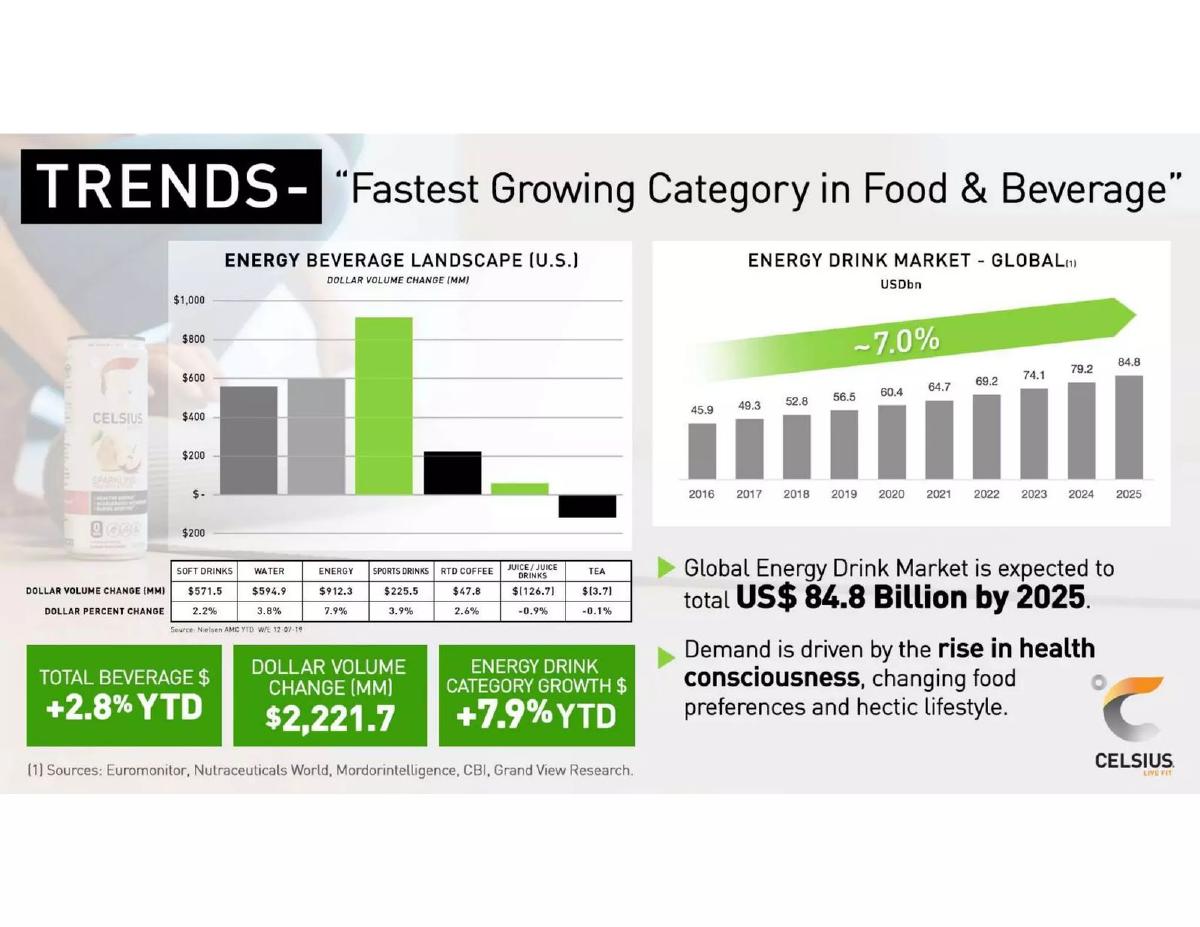
- The global energy drink market was projected to reach $84.8 billion by 2025, growing at a ~7.0% CAGR (Slide 2).
- Celsius achieved a 99.1% growth rate in the MULO (Multi-Outlet) channel for the 52 weeks ending July 2020 (Slide 6).
- International expansion focused on the Nordics and a risk-mitigated royalty-based model in China (Slide 7).
- Normalized gross margins were reported at approximately 50% when excluding outbound freight to match competitor reporting styles (Slide 8).
- The management team is led by CEO John Fieldly, who joined in 2012 and has a background in retail and consumer goods (Slide 9).
Celsius Investor Presentation Analysis: The Blueprint for Functional Growth
The December 2020 investor presentation for Celsius (Nasdaq: CELH) provides a comprehensive look at a brand transitioning from a niche fitness product to a mainstream beverage powerhouse. At the time of this deck, the company was capitalizing on a massive shift in consumer behavior toward health and wellness, positioning its 'thermogenic' formula as a superior alternative to traditional energy drinks. The deck is data-heavy, focusing on distribution reach, category outperformance, and clinical validation.
Slide 1: Title and Brand Identity
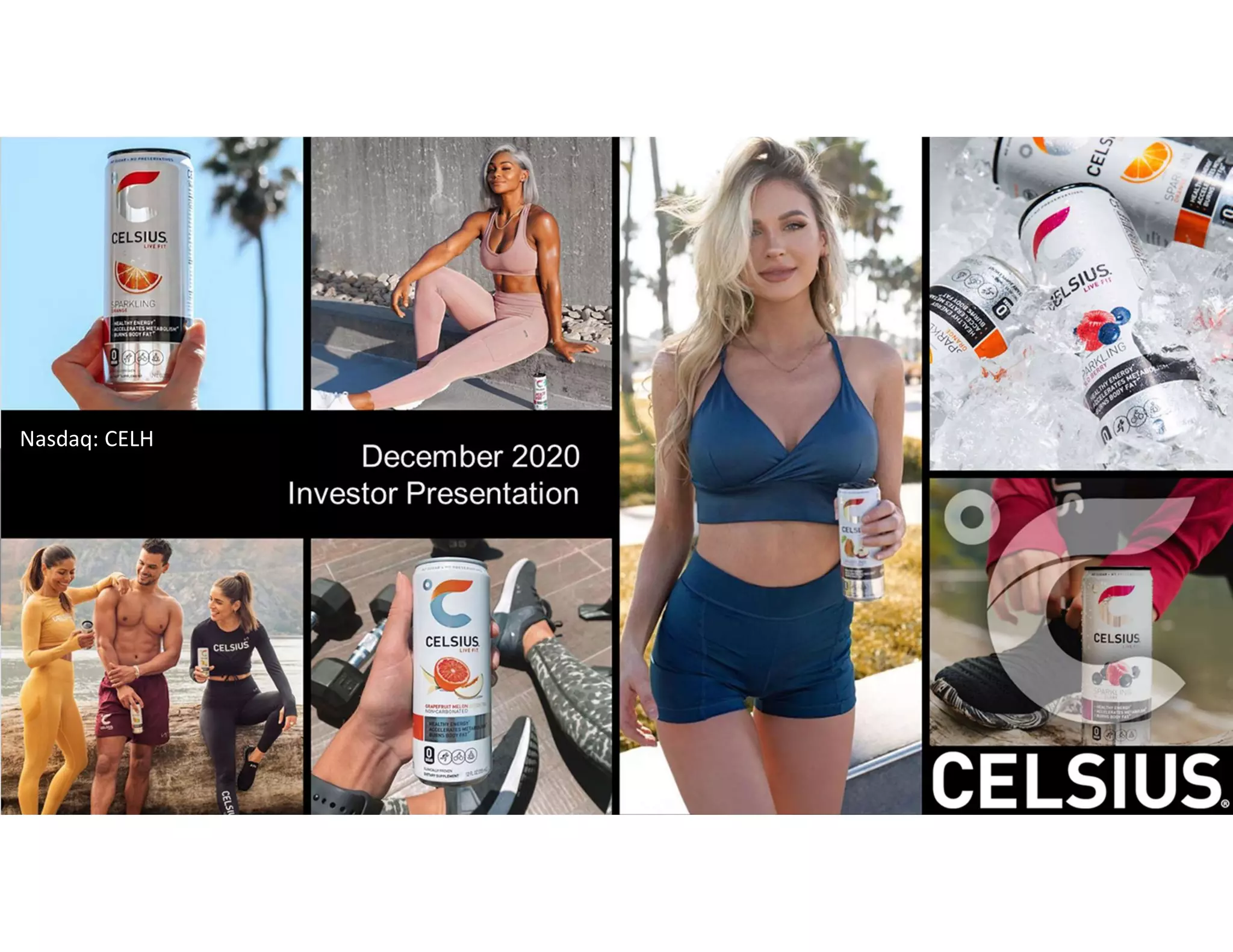
The cover slide establishes the brand's lifestyle positioning. It features a collage of fitness-oriented imagery: athletes in gyms, outdoor workouts, and the product placed in ice. The Nasdaq ticker 'CELH' is prominently displayed, signaling the company's public status. The date 'December 2020' sets the context for the performance metrics that follow.
Slide 2: Market Trends and Category Growth
This slide establishes the 'Why Now?' for investors. It labels the energy beverage category as the 'Fastest Growing Category in Food & Beverage.' Key data points include a global market projection of $84.8 billion by 2025 and a 7.9% YTD growth in the energy drink category. By highlighting that demand is driven by 'health consciousness' and 'hectic lifestyles,' Celsius aligns its product directly with the most profitable tailwinds in the industry.
Slide 3: Clinical Differentiation and Formulation
Celsius addresses the 'How it Works' question by focusing on its proprietary MetaPlus formula. Unlike many competitors who rely solely on caffeine and sugar, Celsius lists green tea (with EGCG), ginger, and guarana seed as key ingredients. The slide makes a bold claim: the drink is 'proven to energize, accelerate metabolism, burn body fat and calories.' A small footnote cites a 10-week clinical study published in the Journal of the International Society of Sports Nutrition, providing the scientific backing necessary for a functional beverage brand.
Slide 4: Brand Performance vs. Category
This is arguably the most important slide for a growth-stage investor. Celsius demonstrates that it is growing at 44% YoY, which is 11.6x faster than the category average. The most compelling stat is that Celsius is a 'Top 11 Brand' despite having only 15% All-Commodity Volume (ACV). This suggests that the brand's velocity (how fast it turns over on the shelf) is exceptionally high, and there is massive untapped potential as they expand into the remaining 85% of the market.
Slide 5: The Distribution Engine
For a beverage company, distribution is destiny. Slide 5 showcases a map of the U.S. covered in distribution lines, supported by 147 premier DSD (Direct Store Delivery) partners and 79,000 retail locations. The logos of partners like UNFI, McLane, Keurig Dr Pepper, and Pepsi provide institutional credibility. The slide lists the benefits of DSD, including 'Improved Store Execution' and 'Increased SKU Placements,' which are critical for winning the 'shelf wars' in retail.
Slide 6: Product Portfolio Diversification
Celsius shows its range beyond the core sparkling orange can. The portfolio includes non-carbonated flavors, a stevia-sweetened line, and 'On-The-Go' powder sticks. Highlighting a 99.1% growth in the MULO (Multi-Outlet) channel, this slide demonstrates that the brand has successfully expanded its footprint across different consumer segments and usage occasions, from pre-workout drinks to coffee alternatives.
Slide 7: Global Expansion Strategy
The deck outlines a two-pronged international strategy. In Europe, specifically the Nordics, Celsius has a 'focused dedicated team' and is a top-selling fitness drink in Sweden. In Asia, the strategy is 'risk-mitigated.' The China agreement involves a royalty-based model where Celsius receives millions in repayment of invested capital and royalty fees without the operational risk of direct distribution. This shows a sophisticated approach to capital allocation.
Slide 8: Financial Performance and Margin Normalization
Slide 8 focuses on profitability and scalability. It shows a 'Gross Profit Normalization' chart, comparing 'As Reported' margins to 'W/O Outbound Freight' margins. By showing a normalized margin of 52.6% for YTD 2020, Celsius argues that its underlying unit economics are as strong as industry leaders like Monster. The slide also notes that the 2020 margins benefited from the Nordic acquisition and increased scale.
Slide 9: Executive Management
The leadership slide features CEO John Fieldly and CFO Edwin Negron-Carballo. Fieldly’s tenure since 2012 suggests stability, while his background in consumer goods and retail supports the company’s distribution-heavy strategy. Negron-Carballo adds 30 years of financial experience, including roles at Frito-Lay and KPMG, providing the corporate governance and financial oversight expected of a Nasdaq-listed company.
Slide 10: Contact and Investor Relations
The final slide provides direct contact information for the CEO, CFO, and Investor Relations. It includes social media icons and the investor website URL, maintaining the transparency required for public market communications.
What Works in This Deck
1. The Efficiency Narrative: The mention of being a top 11 brand with only 15% ACV is a brilliant way to show growth potential. It tells investors that the product is a 'hit' where it is available, and the growth is a simple matter of increasing distribution.
2. Clinical Validation: In a crowded 'healthy' beverage market, citing a specific 10-week clinical study in a peer-reviewed journal (Slide 3) separates Celsius from 'snake oil' marketing. It gives the brand a functional moat.
3. Distribution Credibility: The map and the list of DSD partners (Slide 5) prove that Celsius has solved the hardest part of the beverage business: getting the product onto the truck and onto the shelf.
What Is Missing
1. Unit Economics Detail: While gross margins are discussed, the deck lacks a breakdown of Customer Acquisition Cost (CAC) or specific marketing spend efficiency. For a brand growing this fast, understanding the 'burn' required to achieve that 44% growth is vital.
2. Competitive Landscape Depth: Slide 4 shows logos of competitors, but it doesn't provide a direct comparison of price points, sugar content, or caffeine levels. A side-by-side comparison table would have strengthened the 'better-for-you' argument.
3. Future Product Roadmap: The deck shows the current portfolio but doesn't hint at future innovations (e.g., snacks, different functional categories) that could further increase the Lifetime Value (LTV) of their customers.
What a Founder Should Copy
1. Normalize Your Metrics: If your industry has a standard way of reporting (like excluding freight), show your numbers both ways as Celsius did on Slide 8. It shows you understand your peers and how investors evaluate your sector.
2. Focus on 'White Space': If you have limited distribution but high sales, use the ACV metric. It turns a weakness (not being everywhere) into a massive opportunity (the potential to be everywhere).
3. Use a 'Route to Market' Slide: Don't just say you have customers; show the infrastructure that gets your product to them. The map on Slide 5 is a powerful visual representation of a company's physical footprint and operational maturity.
4. Leverage Clinical Proof: If your product makes a health claim, don't just use marketing speak. Cite the study, name the journal, and explain the mechanism (like thermogenesis). It builds trust with sophisticated investors.
Frequently asked questions
- What is the primary value proposition of Celsius according to the deck?
- Celsius positions itself as a 'fitness drink' rather than a standard energy drink. The deck highlights a proprietary MetaPlus formula that is clinically proven to accelerate metabolism and burn body fat through thermogenesis. This health-conscious positioning is designed to appeal to consumers looking for functional benefits beyond a simple caffeine boost, distinguishing the brand from competitors like Red Bull or Monster.
- How does Celsius handle its international distribution?
- The deck outlines two distinct strategies. In the Nordics (Sweden, Finland, Norway), the company uses a dedicated team and has established a presence in major retailers like 7-Eleven and Lidl. In China, Celsius utilizes a risk-mitigated royalty-based agreement with Qifeng Food Technology, which transitioned to a volume-based royalty fee in 2024 to capture market share without heavy capital expenditure.
- What does the '15% ACV' metric on Slide 4 signify?
- ACV stands for All-Commodity Volume. Stating that Celsius is a top 11 brand with only 15% ACV is a powerful efficiency metric. It suggests that even though the product is only available in 15% of the total retail sales volume area, it is already outperforming brands with much wider distribution. This indicates significant 'white space' or room for growth as they increase distribution.
- Why does the deck show two different gross margin figures?
- Slide 8 shows 'As Reported' margins versus 'W/O Outbound Freight' margins. The company notes that competitors like Monster exclude outbound freight from their cost of sales. By 'normalizing' the data, Celsius shows a margin of 52.6% (YTD 2020) to provide an apples-to-apples comparison for investors evaluating the company's profitability against industry giants.
- What retail channels are most important for Celsius's growth?
- The deck emphasizes the convenience channel and the MULO (Multi-Outlet) channel. Slide 6 highlights a 99.1% growth in MULO, while Slide 4 focuses on the brand's performance in convenience stores. The distribution map on Slide 5 shows a heavy reliance on DSD (Direct Store Delivery) partners like Pepsi, Keurig Dr Pepper, and MillerCoors to maintain shelf presence in these high-velocity locations.