Cent Capital presents a 12-slide pitch for an AI-powered financial co-pilot targeting the mass market. The deck identifies a 'human crisis of financial inequality' and proposes a low-cost subscription model (~$1/month) supplemented by an affiliate layer. A key differentiator is their 'Education, Not Advice' legal framework, designed to bypass the high costs of regulated financial advice. The startup seeks a $3M Seed round to fuel a three-phase go-to-market strategy, starting with B2B2C partnerships to achieve near-zero customer acquisition costs. While the deck provides strong early validatio…
Key takeaways
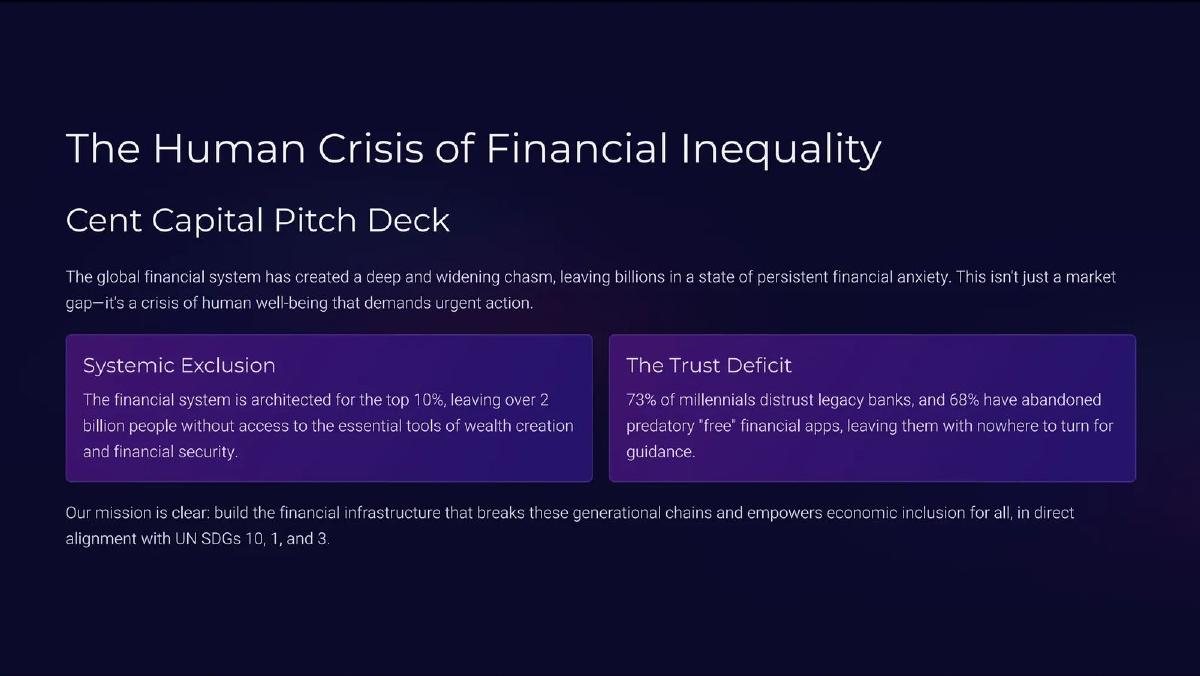
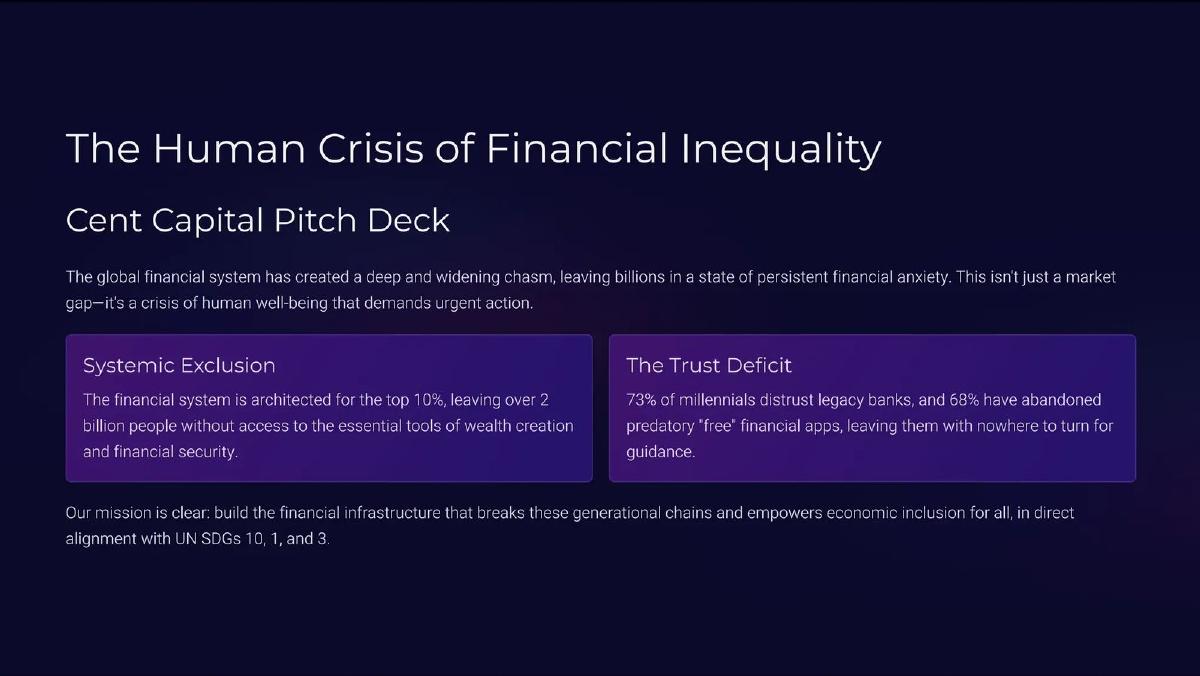
- The company identifies a 'Systemic Exclusion' where the financial system is built for the top 10%, leaving 2 billion people underserved (Slide 1).
- Cent Capital utilizes an 'Education, Not Advice' legal framework to deliver guidance without the costs of regulated advice (Slide 3).
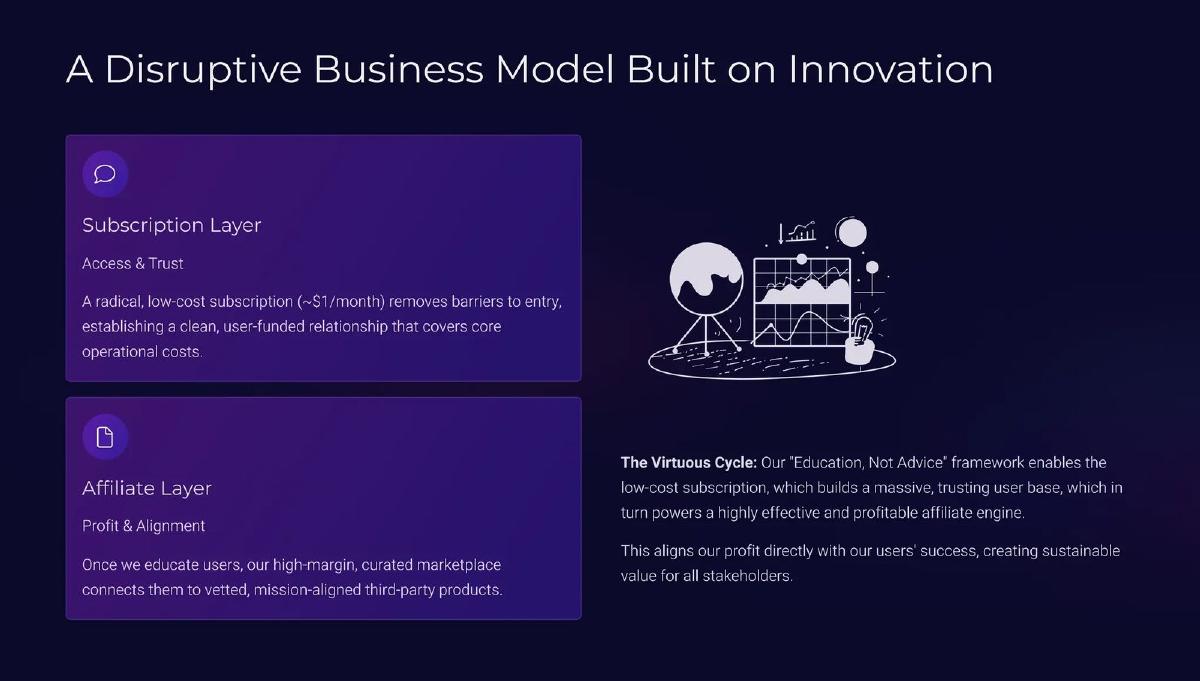
- The business model relies on a dual-layer approach: a ~$1/month subscription for access and a high-margin affiliate marketplace (Slide 4).
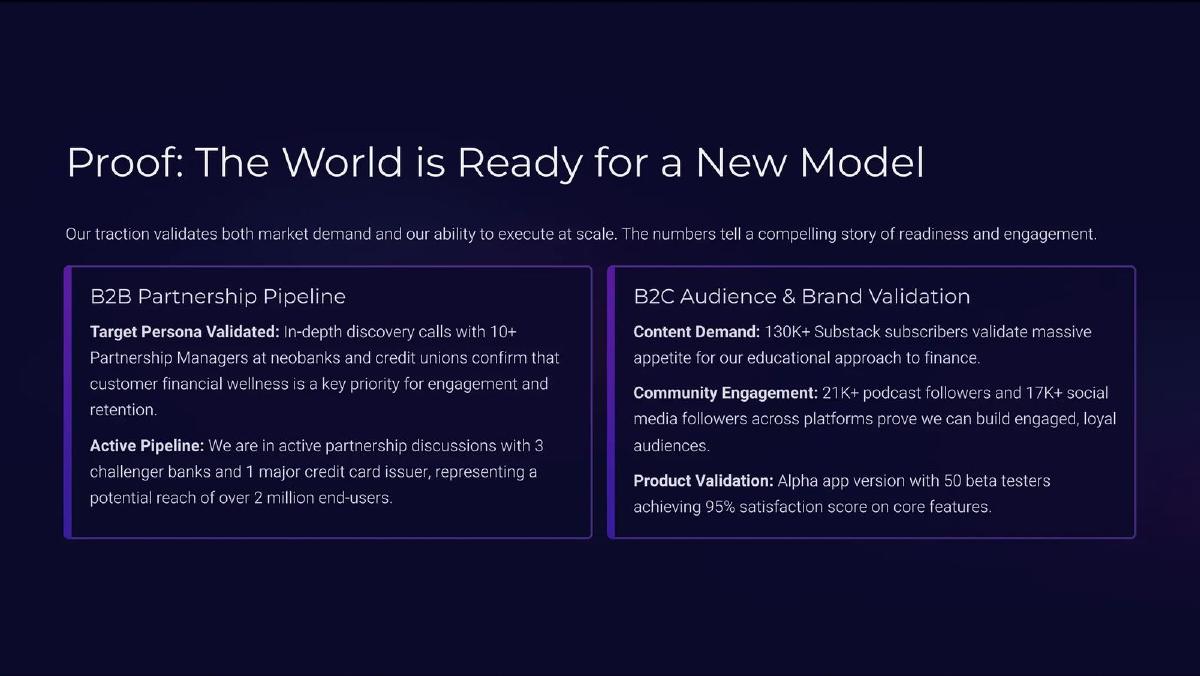
- Traction includes 130K+ Substack subscribers and an alpha app with 50 beta testers achieving a 95% satisfaction score (Slide 5).
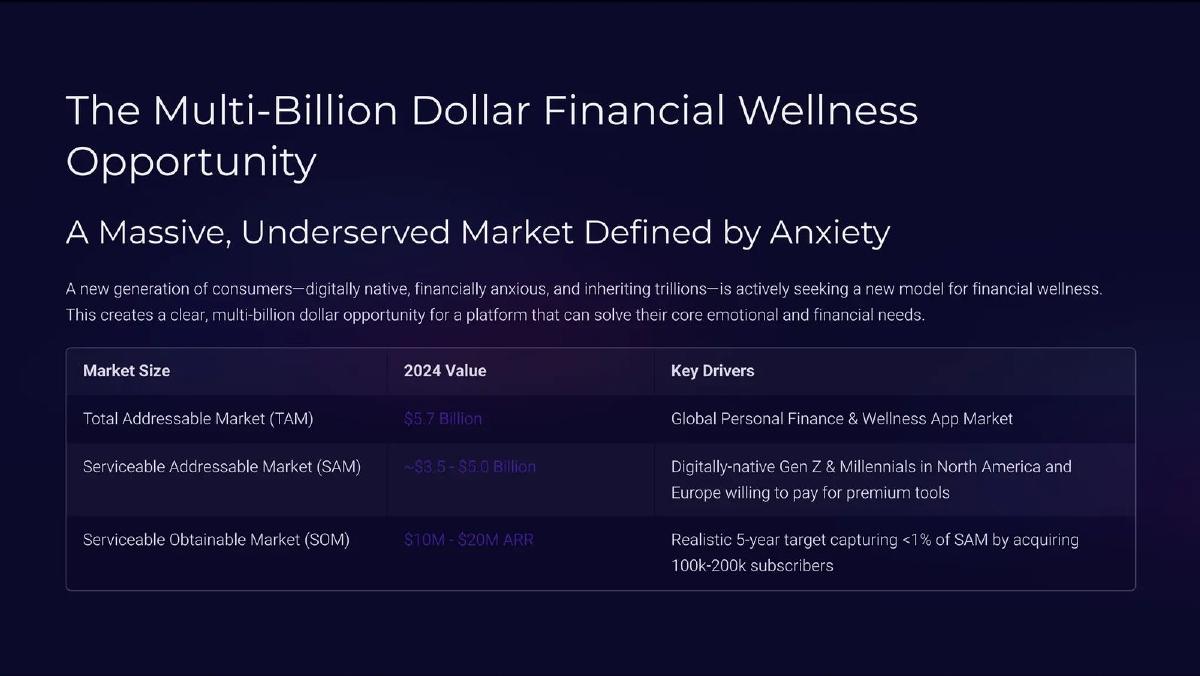
- The Serviceable Obtainable Market (SOM) is targeted at $10M - $20M ARR within 5 years by acquiring 100k-200k subscribers (Slide 6).
- The go-to-market strategy addresses the 'CAC trap' in fintech by focusing on B2B2C partnerships with financial institutions (Slide 7).
- The long-term vision involves evolving into a B2B financial Large Language Model (LLM) for the entire industry by Year 7+ (Slide 10).
- The founders have backgrounds at D.E. Shaw Group, Amazon (AWS), Visa, and Swiggy (Slide 11).
Cent Capital Pitch Deck Teardown
Slide 1: The Problem
The deck opens with 'The Human Crisis of Financial Inequality.' It frames the problem not just as a market gap, but as a systemic issue. Two specific points are raised: 'Systemic Exclusion,' noting that 2 billion people lack access to wealth creation tools, and 'The Trust Deficit,' citing that 73% of millennials distrust legacy banks. The slide also aligns the company's mission with UN Sustainable Development Goals 10, 1, and 3. This is a high-level, emotionally resonant opening designed to establish the 'why' before the 'what.'
Slide 2: The Inflection Point
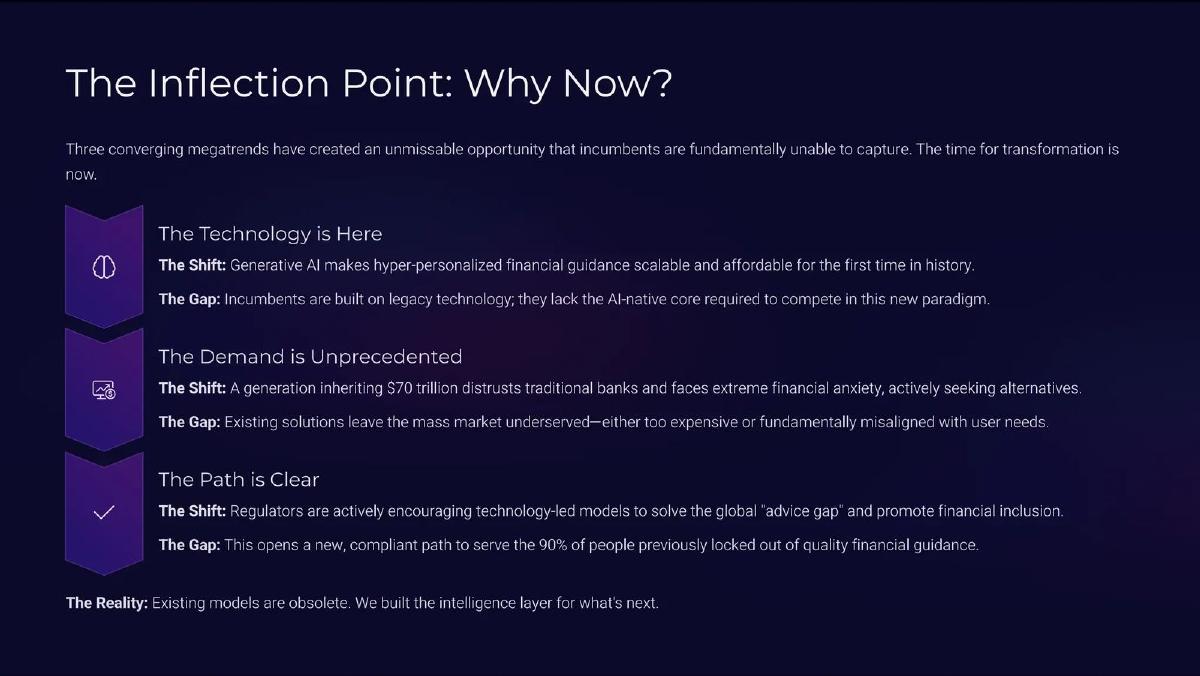
The 'Why Now?' slide identifies three megatrends: Generative AI making personalized guidance scalable, a $70 trillion wealth transfer to a generation that distrusts banks, and regulators encouraging technology-led models to solve the 'advice gap.' The slide explicitly states that incumbents are 'built on legacy technology' and lack the 'AI-native core' necessary to compete. This creates a sense of urgency and highlights the technological shift the company intends to capitalize on.
Slide 3: The Solution
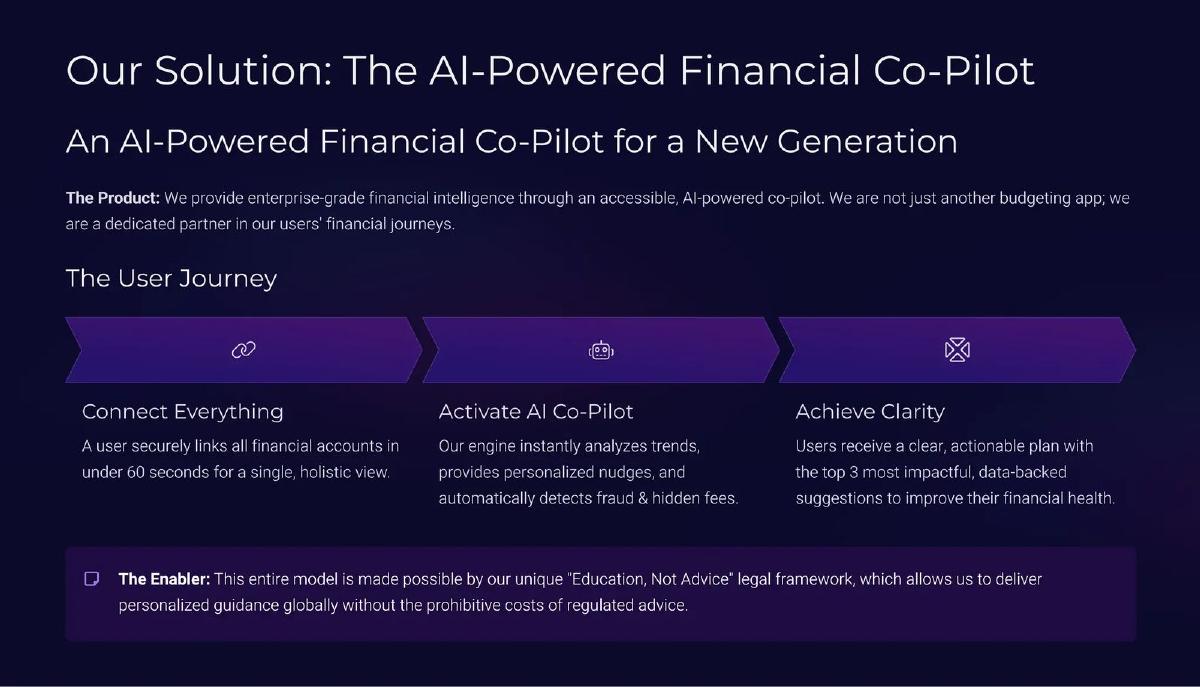
Cent Capital describes its product as an 'AI-Powered Financial Co-Pilot.' The user journey is broken into three steps: 'Connect Everything' (linking accounts in <60 seconds), 'Activate AI Co-Pilot' (analyzing trends and detecting fraud), and 'Achieve Clarity' (actionable suggestions). A critical note at the bottom introduces 'The Enabler': a unique 'Education, Not Advice' legal framework. This is presented as the key to delivering guidance globally without the costs of regulated advice.
Slide 4: Business Model
The business model is dual-layered. The 'Subscription Layer' is described as a 'radical, low-cost subscription (~$1/month)' intended to remove barriers to entry. The 'Affiliate Layer' is the profit engine, connecting educated users to 'vetted, mission-aligned third-party products.' The slide describes a 'Virtuous Cycle' where the legal framework enables the low-cost subscription, which builds a massive user base, which in turn powers the affiliate engine. This is a classic 'land and expand' strategy adapted for consumer fintech.
Slide 5: Traction and Validation
This slide provides 'Proof' through B2B and B2C metrics. B2B validation includes discovery calls with 10+ partnership managers and an active pipeline with 3 challenger banks and 1 credit card issuer, representing 2 million potential end-users. B2C validation is stronger, citing 130K+ Substack subscribers, 21K+ podcast followers, and 17K+ social media followers. They also mention an alpha app with 50 beta testers and a 95% satisfaction score. This slide effectively demonstrates that there is pre-existing demand for their content and approach.
Slide 6: Market Size
The market opportunity is quantified using TAM, SAM, and SOM. The TAM is $5.7 Billion (Global Personal Finance & Wellness App Market). The SAM is ~$3.5 - $5.0 Billion (North American and European Gen Z & Millennials). The SOM is a 'realistic 5-year target' of $10M - $20M ARR, which they plan to achieve by capturing <1% of the SAM (100k-200k subscribers). These numbers are relatively conservative for a venture pitch, which may lend them more credibility.
Slide 7: Go-To-Market Strategy
The deck acknowledges the 'CAC trap' that kills many consumer fintechs, citing an average CAC of $1,450 and 37% retention rates. To counter this, Cent Capital proposes a three-phase plan. Phase 1 (Years 0-1) focuses on B2B2C partnerships to drive adoption at 'near-zero CAC.' Phase 2 (Years 1-3) involves scaling these partnerships and building SEO-driven content. Phase 3 (Years 3+) moves toward product-led growth and viral referrals. This is a logical response to the high cost of direct-to-consumer marketing in this sector.
Slide 8: Competitive Positioning
A standard 2x2 matrix positions Cent Capital in a 'Blue Ocean' of 'Low Price' and 'Affordable Regulated Advice' (though the previous slides emphasized 'Education, Not Advice,' this slide uses the term 'Affordable Regulated Advice'). Competitors like Monarch Money and YNAB are labeled as 'Premium Education Tools' ($12-15/month), while Empower is labeled as 'Regulated Robo-Advice' with 'misaligned incentives' due to lead generation. Cent Capital claims to be the only viable solution for the global mass market.
Slide 9: Defensible Moats
The company identifies three moats: 'Counter-Positioning Power' (incumbents cannot mimic the $1 model without cannibalizing their own business), 'Regulatory Barriers to Entry' (the 'Education, Not Advice' framework), and a 'Mission-Driven Brand Moat' (commitment to UN SDGs). The regulatory moat is described as a 'multi-year, multi-million dollar undertaking,' suggesting it is not easily replicated.
Slide 10: Long-Term Vision
The vision scales from an app to industry infrastructure. Phase 1 is the education platform. Phase 2 (Years 5-7) involves securing licenses for regulated services like robo-advisory and ethical credit. Phase 3 (Years 7+) aims to become the 'B2B Financial LLM,' licensing their proprietary dataset and AI as a SaaS platform to banks and wealth managers. This provides a clear 'exit' or 'scale' narrative beyond a simple consumer app.
Slide 11: The Team
The team slide highlights three founders. Shivam Singh (CEO) has experience at D.E. Shaw Group and Amazon (AWS). Miriam Odabe (CCO) has a background in brand building (Budweiser) and GTM strategy. Brijesh (CTO) was a Principal Software Engineer at Visa and an Engineering Manager at Swiggy. The team is supported by founding engineers and designers from Walmart Global Tech and Google. This is a strong, pedigree-heavy team that covers the necessary bases of finance, brand, and engineering.
Slide 12: Financial Plan and The Ask
The final slide outlines a plan for 'Sustainable, Profitable Growth.' It targets 85-90% gross margins and a lean team growing from 5 to 35 employees over 5 years. A bar chart shows revenue and EBITDA projections, with Year 5 revenue appearing to be around $9.2M. The 'Ask' is a $3M Seed Round for 18-24 months of runway, with 50% allocated to product development, 30% to GTM, and 20% to legal and operations.
What Cent Capital Does Well
The deck is exceptionally clear about the 'CAC trap' in fintech. By acknowledging that traditional customer acquisition is unsustainable for a $1/month product, the founders demonstrate a sophisticated understanding of their industry. The phased B2B2C approach is a practical solution to this problem. Furthermore, the 'Education, Not Advice' framework is presented as a compelling regulatory moat, which is often a major concern for investors in the financial space. The team slide is also a highlight, showcasing relevant experience at high-scale companies like Visa, Swiggy, and Amazon.
What is Missing from the Cent Capital Deck
While the deck is strong on vision and strategy, it is light on current financial performance. There is no mention of current revenue or the number of paying subscribers, suggesting the product may still be in the pre-revenue or alpha stage. The '95% satisfaction score' is based on only 50 beta testers, which is a very small sample size. Additionally, while the affiliate model is mentioned as a 'high-margin' layer, there are no specific projections for affiliate revenue per user, which is critical for understanding the total lifetime value (LTV) of a customer paying only $1/month for the subscription.
What You Should Copy from Cent Capital
Founders should emulate the way Cent Capital addresses industry-wide failures. By explicitly naming the 'CAC trap' and the 'Trust Deficit,' they position themselves as a necessary evolution rather than just another competitor. The use of a 'Virtuous Cycle' diagram (Slide 4) and a 'Phased Go-To-Market' timeline (Slide 7) are excellent ways to visualize complex strategies. Finally, the inclusion of a 'Long-Term Vision' slide (Slide 10) that moves from a B2C app to a B2B infrastructure play is a great way to show investors the potential for a massive, venture-scale outcome beyond the initial product.
Frequently asked questions
- What is Cent Capital's primary product?
- Cent Capital is an AI-powered financial co-pilot designed to provide enterprise-grade financial intelligence to the mass market. According to Slide 3, the product allows users to link all financial accounts in under 60 seconds, receive personalized nudges, and get data-backed suggestions to improve financial health. It is positioned as a 'dedicated partner' rather than just a budgeting app.
- How does Cent Capital plan to acquire users affordably?
- Fintech is notorious for high customer acquisition costs (CAC). Cent Capital plans to bypass this via a B2B2C model. Slide 7 notes that the average fintech CAC is $1,450, which they aim to avoid by partnering with financial institutions (neobanks and credit unions) to offer Cent Capital as a free value-added service to their existing customers.
- What is the 'Education, Not Advice' framework?
- This is the company's core regulatory strategy. As stated on Slide 3 and Slide 9, this legal framework allows them to deliver personalized guidance globally without the prohibitive costs and compliance burdens of regulated financial advice. They claim this creates a 'Regulatory Barrier to Entry' that would cost competitors millions to replicate.
- What traction has the company achieved so far?
- Slide 5 lists several validation points: 130K+ Substack subscribers, 21K+ podcast followers, and 17K+ social media followers. On the B2B side, they are in active discussions with three challenger banks and one major credit card issuer. They also have an alpha app version tested by 50 users with a 95% satisfaction rate.
- What are the financial projections and the funding ask?
- Cent Capital is raising a $3M Seed round for 18-24 months of runway (Slide 12). The funds are allocated as 50% product development, 30% go-to-market, and 20% legal/operations. They project reaching $9.2M ARR by Year 5, with gross margins between 85-90% and a lean team of 35 employees.